
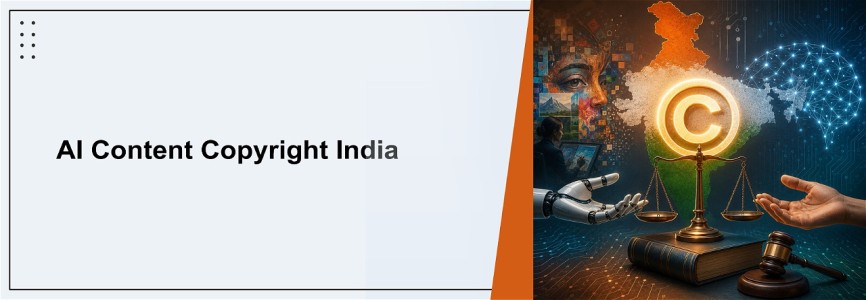



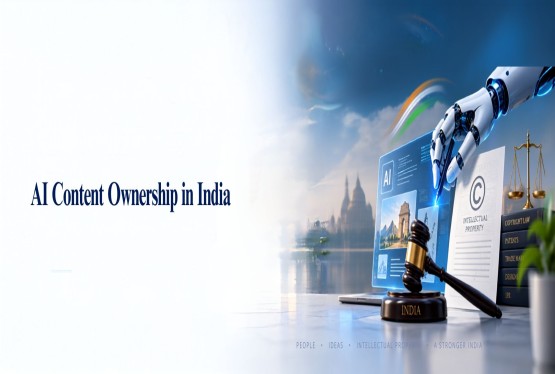
Generative artificial intelligence can now produce text, music, images and video with limited human input. This raises a fundamental copyright question: when a machine produces expressive content, who is the author? Indian copyright law predates modern generative AI, but Section 2(d)(vi) of the Copyright Act, 1957 expressly addresses a computer-generated literary, dramatic, musical or artistic work and identifies the author as the person who causes the work to be created. The difficulty is applying that language to modern systems capable of generating substantial expression from prompts. As of August 2026, the safest conclusion is that Indian law has not yet established a definitive rule that every purely AI-generated work is copyrightable or that every AI-assisted work is unprotectable.
The Statutory Framework
Section 13 identifies protected categories including original literary, dramatic, musical and artistic works, cinematograph films and sound recordings. Section 14 sets out the rights comprised in copyright, while Section 17 generally provides that the author is the first owner, subject to statutory exceptions. For AI content, authorship must be considered before ownership. Section 2(d)(vi) is central because it expressly refers to computer-generated literary, dramatic, musical and artistic works and identifies the person who causes the work to be created as the author. It does not, however, expressly explain how that rule applies when a generative-AI system independently determines much of the final expression.
AI-Assisted Creation and Autonomous Generation
A practical distinction can be drawn between AI-assisted creation and substantially autonomous generation. In AI-assisted creation, a human may develop the concept, give detailed instructions, select outputs, edit or transform them and exercise creative judgment over the final work. The human contribution may therefore contain protectable expression. The position is more difficult where a user gives a short prompt, accepts the first output and contributes little or no creative expression. Indian courts have not yet established a rigid minimum-human-contribution test, so this distinction should be treated as an analytical framework rather than a settled statutory rule.
Tarun Chaudhary v. Kuldeep Meena
In Tarun Chaudhary & Anr. v. Kuldeep Meena & Ors., CS(COMM) 297/2026, order dated 25 March 2026, the Delhi High Court considered a song titled “Teri Yaadon Ki Chadar Odhe”. The Court recorded that the lyrics were human-authored while the music had been generated using SUNO AI. The Court considered Section 2(d)(vi), noted the difficulty in asserting copyright in the song as a whole, impleaded the Registrar of Copyrights and declined at that stage to grant an ex parte ad-interim injunction because it was not sufficiently satisfied prima facie regarding copyright in the song. The order is an important development, but it is not a final ruling that AI-generated music is uncopyrightable.
Originality and Human Contribution
Originality remains fundamental. In Eastern Book Company v. D.B. Modak, (2008) 1 SCC 1, the Supreme Court rejected a purely labour-based approach and emphasised sufficient skill and judgment. In the AI context, evidence of meaningful human selection, arrangement, editing, transformation or other creative judgment may therefore be relevant. It would nevertheless be unsafe to claim that any particular number of prompts automatically creates copyright. The safer approach is to identify the human-created expression and analyse originality in relation to that contribution.
Idea and Expression
R.G. Anand v. Deluxe Films, (1978) 4 SCC 118 remains a leading authority for the principle that copyright protects expression rather than an abstract idea, theme or subject matter. A prompt such as “write a story about a young lawyer who discovers a family secret” is an instruction or concept; it does not necessarily give the user copyright over every expression generated from it. The legal inquiry should focus on the expressive material and the human contribution to that material.
Copyright Registration Is Not a Complete Answer
Registration should not be treated as conclusive proof that an AI-generated component is copyrightable. A registration certificate may be evidence, but questions of originality, authorship, ownership and infringement can still arise. The Tarun Chaudhary proceedings illustrate why documentation of ownership does not automatically resolve the underlying question of copyright in an AI-generated component.
The DABUS Proceedings
Stephen Thaler has sought copyright recognition for “A Recent Entrance to Paradise”, an artwork said to have been generated autonomously by his AI system DABUS. On 9 April 2026, the Delhi High Court directed the Copyright Office to decide the pending application within the timeframe specified by the Court. This was not a judicial declaration that DABUS is an author and did not itself grant copyright to an AI system. Its importance lies in bringing the question of autonomous AI authorship directly before the Indian copyright administration and courts.
AI Training and AI Output Are Different Questions
Whether an AI-generated output is copyrightable is distinct from whether the development or operation of an AI system infringes third-party copyright. In ANI Media Pvt. Ltd. v. OpenAI OpCo LLC, CS(COMM) 1028/2024, judgment dated 24 July 2026, the Delhi High Court considered ANI’s claims concerning the use of copyrighted material in relation to AI training and outputs. The Court declined to grant the interim injunction sought at that stage and addressed issues including storage, training, memorisation, substantial reproduction, jurisdiction and Section 52. The judgment should not be described as a universal final ruling that all AI training is lawful or that AI outputs can never infringe copyright.
AI-Generated Music and Layered Rights
A single AI-assisted song may contain different copyright interests: human-written lyrics, a musical composition, a sound recording, artwork and other material. Each layer may have a different author or owner. If a person writes original lyrics but an AI system generates the musical composition, the lyrics and musical component should not automatically be treated as having identical authorship. Contractual ownership of the lyrics does not by itself settle the legal status of independently generated music.
Practical Recommendations
Creators and businesses should preserve evidence of human creative contribution, including drafts, prompts, edits and source files; review the AI provider’s terms on commercial use and intellectual property; maintain a clear chain of title for human-created material; separate rights in lyrics, scripts, music, artwork, recordings and adaptations; and avoid assuming that an AI output is automatically free from third-party copyright concerns. Where appropriate, documenting which parts were human-created or materially transformed can reduce future disputes.
The Present Position in India
As of August 2026, Indian law should be described as unsettled rather than as providing a simple yes-or-no answer. Section 2(d)(vi) expressly recognises computer-generated works and identifies the person who causes such a work to be created as the author. However, modern generative AI raises difficult questions about what that phrase means where the system produces most of the expressive content. Tarun Chaudhary is an important direct judicial development, but it is an interim order. The DABUS proceedings likewise remain part of an evolving process. It is therefore unsafe to state that AI-generated content is categorically copyrightable or categorically incapable of copyright protection in India.
Conclusion
Generative AI challenges a foundational assumption of copyright law: that creative expression has a human author. Section 2(d)(vi) gives India an important statutory starting point, but it does not resolve every question created by modern generative systems. The emerging jurisprudence supports caution rather than certainty. For creators and businesses, the strongest present strategy is to identify the human contribution, document the chain of title, separate the different layers of rights and analyse the statutory requirements applicable to each component. The eventual position will likely depend on how Indian courts reconcile Section 2(d)(vi) with originality, authorship and human creative expression.


_(b)_of_the_Trademark_Act,_1999_(1)_crop10_thumb.jpg)


_crop10_thumb.jpg)


_crop10_thumb.jpg)
_crop10_thumb.jpg)


_crop10_thumb.jpg)


_crop10_thumb.jpg)


_crop10_thumb.jpg)


_crop10_thumb.jpg)


_crop10_thumb.jpg)


_crop10_thumb.jpg)


_crop10_thumb.jpg)


_crop10_thumb.jpg)


_crop10_thumb.jpg)








_crop10_thumb.jpg)



























_crop10_thumb.jpeg)


























_crop10_thumb.jpg)
