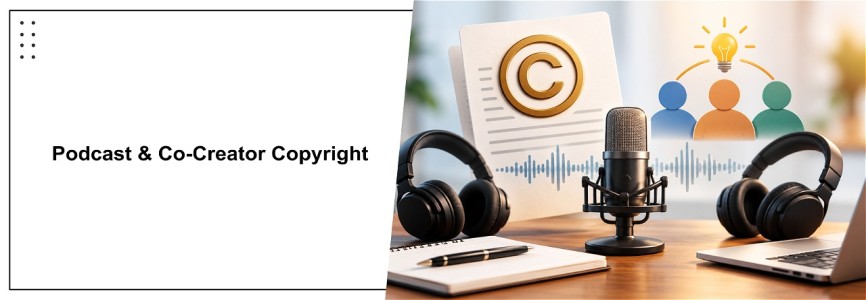



Podcasts are no longer simply recorded conversations. A modern episode may involve a host, guest, writer, researcher, producer, audio engineer, editor, composer, designer and a distribution or media company. The same episode may also appear as an audio file, a video podcast, short clips, promotional graphics and social-media posts.
This creates a basic but legally important question: who owns the copyright?
Indian copyright law does not treat a “podcast” as a separate statutory category. Different elements of a podcast may fall within different categories of protected works, and different people may hold rights in those elements. The final sound recording, underlying script, music, artwork, performances and any video recording should therefore not automatically be treated as though they have one common owner.
The safest approach is to identify each relevant work, identify its author and first owner under the Copyright Act, 1957, and then examine any employment, commissioning, assignment or licensing arrangement.
Is a podcast itself a separate copyright category?
The Copyright Act, 1957 does not contain a separate category called a “podcast”.
Depending on how it is created and distributed, a podcast may involve literary works, musical works, artistic works, sound recordings and, where it is recorded as video, a cinematograph film.
The legal analysis should therefore begin with the actual components of the episode rather than treating the word “podcast” as if it identifies one copyright.
Copyright in the sound recording
Section 2(d)(v) provides that, in relation to a sound recording, the “author” is the producer. Section 2(uu) defines the producer of a sound recording as the person who takes the initiative and responsibility for making the work.
A completed podcast audio file can therefore involve copyright in the sound recording, with the producer occupying the statutory position of author of that sound recording.
This does not mean that the producer automatically owns every underlying work incorporated into the recording.
The final recording and underlying works are different rights
A podcast episode may contain an original script, music, artwork, spoken contributions and a final sound recording.
These can involve different copyright interests.
For example:
-
an original script may be a literary work;
-
an original musical composition may be a musical work;
-
podcast artwork may be an artistic work;
-
the final audio master may be a sound recording;
-
a performance may also attract separate statutory performer’s rights.
Section 13(4) is important because copyright in a sound recording does not affect the separate copyright in a work in respect of which, or a substantial part of which, the sound recording is made.
Therefore:
Ownership of The Final Sound Recording? Automatic Ownership of Every Underlying Work
Who is the first owner?
Section 17 states the general rule that, subject to the Act, the author of a work is its first owner of copyright.
But Section 17 also contains specific exceptions. These include rules concerning certain works made in the course of employment and certain works made for valuable consideration at another person's instance.
The exact exception applicable to a particular work must therefore be identified instead of assuming that every creator is always the first owner or that every person who paid for a project automatically owns everything.
Employee-created podcast content
Suppose a media company employs a writer or producer to create podcast content in the course of employment.
Section 17(c), subject to its conditions and exceptions, provides that in the case of a work made in the course of employment under a contract of service or apprenticeship, the employer is the first owner in the circumstances specified by the provision, in the absence of an agreement to the contrary.
The employment relationship and the precise work created therefore matter.
A full-time employee and an independent freelancer should not automatically be treated in the same way.
Freelancers and independent contractors
Podcast production frequently uses freelancers for scriptwriting, editing, music, artwork, research or production. Payment for a freelance service should not be treated as a substitute for a properly drafted copyright arrangement.
If copyright is to be assigned, Section 19 prescribes requirements concerning the form and contents of the assignment, including identification of the work and specification of the rights assigned, duration and territorial extent.
A contract should therefore clearly state what is being assigned or licensed and for what purposes.
Assignment and licence are different
An assignment and a licence are not identical.
Under Section 18, copyright may be assigned wholly or partially, subject to the Act. Section 19 lays down statutory requirements for assignments.
Section 30 separately recognises licences by copyright owners in writing.
Accordingly, a clause saying that a company may “use” a podcast does not necessarily answer whether ownership itself has been transferred.
The scope of the agreement must be examined.
Who owns the host's contribution?
The host may contribute original scripts, questions, commentary, introductions, analysis or other expression. The legal position depends on the nature of the contribution and the applicable ownership rules.
A host does not automatically own the copyright in the entire podcast merely because the host appears throughout the episode.
Conversely, a producer does not automatically acquire every possible right in the host's underlying contribution merely because the producer arranged the recording.
The relevant work and contractual arrangement must be identified.
What about a guest?
A guest's participation also requires careful analysis.
An interview can contain several potentially distinct contributions: questions or structure created by the interviewer, original responses or prepared material supplied by the guest, the performance of those words, and the final recording.
Section 17(cc) contains a specific rule concerning copyright in an address or speech delivered in public. It should not, however, be mechanically applied to every conversational podcast interview.
The safest approach is to examine what the guest contributed, how the contribution was recorded and what permissions or contractual terms govern its use.
Does appearing together create joint authorship?
No automatic rule makes two participants joint authors simply because they appear in the same podcast.
Section 2(z) defines a “work of joint authorship” as a work produced by the collaboration of two or more authors in which the contribution of one author is not distinct from the contribution of the other author or authors.
The statutory definition therefore focuses on collaboration and the nature of the contributions.
Two people appearing in the same recording may have distinct contributions and therefore cannot simply be labelled joint authors without further analysis.
Indian case law on joint authorship
In Institute for Inner Studies & Ors. v. Charlotte Anderson & Ors., CS(OS) No. 2252/2011, order dated 10 January 2014, the Delhi High Court considered Section 2(z) and the claim of joint authorship in relation to books. The Court discussed collaboration, non-distinct contribution and creative input in examining the claim.
The case was not about podcasts. Its relevance is limited to the general principle that joint authorship depends upon the nature of the collaboration and contribution.
It should therefore not be cited as a podcast-specific authority.
A guest is not automatically a co-owner of the final recording
Even if a guest has contributed original material or has performer rights, that does not automatically mean that the guest owns the copyright in the producer's sound recording.
The different rights must be separated.
For example, the producer may hold copyright in the sound recording while the guest may have rights arising from the guest's own copyrightable contribution and/or performer’s rights, depending on the circumstances.
A written guest release or participation agreement can reduce uncertainty.
Performer’s rights
The Copyright Act separately recognises performers and provides special rights in performances.
Section 38 provides a performer's right, while Section 38A sets out specified exclusive rights in relation to performances, subject to the Act. Section 38B also recognises certain moral rights of performers.
A person who delivers a lecture or makes a performance can fall within the statutory definition of “performer”.
Therefore, a podcast agreement should not assume that ownership of the final sound recording automatically answers every issue concerning a performer's statutory rights.
Payment does not automatically settle every IP issue
A guest may be paid an appearance fee. A freelancer may be paid an editing fee. A composer may receive a fixed amount for music.
Payment is commercially important, but it should not be treated as a universal legal formula for determining ownership of every right.
The parties should expressly document whether the payment is consideration for a licence, assignment, services, performance, or another agreed arrangement.
Original script and written material
If a podcast is based on an original written script, the script may constitute a literary work.
The author and first owner of that literary work must be determined separately from the ownership of the final sound recording.
If a company employs a writer, Section 17 and the contractual terms must be examined.
If the writer is a freelancer, a written assignment or licence should clearly deal with the intended exploitation.
Improvised conversations
Not every spoken sentence in an informal conversation will automatically amount to a separately enforceable copyright claim.
Copyright protects qualifying works, not every idea, fact or fragment of ordinary speech.
At the same time, a prepared speech, scripted monologue, original written segment or other sufficiently protectable expression may require a different analysis.
The safest legal approach is therefore not to assume that all speech is protected or that all speech is unprotected.
Podcast music
Music is one of the most common sources of rights complications.
A podcast may use an original composition, lyrics, a pre-existing sound recording, stock music or music supplied under a licence.
These can involve different rights and different right-holders.
A producer should verify the actual licence terms instead of assuming that music found online is available for podcast use.
Podcast artwork and branding
Podcast cover art, illustrations, photographs and other graphics may involve copyright. The podcast name or branding may also raise separate trademark issues.
Copyright ownership of artwork therefore should not automatically be confused with ownership of the podcast's name or trademark.
Video podcasts
A video podcast creates additional legal layers.
A recorded video podcast may involve a cinematograph film, while the audio component may also constitute a sound recording and the underlying script, music and artwork may carry separate rights.
An agreement covering only “audio podcast rights” may therefore be insufficient if the parties intend to exploit the same content as video, clips, Shorts or Reels.
Short clips from a podcast
A long podcast is often divided into short clips for social media.
The short length of a clip does not create an automatic statutory safe harbour.
A clip can reproduce part of the sound recording and may also contain other protected material.
Whether a particular reuse is lawful depends on the rights involved and, where relevant, on an applicable statutory exception.
There is no general Indian rule that a particular number of seconds of a podcast can always be copied safely.
Fair dealing
Section 52 recognises certain acts that do not constitute infringement, including specified forms of fair dealing for purposes such as criticism or review and reporting current events/current affairs, subject to the statutory requirements.
A podcast clip used genuinely for criticism or review may therefore require a different analysis from a clip copied merely to attract viewers to another commercial channel.
However, calling something “commentary”, “review” or “news” does not by itself create a defence.
The purpose, nature and circumstances of the use must be examined against the statutory provision relied upon.
Revenue sharing is not the same as copyright ownership
Collaborators may agree to split:
-
advertising revenue;
-
sponsorship income;
-
platform revenue;
-
subscription income;
-
licensing revenue; or
-
merchandise income.
Such an agreement does not automatically establish joint copyright ownership.
Similarly, copyright ownership does not automatically determine the commercial revenue split. These are separate contractual questions and should be addressed separately.
Can the producer own the podcast but still need permission?
Yes.
A producer may own the copyright in the final sound recording while still needing to ensure that the underlying materials and other rights have been properly cleared.
For example, the producer may need permission or a valid licence concerning music, artwork, a third-party recording or another protected work incorporated into the episode.
This is why “I own the podcast” is not necessarily the end of the rights-clearance exercise.
Moral rights and attribution
Section 57 recognises certain special rights of authors independently of copyright, including the right to claim authorship and protection against certain prejudicial distortion, mutilation or modification, subject to the statutory framework.
Where content is heavily edited, adapted or repurposed, the parties should therefore consider applicable authorial and performer rights in addition to economic ownership.
What should a podcast agreement contain?
A professionally drafted podcast agreement should consider, among other matters:
-
identity of the parties;
-
nature of each person's contribution;
-
ownership of scripts;
-
ownership of the final sound recording;
-
ownership or licensing of music;
-
artwork and branding rights;
-
guest permissions;
-
performer rights;
-
assignment or licence of copyright;
-
platforms and formats;
-
audio and video rights;
-
social-media clips;
-
promotional use;
-
adaptation and editing;
-
territory;
-
duration;
-
remuneration and royalties;
-
revenue sharing;
-
credit and attribution;
-
third-party materials;
-
warranties and permissions;
-
takedown or dispute procedures;
-
and what happens when the collaboration ends.
The exact drafting will depend on the commercial relationship.
What happens when the collaboration ends?
This issue is often ignored until the podcast becomes successful. A contract should address questions such as:
-
Can either party continue the podcast?
-
Who controls the existing episodes?
-
Can old episodes remain online?
-
Can the parties make new episodes independently?
-
Can either party use old clips for promotion?
-
What happens to sponsorship arrangements?
-
Who owns the podcast name and artwork?
-
Can either party remove or licence old episodes?
Copyright law may not answer all of these commercial questions automatically. Contractual drafting can therefore be critical.
Common myths
“My name is on the podcast, so I own it.”
Not necessarily. A name or hosting role does not by itself determine copyright ownership. “I paid for the recording, so I own every piece of content in it.”
Too broad. The statutory rules and the rights in underlying works must still be examined. “The guest has no rights after signing up for the podcast.”
Too broad. The scope of any agreement and applicable performer or copyright rights matter. “Two hosts automatically become joint authors.”
Not necessarily. Section 2(z)'s requirements must be satisfied.
“A freelancer was paid, so the company automatically owns everything.”
Not necessarily. The statutory ownership position and any valid assignment or licence must be considered. “Thirty seconds of a podcast is always safe to copy.”
There is no general statutory thirty-second safe harbour.
“Copyright in the final recording means copyright in every underlying work.” Incorrect. Different layers can involve different rights.
Conclusion
Copyright ownership in podcasts is best understood as a layered question rather than a single ownership question.
A podcast may contain literary, musical and artistic works, a sound recording, performances and, in the case of video podcasts, a cinematograph film. The statutory rules concerning authorship and first ownership may differ depending on the type of work and the circumstances in which it was created. Employment, commissioning, assignment and licensing arrangements can further affect the parties' rights.
Joint participation should not automatically be equated with joint authorship, and ownership of a final sound recording should not automatically be treated as ownership of every underlying work.
For collaborative podcasts, the most practical legal lesson is straightforward:
-
Identify The Work
-
Identify The Contributor
-
Identify The Right
Document The Permission or Transfer
A podcast may appear to the audience as one unified piece of content. Legally, however, it can be a bundle of different works and rights. Clear agreements made before publication can therefore prevent disputes over ownership, exploitation, revenue and future use.


_(b)_of_the_Trademark_Act,_1999_(1)_crop10_thumb.jpg)


_crop10_thumb.jpg)


_crop10_thumb.jpg)
_crop10_thumb.jpg)


_crop10_thumb.jpg)


_crop10_thumb.jpg)


_crop10_thumb.jpg)


_crop10_thumb.jpg)


_crop10_thumb.jpg)


_crop10_thumb.jpg)


_crop10_thumb.jpg)


_crop10_thumb.jpg)


_crop10_thumb.jpg)








_crop10_thumb.jpg)






























_crop10_thumb.jpeg)