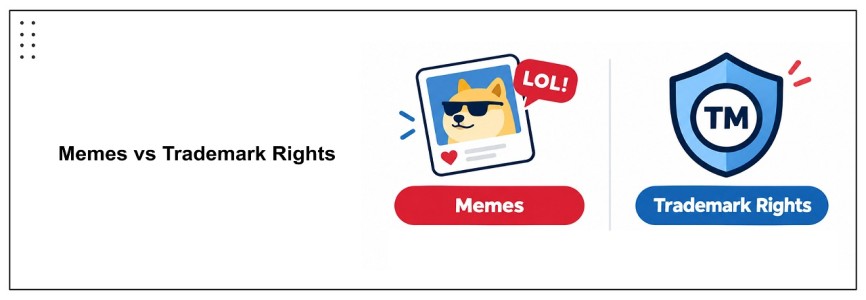



The internet has changed the way people interact with brands. A company logo or slogan used to have a fairly controlled existence. You would see it on a product, in an advertisement, on a billboard, or perhaps in a newspaper article. Today, that same logo can become the subject of a joke and spread across social media within a few hours.
This is where meme culture creates a challenge for trademark law. Memes often take familiar names, logos, slogans, and images and turn them into something funny, critical, or entirely unrelated to their original purpose. Usually the person making the meme isn’t trying to convince people that the brand officially approved it. In many cases the audience knows perfectly well that the content is unofficial.
For trademark registration owners, this creates an uncomfortable situation. They have rights that are designed to protect their brand, but they are dealing with an online culture where people constantly copy, alter, remix, and reinterpret brand identities.
Trademark Law Wasn't Built for Meme Culture
Memes are usually much less straightforward. Imagine someone takes a well-known brand logo and changes it to make fun of the company. The average person viewing that meme is unlikely to think it came from the company's marketing department. The humor often depends on the audience understanding that the image has been altered or used without official approval.
That makes the traditional idea of "consumer confusion" harder to apply. The internet also allows the same trademark to be used for very different things. A logo might be used to criticize a company’s policies. A logo might be used to make a joke about customers. A logo might be used to promote a product. Treating all three situations as the same kind of infringement would be to ignore the very different reasons for those uses.
The Internet Moves Faster Than Legal Action
Speed is another major problem. A meme doesn’t need weeks or months to reach an audience. Funny image can be a viral in one afternoon. Many times the content will be copied thousands of times before a company notices.
This creates a serious practical problem for trademark owners. Suppose a legal team discovers a meme that it believes crosses the line. Lawyers may need to investigate who created it, determine whether the use is commercial, assess the likelihood of confusion, and decide whether sending a legal notice is appropriate. That process takes time.
The meme, meanwhile, keeps moving. The original post may be deleted, but copies may already exist on other platforms. It might have been a screenshot, the caption changed, the picture changed, or it might have been used in another meme. In this context, traditional enforcement can feel like trying to stop water from spreading after the glass has already been knocked over.
There is also a commercial consideration. It may not always be reasonable to put so much effort into removing a joke that the general public will probably forget in a few days.
Parody and Commentary Create a Legal Gray Area
One of the biggest complications comes from parody and commentary. People have used trademarks to criticize and make fun of companies long before social media existed. The law can protect certain forms of expressive use, particularly where the public is unlikely to be confused about whether the trademark owner actually created or endorsed the material.
Meme culture naturally produces a lot of this type of content. It may exaggerate an advertisement by the company, ridicule a product, or even utilize a well-known logo to say something about the actions of the company. This logo is used simply because it is recognized, and not with the intention to advertise or pretend to be the company.
That does not mean every meme is legally protected. The circumstances surrounding the use still matter. There is a significant difference between someone using a company's logo to make a joke and someone putting that logo on T-shirts and selling them without authorization.
The problem is memes don’t always remain in their original context. A harmless satirical image is picked up and reposted by another account for commercial purposes. Someone can add a new caption, and a joke can take on a whole new meaning. As memes travel, separating the original intent from later uses can become extremely difficult.
Some Brands Have Learned to Play Along
Interestingly, some companies have stopped treating every meme as a threat. Instead, they have started participating in internet culture themselves. If a particular brand is part of some kind of joke and becomes popular online, it is likely to become very well-known. Instead of sending cease-and-desist letters, the marketing department will just make fun of the trend or even use it as part of an official campaign. From the marketing point of view, it is highly effective. Humans like to be entertained by things that they can relate to and that understand internet culture.
However, such a strategy can cause inner contradiction in a company. While legal departments will do everything possible to keep control over the trademark, the marketing department will welcome the remixing. Both perspectives have merit. A company obviously needs to protect its brand from genuine misuse. At the same time, trying to control every joke involving the brand can make the company appear overly sensitive or disconnected from its audience. The situation becomes even more complicated when a company tries to claim exclusive rights over phrases or memes that have become widely associated with internet culture. Something may have a legal connection to a brand while the public views it as a shared piece of online culture. That gap between legal and perceived ownership is sometimes hard to reconcile.
Social Media Makes Enforcement Even Harder
Another challenge is that memes don't belong to a single platform. The same meme may show up on Instagram, TikTok, Reddit, Facebook, X, messaging services, bulletin boards, and a plethora of other sites. Each platform has its own reporting system and own rules about intellectual property violations. A company might successfully have one post removed and then discover that the same image has appeared on dozens of other accounts.
Anonymity poses a different challenge. It might be impossible to trace back the author of the meme. In any case, even if the author is traced back, he or she might not necessarily be accountable for the meme’s subsequent incarnations that have spread across the Internet. This makes formal legal action considerably more complicated. A trademark owner may know that a particular use is unauthorized but still have difficulty identifying who should actually receive the legal notice.
Sometimes Enforcing a Trademark Creates a Bigger Problem
Perhaps the most unusual aspect of meme-related trademark disputes is the possibility of public backlash. On the internet, a legal complaint can quickly become entertainment. One of the most remarkable things in trademark conflicts related to memes is that the company might receive an unexpected backlash. The fact is that any legal action made by the company on the internet is likely to turn into entertainment. First, the company decides to send a cease and desist letter to the meme creator. Then, this letter goes out to the Internet, and people start making jokes about it. The response to the company becomes a meme, and soon enough, millions of people start talking about it.
The described phenomenon is very similar to what is called the "Streisand effect." In this case, when you try to suppress something, you draw even more attention to it. In this case, companies understand that even if they are right from the legal point of view, their actions can be counterproductive. Thus, the legal department should not think about winning the battle only, but also about the consequences that this conflict might bring to the company's Image. In some cases, ignoring a meme may protect the brand more effectively than trying to remove it.
What Should Brand Owners Do?
The answer isn't to look the other way on trademark infringement altogether. Businesses still have a real interest in protecting their brands from serious misuse, and that hasn't changed. When someone is selling counterfeit goods under a company's name, using a trademark to promote a rival business, or creating genuine confusion about whether a product or service is officially tied to the brand, legal action still has a place. What matters is being able to tell that kind of misuse apart from ordinary online humor that isn't trying to deceive anyone.
This is why more companies are turning to monitoring systems that track how their trademarks show up across the internet. The goal usually isn't to flag every mention for removal. It's to separate uses that could cause real harm from the harmless jokes and conversations that make up most of what's out there. Alongside this, some companies are putting together internal guidelines that spell out how employees should respond when a meme involving the brand starts to trend, so legal and marketing aren't left improvising in opposite directions when it happens. Underneath all of this is a simple shift in mindset that more brands are coming around to: not every unauthorized use is a threat worth chasing. Sometimes a meme really is just a meme.
Conclusion
Meme culture has thus presented trademark holders with a new problem since it functions very differently from the world of commerce for which many rules about trademark rights were designed. Memes tend to be swift, collaborative, ever-changing, and frequently non-commercial. They may exploit trademarks without any intention to confuse consumers or unfairly take advantage of the good name of the brand owner. This does not mean that trademark law is irrelevant. Firms do hold significant trademark rights if their marks are exploited commercially or in a misleading way.
The real challenge is knowing where to draw the line. Trying to clamp down on every joke, parody, or offhand social media reference is a losing game in practice. Worse, it can backfire, stirring up far more attention than the company ever wanted in the first place. A more sensible approach is to save enforcement energy for uses that actually threaten real commercial or reputational damage, and let the rest of internet culture run its course without interference. In the age of memes, protecting a trademark isn't simply about controlling how a brand is used. It's also about understanding how people use it, why they use it, and how the public is likely to react when a company decides to intervene. Often times, the best way to handle trademarks is not to go up against the joke; sometimes the best way is knowing that it's not really a joke.
FAQs
Q1. Can a meme that uses a company's trademark be considered infringement?
Ans. Yes, it can be, but simply using a trademark in a meme does not automatically amount to infringement. The circumstances matter. A court may consider whether the use is commercial, whether consumers could be confused, and whether the content is being used for purposes such as parody or commentary.
Q2. Is it legal to use a company's logo in a meme?
Ans. It can be, particularly when the logo is being used for commentary, criticism, parody, or another form of expression and there is little risk that people will believe the company created or approved the content. However, using the logo commercially or in a misleading way can create greater legal risk.
Q3. Why don't companies simply remove every meme that uses their trademark?
Ans. Because doing so is often impractical and may create unwanted attention. Memes can spread across numerous platforms within hours, making complete removal extremely difficult. Aggressive enforcement can also lead to public criticism and generate even more attention for the original content.
Q4. Can parody protect someone who uses a trademark in a meme?
Ans. Parody can provide protection in certain circumstances, but it is not a guaranteed defense. The nature of the use, the surrounding context, and whether consumers could be confused about the company's involvement can all be relevant.
Q5. Can widespread memes weaken a company's trademark?
Ans. Widespread internet use does not automatically destroy a trademark. However, companies still need to pay attention to how their marks are being used and whether they are losing their distinctiveness or becoming associated with something other than the company's goods or services.
Q6. Should companies ignore memes about their brands?
Ans. Not necessarily. Companies should pay attention to what is happening, but they don't necessarily need to take legal action every time their trademark appears in a meme. Monitoring the situation and responding only when there is a meaningful legal or commercial risk can often be more effective than trying to eliminate every unauthorized reference.


_(b)_of_the_Trademark_Act,_1999_(1)_crop10_thumb.jpg)


_crop10_thumb.jpg)


_crop10_thumb.jpg)
_crop10_thumb.jpg)


_crop10_thumb.jpg)


_crop10_thumb.jpg)


_crop10_thumb.jpg)


_crop10_thumb.jpg)


_crop10_thumb.jpg)


_crop10_thumb.jpg)


_crop10_thumb.jpg)


_crop10_thumb.jpg)


_crop10_thumb.jpg)








_crop10_thumb.jpg)

















_crop10_thumb.jpeg)