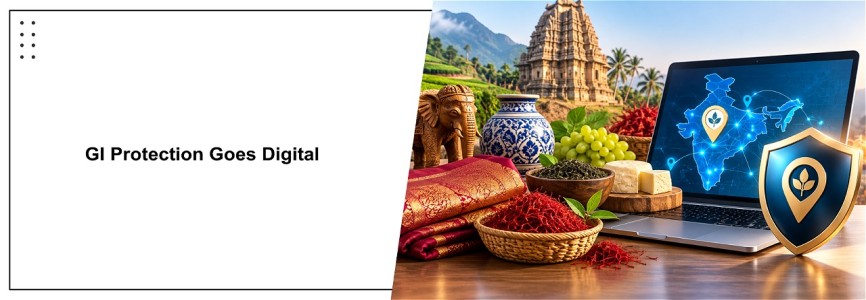



Geographical Indications (GIs) are an important part of India's intellectual property law because they protect products that are closely associated with a particular geographical region. In India, several products such as Darjeeling Tea, Basmati Rice, Kolhapuri Chappal and Banarasi Sarees have gained recognition because of their geographical origin, traditional methods of production and reputation. GI protection in India is mainly governed by the Geographical Indications of Goods (Registration and Protection) Act, 1999 and the Geographical Indications of Goods (Registration and Protection) Rules, 2002. A recent development in this field is the launch of the Geographical Indications (GI) e-Filing Portal by the Intellectual Property Office.
The portal was officially launched on 15 September 2026, on the occasion of GI Day, by the Secretary, Department for Promotion of Industry and Internal Trade (DPIIT). According to IP India, the portal is intended to facilitate the online filing of GI applications and provide applicants and other stakeholders with a more convenient and streamlined digital platform for GI-related filings. Along with the portal, IP India also published the Draft Guidelines for Geographical Indications and invited comments and suggestions from stakeholders. The development is important because it reflects India's continuing effort to digitise the administration of intellectual property rights and make the registration process easier for applicants.
Understanding Geographical Indications
Section 2(1)(e) of the GI Act defines a geographical indication as an indication which identifies goods as originating or manufactured in a particular country, region or locality where a particular quality, reputation or other characteristic of the goods is essentially attributable to their geographical origin. In simple terms, a GI connects a product with the place from which it comes. The geographical origin must have some connection with the quality, reputation or characteristics of the product.
This protection is especially valuable for traditional products and local industries. It helps distinguish genuine products from products that may try to take advantage of the reputation associated with a particular geographical region.GI protection is also different from ordinary trademark protection. A trademark registration is generally associated with a particular business or proprietor, whereas a GI is connected with a geographical area and the community of producers associated with the goods. This makes GIs particularly relevant to farmers, artisans and traditional producers.
What is the New GI e-Filing Portal?
The newly launched GI e-Filing Portal is intended to make the process of filing GI applications more accessible through an online platform. According to IP India, the portal facilitates the online filing of GI applications and provides a digital platform for applicants and stakeholders dealing with GI matters. This is particularly relevant because GI applications are often filed by associations of persons, producer organisations or authorities representing the interests of producers.
Such applications require considerable information about the product, its geographical origin, its characteristics, the geographical area involved and the relationship between the product and that area. Moving the filing process online can make submission easier and reduce the dependence on physical filing. It can also make the maintenance and management of application records more organised. However, it is important not to assume that the entire GI registration and enforcement system has suddenly become completely digital. The portal primarily facilitates online filing, while the substantive requirements relating to registration and protection continue to be governed by the GI Act and the applicable Rules.
How Does GI Registration Work?
For a GI to be registered, the applicant has to establish the connection between the goods and the geographical area from which they originate. The application generally contains information relating to the geographical area, characteristics of the goods, production methods, geographical map and details of the producers. Once an application is filed, it goes through examination. If the application satisfies the necessary requirements, it may be published in the Geographical Indications Journal.
Publication gives interested persons an opportunity to oppose the registration in accordance with the procedure prescribed under the law. Section 21 of the GI Act provides the rights arising from registration. A registered GI gives the registered proprietor and authorised users certain rights in relation to the GI and provides a legal basis for seeking relief against infringement. Therefore, GI registration is not merely a way of officially recognising a product. It provides a statutory framework through which the geographical identity and reputation of the product can be protected.
Kolhapuri Chappal and the Prada Controversy
One recent example that shows the practical importance of GI protection is the controversy involving Kolhapuri Chappal and Prada. Kolhapuri Chappal is a registered GI covering handicraft goods, with the registered geographical area extending across parts of Maharashtra and Karnataka. The GI is associated with the traditional handcrafted footwear produced in these regions. IP India's GI database records the registration and its validity. In 2025, a Public Interest Litigation was filed before the Bombay High Court concerning Prada's “toe ring sandals”. The petition alleged that the footwear was deceptively similar to GI-protected Kolhapuri Chappals and raised questions concerning the protection available under the GI Act.
The matter was considered in Prof. Adv. Ganesh S. Hingmire v. PRADA Group & Ors. The Bombay High Court decided the PIL on 16 July 2025 and dismissed it. The proceedings nevertheless brought considerable attention to the legal protection available to traditional products and the role of GIs in preventing the unauthorised commercial exploitation of their reputation. The case is useful for understanding that simply having a GI registration does not end the legal analysis. Questions relating to infringement, the nature of the alleged use, who can enforce the rights and what remedy is appropriate are also important. The Kolhapuri Chappal controversy also highlights the economic importance of GIs for artisan communities. Protection of a GI can help preserve the connection between a traditional product and the community and region associated with it.
Indian Cases Relating to Geographical Indications
Tea Board, India v. ITC Limited
In Tea Board, India v. ITC Limited, the Tea Board objected to ITC's use of the expression “Darjeeling Lounge” for a lounge at one of its hotels. The Tea Board relied upon its registered GI “Darjeeling”. The Calcutta High Court considered the scope of protection available under the GI Act and examined whether the use of “Darjeeling” in connection with a hotel lounge could amount to infringement of the GI. The case is important because it shows that GI protection cannot automatically be extended to every commercial use of a geographical name. The use must be considered in the context of the goods for which the GI is registered and within the scope of the GI Act.
Khoday Distilleries Ltd. v. Scotch Whisky Association
Another important Indian case is Khoday Distilleries Ltd. v. Scotch Whisky Association, decided by the Supreme Court on 27 May 2008. The dispute concerned the use of the mark “Peter Scot” for whisky manufactured in India. The case involved questions concerning trademark protection and geographical indication-related rights. The Supreme Court examined the relevant provisions and the relationship between different forms of intellectual property protection. The case is useful because it demonstrates that trademark rights and GI rights operate under different statutory frameworks and may sometimes overlap in commercial disputes.
Basmati Rice Dispute
The dispute relating to Basmati Rice is another example of the importance of geographical boundaries in GI protection. In State Government of Madhya Pradesh v. Union of India, issues arose regarding the geographical area associated with the Basmati GI and whether certain districts of Madhya Pradesh should be included within that area. The dispute demonstrates why geographical boundaries are an important part of GI registration. Since the very basis of a GI is the connection between the product and its geographical origin, deciding which areas fall within the protected territory can have significant consequences for producers.
Importance of the New Portal?
The introduction of the GI e-Filing Portal can have several practical benefits. The first is convenience. Applicants can submit GI applications electronically, reducing the need to depend entirely on physical filing. The second is better administrative management. Digital filing can make it easier to maintain application records and manage documents. The third is greater awareness and accessibility. Producer organisations and groups associated with traditional products may find it easier to initiate the registration process when digital facilities are available.
The development is particularly relevant for India because the country has a large number of traditional and region-specific products. Effective GI protection can help prevent unauthorised commercial use of the reputation attached to such products. At the same time, digitalisation comes with its own challenges. Many artisans and producer communities are located in rural areas and may not have easy access to technology or professional legal assistance. Therefore, simply creating an online portal may not be enough. Awareness programmes, technical assistance and accessible guidance will also be important for the system to work effectively.
Draft GI Guidelines, 2026
Another important part of the recent development is the publication of the Draft Guidelines for Geographical Indications. IP India published the draft guidelines alongside the launch of the portal and invited stakeholders to submit their comments and suggestions. The guidelines are intended to provide greater clarity regarding different aspects of GI registration and related procedures. This can be useful because preparing a GI application can involve several complicated factual issues.
Applicants may need to establish the history of the product, its geographical connection, its distinctive characteristics, the geographical boundaries and the interests of the producer community. Clear administrative guidance can therefore help applicants better understand what is expected from them when preparing an application. However, the guidelines should be read together with the GI Act and Rules. They cannot replace or override the statutory requirements governing GI protection.
Conclusion
The launch of the GI e-Filing Portal on 15 September 2026 is an important development in India's intellectual property administration. By facilitating online filing of GI applications, the portal has the potential to make the registration process more convenient and organised. The development is particularly relevant because geographical indications are closely connected with India's traditional products, artisans and local communities. The examples of Kolhapuri Chappal, Darjeeling Tea and Basmati Rice show that GI protection involves not only registration but also questions relating to geographical identity, commercial use, producer interests and enforcement. The Kolhapuri Chappal–Prada controversy, in particular, shows why protection of traditional products continues to be relevant in today's global market.
As Indian products gain greater commercial recognition, protecting the reputation associated with their geographical origin becomes increasingly important. At the same time, the effectiveness of the new portal will depend on how accessible it is to the communities that actually produce GI goods. Digitalisation should therefore be accompanied by awareness, technical support and effective enforcement mechanisms. The new GI e-Filing Portal, together with the Draft GI Guidelines, can be viewed as another step towards modernising India's GI administration while strengthening the legal framework protecting India's regional products and traditional industries.
Frequently Asked Questions
Q1. What is the GI e-Filing Portal?
Ans. The GI e-Filing Portal is an online platform launched by IP India to facilitate electronic filing of Geographical Indication applications and related GI filings. It was officially launched on 15 September 2026.
Q2. Which law governs Geographical Indications in India?
Ans. GI protection in India is primarily governed by the Geographical Indications of Goods (Registration and Protection) Act, 1999 and the Geographical Indications of Goods (Registration and Protection) Rules, 2002.
Q3. What is the significance of Kolhapuri Chappal as a GI?
Ans. Kolhapuri Chappal is a registered GI for handicraft goods associated with the geographical area of Maharashtra and Karnataka. Its registration provides statutory protection against unauthorised use falling within the scope of the GI Act.
Q4. What happened in the Kolhapuri Chappal–Prada dispute?
Ans. A PIL was filed before the Bombay High Court alleging that Prada's toe-ring sandals were deceptively similar to GI-protected Kolhapuri Chappals. The Bombay High Court dismissed the PIL in Prof. Adv. Ganesh S. Hingmire v. PRADA Group & Ors. on 16 July 2025.
Q5. Does a GI belong to one individual?
Ans. No. GI protection is different from ordinary individual trademark ownership. It is connected with a geographical area and the producers associated with the goods, subject to the rights and requirements provided under the GI Act.
Q6. How long is a GI registration valid?
Ans. A registered GI is generally valid for ten years and can be renewed in accordance with the GI Act and Rules.
Q7. What are the Draft GI Guidelines, 2026?
Ans. The Draft GI Guidelines are guidance published by IP India alongside the new e-Filing Portal to provide greater clarity regarding GI registration and related procedures. Stakeholders have been invited to submit comments and suggestions.
Q8. Does the new portal replace the GI Act?
Ans. No. The portal is a digital mechanism for filing GI applications. The substantive rights, requirements and protections continue to be governed by the GI Act and applicable Rules.


_(b)_of_the_Trademark_Act,_1999_(1)_crop10_thumb.jpg)


_crop10_thumb.jpg)


_crop10_thumb.jpg)
_crop10_thumb.jpg)


_crop10_thumb.jpg)


_crop10_thumb.jpg)


_crop10_thumb.jpg)


_crop10_thumb.jpg)


_crop10_thumb.jpg)


_crop10_thumb.jpg)


_crop10_thumb.jpg)


_crop10_thumb.jpg)


_crop10_thumb.jpg)











_crop10_thumb.jpg)











































































































_crop10_thumb.jpeg)