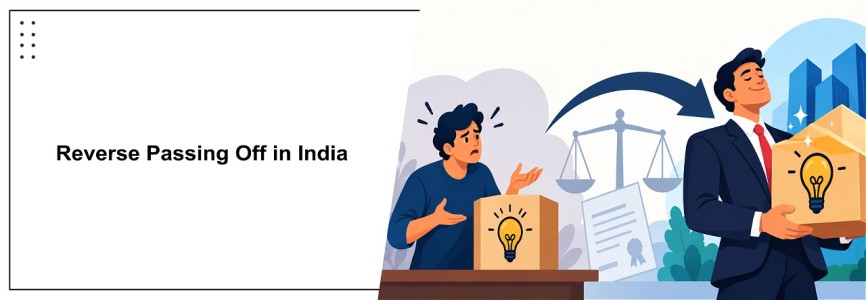



Passing off is a common-law remedy that protects the goodwill and reputation a business builds up in its goods or services. In the usual case, a defendant sells his own goods or services as though they were the plaintiff's, which confuses customers and threatens the plaintiff's goodwill. Reverse passing off turns this around. Here the defendant takes the plaintiff's goods and presents them as his own, often by removing the plaintiff's trade mark, relabeling the product or otherwise hiding where it really came from. Courts in several jurisdictions, the United States in particular, have recognized this wrong, but its place in Indian trademark law has long been unclear. That uncertainty matters more now after the Delhi High Court's decision in Western Digital Technologies Inc. v. Geonix International Pvt. Ltd. (9 March 2026), where the Division Bench held that reverse passing off is not an actionable tort under Indian trademark law.
Understanding Reverse Passing Off
The gist of a typical passing-off action is that the defendant's goods are being passed off as the plaintiff's goods. The classic formulation requires the plaintiff to prove goodwill or reputation, a misrepresentation by the defendant, and damages to the plaintiff resulting or likely to result. Reverse passing off is the converse of passing off in that the direction of the misrepresentation is reversed. The defendant takes goods that originated with the plaintiff, removes or obscures the plaintiff’s identifying marks or other indicia, and sells those goods as if they came from the defendant. The commercial damage is not necessarily that two competing brands get confused. The plaintiff instead alleges that the defendant has appropriated the commercial value embodied in the plaintiff's product, while denying the plaintiff attribution for that product. The distinction is particularly relevant in industries involving refurbishment, repackaging, private labeling, software modification, replacement parts, consumer electronics and other goods where the physical product may retain characteristics that can be used to identify its original manufacturer even after it has had its trade mark removed.
Indian trademark law does not expressly define or provide a separate statutory cause of action for “reverse passing off.” Section 27(2) of the Trade Marks Act, 1999 preserves the common-law remedy of passing off by recognizing an action against a person who represents his goods or services as those of another. Sections 134 and 135 further address the jurisdiction and remedies applicable to infringement and passing-off proceedings, while Section 29 specifically deals with trademark infringement. The legal difficulty arises from the traditional understanding of passing off, which generally concerns a defendant misrepresenting his goods or services as those of the plaintiff. In reverse passing off, however, the alleged misrepresentation operates in the opposite direction: goods originating from the plaintiff are presented or marketed as those of the defendant. This distinction has therefore given rise to the question of whether reverse passing off can independently be sustained within the scope of Section 27(2) of the Act.
Earlier Indian Approach
Before the recent Delhi High Court ruling, Indian law had no settled answer on reverse passing off. The leading authority was Sheila Mahendra Thakkar v. Mahesh Naranji Thakkar, decided by the Bombay High Court in 2003. The dispute concerned products sold under the mark "Vandevi", and the plaintiff argued that the defendant was drawing on the characteristics and goodwill of the plaintiff's product and selling it as his own. The Bombay High Court discussed reverse or inverse passing off and described it as a case where the defendant claims for himself the credit that rightly belongs to the plaintiff for certain goods or services, and so benefits from the plaintiff's reputation. For that reason, the decision has often been cited by parties arguing that Indian passing-off law is flexible enough to cover reverse passing off, even though the Trade Marks Act itself never uses the expression.
The broader character of Indian passing-off law also supports an argument for flexibility. The Supreme Court has repeatedly recognized passing off as a remedy directed towards protecting goodwill against misrepresentation, rather than merely protecting the formal registration of a trade mark. For instance, the Supreme Court in N.R. Dongre v. Whirlpool Corporation held that a passing off action is maintainable and that passing off is independent of statutory trademark registration rights. This flexible common law base gives an intellectual basis for arguing that the law should respond to new forms of commercial misrepresentation. According to this view, the central question is not necessarily whether the conduct fits a traditional formula of "passing off" but whether the defendant has appropriated the plaintiff's goodwill by making a commercially material false representation concerning the origin of goods.
Western Digital v. Geonix: A Significant Shift
The position has now been largely clarified, at least within the Delhi High Court, by Western Digital Technologies Inc. v. Geonix International Pvt. Ltd. The case concerned refurbished hard disk drives. The appellants alleged that used drives they had manufactured were being refurbished, that their trade marks were taken off and replaced with new ones, and that the drives were then sold as the respondents' own products. They argued that consumers could still tell the drives came from the original manufacturer through their physical features and other indicators, which made this a case of reverse passing off.
The Division Bench did not recognize reverse passing off as a separate actionable tort under Indian trademark law. In reaching this conclusion, the Court primarily considered Sections 27(2), 134 and 135 of the Trade Marks Act. It observed that Section 27(2) protects the right to bring a passing-off action where a defendant represents his own goods as those of another. Reverse passing off, however, involves the opposite conduct, where goods belonging to the plaintiff are represented as the defendant’s own. The Court also noted that Section 134 deals with the jurisdiction applicable to passing-off actions, while Section 135 sets out the remedies available for infringement and passing off. On this basis, the Court held that the existing of Indian trademark law does not provide an independent cause of action solely on the ground of reverse passing off.
Significantly, the Court continued that even if, for the sake of argument, reverse passing off could be actionable, the appellants had not made out the necessary elements in the instant case. The Court applied an “initial interest” test, finding that the consumer would have to be able to identify the goods as those of the original manufacturer at the initial point of encounter with the product. Later technical investigation was not enough to prove the identity of the original manufacturer. The Court also noted the traditional requirements of goodwill, misrepresentation and damage, concluding that there was not enough evidence of misappropriation of the appellants' goodwill or damage resulting therefrom in the circumstances before it.
The Current Legal Position
Though the Western Digital case is certainly an important judicial pronouncement, the discussion on reverse passing off need not necessarily be considered to be closed from an intellectual point of view. First of all, it needs to be remembered that the case was not decided by the Supreme Court of India but by a Division Bench of the Delhi High Court. More importantly, Indian passing-off jurisprudence has traditionally been developed on the basis of common-law principles and with considerable adaptability towards newer forms of commercial deceit. It may be argued that the very fact that the statute does not repeal but retains the passing off remedy indicates the desirability of not freezing the common law within the four corners of the statute. However, at the same time, it must be ensured that the judicial development of the law does not overstep its boundaries.
It helps to keep two things apart: reverse passing off as a claim in its own right, and the other ways the law may deal with the same conduct. The Western Digital judgment did not say that such conduct is beyond the law's reach. It expressly left open whether an injunction could be granted under another statute or a different branch of law. So even where a standalone reverse passing off claim fails, the facts may still support some other action. Removing or changing a trade mark, describing refurbished goods in a misleading way, making false statements about where a product comes from, breaking a contract, infringing copyright, acting unfairly in competition, or breaching consumer protection rules could each have legal consequences in their own right.
The decision has important practical implications for brand owners, especially manufacturers whose products are resold, refurbished or otherwise enter secondary markets. Simply removing a manufacturer’s trade mark from a product does not, by itself, guarantee that the conduct will be treated as reverse passing off. Brand owners therefore need to consider other ways of protecting their interests, such as appropriate contractual safeguards, product authentication systems, enforcement of their trade mark rights under Section 29 where applicable, and protection of distinctive packaging, product features and overall get-up. They should also pay attention to consumer protection requirements and ensure that refurbished or modified products are properly identified and disclosed to consumers. In this context, the provisions of the Trade Marks Act, including the limitations on trade mark rights under Section 30, remain relevant when determining the remedies available in a particular
Conclusion
The law of reverse passing off in India has progressed from a point of genuine doubt to one of firmness following the decision of the Delhi High Court in Western Digital Technologies Inc. v. Geonix International Pvt. Ltd. According to the judgment, reverse passing off does not constitute an actionable tort in Indian law on trademark, and the interpretation of Sections 27(2), 134 and 135 of the Trade Marks Act applies only to traditional passing off. However, the discussion is not settled yet. Reverse passing off targets a genuine commercial wrong, where one party takes the value of another's goods while hiding where they really came from. Whether the law should handle this through the flexible common-law doctrine of passing off, through a separate statutory remedy, or through new legislation is still an open question that courts and scholars should keep examining. For the present, however, practitioners should approach reverse passing off cautiously in India and should plead and substantiate conventional infringement, passing off, statutory violations, contractual rights or other available causes of action wherever the facts permit.
Frequently Asked Questions
Q1. What is reverse passing off?
Ans. Reverse passing off occurs when a defendant takes goods originating from the plaintiff, removes or conceals the plaintiff's identifying marks or origin, and represents those goods as originating from the defendant. It is essentially the reverse of conventional passing off, where the defendant's goods are represented as those of the plaintiff.
Q2. Is reverse passing off recognized as an independent tort in India?
Ans. Following the Delhi High Court's decision in Western Digital Technologies Inc. v. Geonix International Pvt. Ltd. on 9 March 2026, the present position at the Delhi High Court is that reverse passing off is not an actionable tort under Indian trademark law.
Q3. Which provision of the Trade Marks Act deals with passing off?
Ans. Section 27(2) preserves the right of action for passing off notwithstanding the Trade Marks Act. It does not expressly refer to or define reverse passing off.
Q4. What is the difference between passing off and reverse passing off?
Ans. In ordinary passing off, the defendant represents his goods as the plaintiff's goods. In reverse passing off, the defendant represents the plaintiff's goods as his own. The direction of the alleged misrepresentation is therefore reversed.
Q5. What was decided in Western Digital v. Geonix?
Ans. The Delhi High Court held that reverse passing off does not provide an independent cause of action under Indian trademark law. The Court also held that, even assuming such a cause of action existed, the factual ingredients required for establishing it were not demonstrated in the case.
Q6. Does Sheila Mahendra Thakkar v. Mahesh Naranji Thakkarrecognise reverse passing off?
Ans. The Bombay High Court considered and discussed the concept of reverse or inverse passing off in that case. The decision has subsequently been relied upon in arguments supporting the proposition that Indian passing-off principles may accommodate reverse passing off. However, the later Western Digital decision takes a restrictive view of its availability as an independent cause of action.
Q7. Can removal of a manufacturer's trade mark from a product amount to trademark infringement?
Ans. Not necessarily. The legal consequences depend on the circumstances, including whether there is unauthorised use of the registered mark, alteration or impairment of goods, application of marks to packaging or advertising, and whether relevant provisions of Sections 29 and 30 are satisfied.
Q8. Can a brand owner obtain an injunction against reverse passing off?
Ans. A standalone injunction based solely on reverse passing off is presently difficult to sustain in light of Western Digital. However, other causes of action may potentially support injunctive relief depending on the facts. The Delhi High Court expressly left open whether relief could be available under another statute or area of law.
Q9. Is the Delhi High Court's decision binding throughout India?
Ans. A Delhi High Court judgment is binding on courts subordinate to it within its territorial jurisdiction but is not binding on High Courts in other States in the same manner as a Supreme Court judgment. Consequently, the possibility of divergent approaches in other High Courts remains, subject to subsequent appellate or Supreme Court decisions.
Q10. What is the likely future of reverse passing off in India?
Ans. The issue remains open to further judicial consideration, particularly because the doctrine concerns emerging forms of product refurbishment, relabelling, secondary markets and digital or technological modification. A future Supreme Court ruling or legislative clarification could potentially settle whether reverse passing off should be recognised independently or addressed through existing statutory and common-law remedies.


_(b)_of_the_Trademark_Act,_1999_(1)_crop10_thumb.jpg)


_crop10_thumb.jpg)


_crop10_thumb.jpg)
_crop10_thumb.jpg)


_crop10_thumb.jpg)


_crop10_thumb.jpg)


_crop10_thumb.jpg)


_crop10_thumb.jpg)


_crop10_thumb.jpg)


_crop10_thumb.jpg)


_crop10_thumb.jpg)


_crop10_thumb.jpg)


_crop10_thumb.jpg)








_crop10_thumb.jpg)



















































_crop10_thumb.jpeg)







































_crop10_thumb.jpg)