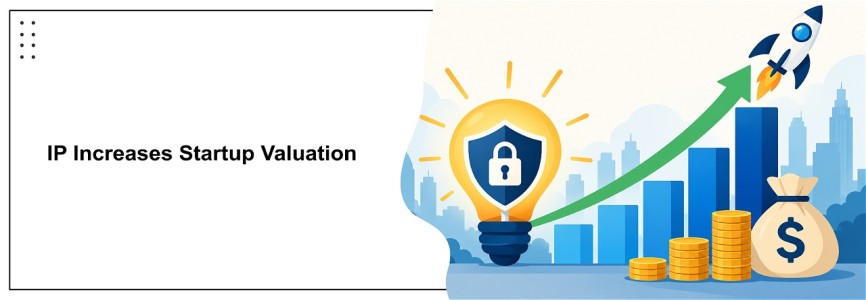



For an early-stage startup, valuation is rarely based only on present revenue or physical assets. A startup may have limited tangible assets but possess patent registration, trademark registration, copyright registration, software, designs, trade secrets, know-how or other intangible assets that are central to its future business.
Can intellectual property increase startup valuation? Yes—but not simply because a startup owns a patent or has registered a trademark. IP can contribute to valuation when it creates or protects economic advantages such as differentiation, exclusivity, licensing opportunities, barriers to imitation and commercially relevant future cash flows. WIPO explains that IP value can arise from direct exploitation, licensing and barriers to entry or reduced substitute threats. However, IP does not have an automatic rupee value merely because it is registered. Commercial relevance, legal strength, ownership, remaining life, market and expected economic benefits all matter.
What Does Startup Valuation Actually Measure?
Startup valuation attempts to capture the economic value and future potential of the business. Depending on the stage of the company, investors may consider revenue, growth, market size, customer traction, margins, technology, competitive advantage, scalability, regulation, intellectual property and exit opportunities.
IP is therefore only one component of overall valuation. The better question is: How does the startup's intellectual property contribute to future economic value?
IP Can Create a Barrier to Entry
One important way IP can support valuation is by making imitation more difficult. Startup India identifies barriers to entry and imitation costs among factors relevant to investors assessing startups.
A patent, trademark or other IP right does not automatically create a strong barrier. Scope of protection, validity, enforceability, commercial relevance, remaining term, geography and competitors' ability to design around the right all matter.
Patents Can Protect Future Revenue Opportunities
For technology-driven startups, patents can be closely connected to future commercialisation. This can be particularly relevant in biotechnology, pharmaceuticals, medical devices, engineering and other research-intensive sectors where patent rights may support commercial exclusivity.
But the economic significance of a patent depends on whether the protected technology contributes to a commercially viable product or service. A patent without meaningful market demand is not necessarily a valuable business asset.
A Patent Is Not the Same as a High Valuation
There is no defensible formula such as “one patent equals X crore of valuation”. WIPO explains that an IP asset has quantifiable value when it can generate measurable economic benefits or enhance associated assets, and that value reflects potential future economic benefits.
Investors may therefore examine what the patent protects, the relevant market, commercial use, remaining protection, competitive alternatives and potential licensing or exploitation opportunities.
Trademarks Can Increase the Value of Consumer Startups
Not every startup is patent-driven. For consumer businesses, a strong trademark and brand can be commercially important. The Trade Marks Act, 1999 provides a statutory framework for assignment and transmission of trademarks, including registration of title following assignment or transmission under Section 45.
The economic value is not the filing fee or registration certificate itself. It may arise from customer recognition, reputation, repeat purchases, differentiation and pricing power.
Brand Strength Can Become an Economic Asset
A trademark can contribute to the value of a broader brand when it is associated with customer loyalty, market recognition, repeat purchases and other commercially measurable benefits. Valuation should focus on the business effects of the brand rather than treating registration as an automatic monetary uplift.
Copyright Can Protect Important Technology and Content
Depending on the business, copyright may protect original software code, website content, graphics, photographs, videos, written materials and other eligible works. The Copyright Act, 1957 contains the statutory framework for ownership and assignment.
Section 19 requires a copyright assignment to be in writing and signed by the assignor or authorised agent, and requires identification of the work and specification of rights, duration and territorial extent. This matters to valuation because investors need confidence that the company owns or has sufficient rights to use the software and content on which the business depends.
Ownership Quality Can Be More Important Than IP Quantity
A startup with many registrations may have a weaker IP position than a startup with a smaller but strategically important portfolio. Ownership defects, unclear contractor arrangements, licensing restrictions or weak commercial relevance can reduce practical value. IP value therefore depends on legal ownership, commercial relevance and enforceability—not simply the number of registrations.
Clean IP Ownership Can Reduce Investor Risk
Investors also care about downside risk. If a startup cannot clearly establish ownership of core software, patents or trademarks, the uncertainty may affect due diligence and transaction terms.
Documented assignments, clear employee and contractor arrangements, consistent registry records and well-maintained licences can make the IP position easier to assess. This does not guarantee a higher valuation, but it can reduce uncertainty around a claimed competitive advantage.
IP Can Support Higher Pricing Power
Where IP protects or supports a meaningful product or brand advantage, it may contribute indirectly to higher revenue, margins or customer retention. The resulting valuation impact may therefore appear through financial forecasts rather than as a separate “IP premium” line item.
IP Can Create Licensing Revenue
A startup may commercialise IP through licensing rather than only through direct sales. WIPO identifies licensing and sale of IP as mechanisms through which IP can generate economic benefits and notes that valuation can assist licensing negotiations and royalty analysis.
For a startup with valuable technology but limited manufacturing or distribution capacity, licensing may therefore become an important commercial strategy.
IP Can Increase Strategic Optionality
A valuable IP portfolio can support multiple strategies: direct commercialisation, licensing, strategic partnerships, joint ventures, selective IP sales or acquisition discussions. These possibilities can contribute to strategic value, although the actual value depends on the likelihood and economics of those opportunities.
IP Can Make a Startup More Attractive for Acquisition
Strategic acquirers may seek technology, patents, software, brands, designs, research or proprietary know-how. Acquiring an existing IP platform can sometimes be faster or commercially preferable to developing equivalent capabilities internally. Acquisition value, however, depends on the target's overall business, legal position and strategic fit—not IP registrations alone.
IP Can Reduce the Cost and Difficulty of Replicating Innovation
A startup may have spent years developing technology, research, prototypes, patents and know-how. The combination of formal IP rights and accumulated know-how can make replication more difficult.
However, development cost should not be confused with economic value. WIPO notes that the cost of creating an IP asset and its economic value to a buyer can be materially different.
How Is IP Actually Valued?
There is no single universal valuation formula. WIPO identifies the income, market and cost methods as principal methods for IP valuation, while its 2025 technology-transfer guide also discusses more advanced approaches such as real options and Monte Carlo techniques.
-
Income approach: estimates expected future economic income and adjusts it to present value.
-
Market approach: compares the IP with comparable transactions; usefulness can be limited where genuinely comparable transactions are scarce.
-
Cost approach: considers the cost of creating or replacing a comparable asset, but may not capture unique commercial potential.
Advanced option-based methods may be relevant in complex, uncertain innovation projects, particularly in technology and life sciences.
IP Valuation and Startup Valuation Are Not the Same Thing
If an expert values a patent portfolio at 5 crore, that does not mean the company's valuation automatically increases by 5 crore.
A startup is a business, not merely a collection of IP assets. Overall valuation can reflect IP, revenue, customers, team, market opportunity, growth, capital needs, liabilities, regulatory risk, competition and other assets and risks. WIPO also distinguishes the value of an IP asset from the price ultimately agreed in a transaction.
Freedom to Operate Still Matters
A startup may own valuable patents and still face third-party IP risks. Patent ownership is not the same as freedom to operate.
An investor may therefore ask both what IP the startup owns and whether it can commercially operate without infringing important third-party rights. This distinction can be particularly important in pharmaceuticals, biotechnology, medical devices and complex technology products.
IP Strength Depends on Quality, Not Just Registration
Relevant factors may include scope of protection, remaining term, geographical coverage, validity risks, ownership, licensing restrictions, enforceability, commercial relevance, technological relevance, market size and competitive alternatives. A strategically important right may contribute more value than a large number of weak or commercially irrelevant registrations.
IP Can Influence Valuation Through Risk as Well as Upside
IP can contribute to an investment case through expected upside and through reduction of certain legal or commercial uncertainties. A documented chain of title, appropriate licences and clear IP records can make the company's claimed competitive position easier to verify.
This should not be overstated: good IP documentation does not itself guarantee a higher valuation. It supports the credibility and risk assessment of the business case.
Trade Secrets Can Also Have Economic Value
Not all valuable IP is registered. Confidential technical know-how, formulas, research information, source code, pricing strategies and manufacturing processes may be commercially important where properly protected. WIPO recognises trade secrets as potentially valuable intangible assets, while noting that their confidential nature can make valuation difficult.
The Life-Sciences Example
Consider a biotechnology startup developing a novel therapeutic platform. Its investment case may depend on patent applications, patent scope, research data, technical know-how, regulatory progress, licensing opportunities, development milestones and market size.
In such a business, IP may be closely connected to the investment thesis. But patent rights do not remove clinical, regulatory, technological or commercial risk. WIPO's current guidance on biotechnology and pharmaceuticals discusses cost, market, income and real-options approaches and emphasises uncertainty and data quality.
The Technology-Startup Example
Consider a hypothetical AI-software startup with proprietary software, trademarks, copyright in source code, proprietary datasets and confidential know-how but no patent portfolio. The absence of patents does not automatically make its IP worthless.
The investor would need to examine what the company owns, what it is licensed to use, how the IP supports customer value and how difficult the overall offering would be to replicate.
What Founders Should Do Before Claiming That IP Increases Valuation
-
Identify the IP: patents, applications, trademarks, copyrights, designs, software, trade secrets, domain names and important licences.
-
Confirm ownership: determine whether each asset belongs to the company, founder, employee, consultant, group company or third party.
-
Clean the chain of title: execute appropriate assignments or licences where required.
-
Assess commercial relevance: determine whether the IP protects a core product, generates revenue, creates customer value, makes imitation harder or supports licensing.
-
Assess risk: review infringement claims, validity issues, licence restrictions, ownership disputes, third-party rights and expiry/renewal issues.
-
Connect IP with financial forecasts: where appropriate, explain how the IP contributes to revenue, margins, cost savings, licensing income, market access or competitive advantage.
What Investors Should Be Careful About
Investors should avoid overvaluing IP merely because a startup presents a large portfolio. A proper assessment should distinguish registered IP from commercially valuable IP.
Questions worth asking include: Is the IP legally owned? Is it enforceable? Is it commercially relevant? Does it protect something customers value? Does it support future cash flows? Can competitors work around it? Is the technology becoming obsolete? Does the company have freedom to operate? Can the IP be licensed or transferred?
The Biggest Mistake: Treating IP as a Valuation Shortcut
A founder should not claim that five patents automatically justify a 50 crore valuation. Equally, an investor should not conclude that a startup without patents has no valuable IP.
The defensible analysis is whether the IP creates measurable or strategically significant economic benefits through exclusivity, future revenue, licensing, cost savings, brand strength, customer loyalty, barriers to entry, reduced imitation, strategic acquisition value or reduced uncertainty.
Conclusion
Intellectual property can increase startup valuation, but IP registration alone does not create valuation. The economic value comes from what the rights enable the business to do. A strong patent may protect technology that generates future revenue. A powerful trademark may support a valuable consumer brand. Copyright may protect critical software and content. Trade secrets may preserve commercially important know-how. Licensing rights may create additional revenue streams. A clean IP ownership structure may also make the business easier for investors to assess.
WIPO describes IP value in terms of potential future economic benefits, including direct exploitation, licensing and barriers to entry. The strongest IP-driven valuation story is therefore not “We have patents.” It is: “Our intellectual property protects something commercially important, creates a defensible advantage, supports future economic returns, and is properly owned and enforceable by the company.”


_(b)_of_the_Trademark_Act,_1999_(1)_crop10_thumb.jpg)


_crop10_thumb.jpg)


_crop10_thumb.jpg)
_crop10_thumb.jpg)


_crop10_thumb.jpg)


_crop10_thumb.jpg)


_crop10_thumb.jpg)


_crop10_thumb.jpg)


_crop10_thumb.jpg)


_crop10_thumb.jpg)


_crop10_thumb.jpg)


_crop10_thumb.jpg)


_crop10_thumb.jpg)








_crop10_thumb.jpg)




































































































_crop10_thumb.jpeg)



























































_crop10_thumb.jpg)