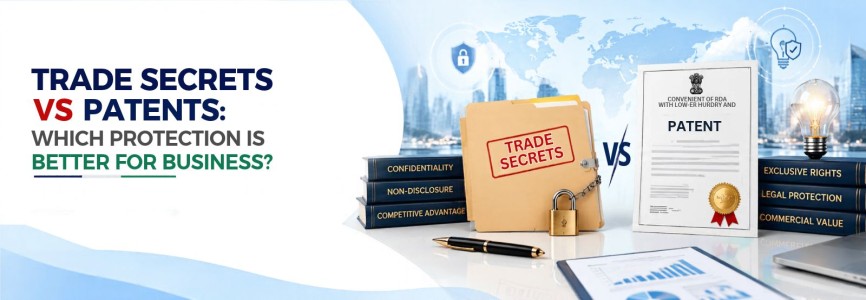



Innovation may be among a business’s most valuable assets. A company may develop a manufacturing process, pharmaceutical formulation, software solution, chemical composition or commercially valuable algorithm. Protecting it requires a deliberate choice about disclosure, exclusivity and confidentiality. Patents provide statutory rights over qualifying inventions for a limited period in exchange for disclosure.
Trade secret protection depends on preserving qualifying information as confidential and preventing its improper acquisition, use or disclosure. Neither is universally better; the choice depends on the innovation, the ability to keep it secret, the likelihood of independent discovery or reverse engineering, and the business model.
What Is a Patent?
A patent is a statutory right granted for an invention satisfying the Patents Act, 1970. Requirements include novelty, inventive step and industrial applicability, together with compliance with the Act’s other requirements and exclusions, including Section 3. Not every idea, discovery, business method, algorithm or software-related concept is patentable merely because it is commercially useful.
A patent’s scope is defined by its claims, read with the specification and applicable law. Section 48 sets out the patentee’s rights for product and process patents, subject to the Act. Under Section 53, the ordinary term is 20 years from the relevant filing date, subject to statutory provisions and renewal fees.
What Is a Trade Secret?
A trade secret is generally understood as commercially valuable information that is not generally known or readily accessible, derives value from secrecy, and is subject to reasonable steps to keep it confidential. This is a useful description of the concept, not a quotation from a single comprehensive Indian trade-secrets statute.
Examples may include confidential manufacturing parameters, formulas, customer information, pricing strategies, technical know-how and research data. Whether particular information qualifies depends on the facts. A confidentiality label alone is not enough; businesses should use proportionate safeguards such as access controls, confidentiality agreements, employee policies and secure storage.
The Legal Position in India
India has a detailed statutory framework for patents but does not currently have a single comprehensive standalone statute devoted exclusively to trade secrets. Confidential information may be protected through contracts, equitable principles and breach-of-confidence jurisprudence; other laws may apply depending on how information was obtained or misused. In John Richard Brady & Ors. v. Chemical Process Equipments Pvt. Ltd. & Anr., AIR 1987 Delhi 372, decided 6 July 1987, the Delhi High Court considered an application for interim injunction involving alleged unauthorised use of technical know-how, specifications, drawings and information supplied under express conditions of strict confidence.
The Court granted interim protection, finding a strong prima facie case on the material before it. This is a useful authority on confidential know-how, but it was an interim-injunction decision involving copyright and passing-off issues as well; it should not be described as a final trial judgment establishing that all confidential information is automatically protected.
The Core Difference
A patent relies on statutory rights obtained through the patent process and disclosure. Trade secret protection relies on maintaining qualifying information as confidential. A patent may be effective against certain unauthorised acts even where a competitor independently developed the same invention. Trade secret protection ordinarily does not prevent genuine independent development. A trade secret may remain valuable beyond a patent’s 20-year term if it remains protectable and secret, but it does not create an exclusive right against the world to use information others lawfully discover.
Practical Comparison
Patent: application and examination; public disclosure; defined statutory scope; ordinarily 20-year term from filing; possible protection against specified acts within the claims; prosecution, maintenance and enforcement costs. Trade secret: no general IP-office registration; secrecy must be maintained; no fixed statutory expiry while information remains protectable; vulnerable to loss of secrecy and independent discovery; ongoing security costs. The comparison is not “patents are expensive, trade secrets are free.” The costs and risks differ.
When Patents May Be Better
Patents may be preferable where the invention is patentable, competitors could reverse-engineer it or independently develop it, and statutory protection is worth the cost and disclosure. Patents may also help where the business expects to license technology or needs a documented IP position for investment, partnerships or enforcement. A patent grant does not automatically prove commercial value, guarantee a market or establish freedom to operate. Claim scope, validity, remaining term, enforceability, market demand and third-party rights all matter.
When Trade Secrets May Be Better
Trade secrets may be attractive where information can realistically remain confidential, is difficult to reconstruct from the product, and would lose value if publicly disclosed. Confidential production parameters or internal know-how may qualify depending on the facts. The strategy is weaker if the product reveals the information, it is easy to reverse-engineer, safeguards are poor, or competitors can independently discover the same solution. Do not choose secrecy merely to avoid patent costs without assessing these risks.
Independent Development and Reverse Engineering
A valid patent may be infringed by acts falling within its claims even if the alleged infringer developed the invention independently; the analysis depends on the patent, conduct and applicable statutory exceptions. Trade secret protection differs: genuine independent development is generally not misappropriation of another party’s secret. Lawful reverse engineering may also reveal information without breaching a duty of confidence, depending on circumstances and applicable law. Contractual restrictions and how the product was obtained may affect the analysis, so reverse engineering should not be described as invariably lawful or unlawful.
Disclosure Before Patent Filing
Public disclosure before filing can jeopardise patentability depending on the circumstances and applicable provisions. Sections 29–34 of the Patents Act address specified anticipation and disclosure situations; it is inaccurate to say every disclosure automatically destroys every possible patent claim. Before publishing, demonstrating, pitching or commercially disclosing a potentially patentable invention, a business should obtain patent advice and use confidentiality arrangements where appropriate. An NDA does not replace timely patent filing when filing is the intended strategy.
Can a Business Use Both Strategies?
A business may combine patent protection with trade secret management, but must distinguish what is disclosed in the patent specification from what remains confidential. A company might seek a patent for qualifying technical features of a machine while preserving separate confidential manufacturing parameters not disclosed and capable of remaining secret. It cannot keep disclosed subject matter secret merely by labelling it confidential. Document what is disclosed, what remains confidential, who can access it and whether the remaining information has independent commercial value.
Pharmaceuticals and Biotechnology
A pharmaceutical or biotechnology company may consider patent protection for a qualifying composition, process or other invention. It may also hold confidential experimental data, process parameters or manufacturing know-how, subject to applicable legal and regulatory requirements. The protections are not interchangeable.
Patentability depends on the claimed subject matter and the Act, including statutory exclusions. Trade secret protection may be inadequate if a product reveals the information or competitors can independently develop it. The decision should be made alongside patentability analysis, disclosure planning, regulatory strategy and commercial due diligence.
Technology and AI Businesses
Technology companies may hold confidential source code, system architecture, security methods, testing data, model-development techniques and business information. Some may qualify for trade secret protection if the relevant requirements are met. Not every algorithm, dataset or software feature is automatically a trade secret or patentable invention.
Patentability depends on the claimed subject matter and applicable exclusions, including Section 3. A business may need a combination of patents, copyright, confidentiality measures and contracts governing employees, contractors and partners.
NDAs and Employee Departures
Non-disclosure agreements can define permitted use, disclosure restrictions, security obligations and return or destruction of information. But an NDA cannot transform public information into a trade secret or guarantee an injunction. When an employee leaves, the issue is not simply whether the employee remembers information.
Relevant questions include whether the information is protectable, whether a valid duty applied and whether conduct breached it. Employers should protect genuine confidential information without assuming ordinary skills, experience and general knowledge can automatically be restricted.
Cost and Commercial Risk
Patent protection may involve drafting, filing, prosecution, professional advice, maintenance and enforcement costs; international protection adds expense. Trade secret protection may require secure systems, access controls, training, audits and agreements. Secrecy carries the risk that a competitor independently develops the same solution. A patent may disclose information and expire after its statutory term. Compare likely commercial benefit, costs, operational burden and risks rather than assuming one route is inherently cheaper or better.
Common Mistakes
Avoid assuming every innovation is patentable; every confidential document is a trade secret; an NDA guarantees secrecy forever; public disclosure always has the same effect on every patent claim; or a granted patent guarantees commercial success or freedom to operate. Review employee, contractor and partner agreements and decide how to handle confidential information before disclosure.
A Practical Decision Framework
Ask: (1) Is the invention patentable? (2) Can competitors discover it from the product? (3) Could they independently develop it? (4) Can it realistically remain confidential? (5) What are the consequences of disclosure? (6) How long will it remain valuable? (7) Can the business afford to obtain and enforce a patent? (8) What do investors, licensees or partners require? (9) Can different elements be protected differently? (10) Are confidentiality safeguards actually in place? These questions align the legal strategy with the business’s competitive advantage.
Conclusion
A patent may be stronger where an invention is patentable, likely to be independently developed or reverse-engineered, and valuable enough to justify disclosure and the costs of statutory protection. A trade secret may be more suitable where valuable information can realistically remain confidential and the business can preserve that secrecy.
Patent protection is governed by a detailed statute; trade secret protection relies on confidentiality obligations, equitable principles and breach-of-confidence jurisprudence. The better protection is the one that most effectively protects the business’s actual competitive advantage. The decision should be made before public disclosure and revisited as technology, markets and business models change.