


A Delhi-based skincare company has been selling products in plastic bottles and containers for three years. It has a valid Extended Producer Responsibility (EPR) registration and regularly reports its plastic packaging quantities. As the business expands, the directors decide to change the company's registered office from Delhi to Gurugram. Its GST registration details are updated, and the compliance team begins preparing the next EPR return.
Everything appears normal until the accountant notices that the company's EPR registration still shows the previous address and GST particulars. The directors now have an important question: Does the company need to obtain a completely new EPR certificate, or can the existing registration be amended?
The answer depends on the nature of the change. Updating the registered office of an existing company is different from transferring a business to another legal entity. Similarly, correcting an existing GST registration detail is not the same as obtaining a new GSTIN because the business has moved to another state.
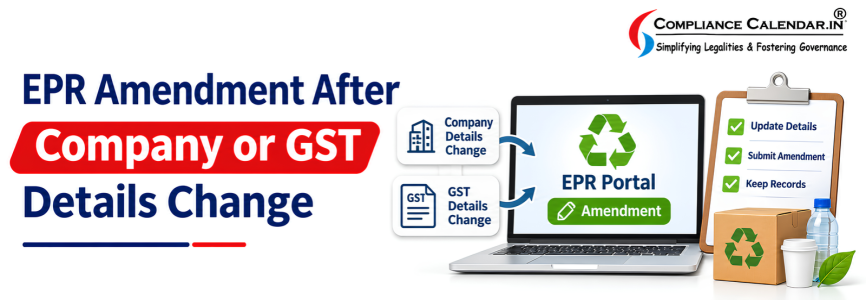
EPR Amendment After Company or GST Details Change is an important compliance activity for producers, importers and brand owners whose registration information no longer matches their business records.
What is an EPR Amendment?
An EPR amendment refers to updating or correcting information associated with an existing Extended Producer Responsibility registration. Under India's Plastic Waste Management Rules, 2016, as amended, qualifying producers, importers and brand owners (PIBOs) must comply with the prescribed EPR registration, plastic packaging waste management and reporting requirements.
Their registration records contain information identifying the responsible business, including its legal name, registered address, PAN, GST details, authorised representative and other applicable particulars. For example, suppose a company originally registered with CPCB as ABC Private Limited. It subsequently changes its name to ABC Private Limited without creating a new legal entity.
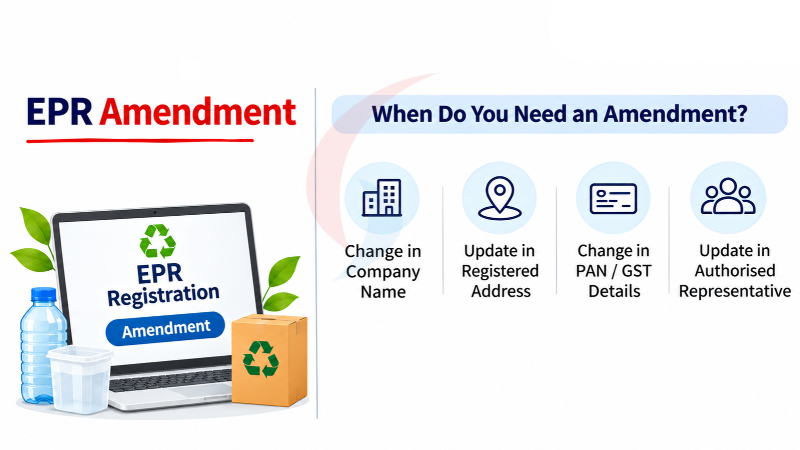
The underlying company may remain the same, but the registration information must be reconciled with the updated corporate documents.An EPR amendment helps ensure that the regulator's records correctly identify the business responsible for meeting the applicable waste management obligations. However, amendments are not unrestricted. Some changes may require approval, additional verification or a fresh registration where the legal identity of the responsible entity has changed. Importers changing their GST details, business address or legal structure should also review their EPR registration obligations.
Read our article on EPR Registration for Importers to understand applicable registration categories, documents and compliance requirements.
When is EPR Registration Amendment Required?
A company should review its EPR registration whenever there is a material change in its legal identity, registered business information, authorised representative or other particulars used to obtain registration. Not every change necessarily requires a new certificate. The first step is to determine whether the registered entity remains legally the same.
|
Change in Business Details |
Compliance Action to Examine |
|---|---|
|
Company name change |
Update legal name with supporting MCA records. |
|
Registered office change |
Update the address and corresponding business documents. |
|
GSTIN change |
Verify whether a registration amendment or new entity-level action is required. |
|
Addition of another GST registration |
Review whether the new GSTIN or premises must be added or reported. |
|
Authorised signatory change |
Update authorised person details and portal credentials. |
|
Contact details change |
Follow the applicable credential modification process. |
|
Business constitution change |
Examine whether the legal entity remains unchanged. |
|
Merger or transfer of business |
Determine whether fresh registration or regulator approval is necessary. |
|
Change in PIBO activities |
Review applicable category, location and EPR obligation changes. |
The importance of keeping this information accurate is reflected in CPCB's registration guidance, which collects the legal name, trade name, PAN, CIN, GST and authorised person details.
Laws and Legal Provisions Governing EPR Registration Amendments
The registration and continuing compliance requirements are primarily derived from environmental legislation and the rules governing plastic packaging waste.
|
Applicable Act or Rules |
Important Provisions |
Legal Requirements |
|---|---|---|
|
Sections 3, 6 and 15 |
Provides powers to regulate environmental protection and penalties for applicable contraventions. |
|
|
Rules 9 and 13 |
Governs EPR responsibilities and registration of covered entities. |
|
|
Schedule II |
Introduced detailed EPR guidelines for plastic packaging. |
|
|
Relevant registration and compliance amendments |
Modified obligations applicable to specified plastic packaging businesses. |
|
|
Amendments to definitions, marking and enforcement provisions |
Updated several requirements under the Plastic Waste Management Rules. |
|
|
Sections 22, 25 and 28, as applicable |
Governs GST registration and amendment of registered particulars. |
These provisions should be read together with CPCB's applicable registration instructions and current portal procedures. The Plastic Waste Management Rules establish the registration and EPR obligations, while the portal instructions determine how relevant business particulars can be updated electronically.
Important distinction: The environmental rules do not establish one universal statutory amendment deadline, document checklist or government fee for every possible change in GST or company details. Companies must follow the procedure applicable to the specific change and registration category.
EPR Amendment After GST Details Change
GST-related changes require careful attention because CPCB uses GST information to verify business identity and registration details. Companies must ensure that their EPR records match their updated GST particulars.
|
Type of GST Change |
Description |
EPR Compliance Requirement |
|---|---|---|
|
Correction of Existing GST Details |
Incorrect GSTIN, trade name or address entered during EPR registration. |
Request correction of the existing EPR record with updated GST documents. |
|
Additional GST Registration in Another State |
A company obtains another GSTIN for operations in a different state under the same PAN. |
Review whether additional GST and business location details must be updated in EPR records. |
|
GSTIN Change Due to Legal Restructuring |
GSTIN changes following business conversion, transfer or change in legal entity/PAN. |
Assess whether fresh EPR registration is required and how existing obligations will be handled. |
Example: A Maharashtra-based company opening a warehouse in Karnataka may obtain an additional GSTIN. It should review whether its existing EPR registration requires an update to reflect the new business location.
Important: A GSTIN change does not automatically require fresh EPR registration. The requirement depends on whether the legal entity remains the same and the applicable CPCB registration procedures.
Practical Story: A Skincare Brand Expanding into Another State
Consider XYZ Private Limited, a fictional business based in Delhi that sells face washes, lotions and creams in plastic packaging. The company already has an EPR registration as a brand owner. After receiving strong orders from southern India, its directors decide to open a distribution facility in Bengaluru.
NatureGlow obtains the required Karnataka GST registration and begins using the new premises. Its accounts team updates the company's billing records, but the EPR compliance team continues using the old company information. During the next compliance review, the company discovers differences between its registered EPR particulars, warehouse records and GST documents.
The finance team initially proposes applying for another EPR registration using the Karnataka GSTIN. However, the compliance adviser first examines whether the new facility belongs to the same legal entity and how it should be reflected in the company's existing EPR records. The team collects the new GST certificate, warehouse details and updated business information, then approaches the appropriate portal or authority for the necessary update.
NatureGlow also reviews its plastic packaging records to ensure that quantities introduced into the market are not omitted or counted twice. This example shows why a GST expansion should trigger an EPR applicability review, not an automatic duplicate registration.
For businesses facing similar packaging responsibilities, our guide on EPR Plastic Registration for Importers and Brands explains the obligations of qualifying importers and brand owners.
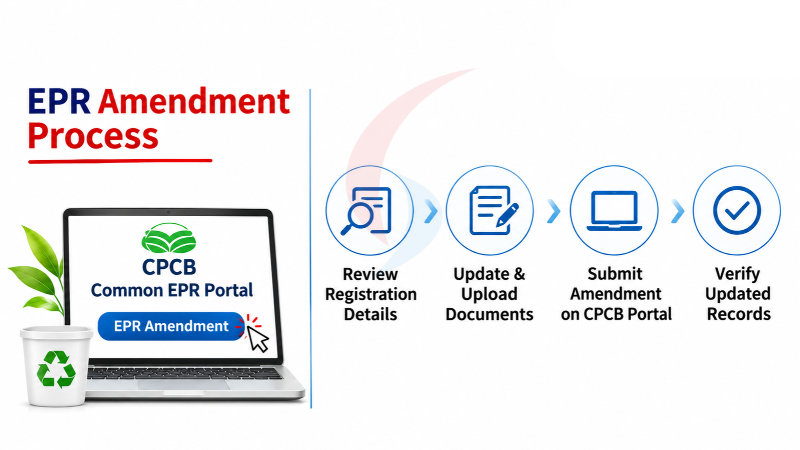
Step-by-Step Process for EPR Amendment After Company or GST Details Change
As of November 2026, businesses must use the CPCB Common EPR Portal for applicable plastic packaging EPR activities. The earlier standalone plastic EPR portal ceased operations on 28 June 2026, and existing records were migrated to the new system.
The exact amendment procedure depends on the account, change requested and currently available portal functions. Where direct editing is unavailable, the applicant should use the designated support or correction procedure rather than registering a duplicate entity.
|
Step |
Particular |
Amendment Procedure |
|---|---|---|
|
Step 1 |
Review Existing Registration |
Check the registered legal name, PAN, GSTIN, address and EPR registration number. |
|
Step 2 |
Identify the Change |
Determine whether it concerns a company name, GST details, registered office or authorised person. |
|
Step 3 |
Confirm Legal Identity |
Verify whether the business retains its existing PAN and legal constitution. |
|
Step 4 |
Prepare Documents |
Collect updated GST, MCA, PAN, address and authorisation records as applicable. |
|
Step 5 |
Access the Common EPR Portal |
Review the available profile, amendment and support facilities. |
|
Step 6 |
Submit the Request |
Provide corrected particulars and supporting documents through the prescribed channel. |
|
Step 7 |
Respond to Observations |
Address additional documentation or clarification requests. |
|
Step 8 |
Verify Updated Records |
Confirm that approved particulars appear correctly in the EPR account. |
|
Step 9 |
Reconcile Compliance Data |
Update internal records and ensure continuity of applicable EPR reporting. |
Companies updating their EPR details should understand the CPCB portal's registration and documentation requirements.
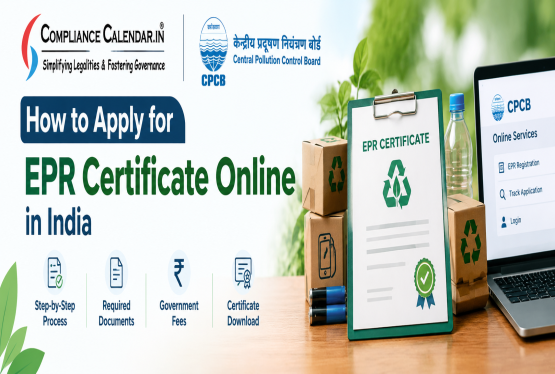
Our guide on How to Apply for EPR Certificate Online explains the application procedure, required information and supporting documents.
Documents Required for EPR Registration Amendment
The required records depend on whether the applicant is changing its company name, GST details, office address or authorised representative.
|
Required Document |
Purpose |
|---|---|
|
Existing EPR Registration Certificate |
Establishes the existing registration. |
|
Updated GST Registration Certificate |
Supports revised GST particulars. |
|
Verifies the registered company's legal identity. |
|
|
Company PAN |
Confirms the taxpayer and legal entity. |
|
MCA Name Change Certificate, if applicable |
Supports a legally approved company name change. |
|
Address Proof |
Supports changed office or premises details. |
|
Board Resolution or Authorisation Letter |
Authorises the person making the request. |
|
Existing and Revised Business Details |
Identifies the exact information requiring amendment. |
|
Supporting Explanation Letter |
Explains the reason and effective date of the change. |
Where the amendment involves a merger, acquisition or business transfer, additional documents may include the relevant scheme, transfer agreement, corporate approvals and records identifying the entity responsible for continuing EPR obligations. Applicants should ensure that their submitted documents are consistent with the information held by GST authorities and MCA.
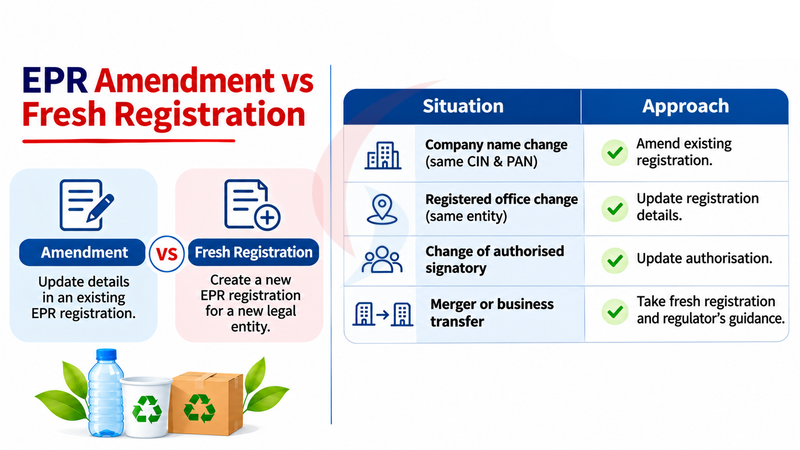
EPR Amendment vs Fresh EPR Registration: What is the Difference?
An amendment generally concerns changes to an existing registration, while fresh registration establishes a new registration for a legally eligible applicant. The distinction becomes particularly important during restructuring.
|
Situation |
General Approach |
|---|---|
|
Company name changes, same CIN and PAN |
Examine amendment of the existing registration. |
|
Registered office changes, same legal entity |
Examine address amendment and jurisdictional implications. |
|
Additional GSTIN under the same PAN |
Review updating or linking the additional business particulars. |
|
Change of authorised signatory |
Follow the prescribed credential or authorisation update procedure. |
|
Proprietorship converted into a private limited company |
Assess fresh registration for the new legal entity. |
|
Business transferred to another company |
Assess new registration, approval and continuity of liabilities. |
|
Merger of registered businesses |
Seek transaction-specific guidance on registrations and outstanding obligations. |
For example, if a sole proprietor incorporates a private limited company and transfers the business to it, the new company is a different legal person. Its EPR compliance position must be assessed independently rather than assuming the proprietor's registration automatically belongs to it. The outcome should be confirmed with the competent authority before the new entity begins regulated operations.A change in manufacturing arrangements may also affect which business is responsible for plastic packaging waste.
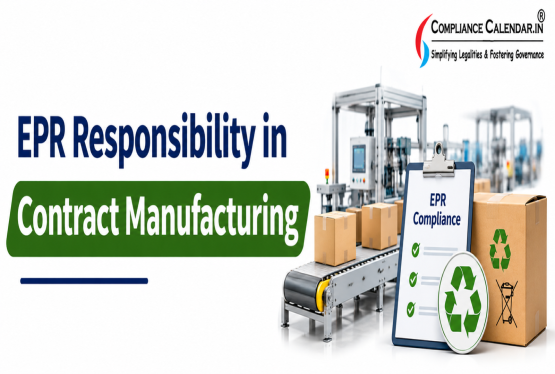
Our article on EPR Responsibility in Contract Manufacturing explains how EPR obligations may apply to brand owners, manufacturers and other responsible entities.
Latest CPCB and EPR Updates in 2026
In 2026, CPCB introduced important changes to plastic waste management rules and EPR registration procedures. Businesses must ensure their registration details remain accurate and comply with the updated requirements.
|
2026 Update |
Key Changes |
|---|---|
|
31 March 2026 – Plastic Waste Management Amendment Rules |
Updated provisions relating to plastic waste processing, recycling, marking and enforcement. |
|
28 June 2026 – Old EPR Portal Discontinued |
The previous plastic EPR portal was discontinued, and existing registration data was migrated to the Common EPR Portal. |
|
PAN-Based Account Linking |
Existing users were instructed to link accounts using matching company PAN and authorised-person PAN details. |
|
Registration Data Verification |
Businesses were advised to verify migrated records and report discrepancies through the new portal. |
Companies that have changed their GST details, legal name or authorised signatory should verify their information on the CPCB Common EPR Portal
Is There a Government Fee or Deadline for EPR Amendment?
There is no single verified CPCB amendment fee or universal statutory deadline applicable to every change in a company's legal name, GSTIN, address and authorised representative. The applicable process may depend on whether the request is a correction, administrative amendment, change in registration category or application by a new legal entity.
|
Particulars |
Compliance Position |
|---|---|
|
Government Amendment Fee |
Verify the applicable fee, if any, through the current portal or authority instructions. |
|
Universal 30-Day EPR Amendment Deadline |
Should not be assumed for all changes without an applicable legal provision. |
|
GST Amendment Timeline |
Governed separately by applicable GST rules. |
|
Fresh EPR Registration Fee |
Depends on the registration category and applicable fee schedule. |
|
Processing Time |
Depends on verification, documentation and authority review. |
Businesses should initiate the required update promptly after the underlying change takes effect. Delaying correction may result in inconsistent records during EPR reporting, certificate transactions or regulatory verification.
Why Choose Compliance Calendar LLP for EPR Registration Amendment?
At Compliance Calendar LLP, we assist businesses with EPR registration, documentation, amendment-related compliance and plastic waste management reporting requirements.
|
Our Services |
How We Help |
|---|---|
|
EPR Amendment Assessment |
Review changes in company, GST and registration details. |
|
Document Preparation |
Assist with supporting records and authorisation documents. |
|
CPCB Portal Assistance |
Support amendment requests through applicable online procedures. |
|
GST and Company Record Reconciliation |
Identify inconsistencies between registration records. |
|
EPR Compliance Review |
Examine packaging obligations and previous reporting information. |
|
Registration Guidance |
Help determine when an amendment or fresh application may be required. |
Businesses can explore our EPR Plastic Registration Services and read our guide on EPR Plastic Waste Registration in India.
For assistance with EPR amendment documentation, contact Compliance Calendar LLP at 9988424211 or info@ccoffice.in
Frequently Asked Questions (FAQs)
Q1. Is EPR amendment required after a company name change?
Ans: A business should review and update its EPR registration when its legal name changes. If the company continues as the same legal entity with the same PAN and CIN, amendment may be appropriate. Supporting MCA documents may be required.
Q2. Can GST details be changed in an existing EPR registration?
Ans: GST-related updates may be considered through the applicable EPR portal or authority procedure. The method depends on whether the change concerns an incorrect entry, additional registration or a new legal entity.
Q3. Is fresh EPR registration mandatory after GSTIN changes?
Ans: Not automatically. A new GSTIN under the same PAN may have different implications from a GSTIN issued to a new legal entity. The business should examine its constitution and the applicable registration instructions.
Q4. What documents are required for EPR amendment?
Ans: Common documents include the existing EPR certificate, updated GST certificate, PAN, company registration records, address proof and authorisation documents. Additional records depend on the change requested.
Q5. Can the registered office address be changed in EPR records?
Ans: An existing company may seek to update its registered office address through the applicable procedure. A change of state may also require examination of registration jurisdiction and business operations.
Q6. What happens if the authorised signatory changes?
Ans: The company should update its authorised representative and relevant login credentials using the prescribed procedure. CPCB has published specific instructions for certain credential changes, although the current Common EPR Portal process should be verified.
Q7. Does a company name change cancel existing EPR targets?
Ans: No. A name change involving the same legal entity does not automatically cancel its outstanding EPR obligations. The company must maintain its applicable records and continue complying with the relevant requirements.
Q8. What changed in the CPCB EPR Portal in June 2026?
Ans: The previous plastic EPR portal ceased operations on 28 June 2026. Registered-unit data was migrated to the Common EPR Portal, and users were instructed to verify their information and report discrepancies.
Q9. Is there a fixed government fee for EPR amendment?
Ans: A universal fee for every type of amendment has not been established in the official guidance reviewed. The applicable amount, if any, should be checked through the current CPCB portal or competent authority.
Q10. Can Compliance Calendar LLP assist with EPR amendments?
Ans: Yes. Compliance Calendar LLP assists businesses with EPR amendment assessments, documentation, registration records, CPCB portal procedures and related plastic waste compliance requirements.
Article last updated on : 20 Nov 2026.













_learn_crop10_thumb.jpg)