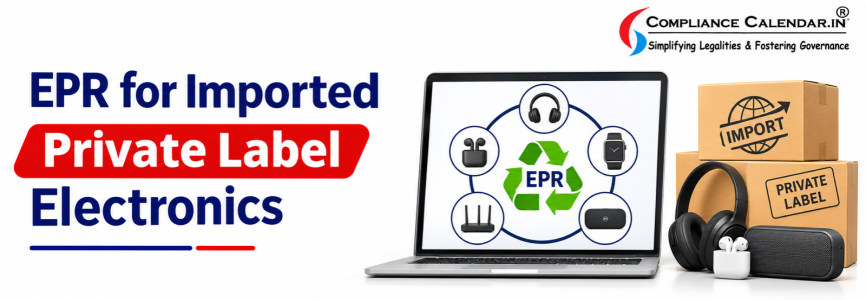



An Indian business does not need to own an electronics factory to launch its own brand. Many companies purchase products from manufacturers in China, Vietnam or other countries, print their brand names on the products and sell them through Amazon, Flipkart, distributors and retail stores.
This business model is commonly known as private labelling. It allows businesses to introduce their own electronics brands without investing in manufacturing facilities.
Consider a Delhi-based company, ABC Electronics Private Limited, planning to import 10,000 electronic products from China. The foreign manufacturer produces the equipment, but every product carries the Indian company's brand name. Before the shipment arrives, the customs broker asks for the company's Extended Producer Responsibility (EPR) registration details.
The directors are confused. They believe the foreign manufacturer should handle recycling because it produces the equipment. However, India's E-Waste (Management) Rules, 2022 specifically recognise businesses selling imported electrical and electronic equipment as producers.
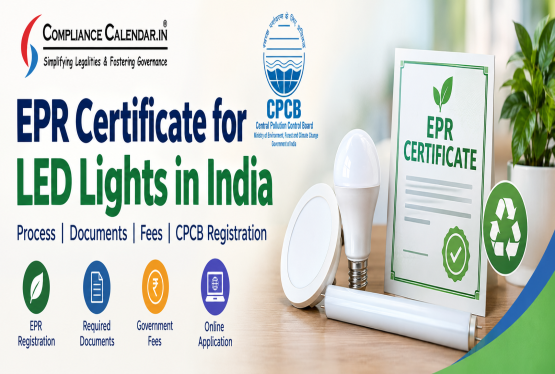
EPR for Imported Private Label Electronics generally requires an eligible Indian importer or brand owner to obtain CPCB registration as a producer when its products fall under Schedule I of the E-Waste (Management) Rules, 2022. The requirement is not limited to manufacturing. It also covers specified imports, brand ownership and the sale of covered electronic equipment.
What is EPR for Imported Private Label Electronics?
Extended Producer Responsibility is a legal obligation requiring producers of specified electrical and electronic equipment to fulfil prescribed e-waste recycling targets. Under India's E-Waste (Management) Rules, 2022, the producer is responsible for meeting its EPR obligations through the prescribed system involving registered e-waste recyclers.
For a private-label electronics business, this means that the company introducing covered imported equipment into the Indian market must examine its own producer responsibilities, even where production takes place outside India. For example, an Indian company may import smart televisions manufactured by an overseas supplier and sell them under its own registered brand. The Indian business is placing those products on the market and may therefore qualify as a producer.
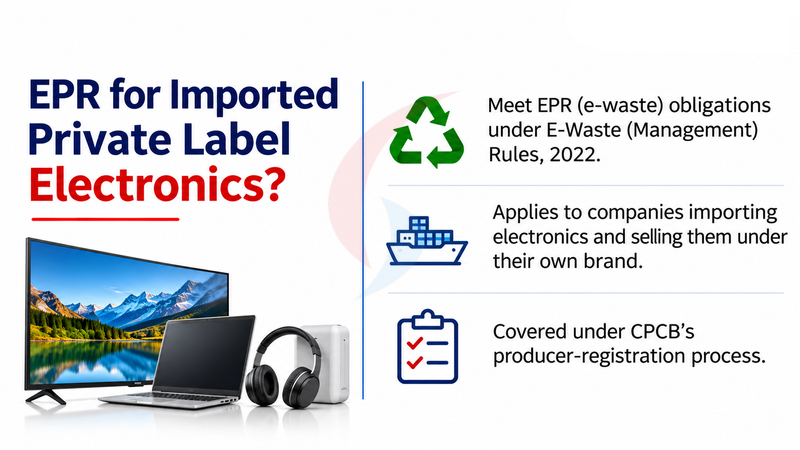
The CPCB's official producer-registration procedure expressly includes businesses that offer to sell imported electrical and electronic equipment, as well as businesses selling equipment manufactured by others under their own brands.
For a general explanation, read our article on EPR E-Waste Registration Requirements Under CPCB Rules.
Is EPR Registration Mandatory for Imported Electronics?
Yes, where the imported electrical or electronic equipment falls under Schedule I and the importer qualifies as a producer under the rules. Rule 3(1)(t) identifies several producer activities, including selling imported equipment and selling products manufactured by another supplier under one's own brand.
Rule 4 requires specified entities to register on the CPCB portal, while Rule 6 establishes producer responsibilities. However, not every electronic accessory automatically falls within the notified EEE categories. Product classification must be established before determining the registration obligation.
|
Business Activity |
E-Waste EPR Applicability |
|
Importing covered electronics under an Indian private label |
Producer registration generally required. |
|
Importing covered electronics for sale under a foreign brand |
Importer may qualify as a producer. |
|
Selling covered electronics made by another manufacturer under one's own brand |
Producer registration generally required. |
|
Manufacturing covered electronic equipment in India |
Applicable manufacturer and/or producer obligations must be assessed. |
|
Importing equipment for genuine captive consumption |
Specific CPCB clarification may apply, subject to conditions. |
|
Importing equipment outside Schedule I |
E-waste producer registration is not automatically required under these rules. |
|
Importing used covered electronics for sale |
Special producer obligations and import restrictions must be examined. |
CPCB has also issued clarification concerning certain imports for captive consumption or supply to already registered producers. These situations should be assessed against the exact conditions of that clarification rather than treated as blanket exemptions.
Laws and Legal Provisions Governing EPR for Imported Electronics
EPR Registration for imported private-label electronics is governed by the Environment (Protection) Act, 1986 and applicable waste management rules.
|
Applicable Act / Rules |
Important Provisions |
Legal Requirements |
|---|---|---|
|
Sections 3, 6 and 15 |
Environmental regulation and penalties. |
|
|
Rules 3, 4, 6, 8 and 15–16, 20–22 |
Producer registration, EPR obligations, recycling certificates and enforcement. |
|
|
G.S.R. 164(E) |
Changes relating to returns and EPR certificate trading. |
|
|
Applicable EPR provisions |
EPR obligations for covered batteries. |
|
|
Rules 9, 13 and Schedule II |
EPR requirements for plastic packaging. |
Important: EPR Registration does not replace BIS Certification, IEC Registration, customs clearance or other applicable product safety approvals.
Which Imported Electronic Products Require EPR Registration?
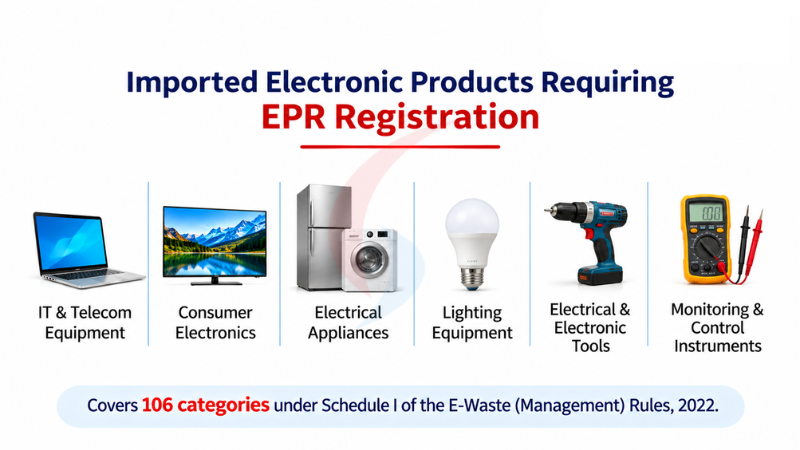
Schedule I of the E-Waste (Management) Rules, 2022 covers a wide range of electrical and electronic equipment, including specified IT products, consumer electronics, appliances, electrical tools and other notified products. The government has identified 106 categories of electrical and electronic equipment under the e-waste regulatory system.
|
Product Group |
Examples |
|
IT and Telecom Equipment |
Computers, laptops, printers and covered communication devices. |
|
Consumer Electronics |
Televisions and other specified audiovisual equipment. |
|
Electrical Appliances |
Refrigerators, washing machines and air-conditioning equipment. |
|
Lighting Equipment |
Specified electric and electronic lighting products. |
|
Electrical and Electronic Tools |
Covered equipment used for electrical or electronic operations. |
|
Monitoring and Control Instruments |
Specified measuring, monitoring and laboratory equipment. |
|
Other Notified Equipment |
Products specifically included in Schedule I. |
The correct classification should be based on the actual Schedule I entry and the equipment's function. For example, a company importing a laptop should verify its applicable EEE classification. A company importing protective laptop sleeves should not assume that the sleeves themselves require e-waste producer registration merely because they are sold as electronic accessories.
Practical Story: ABC Electronics Launches a Private Label Brand
Consider ABC Electronics Private Limited, a fictional company based in Noida. The company wants to launch its own range of laptops and electronic accessories by sourcing products from manufacturers in China. The directors negotiate with an overseas supplier that agrees to manufacture the products using ABC's brand name, logo and packaging.
The first shipment contains 2,000 laptops intended for sale through online marketplaces and distributors. ABC obtains its IEC and begins reviewing applicable BIS and customs requirements. However, during a compliance meeting, the company's adviser explains that importing covered electronic equipment also creates obligations under the E-Waste (Management) Rules, 2022.
ABC identifies the relevant Schedule I equipment category, prepares its producer-registration documents and submits an EPR application through the CPCB portal.
The company also begins maintaining product-wise import quantities in kilograms, instead of recording only the number of units purchased. After completing the applicable registration and other import requirements, ABC launches its products in India and establishes a system for tracking annual EPR obligations.
Key Takeaway: A private-label electronics business can qualify as a producer even when another company manufactures its products overseas. The Indian brand must assess its own CPCB registration and recycling responsibilities.
Documents Required for EPR Registration of Imported Private Label Electronics
The CPCB's producer-registration Standard Operating Procedure requires business identification details, information about the covered products, declarations and historical or proposed sales data. The applicant should also ensure that the company name, registered address and authorised-person details are consistent with its supporting records.
|
Required Document |
Purpose |
|
Establishes the legal identity of the company. |
|
|
Company PAN and GST Certificate |
Supports business registration particulars. |
|
Identifies the importing business. |
|
|
Authorised Signatory PAN and Details |
Verifies the applicant's representative. |
|
Product List with EEE Codes |
Identifies equipment covered by Schedule I. |
|
Import and Sales Data |
Supports calculation of EPR targets. |
|
Covering Letter and Undertaking |
Confirms the application and accuracy of information. |
|
RoHS Compliance Declaration |
Addresses restrictions on hazardous substances. |
|
Technical Documentation Declaration |
Confirms availability of prescribed RoHS technical evidence. |
|
Consumer Awareness Plan |
Explains the proposed awareness activities. |
CPCB may request additional information depending on the product category, application history and verification findings.
For a detailed overview of the registration requirements, read our guide on EPR E-Waste Registration for Producers.
Step-by-Step CPCB EPR Registration Process for Imported Electronics
Producer registration is completed electronically through the CPCB E-Waste EPR system. The applicable portal now supports access through CPCB's Single Sign-On facility.
|
Step |
Registration Procedure |
Key Requirement |
|
Step 1 |
Check EPR Applicability |
Verify the product against Schedule I. |
|
Step 2 |
Identify Producer Category |
Confirm the importing or private-label business's legal role. |
|
Step 3 |
Prepare Business Documents |
Collect PAN, GST, IEC and company details. |
|
Step 4 |
Classify Electronic Products |
Select the relevant EEE codes. |
|
Step 5 |
Prepare Sales and Import Data |
Record applicable quantities by financial year and weight. |
|
Step 6 |
Submit Declarations |
Provide the required RoHS, undertaking and awareness documents. |
|
Step 7 |
Pay Registration Fee |
Pay the applicable CPCB processing charges. |
|
Step 8 |
Respond to Observations |
Provide clarifications or additional documents. |
|
Step 9 |
Obtain EPR Registration |
Download the approved producer certificate. |
|
Step 10 |
Maintain Compliance |
Track targets, purchase eligible recycling certificates and submit returns. |
Applications can be accessed through the CPCB E-Waste EPR Portal or its Single Sign-On facility The approved registration identifies the producer and relevant equipment categories. Additional product categories may require modification of the existing registration.
EPR Registration Government Fees for Electronics Importers
Unlike registrations that carry a single fixed government fee, CPCB's e-waste producer-registration fee depends on the relevant annual recycling target. The published CPCB producer-registration SOP specifies the following processing fee structure.
|
Annual E-Waste Recycling Target |
Registration Processing Fee |
|
Less than 50 MT |
Rs 2,500 |
|
50 MT to less than 100 MT |
Rs 7,500 |
|
100 MT to less than 1,000 MT |
Rs 1,50,000 |
|
1,000 MT to less than 5,000 MT |
Rs 10,00,000 |
|
Above 5,000 MT |
Rs 15,00,000 |
The SOP also specifies Rs 10,000 for producers whose sales have just started, Rs 10,000 for specified amendments and Rs 5,000 as the published annual maintenance charge.
Registration validity: The CPCB SOP provides five-year validity for producer registration, with renewal to be initiated 120 days before expiry.
These amounts should be verified against the current CPCB portal fee schedule before payment, particularly where the applicant qualifies as a new producer or requests an amendment.
EPR Recycling Targets for Private Label Electronics in 2026
A producer's EPR responsibility does not end after obtaining its registration certificate. The business must also fulfil the recycling obligations assigned under the applicable rules. Schedules III and IV prescribe different methods for determining obligations based on the equipment's sales history, average life and other relevant conditions.
|
Financial Year |
General Recycling Target Under Schedule III |
|
FY 2023–24 |
60% |
|
FY 2024–25 |
60% |
|
FY 2025–26 |
70% |
|
FY 2026–27 |
70% |
|
FY 2027–28 onwards |
80% |
These percentages relate to the applicable calculated waste-generation base. They should not automatically be multiplied by the entire quantity of new electronics imported during the same year. For newer producers, Schedule IV contains a separate approach. CPCB's FAQ explains that the target from FY 2025–26 onwards is generally 20% of the relevant sales figure from two financial years earlier for producers covered by that schedule.
For example, if a private-label company imports 10 tonnes of new laptops in FY 2026–27, it should not simply assume it must purchase recycling certificates for 7 tonnes immediately. The actual obligation must be calculated using the applicable schedule, product life and historical sales data.
E-Waste EPR vs Battery EPR vs Plastic Packaging EPR
Imported private-label electronics can involve more than one waste-management category. For example, a laptop contains electronic components, may include a lithium-ion battery and is often supplied in plastic packaging. These materials are not necessarily covered by one combined EPR registration.
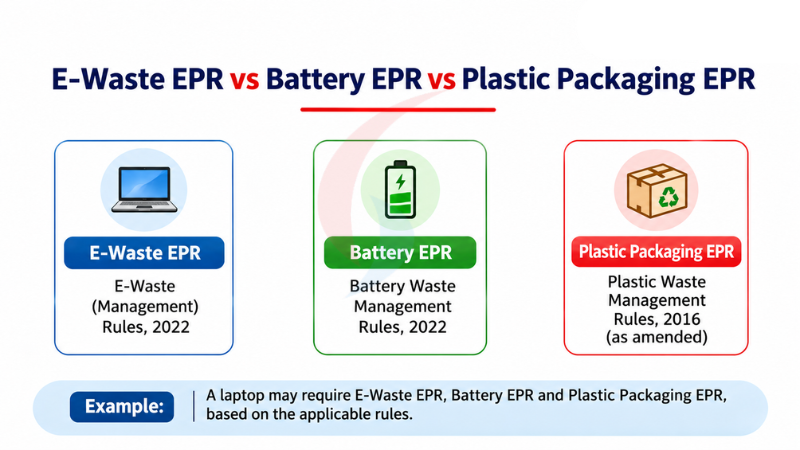
|
EPR Category |
Applicable Rules |
What It Covers |
|
E-Waste EPR |
Covered electrical and electronic equipment. |
|
|
Battery Waste EPR |
Batteries and associated producer obligations. |
|
|
Plastic Packaging EPR |
Applicable plastic packaging introduced into the market. |
Example: An Indian company importing private-label laptops should review e-waste producer registration for the laptops, battery EPR for the relevant batteries and plastic packaging EPR for qualifying packaging materials. However, each obligation must be assessed according to the relevant definitions and exclusions. The presence of a battery or plastic component does not automatically establish the same obligations for every importer.
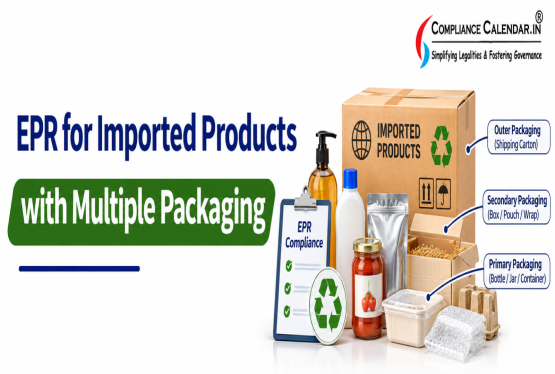
For further guidance, read EPR Battery Waste Certificate Online and EPR for Imported Products with Multiple Packaging
Latest CPCB and E-Waste EPR Updates in 2026
CPCB's official e-waste portal includes several important operational updates relevant to producers in 2026.
|
2026 Development |
Importance for Importers |
|
FY 2026–27 Recycling Targets |
The applicable Schedule III target is 70% of the calculated waste-generation base. |
|
Common CPCB Sign-On |
Stakeholders can access the EPR system through the CPCB SSO facility. |
|
EPR Certificate Transfers |
CPCB announced resumption of certificate transfers on its e-waste portal. |
|
FY 2025–26 Annual Return Extension |
CPCB extended the filing timeline to 30 September 2026. |
|
Quarterly Return Monitoring |
Producers must continue submitting applicable returns under the prescribed schedule. |
|
Environmental Compensation Guidelines |
CPCB's 2025 guidelines remain relevant to regulatory enforcement. |
The official CPCB E-Waste Portal displays the FY 2025–26 annual return extension and the operational status of certificate transfers. The 2024 amendment to the E-Waste Rules also introduced provisions for relaxation of reporting timelines and regulation of EPR certificate exchange prices. Businesses should not assume that the annual return extension automatically changes recycling targets or every other statutory deadline.
Why Choose Compliance Calendar LLP for EPR Registration?
At Compliance Calendar LLP, we assist electronics importers, private-label businesses and brand owners with EPR registration, documentation and regulatory compliance.
|
Our Services |
How We Help |
|
EPR Applicability Review |
Identify whether imported electronics require producer registration. |
|
EEE Product Classification |
Assist with identifying relevant Schedule I equipment categories. |
|
CPCB Registration Assistance |
Support online producer registration and document preparation. |
|
EPR Target Assessment |
Assist with reviewing sales data and applicable recycling obligations. |
|
Multiple EPR Compliance |
Guide businesses on relevant e-waste, battery and plastic packaging requirements. |
|
Returns and Amendments |
Assist with prescribed reporting and registration changes. |
Businesses can explore our EPR E-Waste Registration Services for assistance.
For professional guidance on EPR Registration for Imported Private Label Electronics, contact Compliance Calendar LLP at 9988424211 or info@ccoffice.in
Frequently Asked Questions (FAQs)
Q1. Is EPR Registration mandatory for imported private-label electronics?
Ans: Yes, where the imported product falls under Schedule I of the E-Waste (Management) Rules, 2022 and the business qualifies as a producer. The fact that manufacturing takes place overseas does not automatically exempt the Indian importer from registration.
Q2. Who is responsible for EPR: the foreign manufacturer or the Indian brand?
Ans: The Indian importer or private-label brand may qualify as a producer under Rule 3. It must assess its own CPCB registration and recycling obligations. Contractual arrangements with overseas suppliers do not automatically replace the Indian entity's statutory responsibilities.
Q3. Which electronic products require CPCB EPR Registration?
Ans: Covered products include specified computers, laptops, televisions, appliances, lighting equipment, electrical tools and other electronics listed in Schedule I. The exact EEE code and product classification should be verified before registration.
Q4. What is the EPR recycling target for FY 2026–27?
Ans: Under Schedule III, the general recycling target for FY 2026–27 is 70% of the applicable calculated e-waste generation. Newer producers may be subject to Schedule IV calculations. Used electronics imports have separate requirements.
Q5. Can one EPR certificate cover electronics, batteries and plastic packaging?
Ans: No. E-waste, battery waste and plastic packaging are governed by separate regulations and registration systems. A business importing electronic products containing batteries and plastic packaging must assess the applicability of each regime independently.
6. What documents are required for EPR Registration?
Ans: Common documents include PAN, GST, IEC, incorporation records, authorised-person details, applicable EEE product codes, sales or import data, RoHS declarations and an awareness plan. CPCB may request additional supporting information.
Q7. What is the government fee for E-Waste EPR Registration?
Ans: CPCB's published processing fees depend on the annual recycling target, with separate provisions for newly operating producers. Applicants should check the latest fee displayed on the CPCB portal before submitting payment.
Q8. Is BIS Registration also necessary for imported private-label electronics?
Ans: Certain imported electronics require BIS certification or registration under applicable Indian standards and Quality Control Orders. EPR and BIS serve different purposes, so obtaining one does not replace the other.
Q9. What happens if a private-label electronics importer does not obtain EPR Registration?
Ans: Where registration is mandatory, operating without it may constitute a violation of Rule 4. Regulatory consequences may include environmental compensation, enforcement proceedings and other action under the applicable environmental laws.
Q10. Can Compliance Calendar LLP assist with EPR Registration for electronics importers?
Ans: Yes. Compliance Calendar LLP assists with product classification, CPCB producer registration, documentation, recycling-target assessment and related e-waste compliance requirements.
Article last updated on : 20 Nov 2026.










_learn_crop10_thumb.jpg)