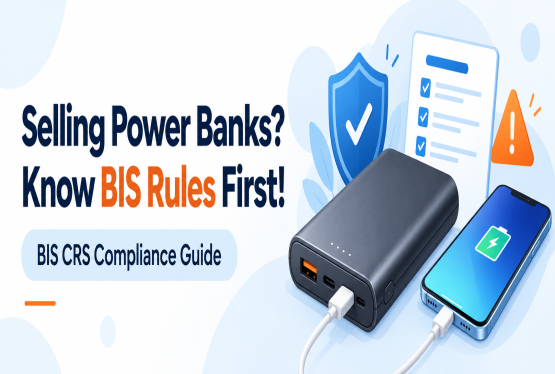



Power banks have become an everyday necessity for people who depend on smartphones, tablets, wireless earphones and other portable electronic devices. Whether someone is travelling, attending meetings or working remotely, a power bank provides convenient backup power. However, businesses manufacturing, importing or selling power banks in India must consider an important environmental compliance requirement known as EPR Battery Registration for Power Banks.
Many businesses focus on product quality, pricing, packaging and BIS certification before launching a power bank brand. Battery waste compliance is sometimes overlooked because the product is new and has not yet become waste. Indian environmental law, however, places responsibilities on qualifying producers from the stage at which batteries are introduced into the market.
Under the Battery Waste Management Rules, 2022, as amended, producers are responsible for ensuring the environmentally sound management of waste batteries. These rules cover rechargeable batteries used in consumer electronics, including lithium-ion and lithium-polymer batteries commonly found inside power banks.
Businesses falling within the definition of a producer must obtain registration through the Central Pollution Control Board (CPCB) and comply with Extended Producer Responsibility requirements. Registration is not simply permission to sell a product. It involves continuing obligations relating to battery quantities, recycling targets, authorised recyclers, EPR certificates, reporting and environmental compliance.
What Is EPR Battery Registration for Power Banks?
EPR stands for Extended Producer Responsibility. It is an environmental compliance mechanism under which a producer remains responsible for the proper management of waste generated from products introduced into the market. In the case of power banks, the responsibility relates to the batteries contained in these devices. Lithium-ion batteries contain materials that may be recovered and reused through appropriate recycling processes. If damaged or discarded batteries are handled carelessly, they can create fire hazards and environmental risks.
EPR Battery Registration is granted to qualifying producers through the CPCB Battery Waste EPR Portal. It identifies the registered business and enables the regulatory authority to monitor its obligations under the applicable rules.
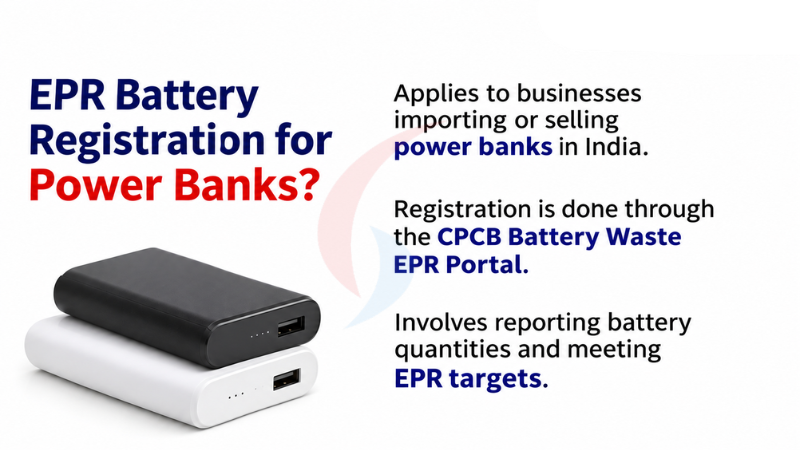
For example, a company importing 10,000 power banks from China and selling them in India may qualify as a producer under the Battery Waste Management Rules, 2022. Even though the business does not manufacture the batteries itself, importing equipment containing batteries falls within the statutory definition of a producer.
The company must assess its registration obligation, report the relevant battery quantities and fulfil applicable EPR targets. Simply purchasing goods from an overseas manufacturer does not automatically transfer the Indian importer's environmental responsibilities to that manufacturer.
Businesses can also understand the general requirements through Compliance Calendar's guide on EPR Battery Registration in India.
Why Power Banks Are Covered Under Battery Waste Management Rules, 2022
Power banks are generally portable electronic devices containing rechargeable batteries. Most consumer power banks use lithium-ion or lithium-polymer battery technology because these batteries provide substantial energy storage in a relatively compact product.
Rule 3 defines a portable battery as a sealed battery weighing less than five kilograms that is not intended for industrial, electric vehicle or automotive applications. Accordingly, the battery inside an ordinary consumer power bank generally falls within the portable battery category.
The Battery Waste Management Rules apply to batteries regardless of their chemistry, shape, size, weight or material composition, subject to the exclusions expressly provided under the rules. Therefore, a small power bank with a 5,000 mAh battery and a larger model with a 20,000 mAh battery may both fall within the regulatory system.
Importantly, the manufacturer must not confuse the weight of the entire power bank with the weight of its internal battery. The battery weight and the dry weight of battery materials are relevant to regulatory reporting. These quantities should be supported by reliable manufacturer specifications and other records.
Our article on EPR Registration for Importers explains the applicable requirements.
Legal Provisions Applicable to EPR Battery Registration for Power Banks
The principal legislation governing battery waste compliance is the Environment (Protection) Act, 1986, together with the Battery Waste Management Rules, 2022, notified through S.O. 3984(E) dated 22 August 2022 and published in the Official Gazette on 24 August 2022.
The rules establish responsibilities for producers, consumers, collection entities, recyclers, refurbishers and regulatory authorities. They also prescribe registration, reporting, recycling, labelling and enforcement requirements.
|
Act / Legal Provision |
Key Requirement |
|---|---|
|
Environmental regulation and penalties |
|
|
Battery and producer definitions |
|
|
EPR registration, targets and reporting |
|
|
Recycler and refurbisher obligations |
|
|
CPCB supervision and environmental compensation |
|
|
Labelling and recycling targets |
These provisions must be read together with subsequent amendments and applicable CPCB notifications.
Documents Required for EPR Battery Registration for Power Banks
Before applying for CPCB Battery EPR Registration, businesses should collect their corporate documents and technical battery information. The accuracy of these documents matters because inconsistencies between GST records, import declarations and battery quantities can create compliance issues.
The principal documents and information generally required include:
|
Documents |
Purpose |
|
PAN and GST Certificate |
Verification of business identity and tax registration |
|
Certificate of Incorporation or Business Registration |
Establishes the legal status of the applicant |
|
CIN, where applicable |
Identification of the registered company |
|
Authorised Person Details |
Identifies the person responsible for registration |
|
IEC, where applicable |
Supports identification of import activities |
|
Battery Specifications |
Establishes battery category, chemistry and capacity |
|
Battery Weight Details |
Determines weight and dry material quantities |
|
Brand and Product Details |
Identifies the power bank products introduced into the market |
|
Manufacturing or Import Data |
Supports EPR reporting and target calculation |
|
Other Portal-Required Declarations |
Supports verification and statutory compliance |
The exact documents depend on the applicant's business constitution and activities. CPCB's instructions identify PAN, CIN and GST details as core registration information, with additional declarations and technical data required according to the application.
For more information, businesses can read Documents Needed for EPR Battery Registration.
Step-by-Step Process for EPR Battery Registration for Power Banks
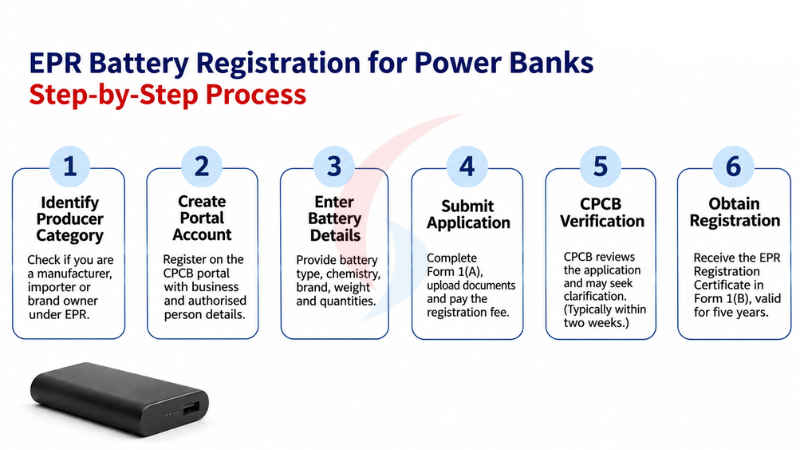
The application process is carried out online through the CPCB's centralised Battery Waste EPR system. Businesses should verify their eligibility and prepare their information before creating an application. EPR Battery Registration for Power Banks is completed online through the CPCB Battery Waste EPR Portal. The process involves the following steps:
|
Step |
Process |
Details |
|---|---|---|
|
Step 1 |
Identify Producer Category |
Determine whether the business is a manufacturer, importer or brand owner covered under EPR. |
|
Step 2 |
Create Portal Account |
Register on the CPCB portal using business and authorised person details. |
|
Step 3 |
Enter Battery Details |
Provide battery type, chemistry, brand information, weight and quantities. |
|
Step 4 |
Submit Application |
Complete Form 1(A), upload documents and pay the applicable registration fee. |
|
Step 5 |
CPCB Verification |
CPCB reviews the application and may request clarification. The prescribed processing period for a complete application is two weeks. |
|
Step 6 |
Obtain Registration |
Receive the EPR Registration Certificate in Form 1(B), valid for five years, subject to compliance requirements. |
Businesses should also understand the difference between producer registration and the EPR certificates used to fulfil recycling obligations.
Read our guide on EPR Battery Waste Certificate Online for further information.
EPR Targets and Recycling Requirements for Power Banks
Obtaining registration is only the beginning of compliance. A registered power bank producer must also meet the applicable EPR obligations established under Schedule II of the Battery Waste Management Rules, 2022.
For rechargeable portable batteries used in consumer electronics, the rules establish collection targets based on the quantity of batteries placed in the market during specified preceding financial years. The applicable target is linked to the battery category and relevant compliance period.
For example, the original Schedule II provides a minimum collection target of 70% of the quantity placed in the market during FY 2021-22 for the FY 2026-27 compliance year. For a business that introduced batteries after the rules were notified, the new-producer provisions must be considered rather than assuming that the historical base-year formula applies without modification.
The rules also require recycling or refurbishment of the applicable collection target and provide for compliance across prescribed ten-year cycles. Accordingly, a company must maintain historical quantity records and monitor the obligation calculated through the regulatory system.
Example of Battery EPR Target Calculation
Suppose a power bank company introduced 20,000 rechargeable power banks in a relevant base financial year. Each power bank contains a battery weighing 200 grams.
The total battery weight introduced would be:
20,000 × 0.20 kg = 4,000 kg.
If the applicable Schedule II collection target for that base year is 70%, the corresponding target would be:
4,000 kg × 70% = 2,800 kg.
This calculation illustrates how battery weight affects compliance obligations. It does not establish the current target for every producer, because the actual obligation depends on the relevant base year, battery classification, applicable amendments and CPCB records.
EPR Battery Registration Fees and Validity
The cost of EPR Battery Registration depends on the applicable CPCB fee schedule and the nature of the application. Under Rule 11(2), CPCB is authorised to determine processing fees for registration and returns. Businesses should distinguish between government registration fees, professional consultancy charges and the separate commercial cost of fulfilling EPR obligations through recycling arrangements or certificate purchases. The statutory producer registration period is five years under Rule 11(4). Rule 4(5) requires a producer to apply for renewal before sixty days of expiry. Registration particulars should also be updated when relevant business information changes.
For a broader explanation of expenses, businesses may refer to EPR Registration Cost in India 2026
Latest Government Updates for Power Bank EPR Compliance in 2026
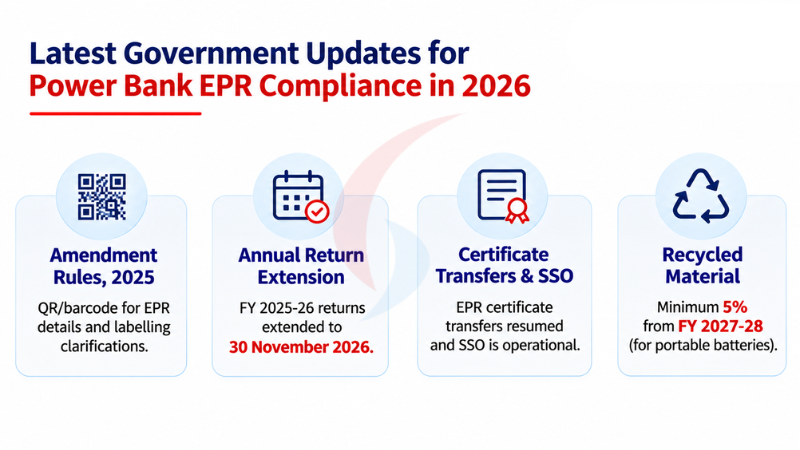
The Battery Waste Management Rules, 2022, have undergone several amendments to strengthen EPR compliance, reporting, recycling and labelling requirements.
|
Update |
Notification / Provision |
Key Requirements |
|---|---|---|
|
S.O. 958(E), dated 24 February 2025 |
Allows eligible producers to display EPR registration details through QR codes or barcodes, subject to prescribed conditions. Also clarifies heavy-metal labelling and certain packaging exemptions. |
|
|
CPCB Annual Return Extension |
CPCB Portal Update, November 2026 |
The deadline for FY 2025-26 annual returns has been extended to 30 November 2026. The general deadline is 30 June of the following financial year unless extended. |
|
EPR Certificate Transfers and SSO |
CPCB Portal Updates |
EPR certificate transfers have resumed, and Single Sign-On (SSO) is operational for EPR portals. |
|
Recycled Material Requirements |
Rule 4(14) |
Minimum domestically recycled material requirements for portable batteries begin at 5% in FY 2027-28, increasing in subsequent years. Specific alternative provisions apply to importers. |
Businesses should regularly check the CPCB Battery Waste EPR Portal and CPCB Official Website for amendments, compliance deadlines and regulatory notifications.
Difference Between BIS Certification and EPR Battery Registration for Power Banks
Businesses frequently assume that obtaining BIS certification eliminates the requirement for EPR Battery Registration. However, these are different regulatory obligations.
|
Particulars |
BIS Certification |
EPR Battery Registration |
|
Main purpose |
Product safety and conformity |
Environmentally sound battery waste management |
|
Regulating authority |
Bureau of Indian Standards |
CPCB |
|
Main focus |
Testing and product standards |
Producer responsibility and battery recycling |
|
Product coverage |
Notified power banks and applicable cells/batteries |
Batteries and equipment containing batteries |
|
Continuing compliance |
Applicable certification conditions |
EPR targets, returns and related obligations |
Power banks are covered under the BIS Compulsory Registration Scheme. The current applicable product standard and transition requirements should be checked through the BIS CRS Portal, including the relevant IS/IEC 62368 requirements and separate battery safety standards where applicable. A company importing power banks may need both BIS-related product compliance and CPCB Battery EPR Registration. One registration does not automatically replace the other.
Businesses can also read BIS Registration for Lithium Batteries 2026
Why Choose Compliance Calendar ?
Businesses planning to manufacture, import or sell power banks in India may require assistance in identifying their producer category, preparing documentation and completing the CPCB application procedure. Compliance Calendar LLP provides professional assistance with EPR Battery Waste Registration, including application documentation, regulatory guidance and related compliance requirements. The objective is to help businesses understand their legal obligations, prepare accurate submissions and avoid common registration errors.
For assistance with EPR Battery Registration for Power Banks, contact Compliance Calendar LLP at 9988424211 or info@ccoffice.in
Frequently Asked Questions (FAQs)
Q1. Is EPR Battery Registration mandatory for power banks in India?
Yes. Businesses qualifying as producers under the Battery Waste Management Rules, 2022, must obtain the applicable CPCB registration. This includes qualifying manufacturers, importers and businesses selling covered batteries under their own brands.
Q2. Do power bank importers need EPR Battery Registration?
Yes. The statutory definition of producer includes importers of batteries and equipment containing batteries. Therefore, importing finished power banks may create a registration obligation even when the batteries are manufactured outside India.
Q3. Is EPR registration required for lithium-ion power banks?
Yes, where the business falls within the producer definition. The Battery Waste Management Rules cover lithium-ion batteries and other battery chemistries, subject to the applicable exclusions. Ordinary consumer power banks generally contain portable rechargeable batteries.
Q4. What documents are required for EPR Battery Registration?
The required information generally includes PAN, GST details, business registration particulars, authorised person details, battery specifications, battery weight and relevant production or import records. CPCB may require additional information depending on the applicant.
Q5. How long is CPCB Battery EPR Registration valid?
Under Rule 11(4), producer registration is valid for five years. Producers must comply with the prescribed renewal requirements and continue fulfilling their reporting and EPR obligations during the registration period.
Q6. Can a business obtain EPR registration without owning a recycling plant?
Yes. A producer does not necessarily need to operate a recycling facility. The rules permit the engagement of appropriately registered recycling or refurbishment entities. However, the producer remains responsible for meeting its statutory obligations.
Q7. Is BIS certification sufficient for selling power banks in India?
No. BIS certification and EPR Battery Registration address different legal requirements. BIS focuses on applicable product standards and safety, while Battery EPR regulates the environmentally sound management of batteries introduced into the market.
Q8. What is the annual return deadline for Battery EPR in 2026?
The general deadline is 30 June of the following financial year. However, CPCB's portal currently displays an extension to 30 November 2026 for FY 2025-26 annual returns. Businesses should verify the applicable portal notice before submission.
Q9. Can EPR registration be obtained for imported power banks?
Yes. Importers qualifying as producers can apply through the CPCB Battery EPR Portal. They must provide the required business and battery information and comply with applicable import-related regulatory requirements.
Q10. What happens if a power bank company fails to comply with EPR requirements?
Non-compliance can result in environmental compensation, regulatory proceedings, suspension or cancellation of registration and other applicable legal consequences. The business may also remain responsible for outstanding EPR obligations.
Article last updated on : 20 Nov 2026.










_learn_crop10_thumb.jpg)