


Imagine running a small cashew processing business in Kollam, Kerala. For years, you have been purchasing raw cashew nuts, processing them and selling the finished kernels to wholesalers across India. One morning, you receive an exciting email from a food distributor in Dubai. The buyer wants 2,000 kilograms of premium cashew kernels, packed and shipped within the next month.
The opportunity looks promising. You have the processing facility, experienced workers and suppliers. But while preparing the export documents, you discover something confusing.
Should you register with the Cashew Export Promotion Council of India (CEPCI)? Is CEPCI RCMC compulsory? Or should you apply through APEDA?
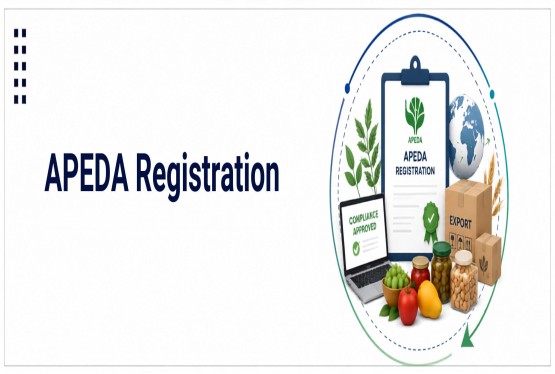
As of 2026, APEDA—not CEPCI—is the designated RCMC issuing authority for cashew kernels, cashew nut shell liquid and cardanol under the relevant DGFT provisions. The change was formally notified through DGFT Public Notice No. 33/2015-2020 dated 25 October 2022, following the inclusion of cashew products in the APEDA Act's First Schedule.
The Cashew Export Promotion Council of India continues to have historical and industry significance, but exporters should not confuse CEPCI membership with the currently prescribed APEDA RCMC.
What Is the Cashew Export Promotion Council of India?
The Cashew Export Promotion Council of India was established on 17 August 1955 with the support of the Government of India and the cashew processing industry.
The council was created to promote Indian cashew kernels, cashew nut shell liquid (CNSL) and related products in international markets.
Historically, CEPCI helped exporters through trade enquiries, buyer-seller interactions, market studies, export promotion events and industry representation. Its activities contributed to the development of Kollam and other Indian cashew-processing centres as important parts of the international cashew supply chain.
A Simple Example
Meet Arjun, a fictional entrepreneur who owns a cashew processing unit in Kollam. Arjun purchases raw cashew nuts, processes them into kernels and supplies packaged cashews to domestic wholesalers.
After receiving an order from Dubai, he begins researching the export registration requirements. He finds several websites describing CEPCI membership and RCMC Registration.
However, he discovers that the official authority responsible for issuing RCMC for covered cashew products has changed. Arjun now needs to distinguish between optional industry membership and the RCMC required under the applicable Foreign Trade Policy.CEPCI vs APEDA: Who Issues Cashew RCMC in 2026?
This is the most important legal distinction in the article. Previously, the Cashew Export Promotion Council of India was the designated council for RCMC relating to cashew kernels, CNSL and cardanol.
However, cashew nuts and specified products were brought within the scope of the Agricultural and Processed Food Products Export Development Authority Act, 1985. Following this change, DGFT designated APEDA as the RCMC authority for cashew kernels, cashew nut shell liquid and cardanol.
|
Particulars |
CEPCI |
APEDA |
|
Full name |
Cashew Export Promotion Council of India |
Agricultural and Processed Food Products Export Development Authority |
|
Main role |
Historically promoted India's cashew exports |
Statutory authority for scheduled agricultural and processed food products |
|
Cashew RCMC authority in 2026 |
Not the designated authority for the transferred products |
Designated RCMC authority |
|
Membership |
Subject to the council's applicable membership arrangements |
Registration through DGFT e-RCMC |
|
Governing Provision |
Council membership rules |
APEDA Act, Foreign Trade Policy and DGFT procedures |
For Arjun, this means he should not pay a CEPCI membership fee assuming it will automatically provide the RCMC now issued by APEDA..
Is Cashew Export Registration Mandatory in India?
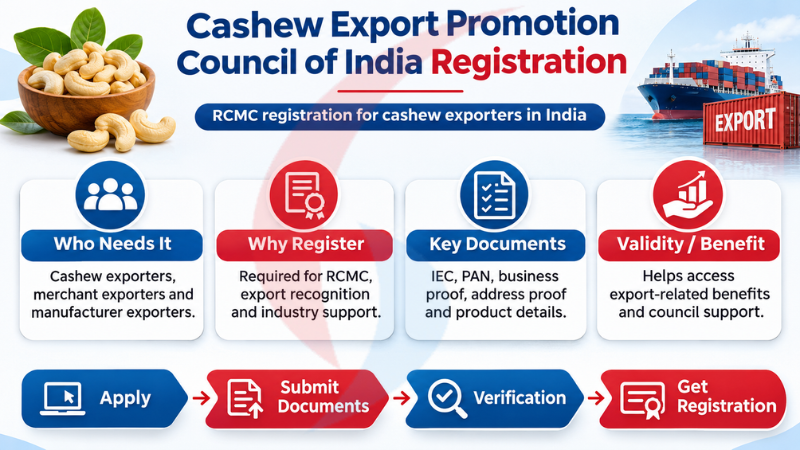
An important distinction must be made between permission to export and registration for Foreign Trade Policy purposes. For commercial cashew exports, businesses generally need an Import Export Code (IEC) and must comply with applicable customs, food safety and foreign exchange requirements.
An RCMC is generally required for specified Foreign Trade Policy authorisations, benefits and concessions unless an exemption applies. It should not be described as a universal licence for every ordinary cashew shipment.
For Arjun, the key question is not simply whether he has an RCMC. He must determine whether his proposed consignment requires one and whether APEDA is the appropriate issuing authority for his product.
The following registrations serve different purposes
|
Registration |
Purpose |
|
Identification for import-export activities |
|
|
Registration for applicable Foreign Trade Policy purposes |
|
|
Food safety compliance, where applicable |
|
|
Applicable indirect tax requirements |
|
|
Relevant customs banking procedures |
|
|
CEPCI Membership |
Separate council membership, subject to current eligibility and availability |
Latest Rs 3 Lakh RCMC Exemption
DGFT Notification No. 36/2026-27, dated 15 September 2026, introduced an exemption from the relevant RCMC requirement for export consignments with an FOB value not exceeding Rs 3 lakh.
For example, if Arjun sends a trial consignment worth Rs 2.4 lakh, the RCMC exemption may apply to that shipment. A larger consignment remains subject to the ordinary RCMC requirements wherever they are prescribed.
Laws Governing Cashew Export Registration in India
Cashew exports are regulated through several Indian laws. Each addresses a different part of the export business.
Foreign Trade (Development and Regulation) Act, 1992
The Foreign Trade (Development and Regulation) Act provides the legal foundation for India's import-export system. Section 3 empowers the Central Government to regulate foreign trade, Section 5 concerns the Foreign Trade Policy, and Section 7 deals with IEC requirements. Exporters generally need a valid IEC, subject to statutory exemptions.
APEDA Act, 1985
The Agricultural and Processed Food Products Export Development Authority Act, 1985 establishes APEDA and provides for its functions concerning scheduled agricultural and processed food products. Section 12 deals with registration of exporters of scheduled products, subject to the Act's provisions.Through Gazette Notification S.O. 3515(E), dated 29 July 2022, cashew nuts and their products were added to the First Schedule of the APEDA Act.
Foreign Trade Policy, 2023
Paragraph 2.57 of the Foreign Trade Policy governs the general requirement to obtain RCMC for specified purposes. The applicable DGFT Handbook of Procedures covers applications, validity, changes in exporter details, de-registration and appeals.
Food Safety and Standards Act, 2006
Cashew kernels are food products. Businesses processing, packing, storing or exporting them must examine the licensing and compliance requirements under the Food Safety and Standards Act, 2006 and applicable regulations. Food safety obligations may include hygiene, packaging, labelling, traceability and product testing, depending on the business and destination.
Customs Act, 1962 and FEMA, 1999
The Customs Act regulates customs declarations, clearance, classification and other relevant export procedures. FEMA and the applicable RBI directions regulate relevant export payment and realisation requirements.
Who Can Apply for Cashew Export RCMC in 2026?
Eligible businesses exporting cashew products can apply through the designated authority under the applicable DGFT procedures. Applicants may include proprietorship firms, partnerships, LLP Registration and companies.
For example, Arjun processes cashew kernels using his own machinery and workers. He operates as a manufacturer exporter.His friend Meera runs a trading business in Mangaluru.
She purchases processed cashew kernels from established manufacturers and sells them to overseas customers. She may operate as a merchant exporter. Both can explore APEDA RCMC under the relevant category, but their supporting documents may differ.
Products Covered
APEDA's cashew information includes several exportable categories:
|
Product category |
Examples |
|
Cashew kernels |
Whole and broken shelled cashews |
|
Raw cashew nuts |
Fresh or dried in-shell cashews |
|
Value-added cashews |
Roasted, salted and flavoured cashews |
|
Cashew Nut Shell Liquid |
CNSL used in industrial applications |
|
Cardanol |
Cashew-derived industrial material |
The applicable RCMC jurisdiction and other legal requirements should be checked against the exact product and ITC (HS) code. Cashew kernels, CNSL and cardanol are expressly addressed in the DGFT authority change.
Documents Required for Cashew Export RCMC
Before applying, Arjun should gather documents that establish his legal business identity and export activity. The precise list depends on whether he is applying as a merchant exporter or manufacturer exporter.
|
Document |
Purpose |
|
Import Export Code |
Exporter identification |
|
PAN |
Business tax identification |
|
Business constitution documents |
Establishes the firm's legal structure |
|
GST details |
Relevant business verification |
|
Registered address |
Verification of business particulars |
|
Bank details |
Relevant financial information |
|
Manufacturing proof |
Required where the manufacturer category applies |
|
FSSAI Licence |
Food business compliance, where applicable |
|
Authorisation or declaration |
Required according to the application |
APEDA's official e-RCMC circular specifies IEC documentation for merchant exporters and additional manufacturing proof for relevant manufacturer or manufacturer-cum-merchant exporters.
Arjun should also ensure that his IEC, PAN and business name are consistent. Incorrect details can result in clarification requests and application delays.
Cashew Export RCMC Registration Process Online in 2026
APEDA uses the DGFT e-RCMC platform for issuance of RCMC.
The authority confirms that this online arrangement has been in operation since 17 July 2023.
|
Step |
Registration process |
What the exporter should do |
|
1 |
Obtain IEC |
Get an active IEC from DGFT. |
|
2 |
Visit DGFT Portal |
Log in at the official DGFT website. |
|
3 |
Select e-RCMC |
Open the Registration-cum-Membership Certificate service. |
|
4 |
Choose APEDA |
Select APEDA for the relevant scheduled cashew product. |
|
5 |
Enter Details |
Provide business, product and exporter information. |
|
6 |
Upload Documents |
Attach the prescribed supporting records. |
|
7 |
Pay Fees |
Complete the applicable online payment. |
|
8 |
Submit Application |
Review the application and submit it for verification. |
|
9 |
Track and Download |
Respond to queries and obtain the certificate following approval. |
Example: Arjun's First Registration
Arjun logs in to the DGFT e-RCMC Portal and selects APEDA as the registering authority. He enters his business and cashew product details, provides the required documents and completes the payment. If APEDA requests clarification about manufacturing proof or other information, he must respond through the available application process.
Cashew Export RCMC Registration Fees in India (2026)
The cost of obtaining an RCMC depends on the authorised issuing organisation. For cashew products covered by APEDA, the authority's published e-RCMC registration fee is Rs 5,900, including GST.
|
Fee particulars |
Amount |
|
APEDA RCMC registration fee |
Rs 5,000 |
|
GST at 18% |
Rs 900 |
|
Total registration fee |
Rs 5,900 |
|
Published online renewal fee |
Rs 5,900 |
|
Published RCMC amendment fee |
Nil |
These amounts are based on APEDA's official e-RCMC circular.
What About CEPCI Membership Fees?
Older CEPCI membership information mentions separate entrance fees and annual subscriptions for Ordinary and Associate Members.
However, these should not be presented as current statutory RCMC charges for cashew kernels, CNSL or cardanol. An exporter interested in separate CEPCI membership should confirm the current membership arrangements directly with the council.
RCMC Validity and Renewal for Cashew Exporters
Under the general DGFT provisions, RCMC ordinarily remains valid for five licensing years unless otherwise specified. For example, if Arjun obtains his APEDA RCMC during FY 2026–27, its general validity would run from 1 April 2026 to 31 March 2031.
The actual expiry date should always be checked on the issued certificate. If Arjun changes his business name, ownership, constitution or registered address, he must update the relevant records according to DGFT procedures. Such changes generally need to be intimated to the registering authority within one month.
The DGFT portal also provides online facilities for RCMC renewal and amendment. For additional guidance, read How to Apply for RCMC Registration Online in India.
Benefits of Cashew Export RCMC Registration in India
RCMC Registration helps eligible cashew exporters gain recognition with the designated export promotion authority under India's Foreign Trade Policy.
APEDA supports exporters through market information, international trade exhibitions, buyer-seller meetings and export development programmes.
These activities can help businesses understand overseas demand, explore new markets and identify potential business opportunities.
For example, Arjun initially exports cashews to a buyer in Dubai. After establishing his business, he plans to expand into Europe and Japan.
Through APEDA's market information and relevant export promotion activities, he can learn about international demand, buyer expectations and potential markets. However, RCMC does not automatically guarantee export orders, government subsidies or financial assistance, as these depend on separate eligibility requirements.
Key Benefits of RCMC Registration for Cashew Exporters
|
Benefits |
How It Helps Cashew Exporters |
|---|---|
|
Export Recognition |
Establishes membership with the designated authority for applicable Foreign Trade Policy purposes. |
|
Market Information |
Provides access to information about international cashew markets, export trends and buyer requirements. |
|
Trade Promotion Opportunities |
Offers opportunities to participate in eligible international exhibitions and buyer-seller meetings. |
|
Government Scheme Eligibility |
May help exporters meet membership requirements for applicable export promotion schemes, subject to eligibility. |
|
Business Expansion |
Helps exporters explore new international markets and potential business connections. |
|
Export Guidance |
Provides access to relevant trade updates, industry information and export development initiatives. |
These benefits can help both new and established cashew exporters plan their international business more effectively. However, exporters must continue to comply with applicable customs, food safety and other legal requirements.
Latest Cashew Export Updates in 2026
Union Budget 2026–27 Announced a Dedicated Cashew Programme
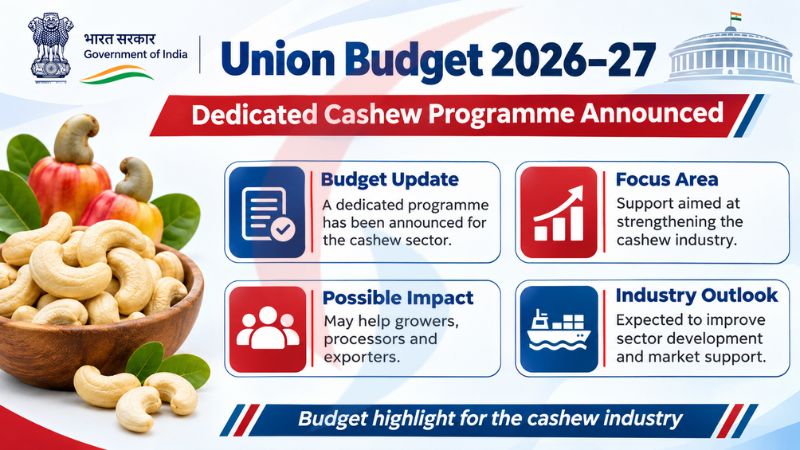
On 1 February 2026, the Union Government proposed a dedicated programme for Indian cashew and cocoa.
The initiative aims to improve self-reliance in raw material production and processing, increase export competitiveness and develop Indian Cashew and Indian Cocoa as premium global brands by 2030.
The Budget announcement is an important policy development, but exporters should not treat it as an automatic subsidy or assume that individual assistance is available without a notified scheme and eligibility conditions.
India's Cashew Exports in FY 2025–26
APEDA's published data demonstrates the importance of different cashew products in India's export industry.
|
Cashew product |
Export quantity (FY 2025–26) |
Export value |
|
Cashew kernels |
32,998.91 MT |
US$265.08 million |
|
Raw cashew nuts in shell |
77,806.41 MT |
US$114.12 million |
|
Roasted and value-added cashews |
3,001.82 MT |
US$24.62 million |
|
Cashew Nut Shell Liquid |
38,648.74 MT |
US$26.76 million |
These figures show that Indian exporters participate in several markets, including processed kernels, raw cashews and industrial by-products.
APEDA Continues Market Promotion Activities
The Department of Commerce's Annual Report 2025–26 records APEDA's efforts to promote Indian cashew exports through international events, branding, processing infrastructure and industry development.
The report also discusses support for processing units and initiatives aimed at improving the competitiveness of Indian cashews.
Compliance Requirements After Cashew Export Registration
Receiving RCMC is only one part of preparing a compliant export business. Let's return to Arjun's Dubai order. He has completed the relevant registration, and his cashew kernels are ready for packing. However, the overseas buyer asks for information about product quality, packaging, shelf life and shipment documentation.
FSSAI and Food Safety Compliance
Cashew processors and food exporters must comply with applicable FSSAI licensing and food safety requirements. These may include hygiene, storage, packaging, labelling and traceability obligations. For food exports, destination-country standards may impose additional conditions.
Customs Compliance
Under the Customs Act, 1962, exporters must comply with applicable customs procedures, product classification and export declaration requirements. The exporter should verify the correct ITC (HS) code and prepare the relevant commercial invoice, packing list, shipping bill and transport documents.
GST and Foreign Exchange Compliance
Exports are generally treated as zero-rated supplies under Section 16 of the IGST Act, 2017, subject to applicable conditions. Exporters must also comply with relevant FEMA and RBI provisions concerning export proceeds and payments.
Recordkeeping
Businesses should maintain accurate records of purchases, processing, packaging, invoices, shipping documents and payments. These records may be important during customs verification, food safety inspections or buyer enquiries.
Common Mistakes to Avoid During Cashew Export Registration
Starting a cashew export business involves more than obtaining an Import Export Code (IEC) and finding international buyers.
Many new exporters face registration delays or shipment-related problems because they overlook important requirements. Choosing the correct RCMC authority, completing applicable legal formalities and understanding destination-country regulations can help businesses avoid unnecessary complications.
The following examples explain three common mistakes made by cashew exporters in India.
|
Common Mistakes |
Practical Example |
How to Avoid Them |
|---|---|---|
|
1. Applying to the Wrong RCMC Authority |
A new exporter follows outdated information and applies for CEPCI RCMC without checking the change in issuing authority. |
Verify the current RCMC jurisdiction. APEDA is the designated authority for cashew kernels, CNSL and cardanol under applicable DGFT provisions. |
|
2. Assuming IEC Is Enough |
A business obtains an IEC and starts preparing exports without checking FSSAI, RCMC or other product-specific requirements. |
Obtain the necessary registrations and approvals based on the product, business activity and applicable laws. |
|
3.IgnoringImporting-Country Regulations |
An exporter prepares cashews for shipment to Europe without checking the buyer's packaging, labelling and food safety requirements. |
Review destination-country rules, product standards and required certificates before dispatching the shipment. |
For example, suppose Arjun receives his first cashew export order from Germany. He has an IEC and has completed the applicable APEDA RCMC registration, but he has not checked the destination country's food safety and labelling requirements. This oversight could delay his shipment or lead to rejection of the goods.
The key takeaway is that successful cashew exporting requires proper registration, accurate documentation and compliance with both Indian regulations and applicable importing-country requirements. Completing these checks before shipment can help exporters avoid delays, additional costs and regulatory difficulties.
Conclusion
When Arjun received his first international cashew order, he believed that exporting would mainly involve processing the nuts, packing them and arranging delivery.
However, he soon discovered that becoming an exporter also requires understanding IEC, RCMC, food safety, customs and foreign exchange requirements.
The most important point for cashew exporters in 2026 is that APEDA is the designated RCMC authority for cashew kernels, CNSL and cardanol, following the changes introduced in 2022.
The Cashew Export Promotion Council of India remains significant in the history of India's cashew industry, but its historical role should not be confused with current RCMC issuing authority.
With India's growing focus on cashew processing, value-added products and international branding, exporters have opportunities to expand their businesses. Proper documentation, accurate registration and compliance with applicable Indian laws can help them prepare for those opportunities.
Frequently Asked Questions (FAQs)
Q1. Who issues RCMC for cashew exporters in India in 2026?
Ans: The Agricultural and Processed Food Products Export Development Authority (APEDA) is the designated RCMC issuing authority for cashew kernels, Cashew Nut Shell Liquid (CNSL) and cardanol. Earlier, CEPCI handled these registrations, but DGFT transferred the responsibility to APEDA through Public Notice No. 33/2015-2020, dated 25 October 2022.
Q2. Is Cashew Export Promotion Council Registration mandatory for exporting cashews?
Ans: Separate CEPCI membership is not automatically mandatory for every cashew export. However, exporters may need APEDA RCMC for specified Foreign Trade Policy benefits, concessions or authorisations. Businesses must also obtain an IEC and comply with applicable customs, FSSAI and other export regulations.
Q3. How can I apply for APEDA RCMC for cashew exports online in 2026?
Ans: Visit the official DGFT portal, log in using your IEC-linked account and select the e-RCMC application service. Choose APEDA as the registering authority, enter your business and product details, upload the required documents and pay the prescribed fee. The certificate is issued after successful verification.
Q4. What is the government fee for cashew export RCMC registration in 2026?
Ans: The published APEDA RCMC registration fee is ?5,000 plus 18% GST, making the total ?5,900. Additional expenses may arise from IEC registration assistance, FSSAI licensing, product testing or professional services. Exporters should verify the current payable amount on the DGFT portal before applying.
Q5. What documents are required for cashew export RCMC registration in India?
Ans: Applicants generally need a valid IEC, PAN-linked business details, registered address and prescribed declarations. Manufacturer exporters may also need supporting documents proving their manufacturing activities. FSSAI licensing and other product-related approvals must be assessed separately according to the business and export activity.
Q6. Can a startup or first-time cashew exporter apply for APEDA RCMC?
Ans: Yes. Eligible startups, proprietorships, partnerships, LLPs and companies can apply for APEDA RCMC through DGFT. A new exporter should first obtain an IEC, identify the correct cashew product category and complete the prescribed application. Previous export turnover is not a universal requirement for every new applicant.
Q7. What is the validity of APEDA RCMC for cashew exporters?
Ans: APEDA RCMC is generally valid for five licensing years, unless otherwise specified. For example, a certificate issued during FY 2026–27 would ordinarily remain valid until 31 March 2031. Exporters should check the expiry date on their certificate and apply for renewal when required.
Q8. Can cashew exporters receive government subsidies or export benefits through APEDA RCMC?
Ans: APEDA RCMC may help exporters satisfy membership requirements for certain export promotion schemes and authorisations. However, it does not automatically guarantee subsidies, financial assistance or export incentives. Eligibility depends on the applicable government scheme, product category, documentation and approval conditions.
Q9. Is FSSAI registration required for exporting cashew nuts from India?
Ans: Cashew processing, packing and other food business activities are subject to applicable requirements under the Food Safety and Standards Act, 2006. Exporters must determine the appropriate FSSAI licence and comply with relevant food safety, packaging and hygiene requirements. Importing countries may also impose additional quality and labelling standards.
Q10. What are the latest cashew export registration updates in India for 2026?
Ans: In Union Budget 2026–27, the government announced a dedicated programme to strengthen India's cashew and cocoa sectors, focusing on production, processing and export competitiveness. APEDA continues as the designated RCMC authority for specified cashew products following the 2022 DGFT change. Exporters should also check the September 2026 RCMC exemption for qualifying consignments up to ?3 lakh FOB value.
Article last updated on : 08 Nov 2026.