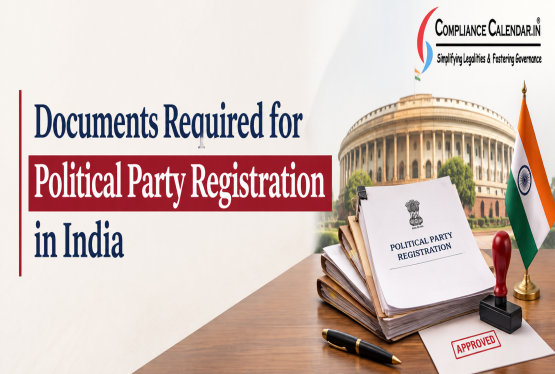



Registering a political party with the Election Commission of India (ECI) is an important step for a group that wants to enter Indian politics. However, receiving a registration certificate does not mean that the party has completed all its legal responsibilities. After registration, the party must maintain its financial records, report donations, prepare audited accounts and complete the required filings with the concerned authorities.
Many newly registered political parties spend their first year building their organisation, appointing office-bearers, opening offices and collecting funds. During this period, financial compliance can easily be overlooked. Some party leaders may also believe that annual filings are required only when the party contests elections or receives large donations. This is not correct. Several reporting requirements apply even when a party has limited financial activity.
Annual compliance helps a political party maintain transparency about the money it receives and spends. It also helps the party meet the conditions for claiming the tax benefits available under the law. In this article, we explain the important annual compliance requirements, financial reports, audit responsibilities, filing deadlines and consequences of non-compliance.
What Does Annual Compliance Mean for a Political Party?
Annual compliance means the financial and legal responsibilities that a registered political party must complete during or after a financial year. These responsibilities mainly include maintaining books of accounts, recording donations, preparing audited financial statements, submitting contribution reports and filing the applicable income tax return. The requirements come from different laws and directions issued by the Election Commission and the Income Tax Department.
For example, a newly registered political party may receive Rs 5 lakh from supporters during a financial year. It may spend Rs 2 lakh on office rent, staff salaries, travel and public meetings. The party must record these receipts and payments, keep supporting documents and prepare its financial statements. It cannot simply use the money and calculate the remaining balance at the end of the year. The records should clearly explain where the funds came from, who contributed them and how the party used them.
Our guide on Register a Political Party in India explains the registration process under Section 29A of the Representation of the People Act, 1951.
Which Annual Filings Must a Political Party Complete?
A registered political party must follow the applicable financial reporting requirements even if it is not recognised as a State Party or National Party. Registration and recognition are different. A party may remain a Registered Unrecognised Political Party (RUPP) for several years, but it still has reporting responsibilities under the applicable election laws and ECI directions.
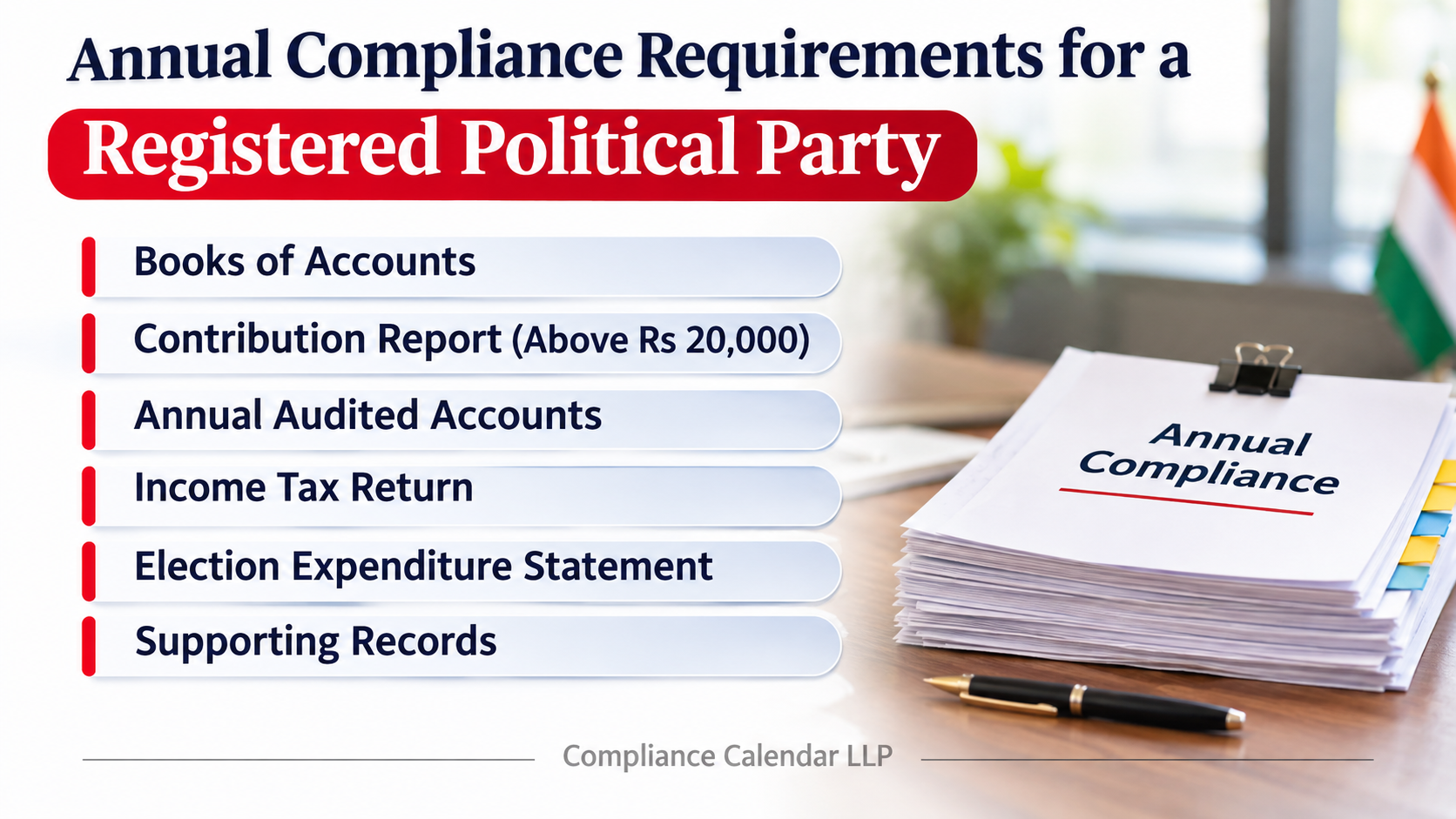
The main responsibilities include maintaining financial records, reporting contributions above Rs 20,000, preparing annual audited accounts and filing the applicable income tax return. If the party contests an election, it must also submit the required election expenditure statement. The following table gives an overview of these responsibilities.
|
Compliance |
What the party needs to do |
|
Books of accounts |
Record donations, membership fees, income, expenses, assets and liabilities. |
|
Contribution Report |
Report contributions exceeding Rs 20,000 under Section 29C. |
|
Annual audited accounts |
Prepare financial statements and get them audited by a qualified practising Chartered Accountant. |
|
Income tax return |
File the applicable return within the prescribed time. |
|
Election expenditure statement |
Report election-related spending after contesting the relevant election. |
|
Supporting records |
Maintain donor details, bank statements, bills, vouchers and payment records. |
These requirements do not all have the same filing date. Contribution reports and annual audited accounts are part of regular financial reporting, while election expenditure statements are connected with elections contested by the party. The party should identify the requirements that apply to its activities and prepare a compliance calendar at the beginning of each financial year.
How Should a Political Party Maintain Its Financial Records?
A political party should maintain proper records of every amount received and spent. This includes donations from individuals and companies, membership fees, funds collected through permitted activities and payments made for office rent, salaries, travel and public meetings. The treasurer or another authorised person should keep the books updated and make sure that the recorded amounts match the bank transactions. The party should also maintain supporting documents so that the auditor can verify the entries instead of relying only on figures entered in an account book.
For example, suppose a political party named Jan Vikas Party operates an office in Jaipur. During the year, it receives Rs 3 lakh through donations and Rs 50,000 as membership fees. It spends Rs 1 lakh on office rent and salaries, Rs 40,000 on public meetings and Rs 30,000 on travel. The party's treasurer should record each receipt and payment, preserve the bills and check the entries against the bank statements. If the party records only the total donations and total expenses without keeping the supporting documents, the auditor may find it difficult to verify the accounts.
The party should pay particular attention to the following financial records:
- Names and addresses of donors wherever required.
- Details of contributions received from individuals and companies.
- Bank statements and records of deposits and withdrawals.
- Membership fees and other income received by the party.
- Bills and vouchers for office rent, salaries, travel and other expenses.
- Details of assets, liabilities and outstanding payments.
- Records of payments made to vendors and service providers.
- Details of cash received and its deposit into the party's bank account.
Political parties must also follow the restrictions on accepting contributions. Section 29B of the Representation of the People Act, 1951 deals with contributions to political parties and restricts donations from prohibited foreign sources. The party should also follow the applicable tax rules for receiving donations, including the prescribed payment methods for contributions above Rs 2,000 when claiming the relevant tax benefit.
If the party is preparing or updating its internal rules, it should review the financial provisions along with the other requirements explained in our article on Documents Required for Political Party Registration.
Does a Political Party Need to Submit an Annual Audit Report?
Yes. Political parties must prepare annual financial statements and get their accounts audited to meet the Election Commission's transparency requirements and the conditions for applicable income tax benefits. An audit checks whether the party has properly recorded its donations, other income, expenses, assets and liabilities. It can also identify differences between the books of accounts, bank statements and supporting documents before the party submits its financial reports.
The Election Commission has referred to the Institute of Chartered Accountants of India's (ICAI) Guidance Note on Accounting and Auditing of Political Parties. The annual financial statements should contain a Balance Sheet, Income and Expenditure Account, Cash Flow Statement, schedules and notes to accounts, significant accounting policies and the auditor's report. A simple statement showing total donations received and total expenses paid is not enough to replace the complete set of financial statements. The party should provide its auditor with the required records and make sure that the final statements follow the prescribed format.
The party should not wait until the filing deadline to begin the audit. Missing bills, incomplete donation details and differences in bank balances can delay the preparation of accounts. The treasurer should review the financial records during the year and share the complete documents with the auditor well before the filing date.
What Is the Contribution Report Under Section 29C?
Section 29C of the Representation of the People Act, 1951 requires the treasurer or another person authorised by a political party to prepare a report of contributions exceeding Rs 20,000 received during a financial year. The report is submitted in Form 24A under Rule 85B of the Conduct of Elections Rules, 1961. It contains details of the contributions and the donors, including the information required under the prescribed form.
The purpose of this report is to make political funding more transparent. The Election Commission and tax authorities can examine the information to understand who contributed money to the party. The report is important for a political party that wants to claim the relevant tax benefit. If the party receives a contribution above Rs 20,000 but does not record the donor's details correctly, it may face difficulty while preparing Form 24A and supporting its tax claim.
For example, if a political party receives Rs 25,000 from an individual during a financial year, the party must record the contribution and maintain the required donor information. It should not combine the amount with other receipts and show only a total donation figure. The party's treasurer should check the contribution records before preparing the report so that the information submitted to the Election Commission is complete and correct.
What Reports Must a Political Party Submit to the Election Commission?
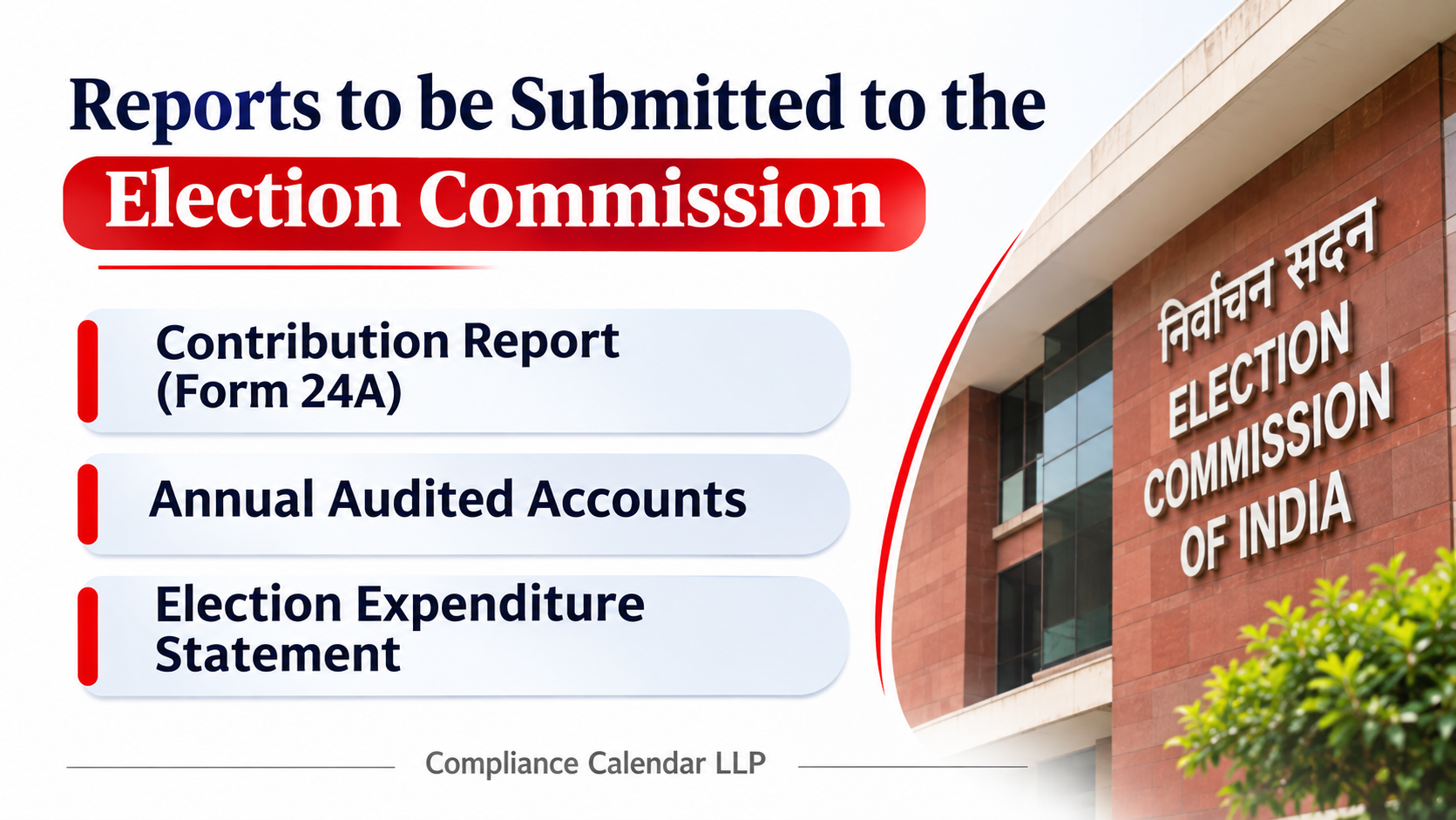
The Election Commission requires political parties to submit financial reports to improve transparency in political funding and election expenditure. The main reports are the Contribution Report, Annual Audited Accounts and Election Expenditure Statement, wherever applicable. These reports serve different purposes, so the party should not treat them as one combined filing.
The filing deadlines mentioned in the Election Commission's December 2025 directions are summarised below. The party should also check the latest ECI instructions and CBDT notifications before submitting its reports.
|
Report |
Purpose |
Filing timeline |
|
Contribution Report (Form 24A) |
Reports contributions exceeding Rs 20,000 received during the financial year. |
By 31 October or another date notified by CBDT, as applicable. |
|
Annual Audited Accounts |
Provides the audited financial statements of the political party. |
Within one month of the due date for filing the political party's income tax return, under the December 2025 direction for RUPPs. |
|
Election Expenditure Statement |
Reports expenditure connected with a contested election. |
Within 75 days of an Assembly general election and 90 days of a Lok Sabha general election. |
The filing authority can depend on the party's status. Recognised National and State Parties submit their applicable reports to the Election Commission of India. Registered Unrecognised Political Parties generally submit the required reports to the Chief Electoral Officer of the State or Union Territory where their headquarters are situated, in accordance with the Commission's directions. RUPPs can also use the ECI's Integrated Election Management System (IEMS) for the applicable online filing process.
A political party should remember that the election expenditure statement is not a report that must be filed every year regardless of activity. It becomes relevant when the party contests the applicable election. The party should maintain election-related accounts separately so that it can prepare the statement within the prescribed period.
Does a Political Party Need to File an Income Tax Return?
Yes. A registered political party must also meet the income tax requirements applicable to it. The law provides a special tax benefit to eligible political parties, but the benefit is subject to conditions. Registration with the Election Commission does not automatically make every amount received by the party tax-free. The party must maintain the required books of accounts, record donations, complete the audit, submit the contribution report and file its income tax return within the prescribed time.
The Income-tax Act, 1961 contained the earlier provisions relating to the tax treatment of political parties under Section 13A. From 1 April 2026, the Income-tax Act, 2025 applies. Section 12 read with Schedule VIII provides the relevant treatment for specified income of political parties and electoral trusts. The party should follow the law applicable to the relevant tax year rather than using an old provision without checking the change in law.
For a political party to claim the applicable benefit, it must pay attention to the conditions relating to books of accounts, donor details, audit, contribution reporting and return filing. It should also follow the prescribed restrictions on receiving donations and maintain the supporting documents. The income tax return, contribution report and audited accounts should contain consistent figures. If the donation amount shown in one report does not match the amount in another, the party may have to explain the difference to the concerned authority.
A newly registered party should not assume that it can skip tax compliance because it has not contested an election or has received only a small amount of money. It should check the applicable return filing requirement and due date for the relevant tax year with a tax professional. The party should also preserve its return acknowledgement and other filing records for future reference.
What Happens If a Political Party Does Not Complete Its Annual Compliance?
Missing an annual filing deadline can affect a political party's tax benefits and create problems with the Election Commission. The consequences depend on the report that was missed and the legal provision or direction that applies. One important example is the contribution report under Section 29C. Section 29C(4) provides that a political party that fails to submit the required contribution report within the prescribed time is not entitled to the relevant tax relief under the Income-tax Act.
The Election Commission's directions issued in December 2025 also state that contribution reports received after the prescribed deadline will be treated as non-compliance under Section 29C(3) and will not be taken on record for any purpose. The Commission has further stated that failure to follow its lawful directions may lead to action under Paragraph 16A of the Election Symbols (Reservation and Allotment) Order, 1968. In addition, incomplete accounts, missing donor details or failure to submit an election expenditure statement can create further reporting and verification problems.
A missed filing does not automatically mean that every political party will lose its registration. The action depends on the nature of the default and the applicable law or ECI direction. However, a party should not ignore a missed deadline or assume that submitting a late report will automatically remove the consequences. It should identify the default, review the applicable rules and take professional advice on the available corrective steps.
How Can a Political Party Avoid Missing Important Compliance Deadlines?
A political party can manage its annual compliance more easily by keeping its financial records updated throughout the year. The treasurer or another authorised office-bearer should be responsible for recording donations, checking expenses, collecting supporting documents and coordinating with the auditor. The party should also review its bank statements regularly so that missing entries or incorrect amounts can be corrected before the annual accounts are prepared.
A simple compliance calendar can help the party track the important work. It should include the contribution report deadline, income tax return due date, annual audit filing deadline and election expenditure reporting deadline whenever the party contests an election. The party should also keep copies of filed reports, acknowledgements and communication received from the Election Commission or Income Tax Department.
The party should follow a few practical steps:
- Assign financial reporting work to the treasurer or an authorised office-bearer.
- Record every donation and payment when it takes place.
- Keep bills, receipts, bank statements and donor details safely.
- Review the accounts before the financial year ends.
- Share complete records with the auditor in advance.
- Check the latest ECI and CBDT notifications before filing.
- Keep copies of all submitted reports and acknowledgements.
These steps can reduce last-minute work and help the party respond properly if the Election Commission or Income Tax Department asks for information.
How Can Compliance Calendar LLP Help with Political Party Annual Compliance?
Political party annual compliance involves financial records, contribution reporting, audit coordination and income tax filing. A party that does not understand these requirements may miss a deadline or submit incomplete information. Compliance Calendar LLP can help political parties understand their applicable responsibilities, organise the required documents and manage the relevant compliance process.
Our team can assist with annual compliance planning, contribution report preparation, coordination for audited financial statements, income tax filing support and election-related financial reporting wherever applicable.
For assistance, contact Compliance Calendar LLP on +91 9988424211, email info@ccoffice.in
Frequently Asked Questions
1. Is Annual Compliance Compulsory for Every Registered Political Party?
Registered political parties must follow the applicable financial reporting requirements and lawful directions of the Election Commission. These include maintaining accounts, submitting contribution reports and annual audited accounts, and meeting applicable income tax return requirements. Election expenditure reporting applies when the party contests the relevant election.
2. Does a Political Party Need to File an Income Tax Return Every Year?
A political party must check and meet the income tax return requirements applicable to it for each tax year. Filing the return within the prescribed time is also one of the conditions for claiming the tax benefit available under the Income-tax Act.
3. Is an Audit Compulsory for Political Parties?
Yes. Political parties must get their accounts audited by a qualified practising Chartered Accountant to meet the Election Commission's financial transparency requirements and applicable tax conditions. The financial statements should follow the prescribed format.
4. What Is Form 24A for Political Parties?
Form 24A is the prescribed contribution report under Rule 85B of the Conduct of Elections Rules, 1961. It contains details of contributions exceeding Rs 20,000 received by a political party during the financial year.
5. What Is the Contribution Report Filing Deadline?
Under the Election Commission's December 2025 directions, the contribution report for the preceding financial year is to be filed by 31 October or another date notified by CBDT, as applicable. Political parties should check the latest applicable notification before filing.
6. Can a Political Party Lose Its Tax Benefits for Missing the Contribution Report Deadline?
Yes. Section 29C(4) of the Representation of the People Act, 1951 provides that a political party failing to submit the required contribution report within the prescribed time will not be entitled to the relevant tax relief under the Income-tax Act.
7. Does a Political Party Need to Submit an Election Expenditure Statement Every Year?
No. The statement is connected with an election contested by the party. The prescribed deadline is 75 days after an Assembly general election and 90 days after a Lok Sabha general election.
8. Can a Newly Registered Political Party Have Annual Compliance Obligations?
Yes. A newly registered political party should start maintaining its financial records and checking its reporting responsibilities from the beginning. It should not wait until it receives large donations or contests its first election.
9. Where Can Political Parties Submit Their Financial Reports Online?
The Election Commission provides the Integrated Election Management System (IEMS) for online submission of applicable financial reports. The filing authority and process depend on whether the party is a recognised National or State Party or a Registered Unrecognised Political Party.
10. What Should a Political Party Do If It Misses a Compliance Deadline?
The party should identify the missed filing, check the applicable legal provision and seek professional advice about the available corrective steps. It should not assume that submitting a late report will automatically remove the consequences of the delay.
Article last updated on : 25 Nov 2026.














_learn_crop10_thumb.jpg)