


Are you planning to start a political party and contest the 2027 Assembly elections? If yes, one of the first things you need to understand is how to register your party with the Election Commission of India (ECI).
Assembly elections are expected in Uttar Pradesh, Punjab, Uttarakhand, Goa, Manipur, Gujarat and Himachal Pradesh around 2027. People who want to enter politics, form a new political organisation or contest elections under a new party may be considering registration now. However, forming a political party is not enough. You must apply for registration under Section 29A of the Representation of the People Act, 1951, prepare the required documents and follow the process prescribed by the ECI.
Let's understand the states going to the polls, the registration process, required documents, expected timeline and election rules in simple language.
Can You Register a New Political Party Before the 2027 Elections?
Yes, you can form a new political party and apply for registration before the 2027 Assembly elections. Indian citizens can form a political organisation and apply to the Election Commission of India for registration under Section 29A of the Representation of the People Act, 1951.
However, if you are planning to contest the 2027 elections, you should not wait until the election announcement. You need time to form the party, prepare its constitution, collect the required member details and affidavits, arrange the documents and submit a complete application to the ECI. The Commission must also examine the application and complete its own process.
For example, a group of people planning to contest elections in Uttar Pradesh may decide to form a new political party in November 2026. They will need to complete the formation formalities and submit their registration application within 30 days. Even after submitting the application, they must allow time for the ECI's scrutiny and hearing. Starting early gives the group a better chance of completing the process before the important election deadlines.
The important point is that registration is possible, but approval and participation in the 2027 elections cannot be guaranteed. The final position will depend on the application, the ECI's decision and the election schedule.
Which States Are Preparing for Assembly Elections in 2027?
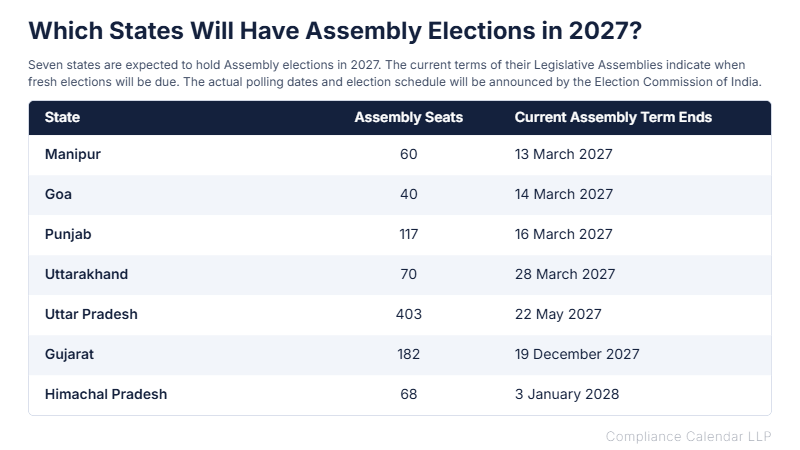
Seven states are expected to hold Assembly elections in 2027. The current terms of their Legislative Assemblies indicate when fresh elections will be due. The actual polling dates and election schedule will be announced by the Election Commission of India.
|
State |
Assembly Seats |
Current Assembly Term Ends |
|
Manipur |
60 |
13 March 2027 |
|
Goa |
40 |
14 March 2027 |
|
Punjab |
117 |
16 March 2027 |
|
Uttarakhand |
70 |
28 March 2027 |
|
Uttar Pradesh |
403 |
22 May 2027 |
|
Gujarat |
182 |
19 December 2027 |
|
Himachal Pradesh |
68 |
3 January 2028 |
The first five states are expected to go to the polls in the early part of 2027. Gujarat's Assembly term ends in December 2027, while Himachal Pradesh's current term ends in January 2028, making its election due around the end of 2027.
If you are planning to form a political party in any of these states, the time available for registration and election preparation may be different. For example, a person planning to contest in Goa or Manipur may have a shorter preparation window than someone planning to contest in Gujarat.
When Should You Start the Registration Process for the 2027 Elections?
There may still be time, but it depends on when you form the party, how quickly you prepare the application and how much time the ECI takes to complete its review. The position is more urgent for states where elections are expected in the first few months of 2027.
A common mistake is to think that registration is a simple form-filling exercise. In reality, the party must first be properly formed. Its members, office-bearers, constitution, registered office details and supporting affidavits must be ready. If the application has missing information or does not follow the ECI's requirements, the process can become difficult and may take longer.
Consider the following practical approach:
|
Stage |
What the party should do |
|
Party formation |
Finalise the party name, founding members and formation date |
|
Within 30 days |
Submit the complete registration application to the ECI |
|
During ECI review |
Respond to queries and attend the required hearing |
|
After registration |
Prepare for candidate selection, nominations and symbol-related requirements |
|
Before election deadlines |
Complete the applicable election formalities |
There is no guaranteed approval date that a new party can use to plan its election campaign. If you want to contest in 2027, begin the registration work as early as possible rather than waiting for the election notification.
What Is the 30-Day Rule for Political Party Registration?
Section 29A(2) of the Representation of the People Act, 1951 requires a newly formed political party to apply for registration within 30 days following the date of its formation. This is a legal deadline for submitting the application, not the time given to the ECI to approve the party.
For example, if a political party is formed on 1 December 2026, it must submit its registration application within the 30-day period following its formation. The party should not delay the application until it has started its election campaign or the state election schedule has been announced.
The ECI's published guidelines state that applications submitted after the prescribed 30-day period are time-barred and will not be considered. Therefore, the date of formation is important. The party should maintain proper records of its formation meeting, adoption of its constitution and appointment of office-bearers.
Remember: You should prepare the documents before or immediately after the party's formation. Do not use the 30-day period as extra time to start collecting basic information.
What Conditions Must You Meet Before Forming a Political Party?
A political party should be formed by a group of Indian citizens who want to work together under a common political name and set of objectives. The party must have a clear structure, members, office-bearers and written rules explaining how it will work.
The ECI's registration guidelines also require the party to follow certain conditions. These include:
- Membership must be open to Indian citizens who have attained 18 years of age.
- The party name should not contain religious or caste references and should be clearly different from the names of existing political parties.
- The party must have a constitution explaining its objectives, membership, organisational structure and internal working.
- The constitution must provide for democratic functioning and regular organisational elections.
- The party must accept the constitutional principles and make the mandatory declaration required under Section 29A(5).
- The party must maintain proper records of its members and office-bearers.
A political party cannot be created only to obtain an election symbol. It must have genuine organisational rules and a clear political purpose. The ECI may ask for details about the party's principles, activities, organisation and relationship with voters.
If you are still deciding how to set up the organisation, first understand the eligibility requirements and timeline for Political Party Registration.
How to Choose a Name for Your New Political Party?
Choosing a party name is one of the first decisions founders need to make. The name should reflect the party's identity and political objectives. It should also be different from the names of existing political parties so that voters do not get confused.
The ECI's guidelines state that a proposed party name should not contain religious or caste references. A name that creates confusion with an existing registered party may also create problems during scrutiny. Before finalising the name, check the list of existing political parties and consider whether the proposed name is clear, suitable and distinct. Avoid choosing a name only because it sounds popular or is similar to a well-known political party.
For example, if a group wants to form a party focused on farmers, employment and local development, it may choose a name that reflects these objectives without using the name or identity of an existing party.
The name should be finalised before the party constitution and registration application are prepared. Changing it later may require additional formalities and communication with the ECI.
Read more about the Political Party Name Rules in India before deciding on the final name.
What Documents Are Required to Register a Political Party?
The ECI requires a registration application along with the party constitution and supporting documents. A new party should prepare these documents carefully because missing or incorrect information can delay the process.
The main documents and information include:
|
Document or Information |
What it is used for |
|
Registration application |
Provides the party's name, head office, formation date, membership strength and office-bearer details |
|
Party constitution |
Explains the party's objectives, membership rules, structure and internal working |
|
Formation records |
Shows when and how the party was formed |
|
Member details |
Provides the names and particulars of party members |
|
Electoral roll extracts or EPIC copies |
Shows that at least 100 members are registered electors |
|
Individual member affidavits |
Confirms the membership and electoral status of at least 100 members |
|
Office-bearer affidavit |
Includes declarations required by the ECI about party members and the proposed office |
|
Office address proof and owner's NOC |
Supports the address of the party office |
|
Office-bearer details |
Includes the prescribed information about assets, liabilities, income and criminal antecedents |
|
PAN and bank account details, if available |
Provides the party's financial identification and account information |
|
Processing fee |
Includes the prescribed non-refundable demand draft of Rs 10,000 |
The ECI's published checklist requires electoral roll extracts or attested EPIC copies for at least 100 members. It also requires individual affidavits from those members. The member records, affidavits and supporting documents should be arranged in the correct order.
For a detailed document list, read Documents Required for Political Party Registration
How to Prepare a Political Party Constitution?
The party constitution is one of the most important documents in the registration process. It explains how the party will function, who can become a member, how leaders will be selected and how important decisions will be taken.
The ECI expects the constitution to provide for democratic functioning. It should not give permanent control to one person or allow decisions to be taken without proper rules. It should clearly explain the powers and duties of the party's main bodies and office-bearers.
The constitution should cover:
- Party name, objectives and membership rules.
- Organisational structure and functions of different committees.
- Appointment and election of office-bearers.
- Tenure of committees and office-bearers.
- Meetings, quorum and decision-making procedures.
- Internal disputes and disciplinary action.
- Party funds, accounts and annual audit.
- Procedure for amending the constitution.
- Rules for merger, split and dissolution of the party.
It must also include the mandatory declaration under Section 29A(5) of the Representation of the People Act, 1951. The party must declare that it will bear true faith and allegiance to the Constitution of India and to the principles of socialism, secularism and democracy, and uphold
You can read more about the Political Party Constitution: Rules, Format and Requirements
How Do You Register a Political Party with the ECI?

A new political party must apply to the Election Commission of India under Section 29A of the Representation of the People Act, 1951. The application should contain the information and documents required under the Act and the ECI's registration guidelines.
The process generally involves the following stages:
- Form the political party
Decide the party name, objectives, founding members and date of formation. Keep a record of the meeting or other documents showing that the party has been formed.
- Appoint office-bearers
Identify the President, General Secretary, Treasurer and other office-bearers. Their roles and responsibilities should be properly recorded.
- Prepare the party constitution
Draft the constitution according to the ECI's requirements. It should explain the party's structure, membership, internal elections, financial rules and decision-making process.
- Collect member documents
Arrange the details of at least 100 registered electors, their electoral roll extracts or attested EPIC copies and individual affidavits. Make sure that the information matches across all documents.
- Arrange the office and supporting records
Prepare the party office address proof, owner's no-objection affidavit and other required information relating to office-bearers, assets, liabilities, PAN and income.
- Complete the application and checklist
Fill in the prescribed application format and ECI checklist. Check that every required detail and supporting document is included. The application should be signed by the party's chief executive officer.
- Pay the registration processing fee
The ECI's published guidelines prescribe a non-refundable demand draft of Rs 10,000 in favour of the Under Secretary, Election Commission of India, New Delhi.
- Submit the application to the ECI
The application and supporting documents must be presented personally or sent by registered post to the Secretary, Election Commission of India, within 30 days of the party's formation.
- Respond to the ECI's process
After receiving a complete application, the ECI may examine the documents, seek further information and call the party's representatives for a personal hearing. The party should respond to any communication within the time given.
You can also refer to How to Register a Political Party in India for a broader explanation of the registration process.
How Long Does the Election Commission Take to Approve Registration?
There is no guaranteed period within which every new political party will receive final registration approval. The time depends on the completeness of the application, the documents submitted, the ECI's scrutiny and the time required to complete the prescribed formalities.
The ECI's published guidelines state that an acknowledgement is generally sent within two weeks after receiving a duly completed application. The guidelines also refer to calling the applicant for a personal hearing within a reasonable period of around two to three months from receipt of a complete application.
These periods should not be treated as a promise that registration will be approved within two or three months. An acknowledgement is not the same as final registration. The Commission must consider the application and decide whether the party meets the legal requirements.
For someone planning to contest the 2027 elections, this difference matters. If the application is submitted late or contains errors, the party may not receive its registration decision before important election-related deadlines.
Can a Newly Registered Political Party Contest the 2027 Elections?
Yes. A political party registered by the ECI can set up candidates in elections, subject to the applicable election laws and deadlines. However, registration does not automatically make the party a recognised State Party or National Party.
A newly registered party is generally treated as a Registered Unrecognised Political Party (RUPP). It can participate in elections, but it does not receive all the benefits available to recognised political parties.
For example, a new party registered in Punjab may be able to set up candidates in the Assembly election if it completes the applicable requirements within time. However, it should not assume that registration will automatically give all its candidates the same reserved symbol. The party must also make sure that its candidates complete their nomination papers, affidavits, deposits and other election formalities within the deadlines announced by the ECI.
To understand the difference between registration and recognition, read Registered and Recognised Political Parties in India
Can a New Political Party Get a Common Election Symbol?
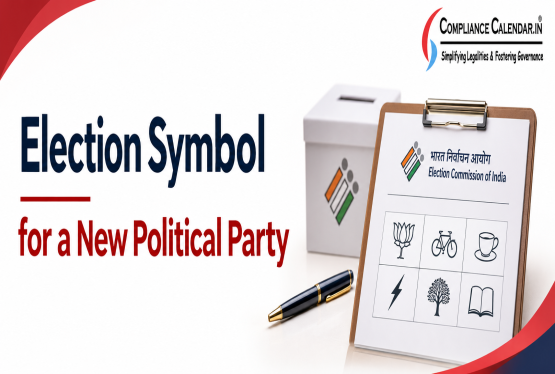
A newly registered political party may apply for a common election symbol under Paragraph 10B of the Election Symbols (Reservation and Allotment) Order, 1968. However, a common symbol is not automatically given just because the party has received registration.
Under the applicable rules, a registered unrecognised political party may seek a common symbol for its candidates if it fulfils the required conditions. For a State Assembly election, the party generally needs to set up candidates in at least 10% of the Assembly constituencies in that state, subject to a minimum of five constituencies in states having 40 or fewer seats. It must also follow the ECI's notification, application and symbol-preference requirements.
This is especially important for new parties planning to contest in 2027. The ECI has already published state-specific information about when applications for a common symbol under Paragraph 10B may be made for the 2026–2027 Assembly elections. The relevant dates and requirements should be checked for the state in which the party plans to contest.
The common-symbol facility under Paragraph 10B is a one-time concession for a newly registered unrecognised party. It should not be confused with a reserved symbol given to a recognised political party..
What Should You Do If Registration Is Still Pending When Elections Are Announced?
If your party's registration application is still pending when the ECI announces the election schedule, do not assume that the application will automatically be approved before the nomination deadline. Contact the ECI through the proper channel, check the status of the application and respond quickly if any information or document is required.
The next step depends on the stage of the registration process and the election deadlines. A party that has not yet received registration should not assume that it can apply for a common symbol as a registered unrecognised political party. It should also not make public promises about its registration status or election symbol before receiving official confirmation.
If the party receives registration in time, it must still complete the separate requirements for setting up candidates and seeking a common symbol, where applicable. If registration is not completed before the relevant deadlines, the party's options for that election may be limited.
Why Do Political Party Registration Applications Get Delayed?
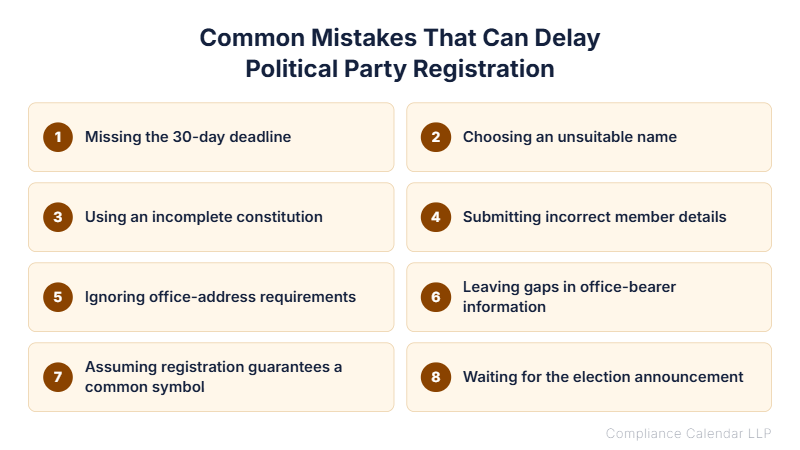
Many political party registration applications face problems because founding members do not prepare all the required details before applying. The following table explains the mistakes to check before submitting an application to the ECI.
|
Common Mistake |
What You Should Check |
|
Missing the 30-day deadline |
Submit the application within 30 days of the party's formation, as required under Section 29A. |
|
Selecting an unsuitable party name |
Avoid names with religious or caste references and check that the proposed name is different from existing political parties. |
|
Preparing an incomplete constitution |
Include the party's objectives, membership rules, organisational structure, internal elections and financial rules. |
|
Incorrect details of 100 members |
Check the electoral roll or EPIC details and individual affidavits of at least 100 members before submission. |
|
Incomplete office-address documents |
Attach the required address proof and owner's no-objection affidavit for the party office. |
|
Missing office-bearer information |
Provide the details and affidavits required by the ECI for the party's office-bearers. |
|
Confusing registration with a common election symbol |
Remember that party registration and common-symbol allotment are separate processes with different conditions. |
|
Starting the process just before elections |
Begin registration early. The ECI's approval process and election deadlines are separate. |
Before submitting the application, check the ECI's complete registration checklist and make sure that the information in the application, constitution, member records and affidavits matches. This can help prevent avoidable queries and delays during scrutiny.
How Can Compliance Calendar LLP Help with Political Party Registration?
Starting a political party involves more than selecting a name and collecting members. Founders must prepare the party constitution, appoint office-bearers, collect member affidavits, arrange office-address documents and submit the application within the prescribed time.
Compliance Calendar LLP helps individuals and groups understand the political party registration process and prepare the required documentation for submission to the Election Commission of India. This includes support with party constitution drafting, document preparation, application review and the registration process.
If you are planning to form a political party in Uttar Pradesh, Punjab, Uttarakhand, Goa, Manipur, Gujarat or Himachal Pradesh for the 2027 Assembly elections, it is better to begin early. The 30-day application deadline and the time required for ECI scrutiny make early preparation important.
For assistance, contact Compliance Calendar LLP at +91 9988424211 or info@ccoffice.in
Frequently Asked Questions
1. Can I register a new political party in India before the 2027 elections?
Yes. You can form a political party and apply for registration with the Election Commission of India under Section 29A of the Representation of the People Act, 1951. However, approval depends on the ECI's examination of the application and completion of the required process.
2. Which states are expected to have Assembly elections in 2027?
Seven states are expected to hold Assembly elections around 2027: Uttar Pradesh, Punjab, Uttarakhand, Goa, Manipur, Gujarat and Himachal Pradesh. The Election Commission will announce the official election dates separately.
3. What is the deadline for applying for political party registration?
A newly formed political party must submit its application within 30 days following its date of formation. Applications submitted after this period are time-barred under Section 29A(2) of the Representation of the People Act, 1951.
4. Does the ECI approve a political party within 30 days?
No. The 30-day period is the deadline for submitting the registration application. It is not the approval timeline. The ECI must examine the application and complete the required formalities before making a decision.
5. How many members are required for political party registration?
The ECI's published guidelines require electoral roll extracts or attested EPIC copies for at least 100 members, along with individual affidavits from those members. Their details must be submitted in the prescribed manner.
6. What is the government fee for political party registration?
The ECI's published registration guidelines prescribe a non-refundable processing fee of Rs 10,000 through a demand draft in favour of the Under Secretary, Election Commission of India, New Delhi.
7. Can a newly registered political party contest Assembly elections?
Yes. A registered political party can set up candidates in Assembly elections, subject to the applicable election laws and deadlines. Registration does not automatically make the party a recognised State Party or National Party.
8. Can a new political party get a common election symbol?
A registered unrecognised political party may apply for a common symbol under Paragraph 10B of the Election Symbols (Reservation and Allotment) Order, 1968. It must meet the applicable conditions and follow the ECI's instructions for that election.
9. Can I register a political party without preparing a constitution?
No. The party constitution is a required part of the registration application. It must explain the party's objectives, membership, organisational structure, internal elections, financial rules and other matters required by the ECI.
10. What happens if I submit the application after 30 days?
The ECI's published guidelines state that an application submitted after the 30-day period is time-barred and will not be considered under the prescribed registration process. The party should therefore submit its complete application within the legal deadline.
11. Can a political party change its name after registration?
A registered political party must inform the ECI about changes in its name and other material details. Any proposed name change should follow the applicable procedure and should not be treated as an informal change.
12. Is political party registration the same as recognition by the ECI?
No. Registration allows an organisation to become a political party under Section 29A. Recognition as a State Party or National Party depends on separate performance conditions under the election symbols rules.
Article last updated on : 26 Nov 2026.














_learn_crop10_thumb.jpg)