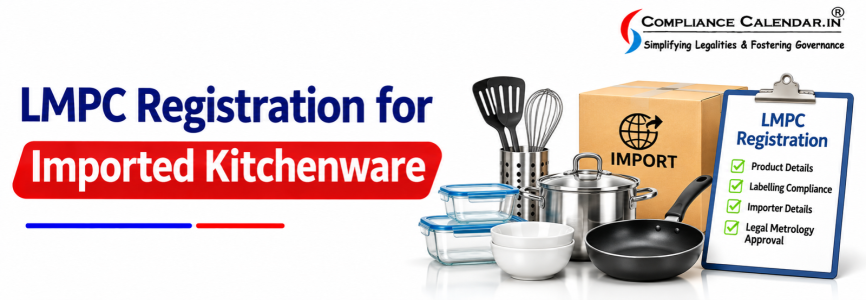



India imports a wide range of kitchenware products, including stainless steel utensils, frying pans, cooking pots, glass containers, ceramic bowls, cutlery and kitchen accessories. These products are sold through supermarkets, retail stores, online marketplaces and independent kitchenware businesses.
Importing kitchenware may appear straightforward. A business selects products from an overseas supplier, places an order, arranges shipping and prepares to sell the goods in India. However, problems can arise when imported products reach Customs without the required packaging declarations or importer registration.
For example, a Delhi-based company imports 5,000 stainless steel cooking utensils from China. Each item comes in a printed retail box, but the packaging displays only the foreign manufacturer's details. The importer later discovers that the products may require Indian importer information, Maximum Retail Price (MRP), country-of-origin details and other mandatory declarations.
This is where LMPC Registration for Imported Kitchenware becomes important. Under the Legal Metrology Act, 2009 and the Legal Metrology (Packaged Commodities) Rules, 2011, importers dealing in covered pre-packaged commodities must comply with applicable registration and labelling requirements.
What Is LMPC Registration for Imported Kitchenware?
LMPC stands for Legal Metrology Packaged Commodities. LMPC Registration identifies manufacturers, packers and importers carrying on activities covered under the Packaged Commodities Rules, 2011. For imported kitchenware, the requirement is particularly relevant when products are packed in predetermined quantities before being offered for retail sale in India.
For example, an importer selling a boxed set of six ceramic bowls may need to register under the applicable LMPC provisions and ensure that the retail package displays the prescribed declarations. The purpose of these requirements is to protect consumers by providing accurate information about the product, quantity, price, origin and responsible business.
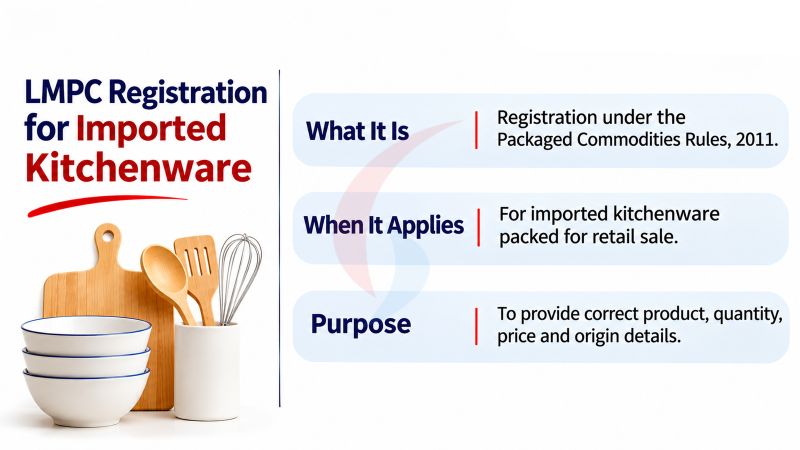
Under Rule 27 of the Packaged Commodities Rules, covered importers must register their name and complete address with the competent Legal Metrology authority. Importers should distinguish LMPC Registration from other permissions such as Import Export Code (IEC), GST registration and BIS certification. Each addresses a different legal requirement.
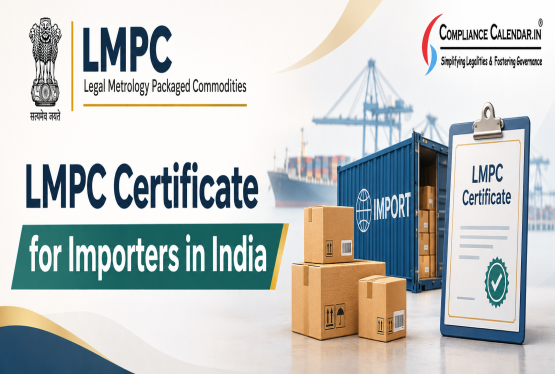
For more information, read LMPC Certificate for Importers in India
Is LMPC Registration Mandatory for Imported Kitchenware?
LMPC Registration is generally required for importers dealing in covered pre-packaged kitchenware products, subject to applicable exclusions and exemptions. Under Section 2(l) of the Legal Metrology Act, 2009, a pre-packaged commodity is broadly a product placed in packaging, without the purchaser being present, in a predetermined quantity.
Kitchenware products sold in individual retail boxes, labelled containers or packaged sets may fall within these requirements. However, importing kitchenware does not automatically make every shipment subject to all retail-package provisions.
|
Imported Kitchenware Product |
General LMPC Applicability |
|
Packaged stainless steel utensils |
Generally applicable when sold as retail packages |
|
Boxed frying pans and cooking pots |
Generally applicable |
|
Packaged ceramic plates and bowls |
Generally applicable |
|
Glass food-storage containers |
Generally applicable when pre-packaged for retail sale |
|
Kitchen knife and cutlery sets |
Generally applicable when sold in retail packages |
|
Kitchenware imported for qualifying industrial use |
May qualify for an exclusion, subject to conditions |
|
Loose goods not sold as pre-packaged commodities |
Requires assessment of the actual packaging and sales arrangement |
For example, importing 1,000 individually boxed frying pans for sale on Amazon may create different Legal Metrology obligations from importing loose kitchen utensils under an arrangement that falls outside the relevant retail-package provisions.
Businesses should examine the product, intended buyer, packaging and distribution arrangement before deciding whether LMPC Registration applies.
A Practical Story: How a Kitchenware Importer Faced a Packaging Problem
For Example, the fictional example of XYZ India Private Limited, a Mumbai-based business that imports household kitchen products. The company purchases stainless steel pans, cooking pots and serving bowls from a manufacturer in Vietnam. In 2026, XYZ places an order for 8,000 packaged kitchenware products worth approximately Rs 32 lakh.
The products are intended for sale through online marketplaces and retail stores across India. When the shipment documents are reviewed, the importer's customs agent notices that the packaging does not contain the Indian importer's complete address or the MRP in Indian rupees. The boxes also lack the required consumer complaint contact details.
The company initially assumes that the foreign manufacturer's labels are sufficient because the goods were properly packed before shipment. However, the Indian packaged commodity requirements are different from the overseas supplier's ordinary labelling practices.
XYZ reviews its LMPC Registration, asks the supplier to revise the packaging design and arranges the necessary compliance documents. The company also introduces a simple internal procedure: every new kitchenware product must undergo packaging approval before the overseas supplier begins mass production. This example shows that LMPC compliance is not merely a registration formality. It should be considered before importing and selling packaged kitchenware in India.
Legal Provisions for LMPC Registration of Imported Kitchenware
LMPC Registration for imported kitchenware is governed by the Legal Metrology Act, 2009, the Legal Metrology (Packaged Commodities) Rules, 2011, and other applicable import laws.
|
Act / Legal Provision |
Key Requirement |
|---|---|
|
Mandatory declarations on packaged kitchenware. |
|
|
Penalties for specified packaging violations. |
|
|
Legal Metrology (Packaged Commodities) Rules, 2011 – Provisions 2–4 |
Definitions, exemptions and packaging conditions. |
|
Legal Metrology (Packaged Commodities) Rules, 2011 – Provisions 6 and 9 |
Mandatory labelling, MRP, importer details and display requirements. |
|
Legal Metrology (Packaged Commodities) Rules, 2011 – Provision 27 |
Registration of covered kitchenware importers, manufacturers and packers. |
|
Filing of the Bill of Entry for imported kitchenware. |
|
|
Mandatory BIS certification for kitchenware covered by applicable Quality Control Orders. |
Important: Covered kitchenware importers must generally apply for LMPC Registration within 90 days of starting the relevant import activity. Mandatory product declarations must also be completed before the goods are offered for retail sale.
Mandatory Labelling Requirements for Imported Kitchenware
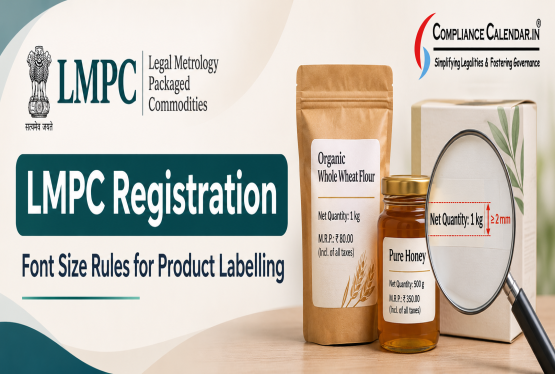
Imported kitchenware sold as covered retail packages must display the prescribed product information clearly and accurately. The information helps consumers identify the product, its quantity, price and the business responsible for the goods.
|
Mandatory Declaration |
Example |
|
Importer Name and Address |
xyz India Pvt. Ltd., Mumbai |
|
Country of Origin |
Made in Vietnam |
|
Product Name |
Stainless Steel Frying Pan |
|
Net Quantity |
1 N |
|
Month and Year of Import |
November 2026 |
|
Maximum Retail Price |
MRP Rs 1,499 inclusive of all taxes |
|
Consumer Care Information |
Customer care phone number and email |
|
Unit Sale Price |
Where required under applicable provisions |
For a package containing six spoons, the quantity may be declared as six pieces using the prescribed expression. Where a kitchen product is sold by weight, capacity or another applicable unit, the declaration must correspond to the actual commodity and statutory requirements.
Importers should avoid using vague expressions or misleading quantities. For example, a carton labelled only as Premium Kitchen Set may not adequately identify the contents if the applicable rules require the individual quantity or description.
MRP must also be displayed in the prescribed manner and include applicable taxes.
For a detailed explanation, read LMPC Labeling Rules: Mandatory Declarations on Packaged Goods
Documents Required for LMPC Registration for Imported Kitchenware
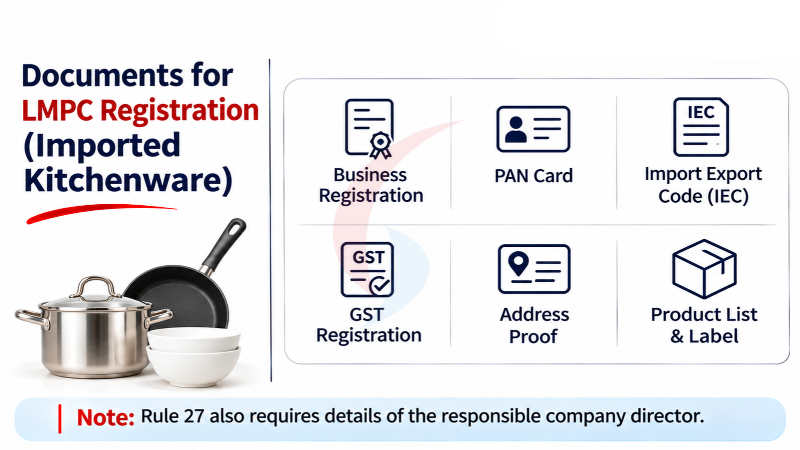
Importers must submit the prescribed business and contact information to the competent Legal Metrology authority. The exact checklist depends on the applicant's business structure, registration jurisdiction and product category.
|
Document |
Purpose |
|
Certificate of Incorporation or Business Registration |
Confirms the importer's legal identity |
|
PAN Card |
Identifies the business for regulatory purposes |
|
Import Export Code (IEC) |
Supports import-related verification |
|
GST Registration, where applicable |
Confirms relevant tax particulars |
|
Registered Office Address Proof |
Establishes the business address |
|
Director or Partner Details |
Identifies persons responsible for the business |
|
Authorisation Letter |
Authorises the person submitting the application |
|
Kitchenware Product List |
Identifies products proposed for import |
|
Product Label or Packaging Artwork |
Helps verify mandatory declarations |
|
Import Invoice, where required |
Supports product and transaction details |
Under the May 2026 amendment, the prescribed Rule 27 registration particulars also include the name of the company director responsible for violations under the Legal Metrology Act and the rules. Importers should avoid submitting inconsistent addresses, incomplete product details or labels that do not match the goods they intend to sell.
LMPC Registration Process for Imported Kitchenware
The registration procedure involves checking applicability, preparing documents and submitting the application through the competent Legal Metrology authority.
|
Step |
Registration Process |
What the Importer Must Do |
|
Step 1 |
Check Applicability |
Confirm whether the imported kitchenware falls within the applicable packaged commodity requirements. |
|
Step 2 |
Prepare Documents |
Collect business, IEC, address and product information. |
|
Step 3 |
Check Product Labels |
Verify importer details, MRP, quantity and country-of-origin declarations. |
|
Step 4 |
Submit Application |
Apply through the relevant Legal Metrology registration process. |
|
Step 5 |
Pay Government Fees |
Pay the prescribed registration charges. |
|
Step 6 |
Address Queries |
Provide additional documents or corrections, if required. |
|
Step 7 |
Obtain Registration |
Retain the approved certificate and comply with subsequent information-update requirements. |
The prescribed application fee under Rule 27 is Rs 500, and the fee for an alteration in registration particulars is Rs 100. Additional expenses may arise from documentation, labelling and professional assistance. The rules generally require covered importers to apply within 90 days of commencing the relevant importing activity. This period should not be treated as permission to market improperly labelled retail packages.
Is BIS Certification Also Required for Imported Kitchenware?
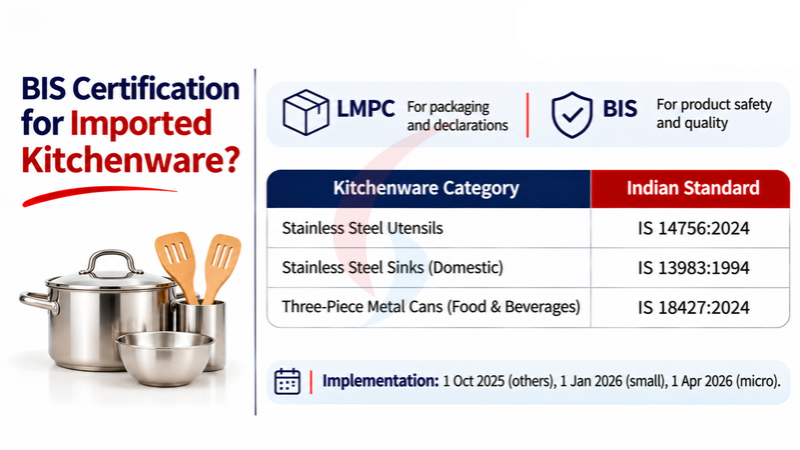
LMPC Registration and BIS certification are separate legal requirements. LMPC primarily concerns packaged commodity registration and consumer-facing declarations. BIS certification concerns conformity with the relevant product safety and quality standards.
Under the Cookware, Utensils and Cans for Foods and Beverages (Quality Control) Order, 2026, certain kitchenware products must conform to specified Indian Standards and bear the BIS Standard Mark under an appropriate licence.
|
Kitchenware Category |
Applicable Indian Standard |
|
Stainless Steel Utensils |
IS 14756:2024 |
|
Stainless Steel Sinks for Domestic Purposes |
IS 13983:1994 |
|
Three-Piece Round Open-Top Metal Cans for Foods and Beverages |
IS 18427:2024 |
The March 2026 Order specifies phased implementation dates and conditional exemptions. The general commencement dates in its table are 1 October 2025 for enterprises other than micro and small enterprises, 1 January 2026 for small enterprises and 1 April 2026 for micro enterprises.
The Order also addresses specified previously manufactured or imported stock and limited research-and-development imports. Other kitchen products, such as domestic pressure cookers, may be subject to separate Quality Control Orders and Indian Standards.
LMPC Registration for Kitchenware Sold on Amazon and Flipkart
Many importers sell kitchen products directly through online marketplaces. For example, a business may import reusable food containers from China and sell them through Amazon, Flipkart or its own website. Where the products are covered pre-packaged commodities, the importer must comply with the applicable registration and packaging requirements. Selling through a marketplace does not remove those obligations.
The e-commerce listing must also comply with applicable Legal Metrology disclosure requirements, including the prescribed information about the product. In 2026, the government introduced additional country-of-origin filtering requirements for e-commerce entities selling imported products. Importers should provide accurate product information to online platforms and ensure consistency between their listings and packaging.
For more information, read LMPC Registration for Amazon and Flipkart Sellers
Does Plastic Packaging Create Additional EPR Obligations?
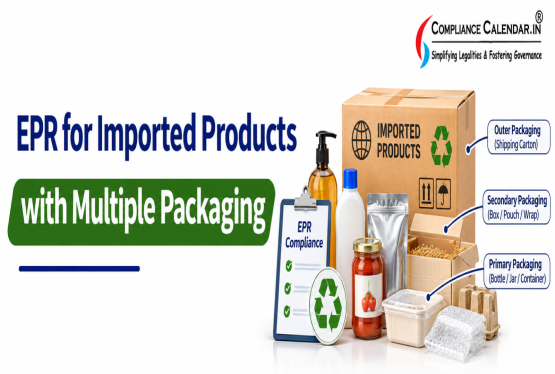
Imported kitchenware is often sold in plastic wrappers, pouches, trays or other packaging materials. For example, a glass storage container set may contain a plastic protective tray and outer plastic film. A frying pan may be packaged with plastic wrapping to prevent damage during transport.
Such packaging may create separate Extended Producer Responsibility (EPR) obligations under the Plastic Waste Management Rules, 2016, as amended. Whether EPR Registration applies depends on the importer's regulated category, the packaging materials involved and the applicable rules. LMPC Registration does not replace EPR compliance.
Businesses importing products with several packaging materials can read EPR for Imported Products with Multiple Packaging
Latest Legal Metrology and Kitchenware Import Updates in 2026
Several important regulatory changes in 2026 affect kitchenware importers, especially those selling packaged goods through retail stores and online marketplaces.
|
Government Update |
Date |
What It Means for Kitchenware Importers |
|
Country-of-Origin Filter for E-Commerce |
13 February 2026 |
From 1 July 2026, e-commerce entities selling imported products must provide a searchable and sortable country-of-origin filter. |
|
Cookware, Utensils and Cans QCO, 2026 |
30 March 2026 |
Specifies BIS certification requirements for covered stainless steel utensils, domestic sinks and food or beverage cans. |
|
LMPC Registration Amendment |
29 May 2026 |
Registration certificates remain valid until cancelled, with prescribed annual updates to registration particulars. |
|
Bonded Warehouse Labelling Permission |
29 May 2026 |
Allows mandatory declarations at eligible AEO Tier-2 and Tier-3 bonded warehouses before goods leave the warehouse. |
|
Fourth Amendment to Packaged Commodities Rules |
21 September 2026 |
Issued further amendments; importers should check the updated rules for any provisions affecting their products. |
The May 2026 amendment is particularly important because importers must distinguish between registration validity and the requirement to maintain accurate registration information.
Penalties for LMPC Non-Compliance
Importers who fail to meet the applicable Legal Metrology requirements may face penalties, enforcement proceedings and customs-related difficulties. For example, if KitchenCraft imports packaged frying pans without the prescribed importer details or MRP, the company may need to address the non-compliance before the goods can lawfully be sold.
Section 36 of the Legal Metrology Act, 2009 addresses specified violations involving packaged commodities. The applicable consequences must also be read with the amendments introduced through the Jan Vishwas legislative changes in 2026. Importers should use the current statutory provisions when determining penalties rather than relying on outdated fixed-penalty figures.
For related guidance, read Customs Clearance Without LMPC Registration
Why Choose Compliance Calendar LLP ?
Compliance Calendar LLP assists importers, manufacturers and online sellers with LMPC Registration, product documentation and Legal Metrology compliance. Our team helps kitchenware importers review registration applicability, prepare supporting documents, understand mandatory package declarations and identify relevant compliance requirements before import.
We also assist businesses with changes in registration particulars and related import compliance procedures. For professional assistance, explore our LMPC Registration Service.
For enquiries, contact Compliance Calendar LLP by email at info@ccoffice.in or via WhatsApp at 9988424211
Frequently Asked Questions (FAQs)
Q1. Is LMPC Registration mandatory for imported kitchenware?
Ans: Yes, where the importer deals in covered pre-packaged kitchenware and the relevant registration provisions apply. Certain products or transactions may qualify for statutory exclusions.
Q2. Which law governs LMPC Registration for kitchenware?
Ans: The Legal Metrology Act, 2009 and the Legal Metrology (Packaged Commodities) Rules, 2011 govern the main requirements. Rule 27 addresses registration, while Rule 6 covers mandatory package declarations.
Q3. Is LMPC Registration required for stainless steel utensils?
Ans: It is generally applicable when stainless steel utensils are imported as covered retail packages. Importers must separately examine mandatory BIS certification requirements for the relevant utensil category.
Q4. What is the government fee for LMPC Registration?
Ans: The prescribed application fee under Rule 27 is Rs 500. Additional expenses may arise from professional assistance, documentation and packaging compliance.
Q5. Is MRP mandatory on imported kitchenware?
Ans: MRP is required on covered retail packages under the applicable rules. The declared maximum retail price must include applicable taxes and be displayed in the prescribed manner.
Q6. Can imported kitchenware be sold online without LMPC Registration?
Ans: Where registration is applicable, selling through Amazon, Flipkart or another marketplace does not remove the requirement. Applicable online product information rules must also be followed.
Q7. Does an LMPC certificate expire every year?
Ans: Under the May 2026 amendment, registration certificates remain valid until cancelled. However, companies and firms must comply with the prescribed annual updating requirements.
Q8. Can kitchenware labels be corrected after import?
Ans: Certain permitted arrangements are available, including mandatory declarations at eligible AEO Tier-2 and Tier-3 bonded warehouses. All applicable conditions must be satisfied before the products leave those warehouses.
Q9. Is BIS certification required for imported kitchenware?
Ans: BIS certification is mandatory for specified products covered by applicable Quality Control Orders. Importers should identify the exact product standard and any applicable exemption.
Q10. Can Compliance Calendar LLP assist with LMPC Registration for imported kitchenware?
Ans: Yes. Compliance Calendar LLP assists with registration documentation, applicability reviews, packaging declarations and related import compliance requirements.
Article last updated on : 27 Nov 2026.











_learn_crop10_thumb.jpg)