



A jewellery showroom keeps some of its most valuable products on display every day. Gold necklaces, diamond rings, silver articles and other expensive items attract customers, but they also make the showroom a place where security needs special attention. This is why many jewellery shop owners hire security guards to manage entry, watch customer movement and protect their business.
But before hiring guards, one question often comes up: Does a jewellery showroom need a PSARA License, or does the security agency providing the guards need it?
The answer depends on how the showroom arranges its security. If a jewellery shop hires guards from an outside private security agency, the agency must hold the required PSARA License for the state where it provides services. The jewellery showroom does not automatically need its own PSARA License just because it hires guards to protect its shop. However, if the jewellery business itself starts providing security guards to other businesses, the licensing requirement may apply to it. Understanding this difference is important. It helps jewellery showroom owners choose the right security provider, check the necessary documents and avoid problems caused by hiring an unlicensed agency.
Does a Jewellery Showroom Need a PSARA License?
In the usual situation, a jewellery showroom does not need a separate PSARA License simply to hire security guards for its own premises. The Private Security Agencies (Regulation) Act, 2005 mainly regulates businesses that provide private security services to other people, companies and establishments.
For example, if a jewellery showroom hires two guards from a private security agency, the agency providing those guards must have the required PSARA License. The showroom should check the agency's licence before signing the agreement and allowing the guards to start work.
The position is different when a business starts providing security services to other customers. If a jewellery company creates its own security service business and supplies guards to other shops, offices or commercial establishments, it may fall within the definition of a private security agency under PSARA.
|
Situation |
Is a PSARA License Required? |
|---|---|
|
Hiring guards directly for your own jewellery showroom |
The showroom does not automatically need a PSARA License just to employ guards for its own premises. |
|
Providing security guards to other businesses |
The business must obtain a PSARA License before operating as a private security agency. |
|
Hiring guards through an outside security agency |
The security agency must hold a valid PSARA License for the state where it provides security services. |
If you want to understand the wider rules, you can also read our article on Is PSARA License Mandatory in India?.
Who Is Responsible for Getting a PSARA License?
This is one of the most important questions for jewellery showroom owners. Many people think that every business employing security guards must obtain a PSARA License. That is not how the law works.
Section 2 of the PSARA Act defines a private security agency in relation to the business of providing private security services, including security guards, to another person or property. Section 4 says that a person cannot carry on or start the business of a private security agency without a licence.
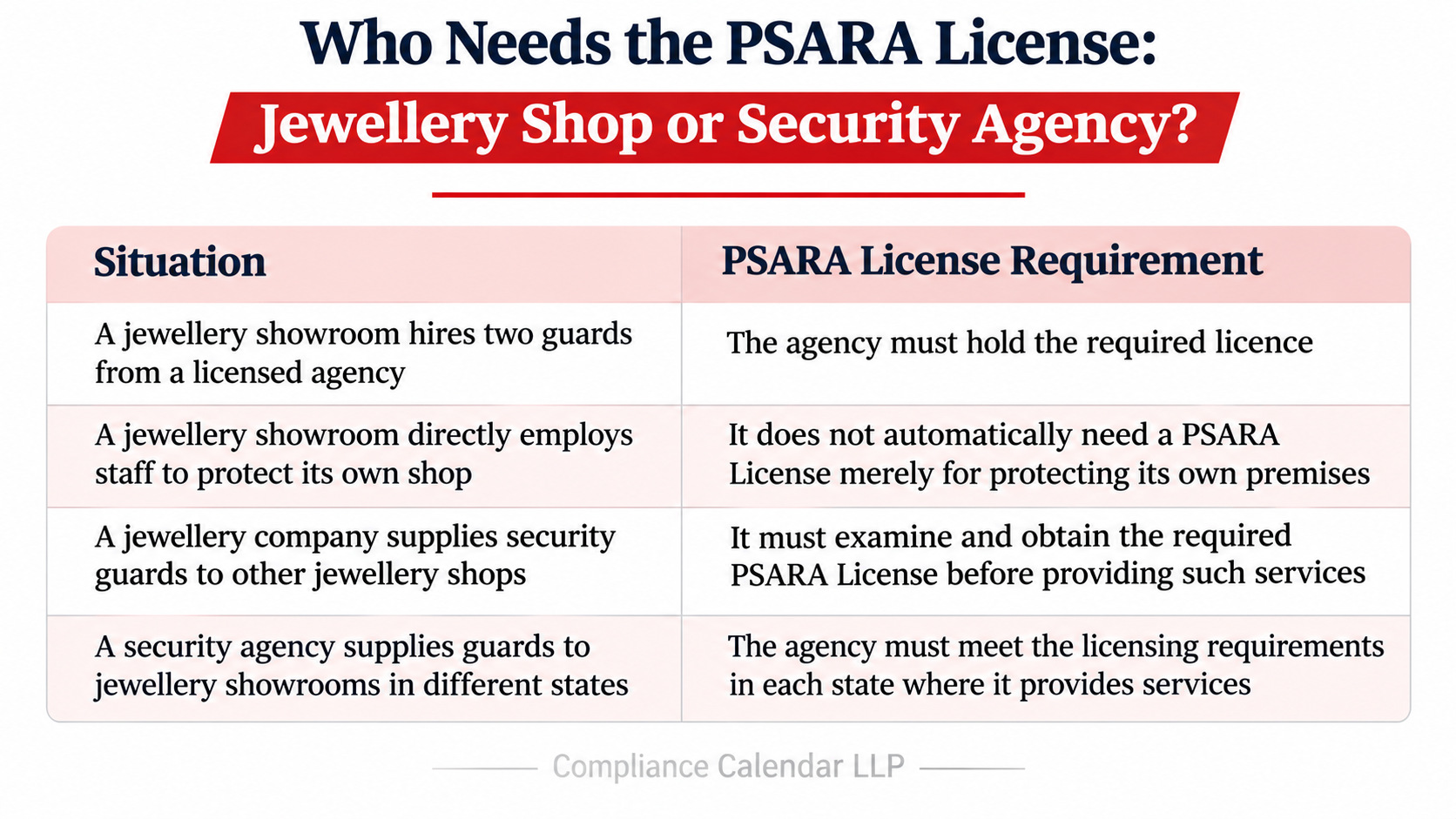
Look at the difference between these situations:
|
Situation |
PSARA License requirement |
|
A jewellery showroom hires two guards from a licensed agency |
The agency must hold the required licence |
|
A jewellery showroom directly employs staff to protect its own shop |
It does not automatically need a PSARA License merely for protecting its own premises |
|
A jewellery company supplies security guards to other jewellery shops |
It must examine and obtain the required PSARA License before providing such services |
|
A security agency supplies guards to jewellery showrooms in different states |
The agency must meet the licensing requirements in each state where it provides services |
The nature of the work matters more than the name of the business. A company cannot avoid PSARA requirements simply by calling its guards helpers, watchmen or support staff if the actual service is private security.
For a better understanding of which other businesses may need this licence, read Businesses That Need PSARA License.
How Does PSARA Apply When a Jewellery Showroom Hires Security Guards?
Jewellery showroom owners generally arrange security in one of two ways. They either hire guards through an outside security agency or directly employ people to protect their own premises. The legal position should be understood according to the arrangement.
When the showroom hires guards through an agency
This is a common arrangement for jewellery businesses. The showroom signs a service agreement with a private security agency, and the agency sends guards to the shop. In this situation, the agency is providing private security services to another business. It must hold the required PSARA License.
The showroom should ask for the licence copy, check its validity and confirm that it covers the state where the showroom is located. It should also ask how the agency handles guard verification, training, supervision and replacement.
When the showroom directly employs guards
Some jewellery businesses prefer to employ their own security staff instead of paying an outside agency. If the employees are hired only to protect the showroom's own property, that arrangement does not automatically make the jewellery business a private security agency.
However, the situation should be reviewed if the company also supplies security personnel to another business, a separate company or outside customers. The actual arrangement and the nature of the services will matter.
In both cases, the showroom should maintain proper security arrangements and follow other employment and business requirements that apply to it.
A Jewellery Showroom in Mumbai: Understanding the Practical Situation
Consider an illustrative situation involving Shree Ganesh Jewellers, a jewellery showroom in Mumbai. The shop sells gold necklaces, diamond rings and other valuable jewellery. During the wedding season, customer visits increase, and the owner decides to hire two security guards.
The owner contacts two private security agencies. Both offer guards at different monthly prices. One agency is cheaper, while the other provides its PSARA License, guard details and information about its verification and training process.
Before making a decision, the owner asks a few questions:
- Does the agency have a valid PSARA License for Maharashtra?
- Are the two guards properly verified?
- Have they completed the required security training?
- Who will supervise them?
- What happens if one guard does not report for duty?
- Can the agency provide a replacement quickly?
The owner checks the documents and selects the agency after reviewing its licence and service arrangements.
In this situation, Shree Ganesh Jewellers is hiring security services to protect its own showroom. It is not running a private security agency or supplying guards to other businesses. Therefore, it should focus on checking the licence and compliance of the agency it hires rather than assuming that it must obtain a PSARA License in its own name.
What Should You Verify Before Hiring a Security Agency?
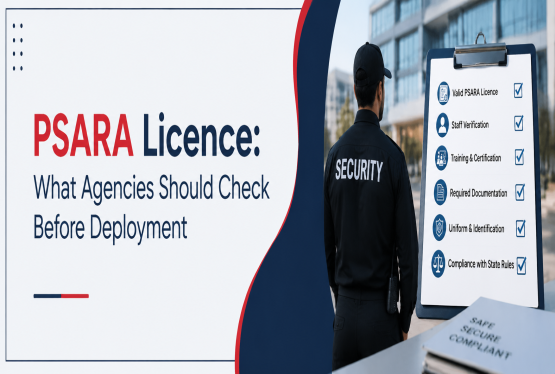
A jewellery showroom should not hire a security agency only because it offers guards at a low price. The guards may be responsible for watching the entrance, managing visitors and reporting suspicious activity. The showroom should therefore check whether the agency is properly licensed and whether it follows the required process for selecting and managing its guards.
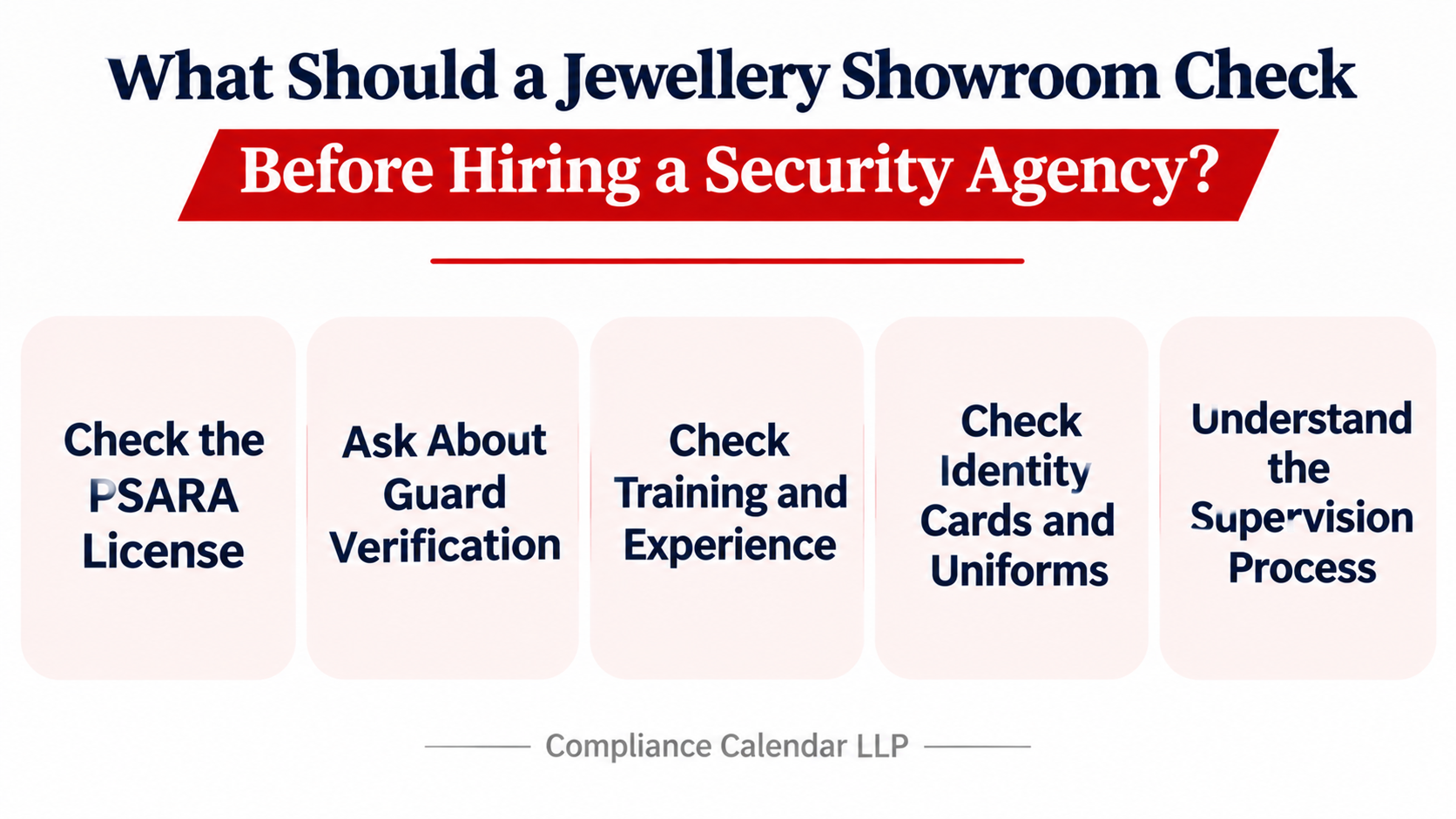
Here are some important checks to make before signing the agreement.
1. Check the PSARA License
Ask the agency for a copy of its PSARA License. Check the name of the licence holder, licence number, validity and state coverage. The details should match the agency that is signing the agreement and providing the guards.
If the showroom is in Mumbai, the agency should have the required licence coverage for Maharashtra. A licence issued for another state should not be treated as automatic permission to provide services in Maharashtra.
2. Ask About Guard Verification
Security guards may work near valuable jewellery, customers, employees and storage areas. The showroom should ask the agency how it checks the identity, address and background of the guards before deployment.
The agency must follow the character and antecedent verification requirements under the applicable PSARA rules. The showroom can ask for confirmation that the required checks have been completed and keep basic details of the guards posted at its premises.
3. Check Training and Experience
A jewellery showroom needs guards who can remain alert while dealing politely with customers. They should know how to manage entry, report unusual activity and respond to an emergency without creating unnecessary panic.
Ask whether the guards have completed the training required under the applicable rules. It is also useful to know whether they have experience working in showrooms, banks, commercial buildings or other places where valuable goods are handled.
4. Check Identity Cards and Uniforms
Ask whether the agency issues photo identity cards to its guards. The showroom should be able to identify every guard posted at its premises and know which agency they work for.
The guards should also wear the uniform prescribed by the agency and applicable rules. Their appearance should not create confusion with the police or armed forces.
5. Understand the Supervision Process
Ask who will supervise the guards and how the agency will check their attendance and work. The showroom should have the contact details of the supervisor or agency representative.
It should also be clear what happens if a guard is absent, leaves the job or needs to be replaced. A proper replacement arrangement helps the showroom avoid gaps in security.
What Documents Should a Jewellery Showroom Ask From the Security Agency?
The showroom does not need to collect every document that the agency submits to the licensing authority. However, it should maintain basic records to confirm that the agency is authorised to provide services and that the guards posted at the shop are properly identified.
|
Document or information |
Why should the showroom check it? |
|
PSARA License copy |
To check that the agency holds the required licence |
|
Agency business details |
To confirm the identity of the service provider |
|
Security service agreement |
To understand the duties, charges and responsibilities |
|
Guard identity details |
To know who is posted at the showroom |
|
Verification confirmation |
To check whether required background checks have been completed |
|
Training details |
To understand whether guards have received the required training |
|
Duty roster |
To know which guards are responsible for each shift |
|
Supervisor contact details |
To report problems and coordinate with the agency |
|
Insurance and other relevant documents, where applicable |
To understand the protection and responsibilities agreed between the parties |
For more information visit : Documents Required for PSARA License
What Are the Responsibilities of the Security Agency?
A security agency cannot treat its work as simply sending guards to stand at the entrance of a jewellery showroom. It must follow the PSARA Act, applicable state rules and the conditions of its licence.
|
Responsibility |
What Does the Agency Need to Do? |
|---|---|
|
Valid PSARA License |
Hold the required PSARA License before carrying on private security agency business. |
|
Background Verification |
Complete the required character and background checks of security guards and supervisors. |
|
Guard Training |
Ensure that guards receive the training prescribed under the applicable rules. |
|
Identity Cards |
Issue photo identity cards to security guards as required. |
|
Record Maintenance |
Maintain the records required under the PSARA Act and applicable rules. |
|
Supervision |
Arrange proper supervision and manage guards deployed at the showroom. |
|
Confidentiality |
Ensure guards do not misuse or share sensitive information they learn while working at the showroom. |
These responsibilities are especially important for jewellery showrooms because security agencies may get access to sensitive business information, such as entry procedures, working hours, stock movement arrangements and emergency contact details.
For a closer look at how agencies should manage guards after deployment, read PSARA Licence: Managing Security Guards at Client Locations.
What Should Security Guards Do at a Jewellery Showroom?
The work of a security guard at a jewellery showroom is not limited to standing near the entrance. The showroom should explain the duties clearly before the guard begins work.
Depending on the showroom's layout and agreement with the agency, the duties may include:
- Watching the main entrance and exit.
- Observing unusual movement around the showroom.
- Helping manage visitor entry.
- Keeping watch over delivery and stock movement areas.
- Informing the showroom manager about suspicious activity.
- Helping staff follow emergency procedures.
- Contacting the supervisor or emergency services when required.
- Following the showroom's opening and closing security instructions.
A guard should not be expected to act like a police officer. If a customer behaves suspiciously, the guard should follow the showroom's approved reporting process and inform the manager. Any further action should be handled safely and lawfully.
The showroom should also avoid giving unclear instructions that could create arguments with customers or put guards in situations beyond their training and lawful duties.
Can a Jewellery Showroom Hire Its Own Security Guards?
Yes, a jewellery showroom may choose to employ people directly to protect its own premises instead of hiring guards through an outside security agency. The important difference is that the showroom is protecting its own property and is not necessarily carrying on the business of providing private security services to others.
Section 4 of PSARA prohibits carrying on the business of a private security agency without the required licence. The definition in Section 2 focuses on a person or organisation engaged in the business of providing private security services to another person or property.
Therefore, direct employment of guards for the showroom's own security does not automatically require the showroom to obtain a PSARA License. However, the arrangement should be reviewed if the jewellery company also supplies guards to other businesses, franchisees or separate customers.
Direct employment does not mean that the showroom can ignore other responsibilities. Depending on the employment arrangement, it may need to follow applicable wage, labour, social security, workplace safety and local establishment requirements.
What If Your Jewellery Business Has Showrooms in Different States?
Many jewellery brands operate more than one showroom. A business may have branches in Mumbai, Pune, Delhi, Jaipur, Bengaluru or other cities. In such cases, the owner should check the security arrangements at each location.
If the jewellery company hires security agencies to protect its own branches, it does not automatically need a separate PSARA License for every showroom. The important question is whether the company itself is providing private security services as a business.
However, the security agency providing guards must meet the licensing requirements for the state where it operates. A licence issued in Maharashtra, for example, should not be assumed to cover security services in Delhi or Karnataka.
For a jewellery company with multiple branches, it is sensible to maintain a branch-wise record of:
- Name and contact details of the security agency.
- PSARA License details and validity.
- Number of guards deployed.
- Guard identity and verification records.
- Service agreement and monthly charges.
- Supervisor details and emergency contacts.
This makes it easier for the company to review its security arrangements and follow up when a branch changes its service provider.
What Are the Risks of Hiring an Unlicensed Security Agency?
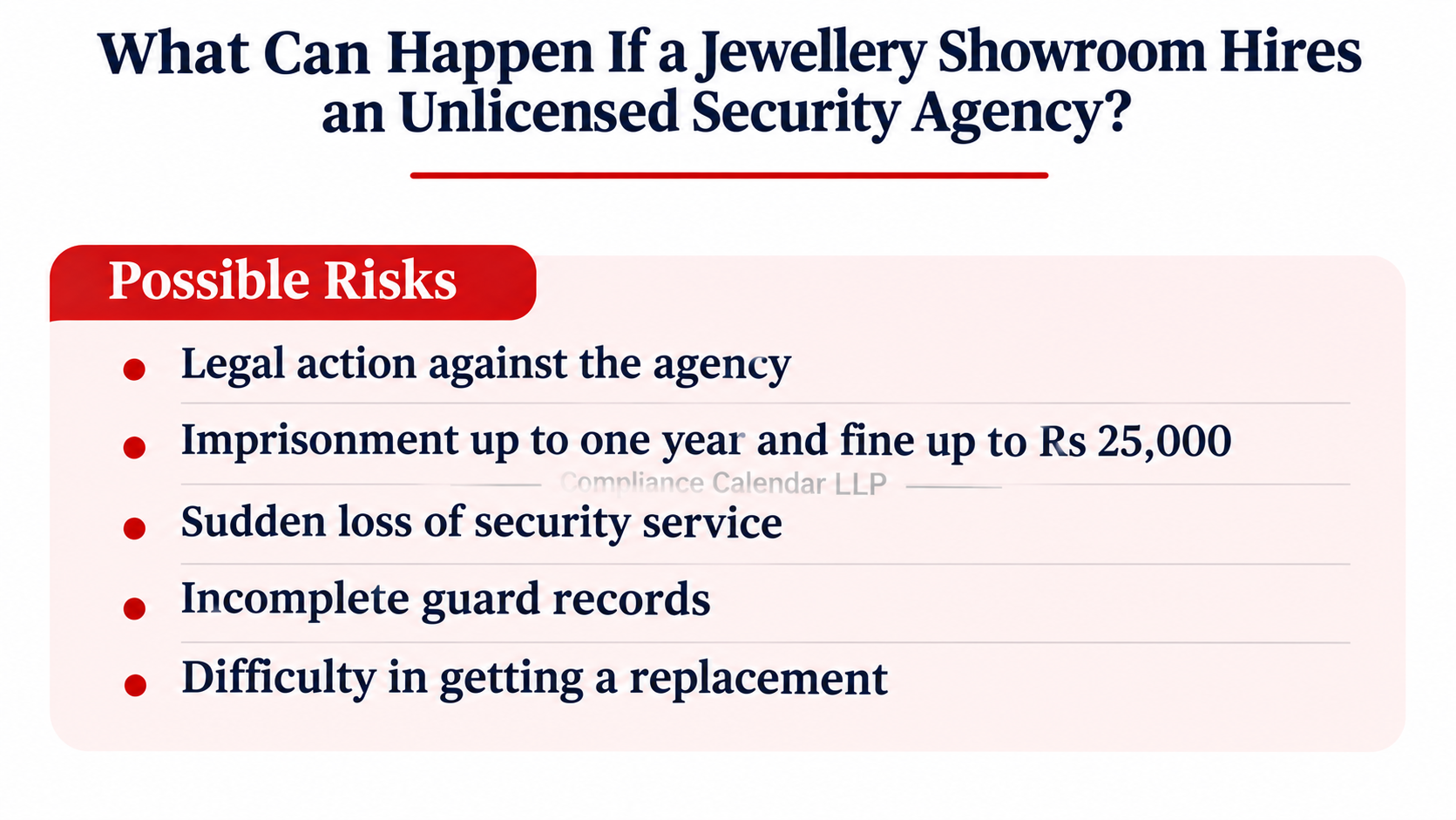
Hiring an agency without checking its PSARA License can create legal and business problems. The agency may be carrying on private security agency business without the licence required under the law. If the authority takes action against it, the showroom may suddenly lose its security service and need to find another provider.
Section 20 of the PSARA Act provides punishment for a person who contravenes Section 4. The punishment may extend to imprisonment for one year, a fine of up to Rs 25,000, or both. This provision addresses the person carrying on private security agency business without the required licence. A jewellery showroom does not automatically become the unlicensed agency simply because it hires guards, but it should still check the provider carefully.
There can also be practical problems. The showroom may not have proper guard records, may find it difficult to confirm who is posted at the premises or may struggle to get a replacement when a guard is absent.
Before hiring an agency, take these simple steps:
- Ask for a copy of the PSARA License.
- Check the licence holder's name, validity and state coverage.
- Keep a copy of the licence and service agreement.
- Ask for guard identity and verification details.
- Confirm the training and supervision arrangements.
- Review the agency's service regularly.
A few checks before signing the contract can help avoid unnecessary problems later.
Is PSARA License the Only Security Check a Jewellery Showroom Needs?
No. A PSARA License is an important check on the agency, but it is not a complete security plan for a jewellery showroom.
The owner should also think about how the guards will work with the showroom's staff and security systems. Depending on the shop's size and location, useful measures may include CCTV cameras, alarm systems, secure storage, access control, stock movement records and emergency contact arrangements. The showroom should have a clear process for reporting theft, suspected fraud, fire, medical emergencies and other incidents. Staff should know whom to contact and how to preserve relevant information for the police or other authorities when required.
For example, a guard may notice that a visitor is repeatedly trying to enter a restricted area. The guard should know how to inform the showroom manager, follow the shop's security instructions and avoid creating an unnecessary confrontation.
How Compliance Calendar LLP Can Help With PSARA License Matters
A jewellery showroom generally does not need to apply for a PSARA License just because it hires guards to protect its own premises. However, a person or business planning to start a private security agency or provide guards to other establishments must understand the licensing requirements before starting operations.
Compliance Calendar LLP helps businesses understand PSARA requirements and supports eligible applicants with documentation, application preparation, filing and follow-up with the concerned authority. We can also guide businesses on the licensing requirements based on the state in which they plan to provide security services.
If you are planning to start a private security agency or need help understanding PSARA compliance, our team can assist you with the next steps connect us on +91 9988424211 or info@ccoffice.in
Frequently Asked Questions About PSARA License for Jewellery Showrooms
1. Does a jewellery showroom need a PSARA License?
A jewellery showroom does not automatically need a PSARA License just because it hires guards to protect its own premises. If it hires guards through an outside private security agency, the agency must hold the required licence for the relevant state.
2. Is PSARA License required to hire two security guards?
The number of guards does not decide whether a PSARA License is required. The main question is whether the business is hiring guards for its own premises or providing private security services to other people or businesses.
3. Who is responsible for obtaining the PSARA License: the jewellery shop or the security agency?
When a jewellery shop hires guards from an outside security agency, the agency is responsible for obtaining the required PSARA License. The showroom should check the licence before hiring the agency.
4. Can a jewellery shop hire security guards directly?
Yes. A jewellery shop may directly employ people to protect its own premises. This does not automatically make it a private security agency. However, other employment and business compliance requirements may apply.
5. Does PSARA apply to gold and diamond showrooms?
PSARA does not require every gold or diamond showroom to obtain a licence merely because it employs security staff for its own protection. The licensing requirement generally applies to businesses providing private security services to others.
6. Does a jewellery showroom in a shopping mall need a separate PSARA License?
Not automatically. If the showroom hires guards from an outside agency, the agency must have the required licence. The showroom should also check the mall's security arrangements and its own service agreement.
7. What should a jewellery shop check before hiring a security agency?
The showroom should check the agency's PSARA License, validity, state coverage, guard identity details, verification process, training information, duty roster and supervisor contact details. It should also sign a written agreement explaining the service and responsibilities.
8. Is police verification required for jewellery showroom security guards?
The security agency must follow the character and antecedent verification requirements under the applicable PSARA rules. A showroom should ask the agency to confirm that the required verification has been completed before the guards start work.
9. Can a jewellery showroom hire guards from an agency without a PSARA License?
A showroom should not hire an agency that is carrying on private security agency business without the required licence. It should ask for valid licence details and check the agency's status before allowing guards to start work.
10. Does a security agency need a separate PSARA License for each state?
PSARA licensing is handled by the relevant State or Union Territory authority. An agency planning to provide services in more than one state must meet the licensing requirements applicable in each state. It should not assume that one state's licence automatically covers the whole country.
11. Can one security agency provide guards to all branches of a jewellery brand?
Yes, an agency may provide services to multiple branches if it has the required licence coverage and meets the applicable requirements in each state. The jewellery company should check the agency's licence details for every branch location.
12. What happens if a security agency's PSARA License expires?
An agency should not continue private security agency business without the required valid licence. A jewellery showroom should check the licence's validity and ask the agency for updated details before continuing the service arrangement.
13. Are security guards required to undergo training under PSARA?
Yes. The applicable PSARA rules prescribe training requirements for security guards and supervisors. Under the Central Model Rules, 2020, entry-level guards generally require at least 20 working days of training, including classroom and field training. Different training periods apply to certain former police personnel and ex-servicemen.
14. Can a jewellery showroom provide security guards to another jewellery shop without a PSARA License?
If a jewellery business starts providing private security services or supplying guards to another business, it may fall within the definition of a private security agency. It should check the PSARA licensing requirement and obtain the required licence before starting those services.
15. What is the punishment for running a private security agency without a PSARA License?
Under Section 20 of the PSARA Act, a person who violates Section 4 by carrying on private security agency business without the required licence may face imprisonment for up to one year, a fine of up to Rs 25,000, or both.
Article last updated on : 24 Nov 2026.













_learn_crop10_thumb.jpg)