


Political parties in India need money to organise meetings, run offices, communicate with voters and carry out election-related activities. This money may come from individual citizens, companies and other eligible donors. However, a political party cannot accept every donation without checking who is giving the money and whether the donation follows the law.
The main rules for political party donations are covered under the Representation of the People Act, 1951, the Companies Act, 2013, the Foreign Contribution (Regulation) Act, 2010 (FCRA), and the Income-tax Act, 2025. These laws explain who can donate, which donations are not allowed, how much cash a party can receive, when donor details must be reported and what records a political party must maintain.
A political party that does not follow these rules may face problems with its tax benefits and other legal compliance requirements. This article explains the main political party donation rules in India in simple language for political parties, donors and companies.
Who Can Donate Money to a Political Party in India?
Under Section 29B of the Representation of the People Act, 1951, a political party can accept voluntary contributions from eligible persons and companies. This may include Indian citizens, business owners, firms and companies, subject to the restrictions under the applicable laws.
An individual can donate money to a political party through a permitted payment method. A company can also make a contribution, but it must follow the conditions under Section 182 of the Companies Act, 2013. A political party should check the identity and eligibility of the donor before accepting the contribution, particularly where the source of money is not clear.
A political party should also understand the difference between receiving a donation and receiving a donation that qualifies for tax benefits. For example, the tax treatment of a contribution depends on whether the political party is registered under Section 29A of the Representation of the People Act, 1951 and whether the donor has followed the required payment conditions.
You can read our guide on How to Register a Political Party in India
Who Is Not Eligible to Donate to a Political Party?
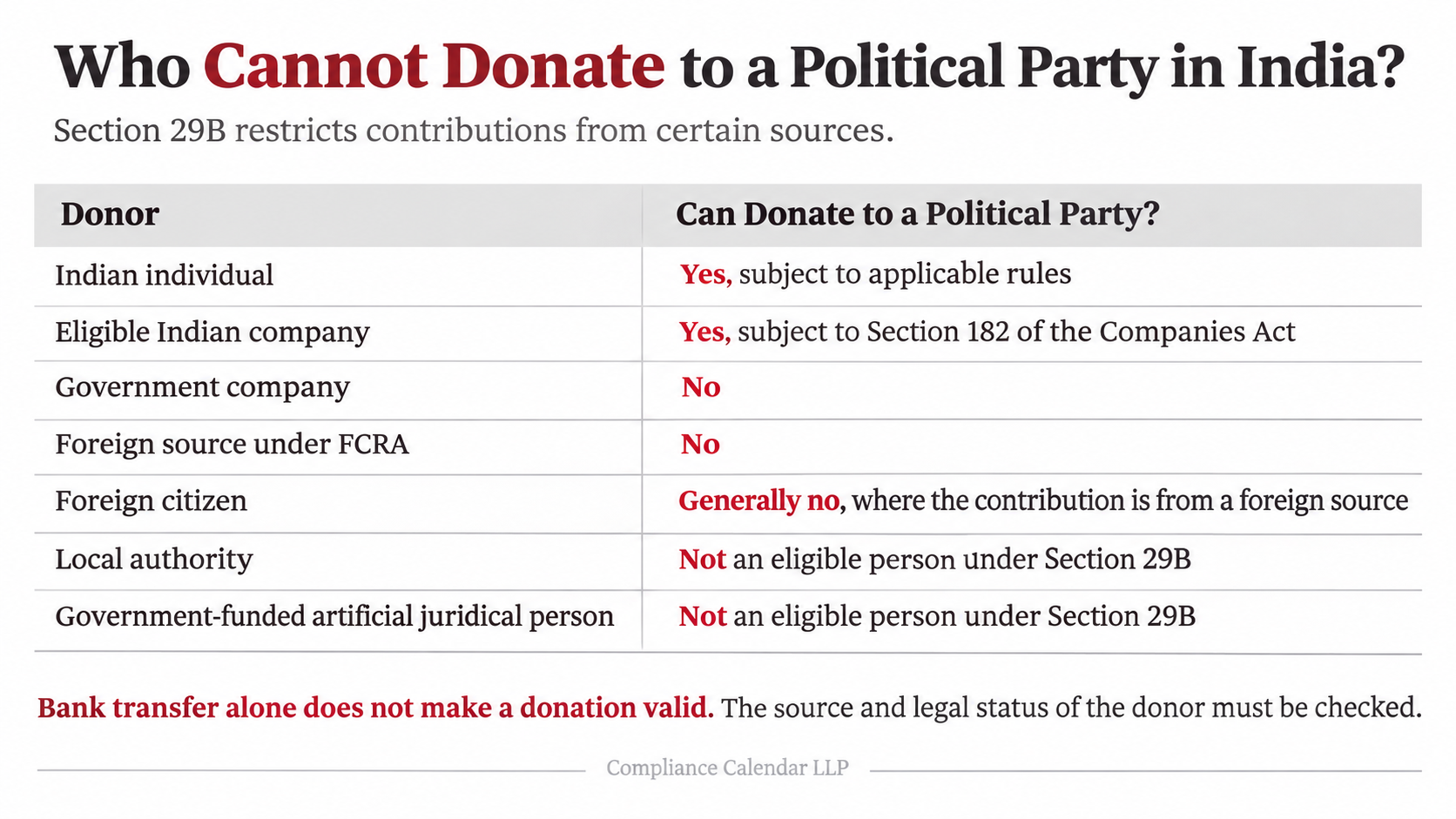
Not every person or organisation is allowed to contribute money to a political party. Section 29B of the Representation of the People Act, 1951 places restrictions on contributions from foreign sources and Government companies. The law also excludes certain Government-funded bodies from the meaning of an eligible person for this purpose.
A political party cannot accept a contribution from a foreign source as defined under the FCRA. It must also avoid accepting donations from Government companies. These restrictions apply even if the donor is willing to transfer the money voluntarily.
The following table explains some important restrictions:
|
Donor |
Can the donor contribute? |
|
Indian individual |
Yes, subject to applicable rules |
|
Eligible Indian company |
Yes, subject to Section 182 of the Companies Act |
|
Government company |
No |
|
Foreign company treated as a foreign source under FCRA |
No |
|
Foreign citizen |
Generally, no, where the contribution is from a foreign source |
|
Local authority |
Not treated as an eligible person under Section 29B |
|
Artificial juridical person wholly or partly funded by the Government |
Not treated as an eligible person under Section 29B |
A political party should not assume that a donation is allowed only because it comes through an Indian bank account. The source of the contribution and the legal status of the donor are also important. If the donor is an overseas Indian or an organisation with foreign connections, the party should check the FCRA position before accepting the money.
Is There a Maximum Limit on Political Party Donations?
The Representation of the People Act, 1951 does not prescribe one general maximum donation limit for every individual donor. This means that an eligible individual may contribute an amount to a political party, subject to the applicable payment, reporting and tax rules.
However, this does not mean that every donor can contribute without restrictions. Companies have a separate limit under Section 182 of the Companies Act, 2013. Foreign-source contributions and donations from prohibited categories are also restricted.
For example, an individual may contribute Rs 50,000 to a political party through a permitted banking method. The party must record the donation and include it in the required contribution report because it is above Rs 20,000. The reporting requirement does not mean that Rs 20,000 is the maximum amount an individual can donate.
Political parties should therefore avoid confusing the donation reporting threshold with the maximum amount that a person can contribute.
Can a Political Party Accept Cash Donations?
Yes, a political party may receive cash donations, but there is an important restriction under the income-tax law. A political party cannot receive a donation exceeding Rs 2,000 in cash if it wants to claim the tax exemption available under Section 12 of the Income-tax Act, 2025.
For donations above Rs 2,000, the payment must be received through an accepted non-cash method, such as an account-payee cheque, an account-payee bank draft, an electronic clearing system through a bank account or another prescribed electronic payment method.
This means that a political party may receive a cash donation of Rs 2,000 or less, subject to the other applicable conditions. However, receiving a small cash donation does not remove the party's responsibility to maintain proper accounts and records.
Example: A person gives Rs 1,500 in cash to a political party. This amount does not cross the Rs 2,000 cash-payment threshold under Section 12. However, if another person gives Rs 10,000 in cash, the party may not satisfy this particular condition for claiming the tax exemption.
The Rs 2,000 rule is different from the Rs 20,000 donation reporting rule. Both apply for different purposes and should not be treated as the same requirement.
What Is the Rs 20,000 Reporting Rule for Political Donations?
Under Section 29C of the Representation of the People Act, 1951, a political party must prepare a report of contributions exceeding Rs 20,000 received from any person or company during a financial year. The report is commonly known as the contribution report and is filed in Form 24A.
The party must maintain the donor's name, address and details of the contribution. If a donor gives more than one contribution during the financial year, the party should check the total amount received from that donor while preparing its report. It should not look at every donation separately and ignore the total contribution.
For example, a person gives Rs 12,000 to a political party in June and another Rs 15,000 in December of the same financial year. The total contribution is Rs 27,000. Since the total exceeds Rs 20,000, the party must include the contribution details in its report.
The important difference between the two limits is:
|
Rule |
What it means |
|
Rs 2,000 |
A donation exceeding this amount cannot be received in cash if the party wants to satisfy the relevant tax-exemption condition |
|
Rs 20,000 |
Contributions exceeding this amount from a person or company must be reported under Section 29C |
The treasurer or another person authorised by the political party must prepare and submit the contribution report to the Election Commission of India. Section 29C links the filing deadline to the due date for furnishing the party's income-tax return. The party should check the applicable filing calendar and any current directions before submitting Form 24A.
You can also read our detailed article on Annual Compliance for Political Parties to understand contribution reporting, audited accounts and other yearly requirements.
How Can Companies Donate to Political Parties in India?
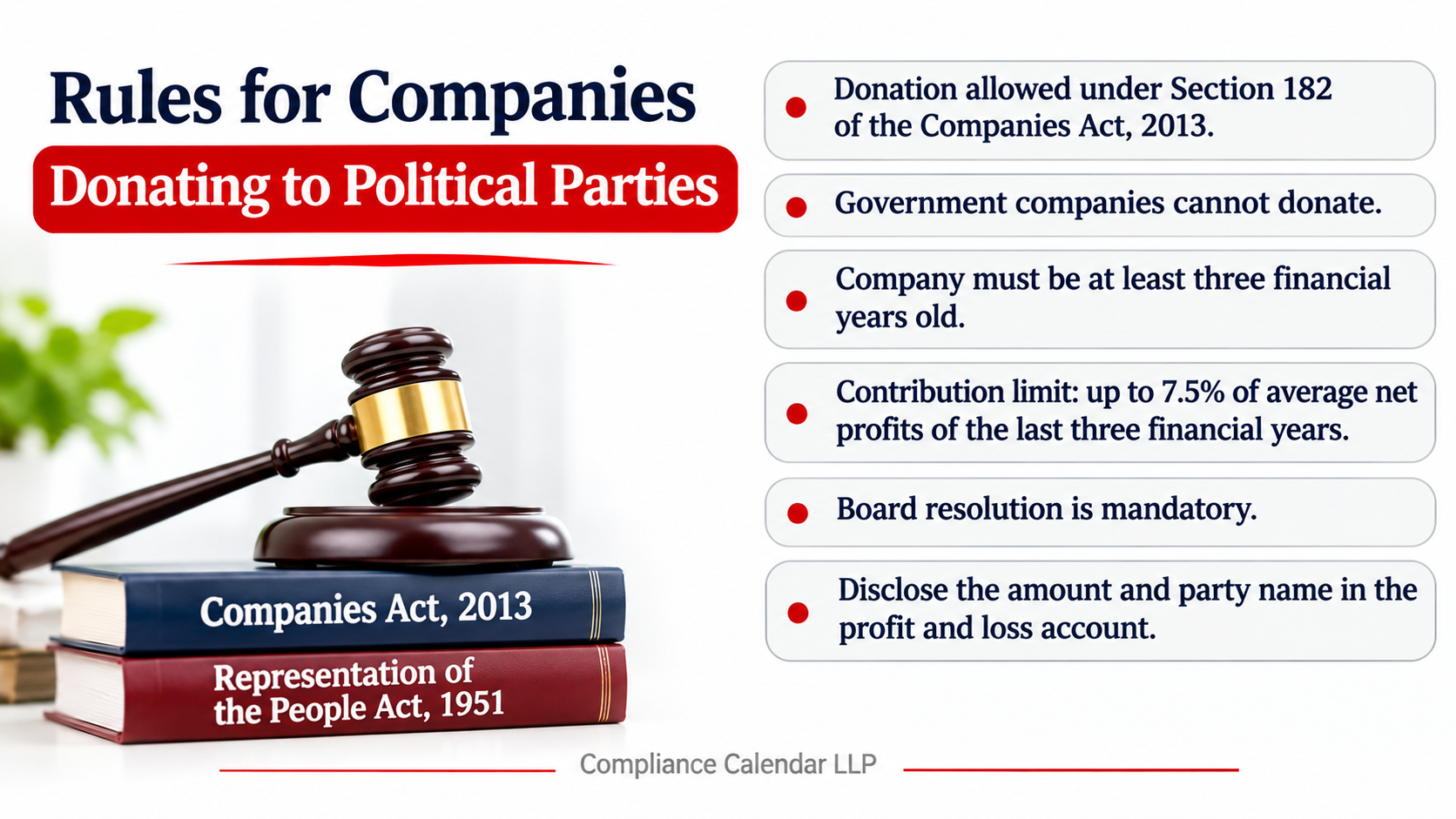
Companies can contribute money to political parties, but they must follow Section 182 of the Companies Act, 2013. The law does not allow every company to make political contributions. A Government company and a company that has not completed three financial years cannot make such contributions. For an eligible company, the total contribution during a financial year cannot exceed 7.5% of its average net profits during the three immediately preceding financial years. The company must also pass a resolution authorising the contribution at a meeting of its Board of Directors.
The company must disclose the amount contributed and the name of the political party in its profit and loss account. A contribution should be properly recorded in the company's books and supported by the relevant Board approval and payment documents.
Example: A company has an average net profit of Rs 2 crore during the three immediately preceding financial years. Its maximum political contribution for the financial year would be Rs 15 lakh, calculated at 7.5% of Rs 2 crore. The company must still satisfy the other conditions under Section 182 before making the contribution.
The Supreme Court's February 2024 judgment on electoral bonds also struck down the removal of the contribution limit under Section 182. Therefore, companies must follow the applicable 7.5% limit rather than assuming that they can contribute any amount.
From 1 April 2026, the Income-tax Act, 2025 applies. Section 136 deals with deductions for contributions made by Indian companies to political parties registered under Section 29A of the Representation of the People Act, 1951, or to electoral trusts. The contribution must not be made in cash, and the company must follow the relevant conditions.
Can Foreign Citizens or Companies Donate to Indian Political Parties?
Indian political parties cannot accept contributions from a foreign source as defined under the Foreign Contribution (Regulation) Act, 2010. Section 29B of the Representation of the People Act, 1951 also restricts political parties from accepting contributions from foreign sources.
This restriction is important because a donation does not become an Indian contribution merely because the money is transferred through an Indian bank account. The identity of the donor and the source of the funds must be checked. A foreign company, foreign citizen or other entity that falls within the definition of a foreign source cannot donate to an Indian political party. A political party should not accept such a contribution without checking the FCRA position.
The position of an Indian citizen living outside India may require a separate check. The FCRA contains specific provisions and exceptions relating to Indian citizens living abroad and money sent from their personal savings through normal banking channels. The party should verify the donor's status and the source of funds before accepting the contribution.
Can a Political Party Accept Donations from an Unregistered Organisation?
A political party may receive a contribution from an organisation only if the donor is legally eligible to make that contribution. The fact that an organisation is not registered under a particular law does not automatically make every contribution from it illegal. The party must check the legal status of the organisation, the source of its funds and whether it falls within the definition of an eligible person under Section 29B. It must also check that the organisation is not a prohibited foreign source, Government company or other restricted body.
For example, an Indian association that is not registered as a company may still need to be examined as an association or body of individuals for the purpose of the applicable law. The political party should obtain the organisation's name, address, authorised representative details and payment information before accepting the contribution.
Can a Political Party Accept Anonymous Donations?
Political parties should maintain proper details of the donations they receive. Under the conditions for tax exemption in Section 12 and Schedule VIII of the Income-tax Act, 2025, a party must maintain records of each voluntary contribution exceeding Rs 20,000, including the name and address of the person who made the contribution.
This means that a political party cannot treat a contribution above Rs 20,000 as an anonymous donation and ignore the donor's details. It must keep the required information and include the contribution in the applicable report.
For smaller contributions, the specific record-keeping condition for donations above Rs 20,000 does not create the same reporting requirement under Section 29C. However, this should not be treated as permission to run unrecorded or unexplained collections. A party should maintain reliable records of all money received so that it can explain its income and spending during an audit or tax assessment.
Note: The party should also ensure that no donation is accepted from a prohibited source merely because the donor's identity is not being disclosed in a public report.
Can Donors Claim Tax Benefits for Political Party Donations?
Yes. Eligible donors may claim a tax deduction for contributions made to a political party, provided they meet the conditions under the Income-tax Act, 2025. The party must be registered under Section 29A of the Representation of the People Act, 1951, and the contribution must not be made in cash. Section 137 of the Income-tax Act, 2025 provides for a deduction for eligible persons who contribute money to a registered political party or an electoral trust. Local authorities and artificial juridical persons wholly or partly funded by the Government are excluded from this benefit.
For companies, Section 136 of the Income-tax Act, 2025 deals with deductions for eligible political contributions. The company must also follow Section 182 of the Companies Act, 2013. A donor should keep the donation receipt, payment proof and other supporting documents. The donor should also check the applicable tax rules for the relevant tax year before claiming the deduction.
The Income-tax Act, 2025 came into effect on 1 April 2026. Older articles may refer to Sections 80GGC and 80GGB of the Income-tax Act, 1961. For contributions governed by the new law, the relevant provisions are Sections 137 and 136, respectively.
What Donation Records Must a Political Party Keep?
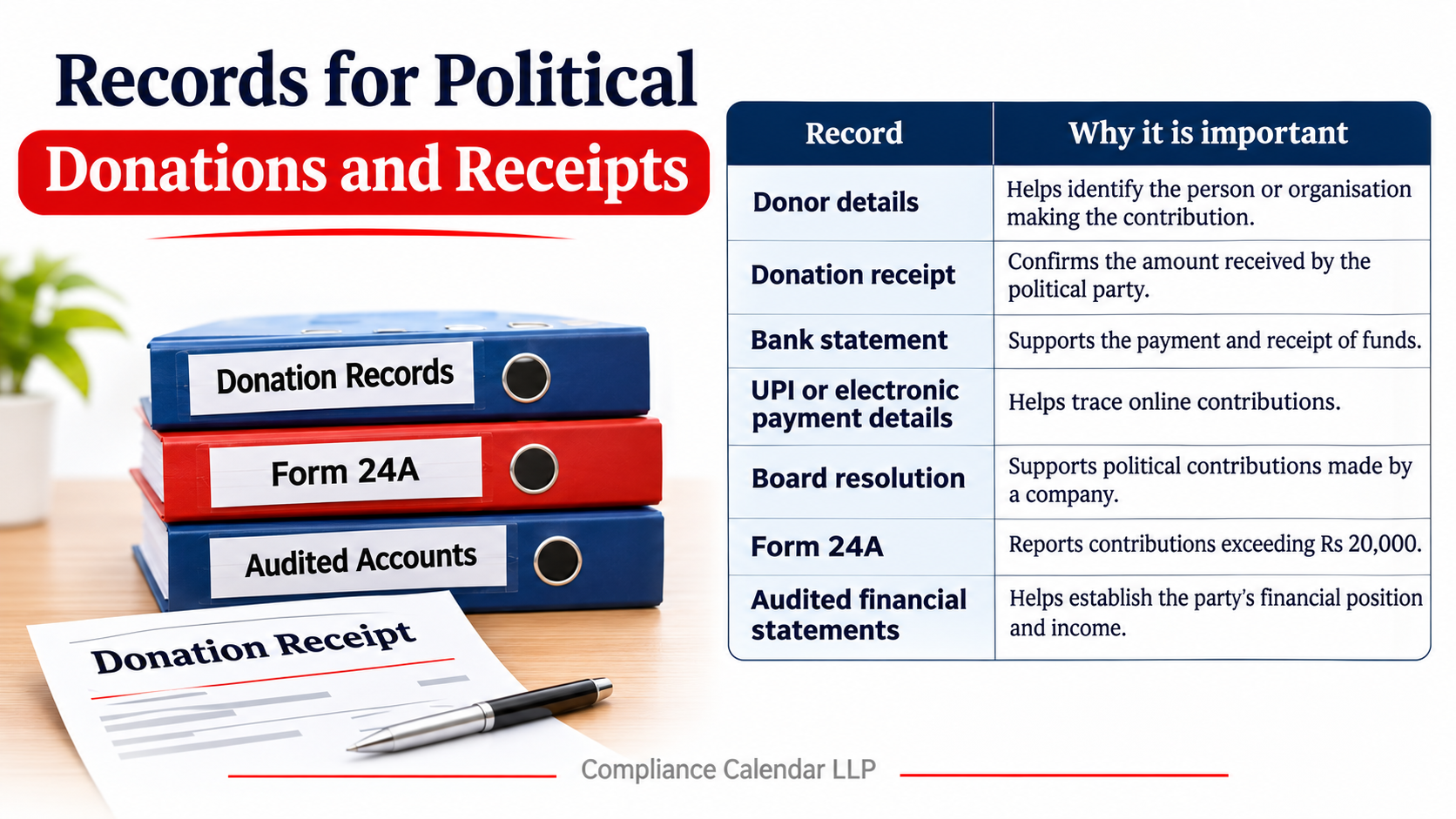
A political party should maintain clear records of every donation received. These records help the party prepare its contribution report, complete its accounts, support its income-tax return and explain the source of its funds.
The party should maintain the donor's name and address, the amount received, the date of receipt, the payment method and the available transaction details. For contributions exceeding Rs 20,000, the party must maintain the specific donor information required under the income-tax law and include the contribution in its Form 24A report.
A political party should also issue a donation receipt or acknowledgement to the donor. The receipt should clearly mention the party's name, donation amount, date, payment method and other relevant details. It should match the party's bank statement and accounting records.
The following records are useful for managing political donations:
|
Record |
Why it is important |
|
Donor details |
Helps identify the person or organisation making the contribution |
|
Donation receipt |
Confirms the amount received by the political party |
|
Bank statement |
Supports the payment and receipt of funds |
|
UPI or electronic payment details |
Helps trace online contributions |
|
Board resolution |
Supports political contributions made by a company |
|
Form 24A |
Reports contributions exceeding Rs 20,000 |
|
Audited financial statements |
Helps establish the party's financial position and income |
A political party must also maintain books of account and get its accounts audited by an accountant to meet the conditions for the relevant tax exemption. It must file its income-tax return within the applicable due date. Keeping proper records throughout the year makes these requirements easier to complete.
For more information about the internal rules and working structure of a political party, read our article on Political Party Constitution: Rules, Format and Requirements.
Are Electoral Bonds Allowed for Political Party Donations?
No. Political parties cannot receive donations through the electoral bond scheme after the Supreme Court struck it down on 15 February 2024. In its judgment, the Supreme Court held that the electoral bond scheme was unconstitutional. The Court also struck down the changes that had removed the 7.5% limit on company political contributions under Section 182 of the Companies Act, 2013.
Therefore, electoral bonds are no longer an available method for making political party donations. Political parties and donors should use lawful and traceable contribution methods and follow the applicable reporting and tax requirements.
What Happens If a Political Party Accepts an Illegal Donation?
Accepting a donation from a prohibited source or failing to follow the applicable reporting and record-keeping rules can create serious compliance problems for a political party. The consequences depend on the nature of the violation and the law involved.
For example, accepting a contribution from a foreign source may violate the FCRA and Section 29B of the Representation of the People Act, 1951. Accepting a company contribution without following Section 182 of the Companies Act, 2013 may also lead to legal consequences for the company and the officers responsible for the violation.
A political party may also lose the tax relief available under Section 12 of the Income-tax Act, 2025 if it does not meet the required conditions. These include maintaining proper books, keeping the required donor records, getting its accounts audited and submitting the contribution report within the applicable deadline. The party should therefore verify donations before accepting them, maintain proper accounts and review its contribution records regularly. If an incorrect or prohibited contribution is received, it should take professional advice on the appropriate legal and accounting steps rather than ignoring the issue.
How Can Compliance Calendar LLP Help with Political Party Donation Compliance?
Managing political party donations involves more than receiving money from supporters. A political party must check donor eligibility, follow payment rules, maintain contribution records, prepare reports and complete its yearly financial compliance.
Compliance Calendar LLP assists political parties with registration and related compliance requirements. Our team can help with understanding applicable donation rules, maintaining the required records, preparing contribution-related filings and managing other political party compliance work.
If you are forming a new political party or need assistance with donation and annual compliance requirements, you can contact Compliance Calendar LLP at +91 9988424211 or info@ccoffice.in
Frequently Asked Questions (FAQs)
1. Can an individual donate money to a political party in India?
Yes. An eligible individual can voluntarily contribute money to a political party. The contribution must follow the applicable payment, reporting and tax rules.
2. Is there a maximum limit on individual political donations?
The Representation of the People Act, 1951 does not prescribe one general maximum limit for individual donations. However, the donor and political party must follow the applicable legal and reporting requirements.
3. Can a political party accept cash donations?
Yes, but a political party cannot receive a donation exceeding Rs 2,000 in cash if it wants to satisfy the relevant tax-exemption condition under Section 12 of the Income-tax Act, 2025.
4. What is the Rs 20,000 rule for political party donations?
A political party must report contributions exceeding Rs 20,000 received from a person or company during a financial year. The report is filed in Form 24A with the Election Commission of India.
5. Can a company donate money to a political party?
Yes. An eligible company can contribute to a political party registered under Section 29A of the Representation of the People Act, 1951. It must follow Section 182 of the Companies Act, 2013, including the 7.5% contribution limit and Board approval requirements.
6. Can a foreign company donate to an Indian political party?
No, where the company falls within the definition of a foreign source under the FCRA. Political parties cannot accept contributions from foreign sources.
7. Can an Indian citizen living abroad donate to a political party?
The answer depends on the donor's status and the source of the money. The FCRA contains specific provisions relating to Indian citizens living abroad and personal savings remitted through normal banking channels. The party should verify the applicable conditions before accepting the donation.
8. Can a political party accept anonymous donations?
A political party must maintain the required donor details for contributions exceeding Rs 20,000. It should also keep proper records of smaller contributions and avoid accepting money from unidentified or prohibited sources.
9. Can a donor claim a tax deduction for a political party donation?
An eligible donor may claim a deduction under Section 137 of the Income-tax Act, 2025 for a non-cash contribution to a political party registered under Section 29A or an electoral trust, subject to the applicable conditions.
10. Is UPI allowed for political party donations?
Electronic payments may be used where they fall within the permitted payment methods. Donors and political parties should keep the UPI transaction details and verify that the payment method satisfies the applicable tax rules.
11. Does a political party have to issue a donation receipt?
A political party should issue a receipt or acknowledgement for donations received. It should mention the amount, date, payment method and relevant donor details so that the transaction can be supported by proper records.
12. What is Form 24A in political party donation compliance?
Form 24A is the contribution report used to report donations exceeding Rs 20,000 received from persons and companies during a financial year. The political party's treasurer or authorised person is responsible for submitting it to the Election Commission of India.
13. What happens if a political party does not file Form 24A?
Failure to submit the required contribution report can result in the political party losing the tax relief available for that financial year under the applicable income-tax provisions.
14. Are electoral bonds still allowed in India?
No. The Supreme Court struck down the electoral bond scheme on 15 February 2024. Political parties can no longer accept donations through electoral bonds.
15. Which law governs political party donations in India?
Political party donations are mainly governed by Section 29B and Section 29C of the Representation of the People Act, 1951, Section 182 of the Companies Act, 2013, the FCRA and the relevant provisions of the Income-tax Act, 2025.
Article last updated on : 26 Nov 2026.















_learn_crop10_thumb.jpg)