


Importing furniture into India can be a profitable business. From designer sofas and office chairs to dining tables, wardrobes and modular cabinets, imported furniture has become popular among homeowners, hotels, offices and commercial establishments.
However, importing furniture involves more than placing an overseas order and arranging customs clearance. Importers must also determine whether their products fall under India's Legal Metrology requirements, particularly when furniture is imported in pre-packaged form for retail sale.
For Example, a business importing 200 flat-packed office chairs from China. The supplier sends the chairs in branded cartons, each containing one chair with its components and assembly instructions. The importer plans to sell these chairs through its website and retail stores.
Before selling the products, the importer must examine whether LMPC Registration for Imported Furniture is required and whether the packages display the prescribed declarations, including importer details, country of origin, product quantity and Maximum Retail Price (MRP).
Under the Legal Metrology Act, 2009 and the Legal Metrology (Packaged Commodities) Rules, 2011, covered importers must comply with registration and packaging declaration requirements.
What Is LMPC Registration for Imported Furniture?
LMPC Registration stands for Legal Metrology Packaged Commodities. It refers to the regulatory requirements applicable to certain goods packed before being offered for sale, distribution or delivery. LMPC Importer Registration is required under Rule 27 of the Legal Metrology (Packaged Commodities) Rules, 2011 for importers carrying on activities covered by that provision.
The registration records the name and address of the importer and the particulars required under the rules. It helps identify the business responsible for compliance with applicable packaged commodity requirements. For example, an Indian company importing packaged dining chairs from Italy for retail sale may need LMPC Registration and compliant product declarations.
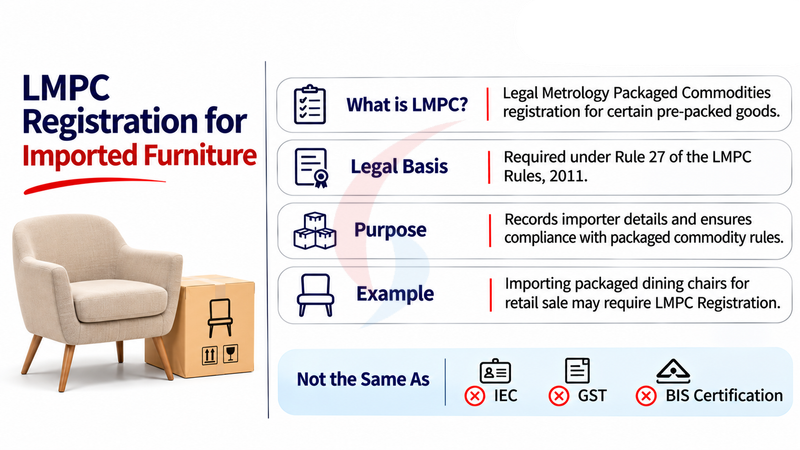
However, a company importing furniture in bulk for installation in its own commercial premises may require a different applicability assessment. LMPC Registration is not the same as an Import Export Code (IEC), GST registration or BIS certification. Each serves a separate legal purpose.
For additional guidance, read LMPC Registration: Legal Metrology Compliance Guide.
Is LMPC Registration Mandatory for Imported Furniture?
LMPC Registration is required where the importer and transaction fall within Rule 27 of the Packaged Commodities Rules. The important question is whether the furniture is imported as a covered pre-packaged commodity. Under Section 2(l) of the Legal Metrology Act, 2009, a pre-packaged commodity generally refers to a commodity placed in packaging of a predetermined quantity without the purchaser being present, whether the package is sealed or not.
For furniture, the assessment may depend on how the product is packed, sold and supplied. Simply placing a large sofa inside protective material for transportation does not, by itself, conclusively establish the application of every retail-package declaration requirement.
|
Imported Furniture |
LMPC Applicability |
|---|---|
|
Flat-packed office chairs sold individually |
Generally applicable where supplied as retail packages |
|
Branded dining tables in retail cartons |
Generally applicable if covered as pre-packaged commodities |
|
Packaged bookshelves sold online |
Generally applicable |
|
Imported wardrobes in retail-ready packaging |
Generally applicable |
|
Furniture imported directly for qualifying institutional use |
Retail-package provisions may be excluded, subject to conditions |
|
Custom furniture shipped solely in protective transport packaging |
Requires assessment of packaging and sale arrangements |
|
Furniture parts and fittings sold as packaged retail products |
Applicable where they meet the relevant packaged commodity conditions |
The Legal Metrology Rules distinguish retail packages from goods supplied to qualifying industrial or institutional consumers.
An importer should not assume that every business-to-business transaction is automatically exempt. The buyer's status, intended use, sourcing arrangement and applicable packaging requirements must be considered.
A Practical Story: How a Furniture Importer Faced Customs Difficulties
For Exampl, a fictional company, ABC Furnishings Private Limited, based in Delhi. ABC imports affordable furniture from Vietnam and sells it through an online marketplace and two retail showrooms. In 2026, the company placed an order for 500 flat-packed study tables, with an estimated consignment value of Rs 28 lakh.
The overseas supplier prepared the furniture in individual branded cartons. Each carton displayed the product model, colour and manufacturing details, but there was no Indian importer address, Indian MRP or consumer complaint contact information. When ABC 's customs clearance team reviewed the shipment documents, it identified potential Legal Metrology compliance issues.
ABC examined its registration position, prepared the required importer information and arranged compliant labels through the legally permitted process. The company also reviewed its future purchase orders to ensure that overseas suppliers included the necessary Indian-market information before dispatch. This example shows that identifying LMPC requirements before shipment can prevent avoidable customs queries, relabelling expenses and delivery delays.
Legal Provisions for LMPC Registration of Imported Furniture
LMPC Registration for imported furniture is governed by the Legal Metrology Act, 2009, the Legal Metrology (Packaged Commodities) Rules, 2011, and other applicable import regulations.
|
Act / Legal Provision |
Key Requirement |
|---|---|
|
Mandatory declarations on covered packaged furniture. |
|
|
Penalties for non-compliance with packaging requirements. |
|
|
Legal Metrology (Packaged Commodities) Rules, 2011 – Provisions 2–4 |
Definitions, exemptions and packaging conditions. |
|
Legal Metrology (Packaged Commodities) Rules, 2011 – Provisions 6 and 9 |
Product labelling, MRP, importer details and display requirements. |
|
Legal Metrology (Packaged Commodities) Rules, 2011 – Provision 27 |
Registration of covered importers, manufacturers and packers. |
|
Filing of the Bill of Entry for imported furniture. |
|
|
Mandatory BIS certification for furniture covered by applicable Quality Control Orders. |
Important: Covered furniture importers must generally apply for LMPC Registration within 90 days of starting the relevant import activity. Applicable labelling requirements must be followed before selling the products.
LMPC Labelling Requirements for Imported Furniture
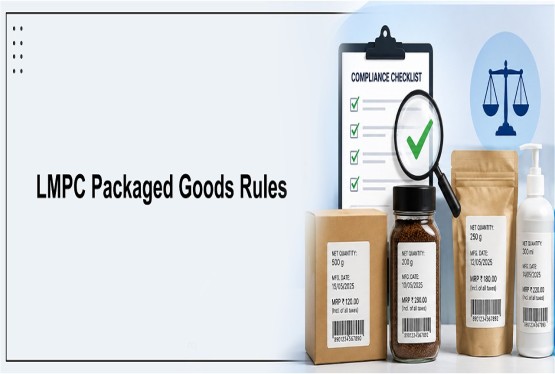
Under Rule 6 of the Packaged Commodities Rules, covered retail packages must display mandatory declarations. These details help buyers understand what they are purchasing, its quantity, origin, price and the responsible business. The information must be accurate, legible and displayed in the prescribed manner.
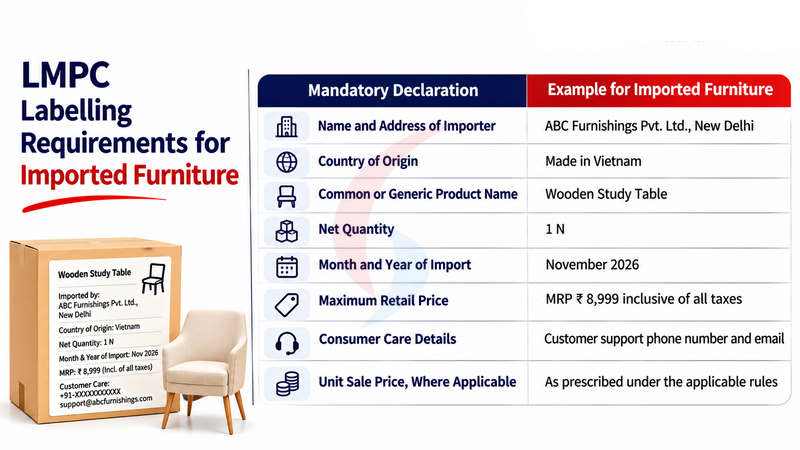
|
Mandatory Declaration |
Example for Imported Furniture |
|---|---|
|
Name and Address of Importer |
ABC Furnishings Pvt. Ltd., New Delhi |
|
Country of Origin |
Made in Vietnam |
|
Common or Generic Product Name |
Wooden Study Table |
|
Net Quantity |
1 N |
|
Month and Year of Import |
November 2026 |
|
Maximum Retail Price |
MRP Rs 8,999 inclusive of all taxes |
|
Consumer Care Details |
Customer support phone number and email |
|
Unit Sale Price, Where Applicable |
As prescribed under the applicable rules |
The exact wording and declaration requirements depend on the commodity and packaging conditions. For furniture sold by number, the declared quantity can be expressed in the prescribed unit of count. The importer should not print a misleading quantity or declare the weight of a table as the net quantity when the relevant packaged commodity is sold as one complete unit.
Similarly, MRP means the maximum retail price inclusive of applicable taxes. A covered package should not show a price that excludes GST while presenting it as the final MRP. Furniture sellers should also ensure that online product details are consistent with physical package declarations.
For more information, read LMPC Certificate for Importers in India
Documents Required for LMPC Registration for Imported Furniture
Importers must submit the prescribed business and registration information to the competent Legal Metrology authority. Additional documents may be requested depending on the applicant's constitution, jurisdiction and online application system.
|
Document |
Purpose |
|---|---|
|
Certificate of Incorporation / Business Registration |
Establishes business identity |
|
PAN |
Identifies the applicant |
|
GST Registration, Where Applicable |
Supports business verification |
|
Import Export Code (IEC) |
Identifies the importer for customs purposes |
|
Registered Office Address Proof |
Confirms business location |
|
Import Premises Details |
Identifies relevant import premises |
|
Director / Partner Details |
Identifies responsible persons |
|
Authorisation Letter |
Authorises the applicant's representative |
|
Furniture Product List |
Identifies products proposed for import |
|
Product Labels or Artwork |
Helps assess packaging declarations |
|
Import Invoice / Purchase Documents, Where Relevant |
Supports product and transaction details |
Under the May 2026 amendment, Rule 27 also requires the name of the company director responsible for violations under the Act and rules to be included in the prescribed particulars.
Businesses should ensure that the submitted information reflects the actual applicant and its business operations.
LMPC Registration Process for Imported Furniture
The registration procedure can be completed through the relevant Central or State Legal Metrology authority, depending on the applicable jurisdiction.
|
Step |
Registration Process |
Important Action |
|---|---|---|
|
Step 1 |
Check Applicability |
Determine whether the furniture is a covered pre-packaged commodity. |
|
Step 2 |
Prepare Documents |
Collect IEC, PAN, business details and product information. |
|
Step 3 |
Review Labels |
Verify prescribed declarations on retail packaging. |
|
Step 4 |
Submit Application |
Apply through the applicable Legal Metrology system. |
|
Step 5 |
Pay Fees |
Pay the prescribed registration fee. |
|
Step 6 |
Address Queries |
Provide clarification or corrections, if requested. |
|
Step 7 |
Obtain Registration |
Retain the registration certificate and maintain accurate records. |
Under Rule 27, the prescribed application fee is Rs 500, while the prescribed fee for alteration of registration particulars is Rs 100, subject to the rules as applicable. These amounts represent statutory registration charges and do not include professional fees or other business expenses.
LMPC Registration Cost and Timeline
The total cost of LMPC compliance includes the prescribed government fee and any additional expenditure incurred for document preparation, packaging changes or professional assistance. The application processing period may differ according to the relevant authority, completeness of documents and any required clarification.
Importers should avoid assuming that every application will be approved within a fixed number of days. Rule 27's 90-day provision is a deadline for applying after commencing the relevant activity, not a guaranteed certificate issuance timeline. Businesses importing several categories of furniture should ensure the registration details and declared product information remain accurate.
For importers maintaining multiple storage facilities, read LMPC Registration for Multiple Warehouses
Latest Legal Metrology and Furniture Import Updates in 2026
In 2026, the government introduced important changes to LMPC Registration, online product listings and BIS certification for imported furniture. Importers should understand these updates to avoid compliance issues.
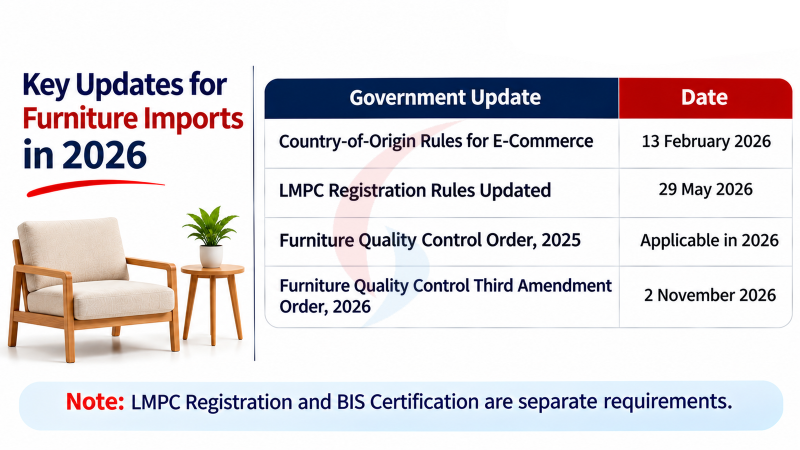
|
Government Update |
Date |
What It Means for Furniture Importers |
|---|---|---|
|
Country-of-Origin Rules for E-Commerce |
13 February 2026 |
From 1 July 2026, e-commerce platforms selling imported products must provide a filter that allows customers to search and sort products by country of origin. |
|
LMPC Registration Rules Updated |
29 May 2026 |
LMPC Registration remains valid until cancelled. Importers must update prescribed business and product details annually. |
|
Furniture Quality Control Order, 2025 |
Applicable in 2026 |
Specified furniture products, including chairs, tables, beds and storage units, must meet applicable BIS standards, subject to exemptions. |
|
Furniture Quality Control Third Amendment Order, 2026 |
2 November 2026 |
Certain furniture imports qualify for a temporary BIS exemption if the purchase order was placed by 12 August 2026, the Bill of Lading is issued by 30 November 2026 and the Bill of Entry is issued by 31 December 2026. Required documents must be submitted to BIS within seven days of clearance. |
Important: LMPC Registration and BIS Certification are separate requirements. LMPC deals mainly with importer registration and packaged product declarations, while BIS Certification checks compliance with prescribed product standards. Furniture importers should check whether both requirements apply before importing goods.
Penalties for LMPC Non-Compliance
An importer that fails to meet applicable Legal Metrology requirements may face enforcement action, monetary penalties and delays in releasing goods. Section 36 of the Legal Metrology Act addresses specified violations relating to non-compliant packaged commodities. Rule 32 also contains provisions for contraventions of the Packaged Commodities Rules.
The penalty provisions have been affected by the Jan Vishwas legislative changes in 2026. Importers should therefore use the amended statutory provisions applicable on the date of the alleged violation rather than rely on older penalty tables. For example, if ABC imports packaged study tables without the required declarations, the problem may need to be resolved before the goods can lawfully enter the retail market. The importer may also face additional storage, labelling and administrative expenses.
For related guidance, read Customs Clearance Without LMPC Registration
Why Choose Compliance Calendar LLP ?
Compliance Calendar LLP assists businesses with LMPC Registration, importer documentation, packaging declaration reviews and related Legal Metrology compliance requirements. Our team helps furniture importers assess applicability, prepare registration documents, review product information and understand the requirements relevant to their import activities. Businesses importing furniture through multiple locations or selling through online marketplaces can also obtain assistance with the applicable documentation and regulatory procedures.
For enquiries, contact Compliance Calendar LLP by email at info@ccoffice.in or via WhatsApp at 9988424211
Frequently Asked Questions (FAQs)
Q1. Is LMPC Registration mandatory for imported furniture?
Ans: LMPC Registration is required where the importer and packaged furniture fall within the applicable Legal Metrology provisions. Not every furniture shipment is automatically covered, so its packaging and intended use must be examined.
Q2. Which law governs LMPC Registration for furniture?
Ans: The Legal Metrology Act, 2009 and the Legal Metrology (Packaged Commodities) Rules, 2011 govern the principal requirements. Rule 27 addresses importer registration, while Rule 6 prescribes applicable retail-package declarations.
Q3. Is LMPC Registration required for imported office chairs?
Ans: It is generally required where office chairs are imported as covered pre-packaged commodities for retail sale. Qualifying institutional or industrial transactions may have different requirements under the applicable exclusions.
Q4. What is the government fee for LMPC Registration?
Ans: Rule 27 prescribes an application fee of Rs 500. Additional expenses may arise from documentation, professional assistance and other compliance requirements.
Q5. Is MRP mandatory on imported furniture packaging?
Ans: MRP must be declared on covered retail packages in accordance with the applicable rules. The declared Maximum Retail Price must include applicable taxes and follow the prescribed display requirements.
Q6. Can imported furniture be sold online without LMPC Registration?
Ans: Where LMPC Registration is applicable, selling through an online marketplace does not remove that requirement. The applicable package declarations and e-commerce information requirements must also be followed.
Q7. Does LMPC Registration expire in 2026?
Ans: Under the May 2026 amendment, registration certificates remain valid until cancelled. However, businesses must comply with the prescribed requirement to update registration information annually when applicable.
Q8. Is BIS certification also required for imported furniture?
Ans: Specified furniture categories are covered by the Furniture (Quality Control) Order, 2025, as amended. Importers should assess the relevant product standard, commencement date and any available exemption separately from LMPC Registration.
Q9. Can furniture labels be corrected after import?
Ans: Certain labelling arrangements are permitted under the rules, including specified bonded warehouse arrangements for eligible AEO Tier-2 and Tier-3 operators. Importers should verify the applicable conditions before correcting declarations.
Q10. Can Compliance Calendar LLP assist with LMPC Registration for imported furniture?
Ans: Yes. Compliance Calendar LLP assists with applicability reviews, registration documentation, package declaration requirements and related importer compliance procedures.
Article last updated on : 27 Nov 2026.












_learn_crop10_thumb.jpg)