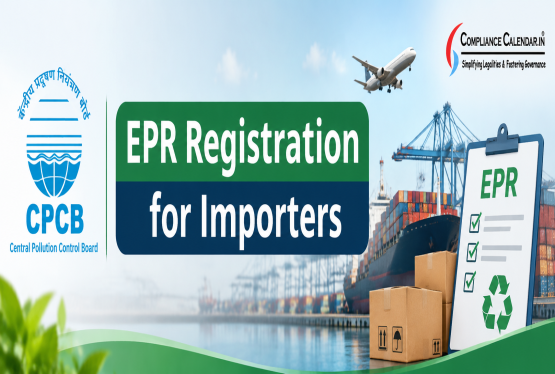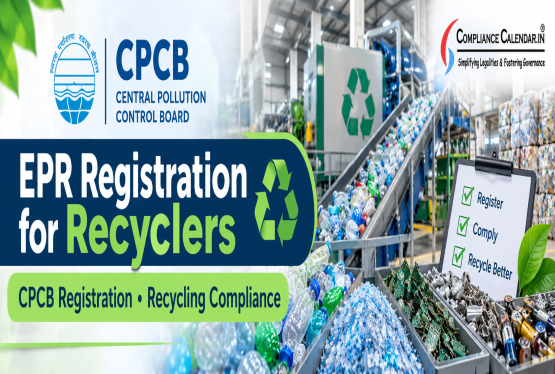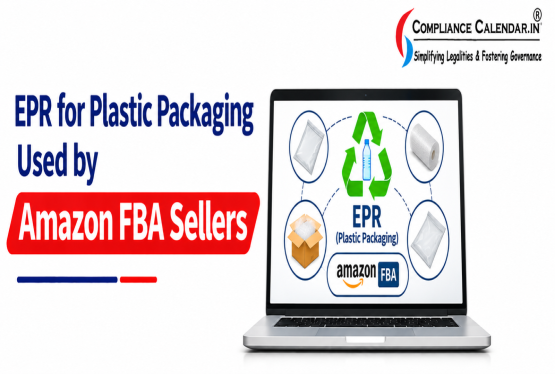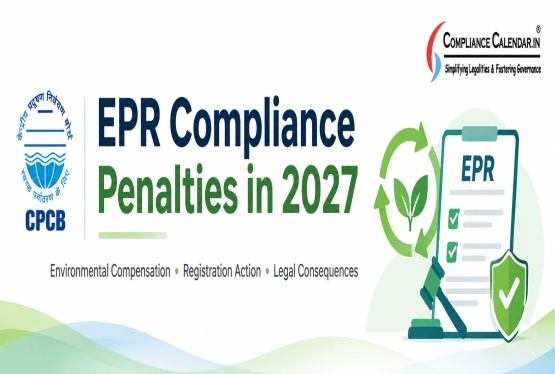



Businesses that manufacture, import or sell products in plastic packaging have to take responsibility for the plastic waste generated by that packaging. Under the Extended Producer Responsibility (EPR) rules, they must meet specific plastic waste recycling targets.
For FY 2027–28, the minimum recycling targets are 80% for Category I, 60% for Category II, 60% for Category III and 80% for Category IV. These percentages are calculated against the applicable EPR target of the business, not simply against the total plastic packaging it sells or uses.
This means a business cannot apply one common recycling percentage to all its plastic packaging. It must identify each packaging category, calculate its applicable EPR obligation and arrange the required processing. Understanding these targets is important for Producers, Importers and Brand Owners (PIBOs) that want to avoid a shortfall in their EPR compliance.
For more information read our article on : Plastic Waste Registration Guide
What Are the Plastic Waste Recycling Targets for FY 2027–28?
The Plastic Waste Management Rules, 2016, and the EPR guidelines require covered businesses to ensure that a minimum quantity of plastic packaging waste is recycled or, in the case of compostable plastic packaging, processed through industrial composting.
The minimum targets for FY 2027–28 are:
|
Plastic packaging category |
Type of packaging |
Minimum target |
|
Category I |
Rigid plastic packaging |
80% |
|
Category II |
Flexible plastic packaging |
60% |
|
Category III |
Multilayered plastic packaging |
60% |
|
Category IV |
Compostable plastic packaging |
80% |
These are minimum targets under the EPR framework. A business must calculate its recycling obligation separately for each applicable category. Category IV is different because its target is met through industrial composting rather than ordinary plastic recycling.
Which Types of Plastic Packaging Are Covered Under EPR?
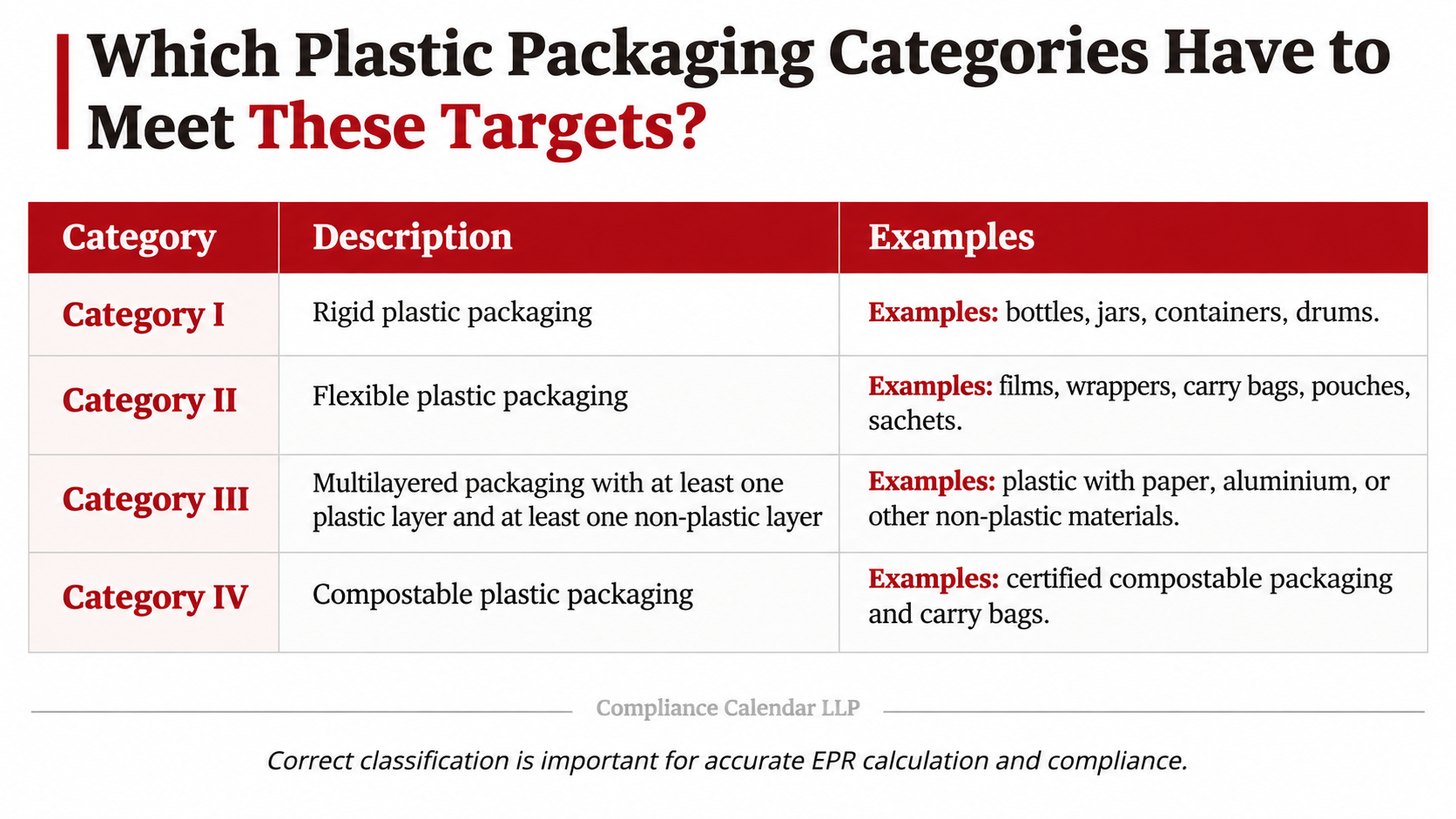
The recycling target depends on the type of plastic packaging a business introduces into the market. The EPR framework divides plastic packaging into four categories. Correct classification matters because a wrong category can lead to an incorrect EPR calculation and a shortfall in compliance.
|
Category |
Packaging type |
Common examples |
|
Category I |
Rigid plastic packaging |
Plastic bottles, jars, containers and drums |
|
Category II |
Flexible plastic packaging |
Plastic films, wrappers, carry bags, pouches and sachets |
|
Category III |
Multilayered packaging containing at least one plastic layer and at least one non-plastic layer |
Packaging made using plastic with paper, aluminium or other non-plastic materials |
|
Category IV |
Compostable plastic packaging |
Packaging and carry bags made from certified compostable plastic |
For example, a company selling drinking water in rigid plastic bottles will generally deal with Category I packaging. A snack company using flexible plastic pouches will generally deal with Category II. A food company using packaging that combines plastic and aluminium layers may fall under Category III.
The category should be decided by examining the actual packaging material and its construction. A business should not classify packaging only by its appearance or product name.
Who Is Responsible for Meeting the Recycling Targets?
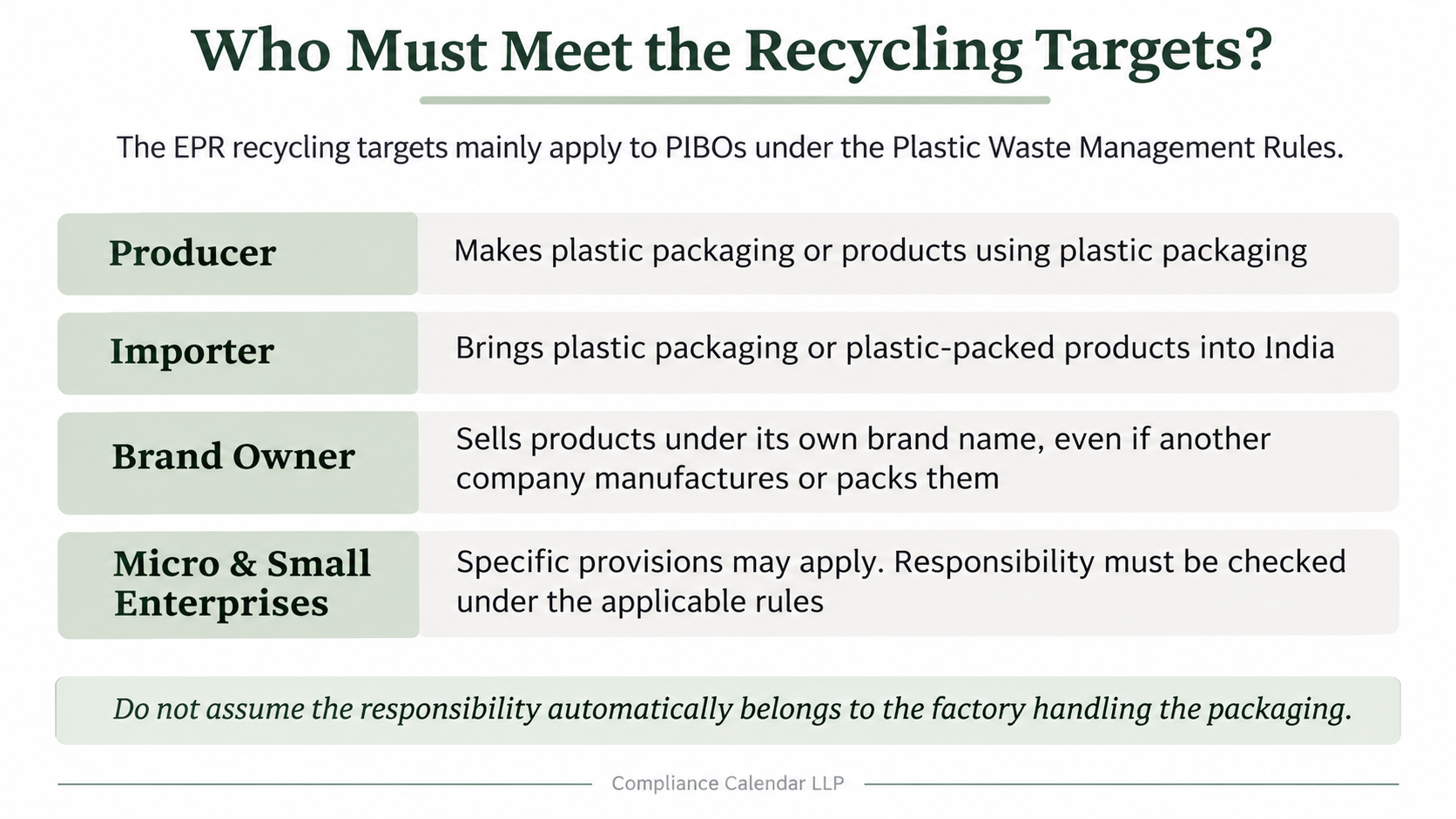
The EPR recycling targets mainly apply to Producers, Importers and Brand Owners (PIBOs) covered under the Plastic Waste Management Rules.
A Producer may manufacture plastic packaging or manufacture products using plastic packaging. An Importer may bring plastic packaging or products packed in plastic into India. A Brand Owner sells products under its own brand name, even if another company manufactures or packs those products.
For example, a company selling shampoo under its own brand may appoint another factory to manufacture and pack the shampoo in plastic bottles. The company selling the shampoo under its brand must examine its EPR responsibility. It cannot assume that the responsibility automatically belongs to the factory simply because the factory handles the packaging.
Eligible micro and small enterprises have specific provisions under the EPR framework. Their responsibility must be checked according to their business category and the applicable rules. Businesses should not assume that every small company has the same exemption.
If you want to understand the registration requirements and general responsibilities of covered businesses, read our guide on EPR Plastic Waste Registration in India.
How Is the Recycling Target Calculated for FY 2027–28?
The recycling percentage is applied to the business's applicable EPR target for each packaging category. The EPR target itself is calculated using the packaging quantities and the rules applicable to the particular business type. It is not automatically equal to the total packaging introduced into the market during FY 2027–28.
Once the applicable EPR target is known, the business can calculate the minimum quantity that must be recycled.
For example, if a business has an applicable EPR target of 100 tonnes for Category I, its minimum recycling obligation will be 80 tonnes. If its Category II EPR target is 100 tonnes, it will need to meet a recycling obligation of 60 tonnes.
The calculation would look like this:
|
Category |
Applicable EPR target |
Recycling percentage |
Minimum quantity to be processed |
|
Category I |
100 tonnes |
80% |
80 tonnes |
|
Category II |
100 tonnes |
60% |
60 tonnes |
|
Category III |
100 tonnes |
60% |
60 tonnes |
|
Category IV |
100 tonnes |
80% |
80 tonnes through industrial composting |
These are illustrative figures. A business must use its actual category-wise EPR targets from the applicable calculations and portal records.
Practical Example: How a Food Packaging Company Can Calculate Its Target
A food company based in Noida sells snacks in flexible plastic pouches and multilayered packets. After reviewing its packaging records, it identifies its applicable EPR target as 40 tonnes for Category II and 30 tonnes for Category III.
For FY 2027–28, its minimum recycling requirement would be:
- Category II: 40 tonnes × 60% = 24 tonnes.
- Category III: 30 tonnes × 60% = 18 tonnes.
The company must therefore meet the applicable processing obligation for 24 tonnes of Category II and 18 tonnes of Category III packaging waste. It cannot simply process 42 tonnes of mixed plastic waste and assume that both targets are automatically fulfilled. The category and certificates must support the quantities being claimed.
This is why businesses should maintain separate records for each packaging category from the beginning of the financial year.
Can a Business Use One Category's Recycling Surplus to Meet Another Category's Target?
Businesses should not assume that extra recycling certificates in one category can automatically cover a shortfall in another category. CPCB's clarification dated 19 January 2026 states that recycling obligations for Categories I, II and III must be fulfilled using certificates of the same category. Exchange of recycling obligations across these categories is not permitted under the clarification.
For example, if a company has a surplus of 10 tonnes of Category I recycling certificates but a shortfall of 10 tonnes in Category II, it cannot simply transfer the Category I surplus to meet the Category II obligation.
Businesses must also keep recycling and end-of-life disposal separate. A surplus under end-of-life disposal cannot be used to meet a recycling target. Therefore, companies should check the category and type of every certificate before relying on it for EPR compliance.
Does Plastic Waste Sent for Disposal Count Towards the Recycling Target?
No. Plastic waste sent for end-of-life disposal does not count towards the minimum recycling target.
Recycling means processing plastic waste so that the material can be recovered and used again. End-of-life disposal covers permitted methods used for plastic waste that cannot be recycled, such as co-processing in cement kilns, waste-to-energy and other approved processes.
A business must first meet its applicable recycling obligation. It cannot send plastic waste for disposal and report that quantity as recycled waste. Category IV compostable plastic packaging has a separate processing route through industrial composting facilities.
How Can Businesses Meet Their FY 2027–28 Recycling Targets?
A business should plan its recycling requirement before the financial year ends. It should first check its EPR target for each packaging category and compare it with the quantities recorded in its packaging data. This helps the business understand how much plastic waste it must get processed.
The business can then work with registered Plastic Waste Processors (PWPs) and arrange the required recycling or industrial composting, as applicable. It should check the processor's registration and ensure that the processing certificates support the category and quantity being claimed.
For example, a company using flexible plastic pouches should not assume that hiring a general waste collection agency completes its Category II EPR responsibility. It needs to arrange the required processing through the appropriate registered channel and maintain valid supporting certificates.
Businesses can also refer to our EPR Registration Complete Guide to understand the registration and compliance support available.
Which Documents Are Required to Report Recycling Compliance?
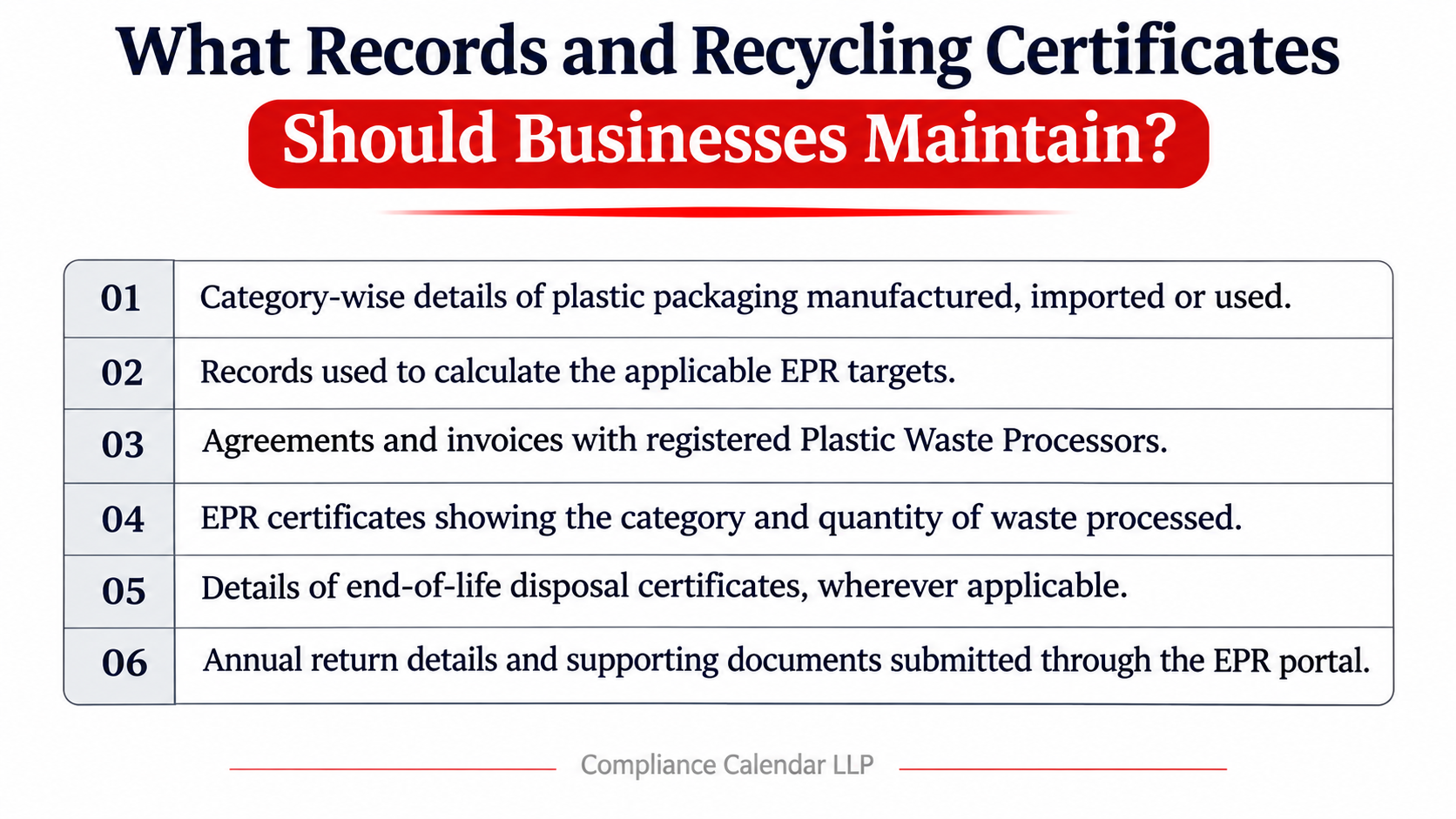
A business must be able to show how much plastic packaging it has introduced into the market and how much of the resulting waste has been processed. Its EPR portal figures should match the supporting records and certificates.
The following records are important:
- Category-wise details of plastic packaging manufactured, imported or used, as applicable.
- Records used to calculate the applicable EPR targets.
- Agreements and invoices with registered Plastic Waste Processors.
- EPR certificates showing the category and quantity of waste processed.
- Details of end-of-life disposal certificates, wherever applicable.
- Annual return details and supporting documents submitted through the EPR portal.
The certificates should be checked carefully before they are used to claim fulfilment of an EPR target. A payment receipt or a general waste collection record does not by itself prove that the required recycling has taken place.
For more detailed explanation you can read our guide on : Plastic Waste Recycling Plant Setup
What Happens If a Business Fails to Meet Its Recycling Target?
A business that fails to meet its applicable EPR obligation may face environmental compensation under the Plastic Waste Management Rules. The amount and consequences depend on the nature and extent of the shortfall and the applicable provisions.
Incorrect reporting can also create compliance problems. For example, claiming Category I certificates against a Category II shortfall or reporting end-of-life disposal as recycling may result in the claimed quantity not being accepted.
Businesses should therefore review their targets, certificate records and portal entries before filing their annual returns. They should not wait until the end of the year to discover that their recycling quantity is below the required level.
When Should Businesses Report Their FY 2027–28 Recycling Compliance?
Businesses must report their EPR compliance through the centralised online portal and file the applicable annual return within the prescribed time. The annual return should reflect the packaging quantities, category-wise obligations and processing certificates used to meet those obligations.
For FY 2027–28, businesses should keep their records updated throughout the year and check the annual return deadline notified by CPCB for that reporting cycle. They should not rely on an old deadline without checking the latest portal instructions or official notice.
Before filing, the business should compare its reported quantities with the certificates issued by registered processors. Any difference in the records should be checked and corrected before the return is submitted.
How Can Compliance Calendar LLP Help with Plastic Waste EPR Compliance?
Meeting the FY 2027–28 recycling targets requires correct packaging classification, category-wise EPR calculations and proper recycling records. A mistake in any of these areas can result in a shortfall or incorrect reporting.
Compliance Calendar LLP can assist businesses with understanding their plastic waste EPR obligations, reviewing packaging categories, checking applicable recycling targets and supporting EPR registration and compliance requirements.
For assistance, contact Compliance Calendar LLP at +91 9988424211 or info@ccoffice.in
Frequently Asked Questions
1. What is the Category I recycling target for FY 2027–28?
The minimum recycling target for Category I rigid plastic packaging is 80% of the applicable EPR target.
2. What is the Category II recycling target for FY 2027–28?
The minimum recycling target for Category II flexible plastic packaging is 60% of the applicable EPR target.
3. What is the Category III recycling target for FY 2027–28?
The minimum recycling target for Category III multilayered plastic packaging is 60% of the applicable EPR target.
4. What is the Category IV recycling target for FY 2027–28?
The minimum target is 80%. Category IV compostable plastic packaging must be processed through industrial composting facilities.
5. Are recycling targets calculated on total plastic packaging sold?
No. The recycling percentage is applied to the applicable EPR target for each category. Businesses must first identify their category-wise EPR obligations.
6. Can a company use Category I recycling certificates to meet its Category II target?
No. CPCB's January 2026 clarification requires the recycling obligations for Categories I, II and III to be met using certificates of the same category.
7. Does end-of-life disposal count towards the recycling target?
No. End-of-life disposal and recycling are separate obligations. Waste sent for permitted disposal cannot be counted towards the minimum recycling target.
8. Can a business meet its recycling target by working with any waste collection agency?
No. Businesses should ensure that the relevant processing is carried out through registered Plastic Waste Processors and that the required certificates are available to support their EPR claims.
9. What happens if a business does not meet its FY 2027–28 recycling target?
The business may face environmental compensation for failure to meet its applicable EPR obligation. Incorrect reporting or unsupported certificate claims can also create compliance problems.
10. Is recycled plastic content the same as the recycling target?
No. A recycling target concerns the quantity of plastic packaging waste that must be processed. Recycled plastic content concerns the quantity of recycled plastic material that must be used in new packaging. These are separate EPR obligations.
Article last updated on : 26 Nov 2026.










_learn_crop10_thumb.jpg)