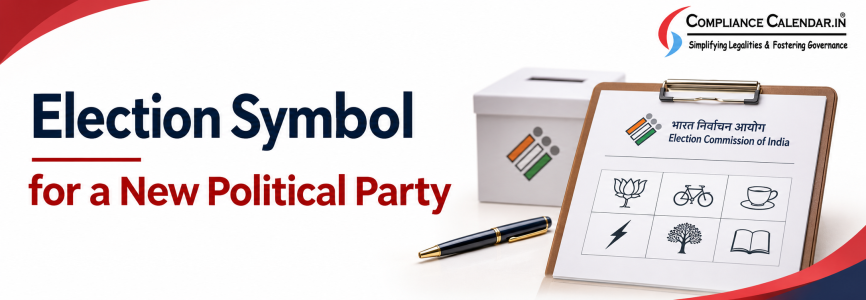



A new political party needs more than a name and a group of members to enter an election. It also needs to understand how election symbols work. During elections, voters use symbols to identify candidates and the political parties they represent. A familiar symbol can help voters recognise a party on the EVM or ballot paper.
However, registering a political party does not automatically give it a permanent or exclusive election symbol. The Election Commission of India (ECI) follows a separate process for symbol allotment. A newly registered party can generally use an available free symbol for its candidates. It may also apply for a common symbol if it meets the conditions under the Election Symbols (Reservation and Allotment) Order, 1968.
This article explains how a new political party can get an election symbol, what conditions it must meet, when it should apply and what happens if it does not receive its preferred symbol.
Does a New Political Party Get an Election Symbol After Registration?
No. A new political party does not automatically receive an exclusive election symbol when the Election Commission registers it under Section 29A of the Representation of the People Act, 1951. After registration, the party generally remains a Registered Unrecognised Political Party (RUPP) unless it later meets the conditions for recognition as a State or National Party. Registration allows it to participate in elections, but it does not give it the same symbol rights as a recognised political party.
A registered unrecognised party can use an available free symbol for its candidates under the applicable rules. If it wants its candidates to use the same symbol in several constituencies, it can apply for a common symbol under Paragraph 10B of the Election Symbols Order. The Election Commission must approve the application. A party should therefore avoid announcing a symbol as its official election symbol until the allotment is confirmed.
If you are planning to register your political organisation, first understand the process to register a political party in India for avoid any kind of confusion.
What Are the Different Types of Election Symbols?
The Election Commission divides election symbols into two main categories: reserved symbols and free symbols. The difference is important because a new political party cannot simply select a symbol that already belongs to another recognised party.
|
Type of symbol |
What it means |
Who can use it? |
|
Reserved symbol |
A symbol kept for a recognised political party |
Candidates set up by that party, according to ECI rules |
|
Free symbol |
A symbol that is not reserved for a recognised political party |
Eligible candidates, including candidates of registered unrecognised parties |
For example, the Lotus is the reserved symbol of the Bharatiya Janata Party, and the Hand is the reserved symbol of the Indian National Congress. A newly registered political party cannot use either symbol just because its members prefer it. It must choose from the free symbols available for the election or apply for a common symbol under the applicable rules.
You can read our article on the difference between registered and recognised political parties to understand why a registered party does not automatically receive a reserved symbol.
How Does a New Political Party Apply for an Election Symbol?
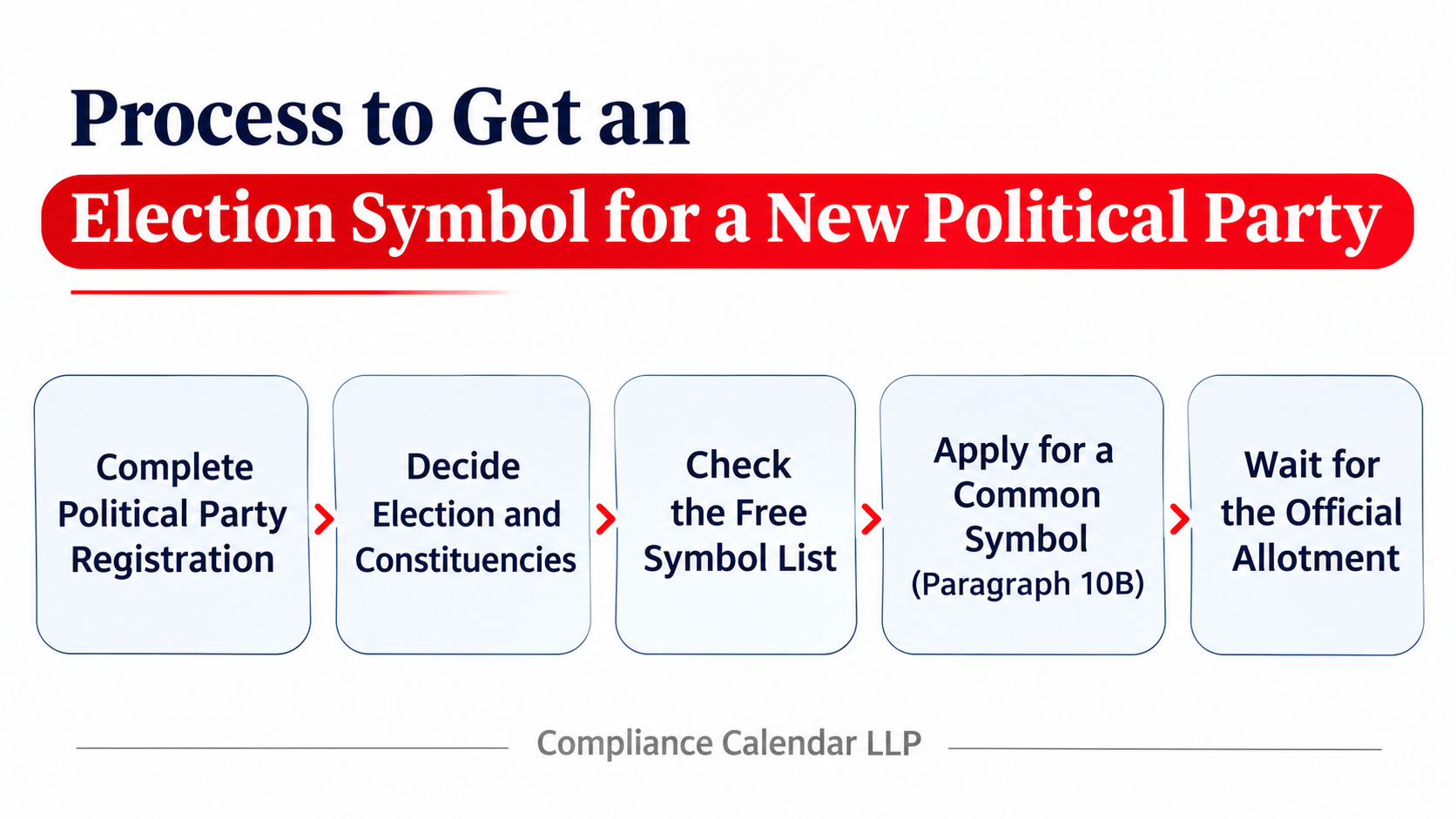
The process depends on how many constituencies the party wants to contest. If it plans to field a candidate in only one constituency, the candidate can choose from the available free symbols while filing the nomination paper. If the party wants the same symbol for candidates in several constituencies, it should consider applying for a common symbol under Paragraph 10B.
The party should first decide its election plan, check the free-symbol list and confirm whether it meets the conditions for a common symbol. It must then submit the required information to the Election Commission within the prescribed time. The Commission considers the application and decides whether the requested symbol can be allotted.
Step 1: Complete Political Party Registration
The party must first be registered with the Election Commission under Section 29A of the Representation of the People Act, 1951. It should have its name, constitution, office-bearers, membership details and other registration documents in order.
After registration, the party should keep its registration certificate and official details safely. These records help establish the party's identity when it communicates with the Election Commission. If you are preparing the registration application.
you can also read documents required for political party registration.
Step 2: Decide Where the Party Wants to Contest
The party should decide whether it wants to contest a State Assembly election or a Lok Sabha election. It should also identify the constituencies where it plans to field candidates.
This decision matters because the minimum number of constituencies and the application conditions are different for Assembly and Lok Sabha elections. A party planning to contest only one Assembly seat, for example, should not assume that it can receive a common symbol for several constituencies under Paragraph 10B.
Step 3: Check the Free Symbol List
The Election Commission publishes a list of free symbols for elections. The party should check the list for the relevant election and select its preferred symbols.
The party should not assume that a symbol available in one election will remain available in another. Symbol availability and allotment depend on the relevant election, the applicable rules and the applications received by the Commission.
Step 4: Apply for a Common Symbol, If Needed
If the party wants one symbol for candidates contesting multiple constituencies, it must apply under Paragraph 10B and meet the prescribed conditions. It must inform the Commission about the constituencies where it intends to field candidates and provide its symbol preferences.
The application should also include the required undertaking and other details asked for by the Commission. The party should follow the latest ECI instructions and prescribed format instead of relying on an old application form.
Step 5: Wait for the Official Allotment
Submitting an application does not mean that the symbol has been approved. The Election Commission considers the application and decides whether the requested symbol can be allotted.
The party should wait for the official decision before printing the symbol on campaign material or asking its candidates to use it. Once the allotment is confirmed, it should share the details with the candidates and election team.
What Conditions Must a Party Meet to Get a Common Symbol?
A registered unrecognised political party can apply for a common symbol under Paragraph 10B of the Election Symbols Order. The party must meet the minimum candidate requirement and follow the application deadlines. The conditions are different for State Assembly and Lok Sabha general elections.
|
Requirement |
State Assembly general election |
Lok Sabha general election |
|
Minimum candidates |
At least 5% of the Assembly constituencies in the State. In a State with 40 or fewer seats, at least 3 constituencies |
At least 2 Parliamentary constituencies in the State |
|
Symbol preference |
10 free symbols in order of preference |
10 free symbols in order of preference |
|
Constituency details |
Submit the list of constituencies within the prescribed time |
Submit the list of constituencies within the prescribed time |
|
Undertaking |
Give an undertaking to field candidates in the required number of constituencies |
Give an undertaking to field candidates in the required number of constituencies |
For example, if a State has 200 Assembly constituencies, a registered unrecognised party must plan to field candidates in at least 10 constituencies to meet the 5% requirement. If the State has 40 or fewer Assembly seats, the party must field candidates in at least 3 constituencies. For a Lok Sabha general election, the party must field candidates in at least 2 Parliamentary constituencies in the State where it seeks the common symbol.
There is another important point. Under the current rules, the common-symbol concession is available for two general elections. A party that has used the concession on two occasions can become eligible again in a later general election if, on at least one of those previous two occasions, its candidates together secured at least 1% of the total valid votes polled in the concerned State. The party should check the latest ECI directions before applying, especially if it has already received a common symbol in an earlier election.
Can a New Political Party Choose Its Own Election Symbol?
Yes, but there are conditions. A party applying for a common symbol under Paragraph 10B can select up to ten free symbols in order of preference. It may also propose up to three new symbols of its own choice, along with their names, clear designs and drawings. The Election Commission may consider these new designs if it has no objection to allotting them.
The proposed symbol must not look like an existing reserved or free symbol. It must not have a religious or communal meaning and must not depict a bird or animal. A party cannot assume that the Commission will approve a new design simply because it has submitted it. The Commission has the final say on whether the proposed symbol can be allotted.
There is also a separate deadline for proposing a new symbol. For an election at the end of the normal term, the proposal must reach the Commission at least three months before the term of the concerned House expires. If the House is dissolved early, the proposal must be made within one month of its premature dissolution. These conditions apply to the relevant Assembly or Lok Sabha election.
What Details Are Required for a Common Symbol Application?
The party should prepare its information before applying. The exact application format and supporting papers may depend on the latest instructions issued by the Election Commission for that election. It should check the current proforma rather than use an old form downloaded from an unrelated website.
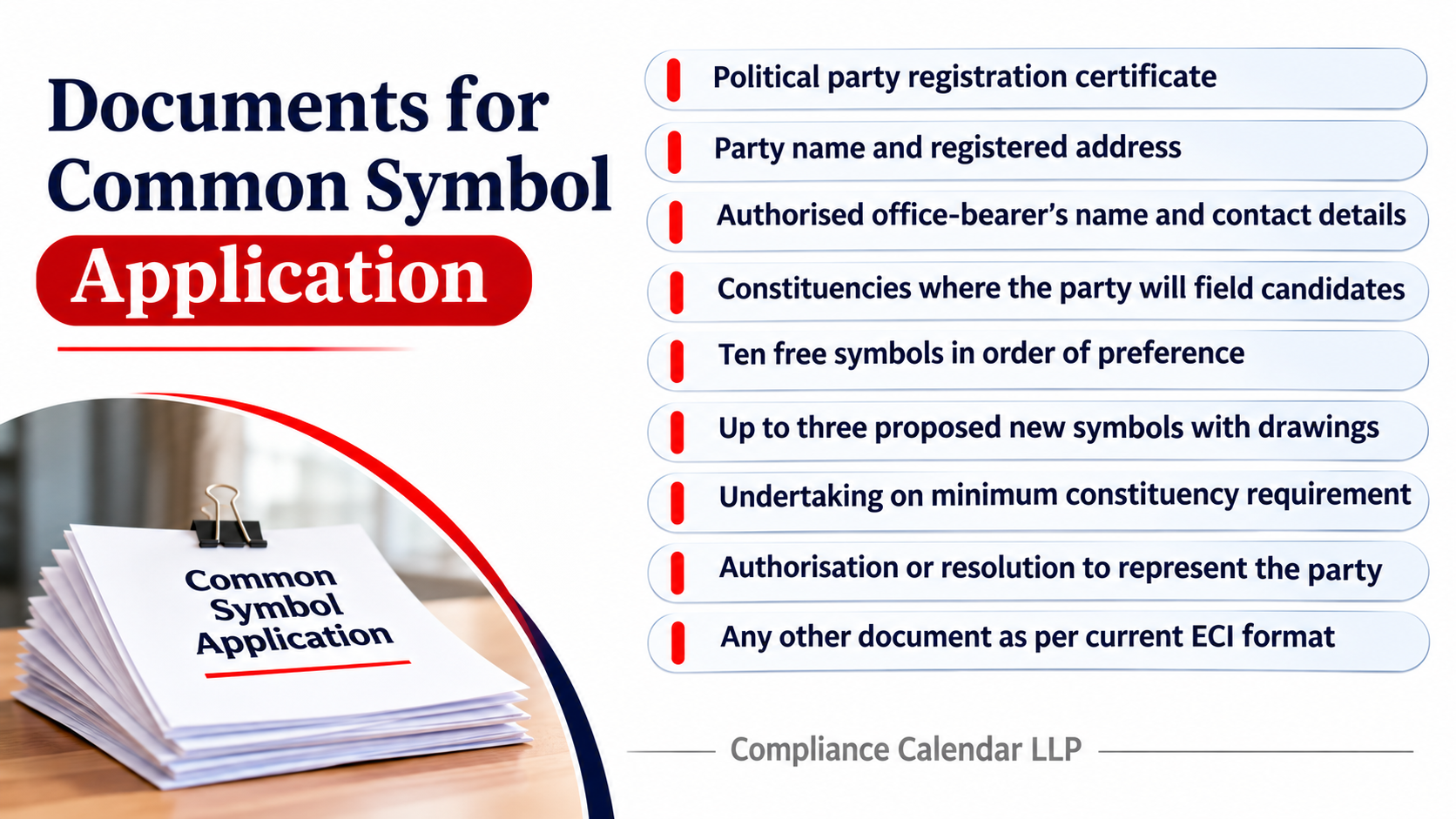
The party should generally keep the following details ready:
- Political party registration certificate.
- Full name and registered address of the party.
- Name and contact details of the authorised office-bearer.
- Details of the Assembly or Parliamentary constituencies where it plans to field candidates.
- Names of ten free symbols in order of preference.
- Names, designs and drawings of up to three proposed new symbols, if the party wants to suggest new designs.
- Required undertaking confirming that the party will field candidates in the minimum number of constituencies.
- Authorisation or resolution showing that the person submitting the application is permitted to represent the party.
- Any additional declaration or document required by the Election Commission's current application format.
The party should make sure that its name, address and office-bearer details match its registration records. If the party has changed its office address or leadership, it should check whether the change has been properly communicated to the Commission. Its constitution should also clearly explain the party's leadership and decision-making process.
For help understanding this document, read Political Party Constitution: Rules, Format and Requirements.
When Should a New Political Party Apply for a Common Symbol?
A party should start preparing well before the election notification. It should not wait until its candidates are ready to file nomination papers. Paragraph 10B sets out when the party must inform the Election Commission about its intention to contest and which constituency details it must submit.
For an Assembly or Lok Sabha election at the end of the normal term, the party can give its intention to contest during the six-month period before the House's term expires. It must give the required intimation no later than five clear days before the scheduled date of the election notification. If the House is dissolved before the end of its normal term, a different period applies. The party can give its intimation after dissolution, but it must still meet the five-clear-day deadline before the scheduled notification.
The party must also submit the list of constituencies in which it plans to field candidates within the time prescribed under Paragraph 10B. Missing a deadline can affect its eligibility for a common symbol. It should therefore check the election schedule and the latest instructions issued by the Commission before submitting its application.
What Happens If a Party Does Not Get a Common Symbol?
Not receiving a common symbol does not automatically stop a registered political party from contesting an election. Its candidates may still choose from the free symbols available in their respective constituencies, subject to the rules and the final decision of the Returning Officer.
However, the candidates may receive different symbols. For example, a new party may plan to contest in five constituencies. If it does not receive approval for a common symbol, its candidates may have to choose separate free symbols in those constituencies. The symbol available in one constituency may not be available in another.
The party should therefore prepare for this possibility. It should not print campaign posters, banners or flags showing one symbol as the party's approved common symbol until the allotment is confirmed. It should also explain the position clearly to its candidates so that nobody makes an incorrect claim during the election.
Can More Than One Candidate Choose the Same Free Symbol?
Yes. A free symbol may be chosen by more than one candidate in the same constituency. When this happens, the Returning Officer follows the priority rules under Paragraph 12 of the Election Symbols Order to decide which candidate will receive it.
For example, where one candidate is set up by a registered unrecognised political party and the other candidates choosing the same free symbol are independent candidates, the registered party candidate gets priority under the prescribed rule. If candidates set up by two or more registered unrecognised parties choose the same symbol, the rules provide a separate process for deciding the allotment.
This is why a party should not assume that selecting a free symbol guarantees that its candidate will receive it. The final allotment depends on the choices made by other candidates and the rules applicable in that constituency. A symbol that was available when the party began planning its campaign may not necessarily be allotted to its candidate.
Example : How Did Aam Aadmi Party Get the Broom Symbol?
The Aam Aadmi Party is a useful real example of how a new political party can receive an election symbol after registration. The party was registered with the Election Commission in March 2013. Registration did not itself give the party its election symbol.
On 1 August 2013, the Election Commission allotted the broom symbol to AAP for the Delhi Assembly election. Before the allotment, the party had submitted three preferences: broom, candle and tap. The Commission approved its first preference, the broom. The party formally launched the symbol at a public event in New Delhi on 3 August 2013.
The example shows that a party can express its preferences, but the final decision belongs to the Election Commission. It also shows why a newly registered political party should complete its registration first and then follow the separate symbol allotment process. AAP's later recognition and reserved-symbol status should not be confused with the position of a newly registered party applying for the first time.
What Can Delay or Affect the Allotment of an Election Symbol?
A new political party should understand the symbol rules before announcing its election plans. A small mistake in the application or a missed deadline can create problems when the party is preparing to contest an election.
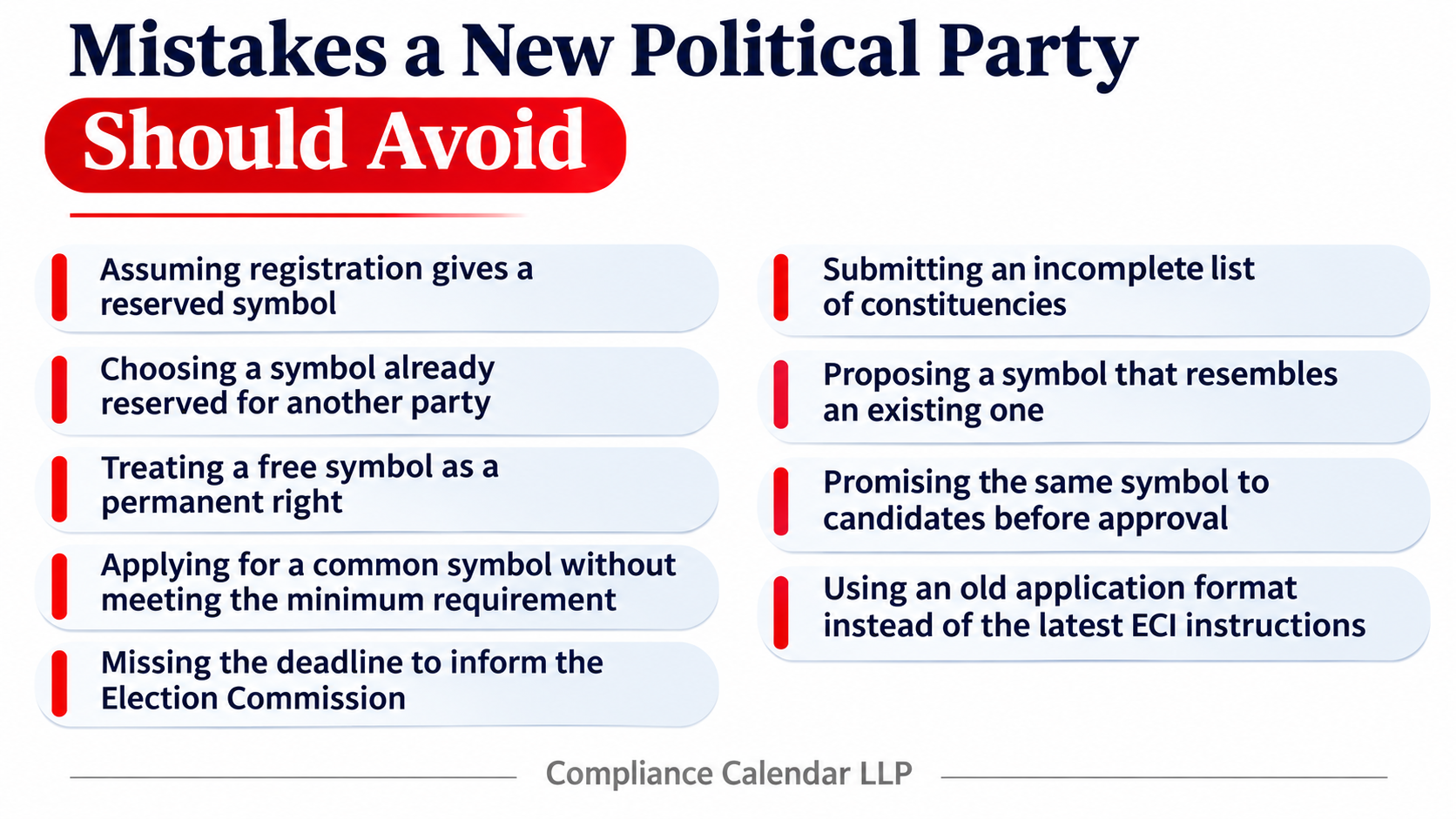
Some common mistakes include:
- Assuming that registration automatically provides a reserved election symbol.
- Selecting a symbol that is already reserved for another recognised party.
- Treating a free symbol as the party's permanent property.
- Applying for a common symbol without meeting the minimum constituency requirement.
- Missing the deadline for informing the Commission about the party's intention to contest.
- Submitting an incomplete list of constituency details.
- Proposing a new symbol that resembles an existing symbol or breaks the ECI's restrictions.
- Promising candidates that they will receive the same symbol before the Commission approves it.
- Using an old application format without checking the latest ECI instructions.
The party should also keep a copy of its application, undertaking, supporting documents and every communication received from the Election Commission. These records can help if the Commission asks for clarification or additional information.
Can a Registered Political Party Contest Elections Without a Common Symbol?
Yes. A registered political party does not have to receive a common symbol before it can contest an election. Its candidates can participate by choosing from the free symbols available in their respective constituencies and completing the required nomination formalities.
However, a party should understand the practical difference. If its candidates receive different symbols, voters may not see one common symbol representing the party across all the constituencies it contests. This can make it harder for the party to build a single visual identity during that election.
A party should therefore decide its election plan early. If it meets the requirements for a common symbol, it can apply under Paragraph 10B. If it does not meet those requirements, it can still explore the free-symbol option for its candidates.
You can also read Can a Registered Political Party Contest Elections? for a broader explanation of election participation by registered parties.
How Can Compliance Calendar LLP Help with Political Party Registration?
Starting a political party involves several steps. The founders need to select a suitable name, prepare the party constitution, arrange member details and submit the registration application to the Election Commission. After registration, they may also need guidance on election participation and symbol-related requirements.
Compliance Calendar LLP can assist with political party registration, preparation of the party constitution, document checking and filing support. The team can also help founders understand the difference between free symbols, reserved symbols and the common-symbol application process. The final decision on party registration and symbol allotment rests with the Election Commission of India.
For assistance, contact Compliance Calendar LLP at +91 9988424211 or info@ccoffice.in
Frequently Asked Questions
1. Does a new political party get an election symbol after registration?
No. Registration does not automatically provide an exclusive election symbol. A newly registered party can use available free symbols for its candidates or apply for a common symbol if it meets the conditions under Paragraph 10B.
2. What is a common election symbol?
A common election symbol is the same symbol allotted to candidates set up by a registered unrecognised political party in multiple constituencies. It helps voters identify candidates belonging to the same party.
3. How many constituencies must a new party contest to get a common symbol?
For a State Assembly general election, the party must field candidates in at least 5% of the Assembly constituencies, subject to a minimum of three constituencies in States having 40 or fewer seats. For a Lok Sabha general election, it must field candidates in at least two Parliamentary constituencies in the State.
4. Can a new political party choose its own symbol?
A party can select its preferences from the free-symbol list. It can also propose up to three new symbol designs when applying for a common symbol under Paragraph 10B. The Election Commission decides whether to accept the proposed designs.
5. Can a new political party use the symbol of an existing national party?
No. A newly registered party cannot simply use a symbol reserved for an existing recognised National or State Party. It must follow the free-symbol and common-symbol rules.
6. Can a political party get the same symbol for all its candidates?
Yes, if it receives approval for a common symbol under Paragraph 10B and meets the prescribed conditions. Without this approval, its candidates may receive different free symbols.
7. How many symbol preferences can a political party submit?
A party applying for a common symbol can submit ten free symbols in order of preference. It may also propose up to three new symbols, subject to the conditions and deadlines under Paragraph 10B.
8. Is a common election symbol permanent?
No. A common symbol allotted under Paragraph 10B is not automatically a permanently reserved symbol. Reserved symbols are associated with recognised political parties under the Election Symbols Order.
9. Can a political party apply for a common symbol more than once?
The common-symbol concession is available for two general elections. Under the amendment effective from 28 March 2026, a party that has used the concession twice may become eligible again in a later general election if, on at least one of those previous two occasions, its candidates together secured at least 1% of the total valid votes polled in the concerned State.
10. Can a political party contest elections without a common symbol?
Yes. Candidates set up by a registered unrecognised political party can choose from the available free symbols under the applicable rules. A common symbol is not compulsory for contesting an election.
11. Can a new political party propose an animal or bird as its symbol?
No. A party proposing a new symbol under Paragraph 10B cannot propose a symbol depicting a bird or animal. The proposed design must also not resemble an existing reserved or free symbol or carry a religious or communal meaning.
12. Can Compliance Calendar LLP help with political party registration?
Yes. Compliance Calendar LLP can assist with political party registration, preparation of the party constitution, document checking and guidance on related requirements. The final decision on registration and symbol allotment is made by the Election Commission of India.
Article last updated on : 25 Nov 2026.














_learn_crop10_thumb.jpg)