


Starting a political party in India is a big decision. It usually begins when people with similar views come together because they want to bring changes in society, raise public issues or take part in elections. Some may want to work for farmers, while others may focus on education, employment, women's safety or the development of their state.
However, starting a political party involves more than selecting a name and announcing it to the public. The founding members need to decide the party's purpose, prepare its constitution, appoint office-bearers and organise its records. They must also understand the registration process with the Election Commission of India (ECI).
There is an important difference between forming a political party and getting it registered. A group may form a political organisation, but it must apply to the ECI under Section 29A of the Representation of the People Act, 1951 to seek registration as a political party. This article explains how to start a political party in India, what needs to be prepared and what happens after formation.
Can Anyone Start a Political Party in India?
Yes. Indian citizens can come together and form a political organisation if they share common political goals. They do not have to be existing politicians, elected representatives or members of another political party to begin this process.
For example, people working together on local public issues may decide that they want to take their work to a wider level. They can bring like-minded members together, form an organisation, decide its objectives and create a political party.
However, getting the party registered with the ECI involves additional requirements. The party must have a constitution, a proper organisational structure and the information and supporting documents required by the Commission. Its membership rules must also be open to adult Indian citizens without discrimination.
What Should Be Decided Before Starting a Political Party?
Before announcing a new political party, the founding members should sit together and settle a few important matters. These decisions will form the base of the party and will also help when preparing its constitution.
|
Important decision |
What the members need to decide |
|
Party purpose |
What public issues will the party work on? |
|
Party name |
What name will represent the organisation? |
|
Founding members |
Who will take responsibility for starting and managing the party? |
|
Party leadership |
Who will serve as President, Secretary, Treasurer and other office-bearers? |
|
Membership rules |
Who can join and what will the membership process be? |
|
Party office |
Where will the main office operate? |
|
Party constitution |
What rules will guide the party's working and decision-making? |
These decisions should not be left until the registration application is being prepared. For instance, the party name and formation date will be required in the application, while the constitution must explain how the party will be managed.
Steps to Start a Political Party in India
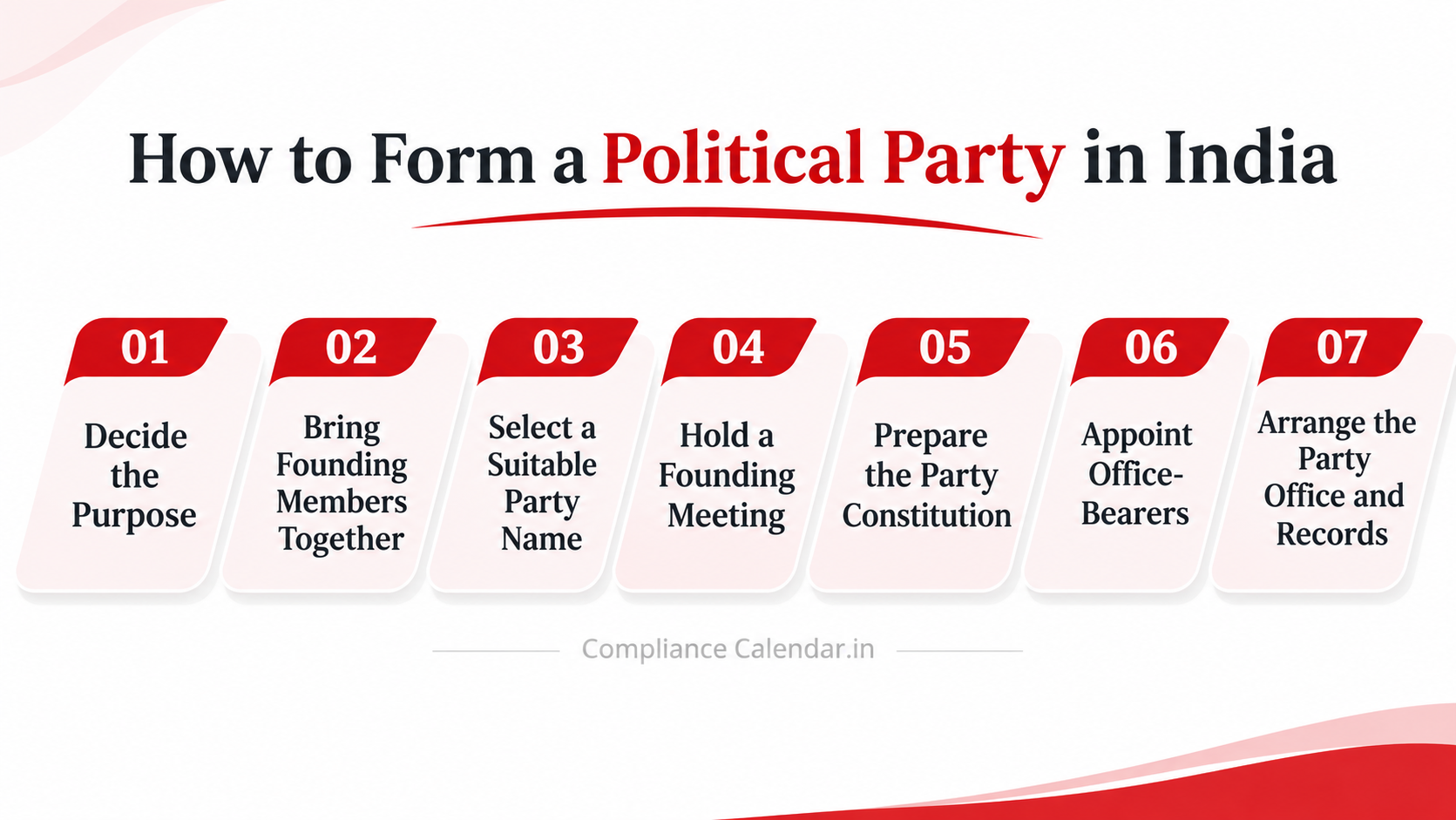
Forming a political party requires the founding members to organise their ideas and put their decisions in writing. The following steps explain how to begin.
1. Decide the Purpose of the Political Party
The first thing is to decide why the group wants to start a political party. Members should discuss the public issues they want to address and the kind of work they plan to do. A party may focus on rural development, education, employment, public health, farmers' welfare or other issues. These ideas should be clear enough to become part of the party's objectives.
The objectives must also be in line with the Constitution of India. A party should not be formed around activities that go against the constitutional framework.
2. Bring Founding Members Together
Once the purpose is clear, the next step is to bring together people who are willing to work for the organisation. They should discuss the party's future, its leadership and how decisions will be taken. The ECI's registration guidelines require supporting electoral records and individual affidavits from at least 100 members who are registered electors. Therefore, the founding group should start organising genuine membership records from the beginning.
These members should understand the party's objectives and agree to become part of its organisation. Their details will be needed when the party applies for registration.
3. Select a Suitable Party Name
The name should give the new party its own identity. It should not be identical or confusingly similar to an existing political party. The ECI's registration checklist also says that the proposed name should not have religious, communal or caste connotations.The founding members should check existing party names before finalising their choice. They should also consider the meaning of the words used, particularly if the name contains Hindi or regional-language words.
Read our related article on Political Party Name Rules in India for more information about the ECI's naming requirements.
4. Hold a Founding Meeting
Once the members agree on the party's purpose and name, they should hold a formal meeting to record the formation of the organisation.During this meeting, members can approve the proposed name, discuss the objectives, adopt the constitution and select the first office-bearers. The decisions should be recorded in the meeting minutes.
The date of this meeting and the date on which the party is formally formed are especially important. Section 29A requires the registration application to be made within 30 days following the date of formation. The party should keep proper proof of its formation date.
5. Prepare the Party Constitution
A political party constitution is the document that explains how the organisation will work. It sets the rules for membership, leadership, internal elections, meetings, decision-making and party funds. The ECI expects the constitution to provide for internal democracy. It must also contain the mandatory declaration under Section 29A(5) of the Representation of the People Act, 1951.
Some important matters covered in the constitution include:
|
Constitution provision |
What it should cover |
|
Party name and objectives |
The official name and the party's aims |
|
Membership |
Eligibility, admission and membership rules |
|
Organisational structure |
Committees, councils and their responsibilities |
|
Office-bearers |
Roles, powers and duties of party leaders |
|
Internal elections |
How leaders are elected and how often elections are held |
|
Meetings |
Notice, quorum and decision-making rules |
|
Discipline |
How complaints and internal disputes are handled |
|
Funds and accounts |
How party money is received, used and audited |
|
Amendments |
How changes to the constitution are approved |
|
Merger or dissolution |
What happens if the party merges or closes |
The constitution should not give unlimited decision-making power to one person. It should explain how members can take part in decisions and how the party will hold regular organisational elections.
For a detailed explanation, read Political Party Constitution: Rules, Format and Requirements.
6. Appoint Office-Bearers
A political party needs people who can manage its activities and take responsibility for its decisions. The founding members should select the first office-bearers according to the party's constitution. Common positions include President, Vice-President, General Secretary, Secretary and Treasurer. The party may also have an executive committee or other organisational bodies.
The constitution should explain how these office-bearers are appointed or elected, how long they remain in their positions and what responsibilities they have. The ECI's guidelines require a democratic structure and regular internal elections.
7. Arrange the Party Office and Records
The party should decide where its main office will operate. This address will be used for official communication with the Election Commission.The founding members should keep the formation minutes, constitution, office-bearer details, membership records and address proof organised. They should also arrange the required office-address affidavit and supporting ownership documents or other evidence specified in the ECI checklist.
The party office should not be in a government building. The ECI's guidelines also require an undertaking about the use of the premises and the absence of disturbance or hardship to the public.
How Many Members Are Required to Register a Political Party?
The ECI's published registration guidelines require electoral records and individual affidavits for at least 100 members of the applicant organisation. These members must be registered electors.
The party must provide certified extracts from the latest electoral rolls or properly attested copies of Elector Photo Identity Cards (EPICs) for these members. Individual affidavits are also required to confirm that they are registered electors and are not members of another political party registered with the Commission.
This requirement is important because the ECI needs to verify the membership details of the organisation applying for registration. It is better to collect and check these records before preparing the final application.
What Are the Steps for ECI Registration of a Political Party?
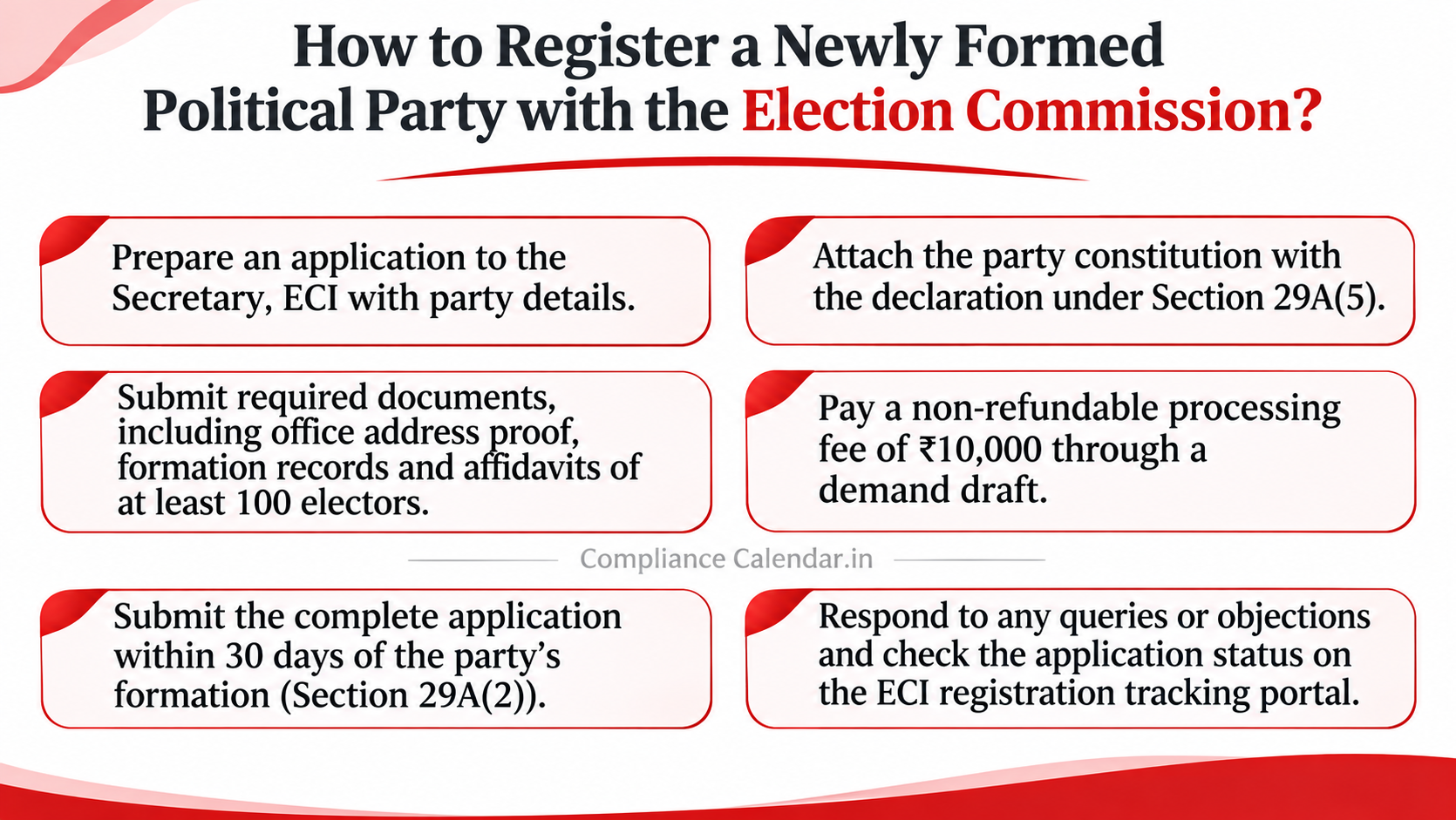
After forming the party, its members must apply to the Election Commission of India (ECI) under Section 29A of the Representation of the People Act, 1951.
- Prepare an application addressed to the Secretary of the ECI, mentioning the party name, formation date, office address, office-bearers and membership details.
- Attach the party constitution with the declaration required under Section 29A(5).
- Submit the required documents, including office address proof, formation meeting records and electoral records and affidavits of at least 100 registered electors.
- Pay the non-refundable processing fee of Rs 10,000 through a demand draft, as prescribed in the ECI guidelines.
- Submit the complete application within 30 days of the party's formation, as required under Section 29A(2).
- Respond to any queries or objections raised during the ECI's review. The application status can be checked through the ECI registration tracking portal.
You can read our detailed guide on How to Register a Political Party in India for the complete registration procedure.
What Happens After the Registration Application Is Submitted?
Submitting the application does not mean that the party is automatically registered. The Election Commission first checks the application and the supporting documents. If any important information is missing or incorrect, the application may face problems during scrutiny.
The ECI's guidelines also require the proposed party name to be published in two national daily newspapers and two local daily newspapers on two days. The public notice gives people an opportunity to raise objections to the proposed registration. The notice is also displayed on the Commission's website. If an objection is received, the ECI may consider it and ask the applicant to provide an explanation or additional information. The party should respond to the Commission's communication and follow the instructions given during the process.
What Responsibilities Does a Registered Political Party Have?
Registration is not the end of the process. A registered political party must continue to follow its constitution and the requirements mentioned in the ECI guidelines.
For example, the party must conduct regular internal elections, maintain proper records of its activities and manage its funds in a transparent way. It must also submit its audited annual accounts to the Election Commission within the prescribed period.
The ECI's current published guidelines also require a registered party to contest an election conducted by the Commission within five years of registration. If it does not contest elections continuously for six years, it may be removed from the list of registered parties. A party must also inform the Commission about important changes, such as changes in its name, head office or office-bearers, without delay.
Does Forming a Political Party Automatically Give It an Election Symbol?
No. Forming a political party and getting it registered with the ECI do not automatically provide a reserved election symbol.
The Election Commission follows separate rules for election symbols under the Election Symbols (Reservation and Allotment) Order, 1968. A newly registered party may be classified as a Registered Unrecognised Political Party (RUPP) until it meets the conditions for recognition as a State or National Party. Recognition depends on election performance and the criteria laid down by the ECI. Therefore, a new party should understand that registration, recognition and reservation of an election symbol are three different matters.
Real Example: Azad Samaj Party Was Launched in Uttar Pradesh in 2020
On 15 March 2020, Chandrashekhar Azad, the chief of the Bhim Army, launched the Azad Samaj Party at an event in Noida, Uttar Pradesh. The launch took place on the birth anniversary of Bahujan Samaj Party founder Kanshi Ram. The party also introduced its flag during the event. The announcement marked the entry of a new political organisation into Uttar Pradesh's political landscape.
The launch was reported by The Indian Express, NDTV and other news organisations on the same day. It is a useful example of how a public organisation can create a separate political platform and enter electoral politics.
However, announcing a party and getting it registered with the Election Commission are different steps. A new organisation must still follow the applicable registration procedure under Section 29A if it wants to become a registered political party.
How We Help You Register a Political Party
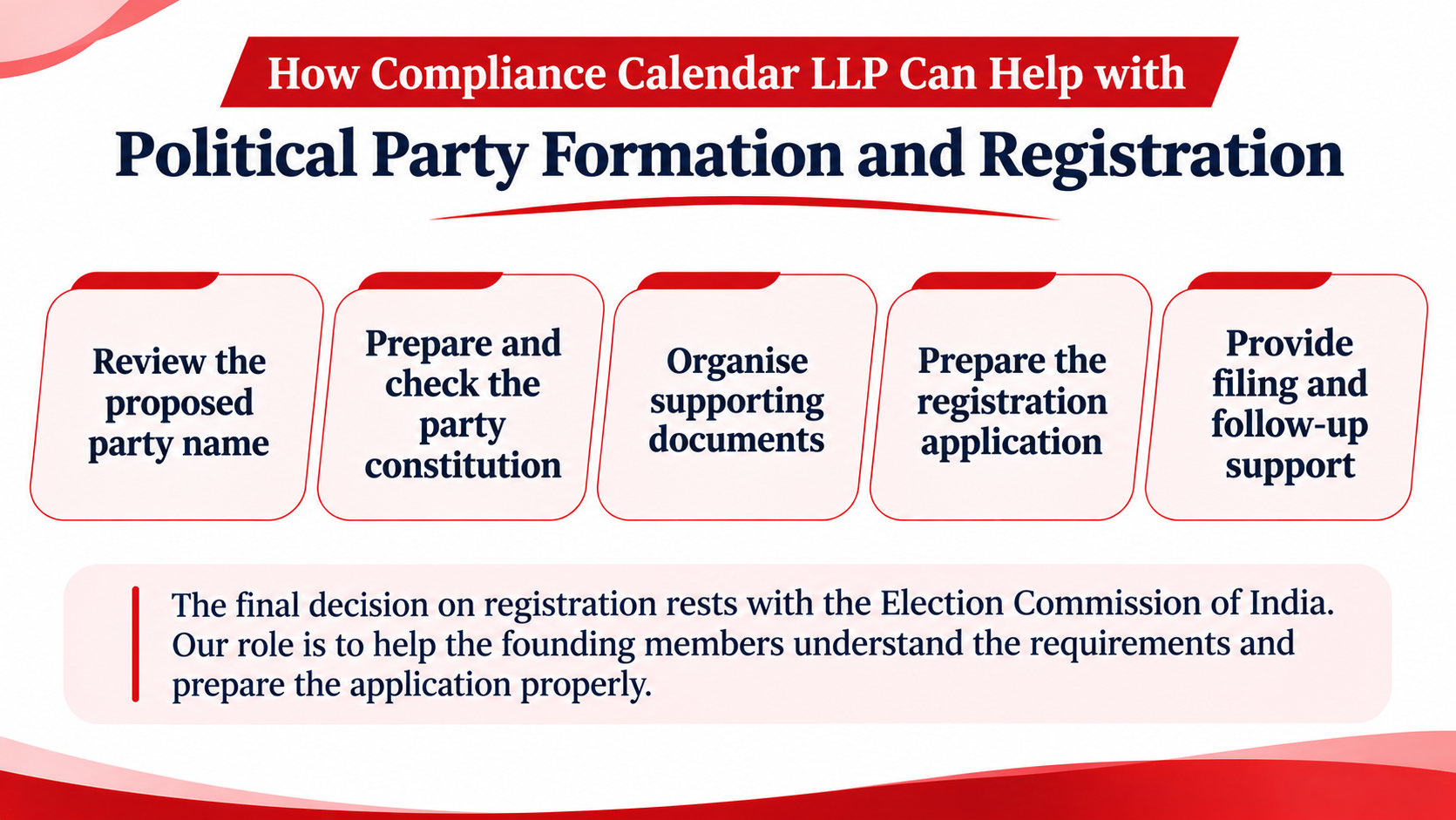
Starting a political party involves several decisions and documents. The founding members need to select a suitable name, prepare the constitution, record the formation, organise membership details and understand the ECI's registration requirements. Compliance Calendar LLP can assist with reviewing the proposed name, preparing and checking the party constitution, organising supporting documents, preparing the registration application and providing filing and follow-up support.
The final decision on registration rests with the Election Commission of India. Our role is to help the founding members understand the requirements and prepare the application properly.
If you are planning to form a political party in India and need assistance with the process, contact Compliance Calendar LLP on +91 9988424211 or info@ccoffice.in
Frequently Asked Questions (FAQs)
1. How can I start a political party in India?
You can start by bringing together people who share a common political purpose. The group should decide its objectives, select a name, hold a founding meeting, prepare a constitution and appoint office-bearers. It can then apply to the ECI for registration under Section 29A.
2. Who can form a political party in India?
Indian citizens can come together to form a political organisation. The party must follow the applicable rules and meet the ECI's conditions if it wants official registration.
3. How many members are required for political party registration?
The ECI's published guidelines require electoral records and individual affidavits from at least 100 members who are registered electors.
4. Is registration with the Election Commission compulsory?
A group can form a political organisation, but registration under Section 29A is required if it wants to become a registered political party with the ECI.
5. What is the time limit for applying for political party registration?
The application must be submitted within 30 days following the date of formation of the party under Section 29A of the Representation of the People Act, 1951.
6. Is a constitution necessary for a political party?
Yes. The party constitution explains its objectives, membership rules, leadership structure, internal elections, decision-making and financial management. It must also contain the mandatory declaration under Section 29A(5).
7. What is the political party registration fee in India?
The ECI's published guidelines specify a non-refundable processing fee of Rs 10,000 through a demand draft in the prescribed manner. Applicants should check the latest instructions before making payment.
8. Can a political party be formed for only one state?
Yes. A group can form a political party with plans to work in one state or across India. However, forming a party for one state does not automatically give it the status of a recognised State Party. Recognition depends on the ECI's election performance criteria.
9. Does a newly registered political party get a reserved election symbol?
No. Registration does not automatically provide a reserved election symbol. Symbol allotment and recognition are governed by separate ECI rules.
10. Can Compliance Calendar LLP help in starting a political party?
Yes. Compliance Calendar LLP can assist with reviewing the proposed name, preparing the party constitution, organising supporting documents and providing registration filing and follow-up support. The final decision rests with the Election Commission of India.
Article last updated on : 23 Nov 2026.











_learn_crop10_thumb.jpg)