


Importing spare parts into India is an important part of the automobile, electronics, engineering and manufacturing industries. Businesses regularly import replacement motors, bearings, machine components, electronic parts, filters and other accessories to maintain equipment or supply the replacement market.
However, importing spare parts can create unexpected compliance problems when businesses overlook the Legal Metrology requirements applicable to packaged products.
Consider an Indian company importing 2,000 packaged automobile filters from China. Each filter comes in a branded retail box displaying the foreign manufacturer's name and product number. The importer plans to sell these filters through automobile spare-part shops and online marketplaces.
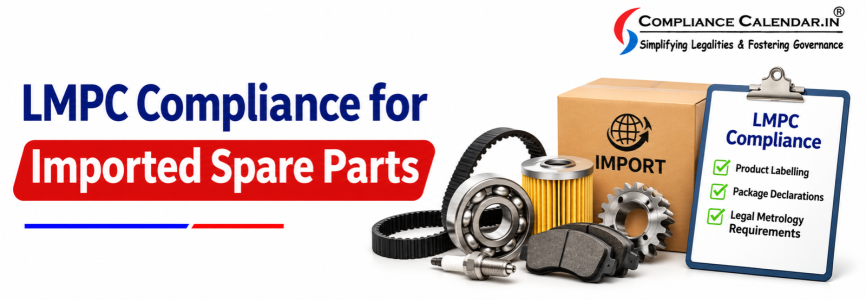
Before distributing the products, the company must examine whether LMPC Compliance for Imported Spare Parts applies and whether the packaging contains the prescribed declarations, including importer details, country of origin, quantity and Maximum Retail Price (MRP).
What Is LMPC Compliance for Imported Spare Parts?
LMPC stands for Legal Metrology Packaged Commodities. It refers to requirements governing certain products packed in predetermined quantities before being supplied to buyers. For imported spare parts, LMPC compliance commonly involves two separate obligations: registration of the covered importer under Rule 27 and correct declarations on covered retail packages under Rule 6 of the Packaged Commodities Rules, 2011.
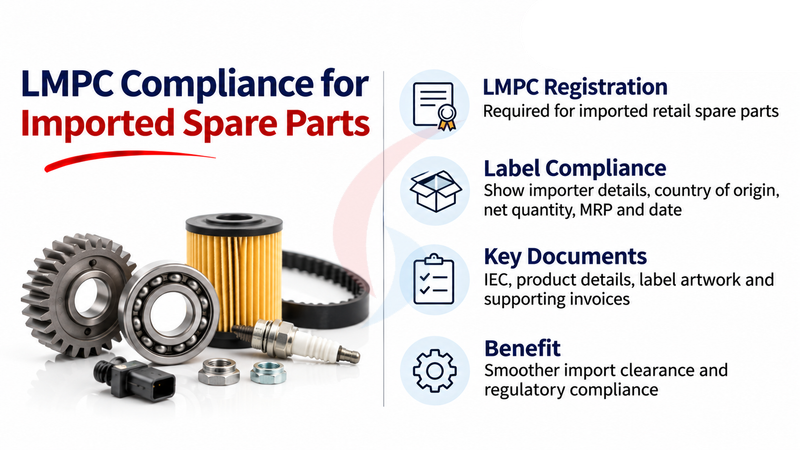
For example, an imported car air filter packed individually for retail sale may need declarations showing the Indian importer, product description, country of origin, quantity, MRP and other prescribed information. The objective is to help purchasers identify the product, understand its quantity and price, and contact the responsible business. Importers should remember that LMPC Registration is not product testing or quality certification. It does not replace an Import Export Code, GST Registration or any BIS certification that may apply to a particular spare part.
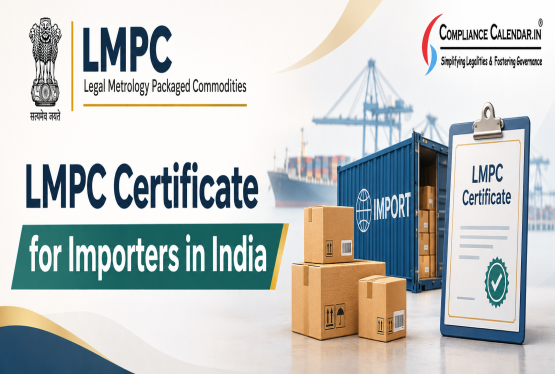
For additional information, read LMPC Certificate for Importers in India
Is LMPC Registration Mandatory for Imported Spare Parts?
LMPC Registration may be required where a business imports pre-packaged spare parts falling within the relevant provisions of the Packaged Commodities Rules. The key factor is not simply whether the goods are described as spare parts. Their packaging, quantity, intended use and method of sale must be examined.
The Department of Consumer Affairs explains that the Packaged Commodities Rules generally cover pre-packaged commodities, while loose commodities are treated differently. The rules also contain exclusions for qualifying industrial and institutional packages.
|
Imported Spare Parts |
General LMPC Position |
|
Individually boxed car air filters for retail sale |
Retail-package requirements generally apply |
|
Packaged motorcycle spare parts sold in shops |
Generally applicable |
|
Replacement electrical switches in retail packs |
Generally applicable, subject to product-specific rules |
|
Packaged electronic replacement parts sold online |
Generally applicable |
|
Parts supplied for qualifying industrial use |
May qualify for the industrial-consumer exclusion |
|
Spare parts used for warranty servicing and not sold to customers |
Special relief applies to specified date declarations |
|
Loose spare parts not imported as pre-packaged commodities |
Requires a separate applicability assessment |
|
Bulk parts packed only for transport |
Depends on the actual packaging and supply arrangement |
An importer should not assume that every business-to-business transaction is exempt. A distributor purchasing spare parts for resale is different from a qualifying industrial consumer purchasing parts for use in its own operations.
A Practical Example: When an Importer Discovers an LMPC Labelling Problem
Consider a fictional company, XYZ Components Private Limited, based in Delhi. XYZ imports vehicle filters, replacement switches and small engine components from Thailand. In 2026, the company places an order for 6,000 packaged spare parts worth approximately Rs 24 lakh.
The products arrive in branded retail boxes displaying the foreign manufacturer's details and product identification numbers. During the documentation review, AutoMax discovers that the packaging does not contain the complete Indian importer address, MRP in Indian rupees or prescribed consumer care information.
The company initially assumes that having an IEC and GST Registration is enough to import and distribute the goods. However, its compliance team explains that covered pre-packaged spare parts must also satisfy the relevant Legal Metrology requirements.
XYZ reviews its LMPC Registration, checks the package declarations and arranges corrections through a legally permitted process before distributing the products. The company also starts checking packaging artwork before confirming future import orders. This example shows why LMPC compliance should be examined before spare parts are shipped to India, rather than after problems arise during clearance or distribution.
Legal Provisions for LMPC Compliance for Imported Spare Parts
The principal legal requirements arise from the Legal Metrology Act, 2009 and the Legal Metrology (Packaged Commodities) Rules, 2011, as amended. The Customs Act, 1962 governs the import clearance process, while separate product certification requirements may apply.
|
Act / Legal Provision |
Key Requirement |
|
Requires prescribed declarations on covered pre-packaged commodities |
|
|
Addresses specified packaging-related violations |
|
|
Defines important packaging and consumer-related terms |
|
|
Provides exclusions for qualifying packages |
|
|
Prescribes mandatory package declarations |
|
|
Governs the manner of displaying declarations |
|
|
Legal Metrology (Packaged Commodities) Rules, 2011 – Rule 26 |
Provides specified exemptions and exceptions |
|
Legal Metrology (Packaged Commodities) Rules, 2011 – Rule 27 |
Governs registration of manufacturers, packers and importers |
|
Governs filing of the Bill of Entry |
|
|
Enables compulsory certification for products covered by applicable Quality Control Orders |
Rule 27 generally requires covered importers to apply for registration within 90 days of commencing the relevant importing activity. However, the registration period does not excuse failures to comply with applicable package declarations.
Mandatory LMPC Labelling Requirements for Imported Spare Parts
Imported spare parts sold in covered retail packages must display the prescribed information in a clear and legible manner. The exact declarations depend on the product and applicable provisions.
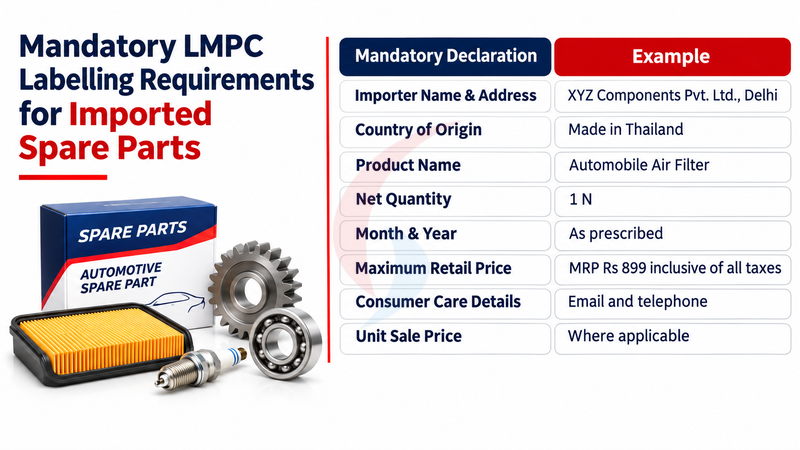
|
Mandatory Declaration |
Example |
|
Importer Name and Address |
XYZ Components Pvt. Ltd., Delhi |
|
Country of Origin |
Made in Thailand |
|
Product Name |
Automobile Air Filter |
|
Net Quantity |
1 N |
|
Month and Year Information |
As prescribed for the relevant product |
|
Maximum Retail Price |
MRP Rs 899 inclusive of all taxes |
|
Consumer Care Details |
Customer care email and telephone number |
|
Unit Sale Price |
Where applicable |
Where a packet contains four replacement spark plugs, the declared quantity should accurately reflect the number of components in the package. Importers should also verify whether additional product-specific declarations are required. For example, electrical components and automotive parts may be subject to separate safety, quality or industry requirements.
Read LMPC Labeling Rules: Mandatory Declarations on Packaged Goods for further guidance.
Special LMPC Provisions for Warranty Spare Parts
One of the most important provisions for spare-part importers was introduced through the Legal Metrology (Packaged Commodities) Amendment Rules, 2023. The amendment to Rule 6(1)(d), effective from 1 April 2024, provides specific relief for spare parts and accessories used for servicing under warranty and not sold to end customers.
Importantly, the relief relates to the date-declaration requirement under that particular clause. It is not a blanket exemption from every Legal Metrology requirement. The same amendment contains a specific provision for declaring the month and year of manufacture on retail packages of electronic products, spare parts and accessories.
|
Type of Spare Part |
Important Requirement |
|
Spare part supplied for retail sale |
Follow applicable retail-package declarations |
|
Spare part used only for warranty servicing and not sold to customers |
Specific relief from the relevant date-declaration provision |
|
Electronic spare part sold in retail packaging |
Follow the prescribed manufacture-date display provision |
|
Replacement part supplied for qualifying industrial use |
Examine the applicable industrial-consumer exclusion |
For example, a replacement component supplied free of charge by a manufacturer during a valid warranty repair may qualify for the specific date-declaration relief, whereas the same component sold separately in a retail shop may remain subject to ordinary retail-package requirements.
Documents Required for LMPC Registration for Imported Spare Parts
Importers need to provide accurate business and registration information to the competent Legal Metrology authority. The exact checklist depends on the applicant's business structure and the applicable jurisdiction.
|
Document |
Purpose |
|
Certificate of Incorporation or Business Registration |
Confirms legal business identity |
|
PAN |
Establishes tax identity |
|
Import Export Code (IEC) |
Identifies the importer |
|
GST Registration, where applicable |
Supports business particulars |
|
Registered Office Address Proof |
Verifies business location |
|
Director or Partner Details |
Identifies responsible persons |
|
Authorisation Letter |
Authorises the applicant |
|
Spare Parts Product List |
Identifies imported product categories |
|
Product Label Samples, where requested |
Supports declaration verification |
|
Import Invoice, where required |
Supports transaction details |
Under the May 2026 amendment, the prescribed registration information includes identification of the company director responsible for violations under the Legal Metrology Act and rules. Businesses should keep the details consistent across their registration documents and import records.
LMPC Registration Process for Imported Spare Parts
The process begins by determining whether the imported products fall within the applicable Packaged Commodities Rules.
|
Step |
Registration Process |
Important Action |
|
Step 1 |
Check Applicability |
Identify covered spare parts and any statutory exclusions |
|
Step 2 |
Prepare Documents |
Collect business, IEC and product information |
|
Step 3 |
Verify Packaging |
Check mandatory declarations and any special spare-part provisions |
|
Step 4 |
Submit Application |
Apply through the competent Legal Metrology authority |
|
Step 5 |
Pay Registration Fee |
Pay the prescribed government charges |
|
Step 6 |
Address Observations |
Correct application deficiencies, where required |
|
Step 7 |
Obtain Registration |
Retain the certificate and maintain updated information |
The prescribed Rule 27 application fee is generally Rs 500, while the fee for alteration of registered particulars is Rs 100. These statutory fees do not include professional charges, labelling costs or other expenses.
LMPC Compliance for Spare Parts Sold Online
Many businesses sell replacement components through Amazon, Flipkart, their own websites and specialised spare-part marketplaces. For example, a retailer may import packaged replacement blender blades or water-purifier filters and offer them individually online.
Where the products qualify as covered pre-packaged commodities, the importer must comply with applicable registration and package declarations. The information appearing in online listings should be consistent with the prescribed product information and should not mislead customers about price, quantity or origin.
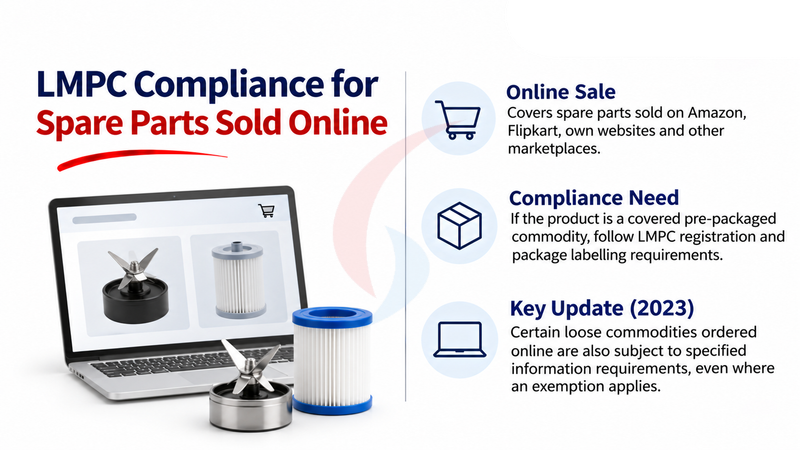
The 2023 amendment also introduced a special provision concerning certain loose commodities ordered through e-commerce channels. Such goods remain subject to specified information requirements even where the relevant exemption applies.
For related information, read LMPC Registration for Amazon and Flipkart Sellers
BIS Certification and Other Requirements for Imported Spare Parts
LMPC Registration does not replace product-specific certification or import restrictions. Some spare parts may be covered by mandatory BIS Quality Control Orders, while others may be subject to particular automotive, electrical, electronic or environmental requirements.
For example, an imported electrical component may need separate safety or certification checks if it falls within a notified product category. Importers should identify the exact product description, applicable Indian Standard, customs classification and intended use rather than assume that every spare part requires BIS certification.
|
Compliance Requirement |
Purpose |
|
LMPC Registration |
Registration of covered packaged commodity importers |
|
Package Labelling |
Consumer information and quantity declarations |
|
IEC |
Import-export identification |
|
BIS Certification |
Product conformity where legally mandatory |
|
EPR Registration |
Waste management obligations for covered products or packaging |
|
Customs Compliance |
Classification, valuation, documentation and clearance |
For example, an importer dealing in electronic replacement products may need to examine whether E-Waste Management Rules or another EPR regime applies to the relevant products.
For guidance on packaging responsibilities, read EPR for Imported Products with Multiple Packaging
Latest Legal Metrology Updates Affecting Imported Spare Parts in 2026
Several important changes affect businesses importing spare parts, particularly registration particulars, package labelling and e-commerce requirements.
|
Government Update |
Date |
Key Change |
|
Legal Metrology Third Amendment Rules, 2026 |
29 May 2026 |
LMPC registration remains valid until cancelled, with prescribed annual updates and responsible-director details |
|
Bonded Warehouse Labelling |
29 May 2026 |
Permits mandatory declarations at eligible AEO Tier-2 and Tier-3 bonded warehouses |
|
Legal Metrology Fourth Amendment Rules, 2026 |
21 September 2026 |
Amends specified package declaration requirements, mainly affecting certain cosmetics and toiletries |
|
Guidance on Imported Packages |
8 October 2026 |
Addresses uniform implementation of mandatory declarations on imported pre-packaged goods |
|
Country-of-Origin E-Commerce Filter |
Effective 1 July 2027 |
Requires e-commerce entities to provide a searchable and sortable country-of-origin filter for imported product listings |
The April 2026 Second Amendment expressly specifies 1 July 2027 as the commencement date of the country-of-origin filter requirement. Importers should distinguish this future obligation from country-of-origin information already required for applicable imported retail packages.
Penalties for Non-Compliance with LMPC Requirements
Importers who fail to comply with applicable Legal Metrology requirements may face enforcement action and customs-related difficulties. Section 36 of the Legal Metrology Act, 2009 addresses specified contraventions involving packaged commodities. Other provisions may apply depending on the nature of the violation. For example, if xyz sells imported packaged filters without prescribed importer information or quantity declarations, the business may be required to address the non-compliance and face applicable legal consequences.
The Jan Vishwas (Amendment of Provisions) Act, 2026 introduced changes affecting specified Legal Metrology offences and compliance procedures. Importers should therefore consult the amended statutory provisions applicable to the particular violation rather than assume an older penalty amount remains unchanged.
For more information, read Customs Clearance Without LMPC Registration
Why Choose Compliance Calendar LLP ?
Compliance Calendar LLP assists importers, manufacturers and distributors with LMPC Registration, packaging declaration reviews and Legal Metrology compliance. Our professionals help spare-part importers understand registration applicability, prepare supporting documents, review package information and identify relevant exemptions. We also assist businesses with LMPC Registration amendments and related import compliance procedures. For professional assistance, visit our LMPC Registration Service.
For enquiries, contact Compliance Calendar LLP by email at info@ccoffice.in or via WhatsApp at 9988424211
Frequently Asked Questions (FAQs)
Q1. Is LMPC Registration mandatory for imported spare parts?
Ans: LMPC Registration is generally required where an importer deals in covered pre-packaged spare parts. Applicability depends on the product, packaging and relevant statutory exclusions.
Q2. Are automobile spare parts covered under LMPC requirements?
Ans: Individually packaged automobile spare parts sold through retail channels may fall within the Packaged Commodities Rules. Importers should examine the applicable registration and labelling requirements.
Q3. Are spare parts imported for industrial use exempt from LMPC?
Ans: Qualifying industrial-consumer packages may be excluded from specified retail-package requirements. The exemption depends on the buyer, intended use and applicable legal conditions.
Q4. Are warranty replacement spare parts exempt from LMPC?
Ans: A specific exemption applies to the relevant date-declaration requirement for spare parts used for warranty servicing and not sold to end customers. It does not automatically remove every Legal Metrology obligation.
Q5. What declarations are required on imported spare-part packages?
Ans: Covered retail packages generally require importer information, country of origin, product description, net quantity, MRP and consumer care details, together with any other applicable declarations.
Q6. What is the government fee for LMPC Registration?
Ans: The prescribed application fee under Rule 27 is generally Rs 500. Additional costs may arise from documentation, packaging corrections and professional assistance.
Q7. Is LMPC Registration required for loose spare parts?
Ans: Loose products that do not qualify as pre-packaged commodities may fall outside the relevant provisions. However, importers should examine their actual supply arrangements and any special e-commerce requirements.
Q8. Can imported spare parts be labelled after arriving in India?
Ans: Certain arrangements allow mandatory declarations at eligible AEO Tier-2 and Tier-3 bonded warehouses. The applicable conditions must be satisfied before the packages leave those warehouses.
Q9. Is BIS certification mandatory for every imported spare part?
Ans: No. BIS certification depends on whether the particular spare part falls under a notified mandatory certification requirement. LMPC Registration and BIS certification are separate obligations.
Q10. Can Compliance Calendar LLP assist with LMPC Registration for spare parts?
Ans: Yes. Compliance Calendar LLP assists with registration applicability, documentation, label reviews, amendments and related importer compliance requirements.
Article last updated on : 27 Nov 2026.










_learn_crop10_thumb.jpg)