


Cinemas and multiplexes welcome hundreds or even thousands of visitors every day. People come to watch movies, buy food, meet friends and spend time with their families. During weekends, holidays and popular movie releases, the number of visitors can increase sharply. Managing such a large number of people requires proper security arrangements.
Many cinema owners hire private security agencies to manage entry points, check visitor movement, protect cinema property and handle crowd-related situations. However, an agency providing security guards to a cinema or multiplex must understand the legal requirements under the Private Security Agencies (Regulation) Act, 2005 (PSARA).
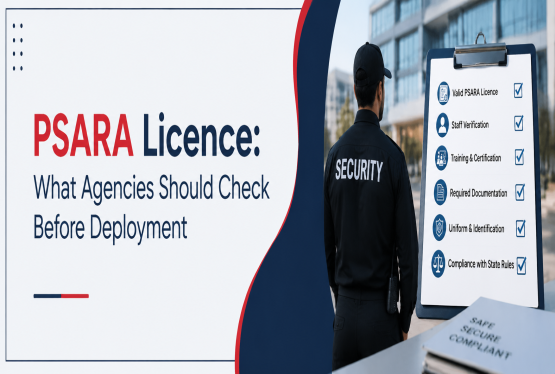
A PSARA License is required when a business operates as a private security agency and provides private security services to another person or business. Therefore, an agency supplying guards to cinemas, multiplexes or entertainment centres must check the PSARA licensing requirements in the State where it plans to work. The cinema operator should also verify the agency's licence and other relevant documents before signing a security contract.
Does a Cinema or Multiplex Need a PSARA License?
The requirement depends on who is providing the security staff. Under the PSARA Act, a private security agency is a person or organisation engaged in the business of providing private security services, including supplying security guards to companies, businesses or other persons.
If a cinema or multiplex hires an outside security agency to provide guards, the agency must hold the required PSARA License. However, a cinema operator that directly employs its own security staff is not automatically a private security agency simply because it has guards working at its premises. The legal position depends on the actual employment and service arrangement.
|
Situation |
PSARA Requirement |
|
A security agency supplies guards to a cinema |
The agency must hold the applicable PSARA License. |
|
A security company provides security services to multiple multiplexes |
The company must obtain the required PSARA License for its operations. |
|
A cinema directly employs its own security staff |
It is not automatically treated as a private security agency under PSARA merely for employing its own staff. |
|
A multiplex hires a third-party agency for crowd and property security |
The agency must meet the applicable PSARA requirements. |
Cinema owners should not assume that a security agency is legally authorised just because it has been operating for several years or has supplied guards to other businesses. The licence should be checked before the agency starts work.
For more information Kindly Visit : Is PSARA License Mandatory?
Why Do Cinemas and Multiplexes Need Proper Security Arrangements?
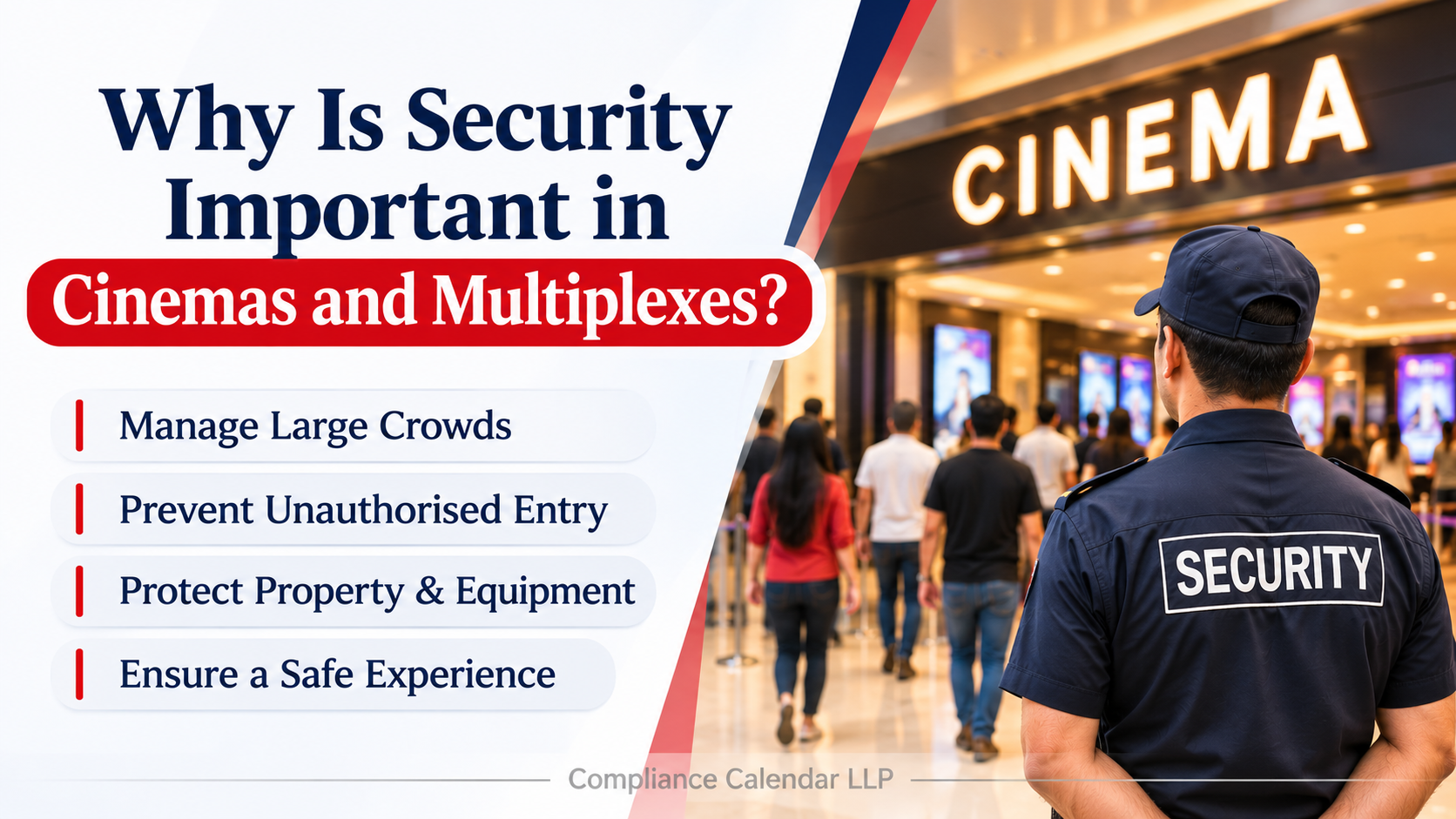
A cinema has several areas where visitors, employees, vendors and service staff move throughout the day. These include ticket counters, entrance gates, screening halls, food counters, parking areas, staircases and emergency exits. During weekends, holidays and popular movie releases, the number of visitors can increase quickly. Without proper security arrangements, managing such crowds can become difficult, and even a small issue may create confusion.
Security staff help maintain order and support the cinema's daily operations. They manage long queues, prevent unauthorised entry into restricted areas, protect cinema equipment and other property, and guide visitors towards the correct screening halls and exits. They may also monitor parking areas, report suspicious activities and assist people in moving to safe areas during an emergency, following the cinema's emergency plan. These responsibilities should be clearly defined in the agreement between the cinema operator and the security agency so that guards understand their duties before starting work.
What Security Services Can Private Agencies Provide at Cinemas and Multiplexes?
A private security agency can provide different security-related services depending on the cinema's requirements and the duties permitted under its contract. The exact responsibilities should be decided before guards are deployed.
For example, a multiplex may need guards at its main entrance, parking area, ticket counter and different floors. A single-screen cinema may require a smaller team to manage entry, protect the premises and assist with visitor movement.
|
Security Area |
Work That Guards May Handle |
|
Main Entrance |
Managing visitor entry and monitoring designated access points. |
|
Ticket Counter |
Maintaining queues and helping prevent crowding near ticket counters. |
|
Screening Halls |
Monitoring permitted areas and reporting unauthorised access. |
|
Parking Area |
Monitoring vehicle movement and protecting designated parking spaces. |
|
Food Courts |
Supporting crowd management around food and refreshment counters. |
|
Restricted Areas |
Preventing unauthorised entry into staff rooms, control rooms and storage areas. |
|
Emergency Exits |
Helping keep exit routes clear and guiding visitors during an emergency. |
|
Property Protection |
Watching over cinema equipment, furniture and other assets. |
Important: Private security guards do not automatically have the authority to perform police functions, conduct statutory inspections or take over specialised fire and emergency duties. Their work must remain within the law, their training and the responsibilities approved by the cinema management.
What Documents Are Required for a PSARA License?
An agency planning to provide security guards to cinemas or multiplexes must prepare the documents required by the concerned State or Union Territory. The exact list may differ because State PSARA Rules and application procedures can vary.
The documents generally relate to business registration, the applicant's identity, business address, financial and statutory details, and the required declarations.
|
Document Category |
Examples of Documents |
|
Business Registration |
Certificate of Incorporation, LLP registration certificate or partnership deed, as applicable. |
|
Applicant Identity |
PAN card, identity proof and address proof of the proprietor, partners or directors. |
|
Business Address |
Office address proof, rent agreement or ownership documents, as applicable. |
|
Business Details |
PAN, GST registration details, if applicable, and other business information. |
|
Applicant Declarations |
Affidavits and declarations required under the PSARA Act and State Rules. |
|
Employee Details |
Details required for verification of security guards and supervisors. |
|
Training Details |
Documents or arrangements showing compliance with prescribed training requirements. |
|
Other Supporting Documents |
Any additional documents requested by the concerned Controlling Authority. |
What Is the Process for Obtaining a PSARA License for Cinema Security?
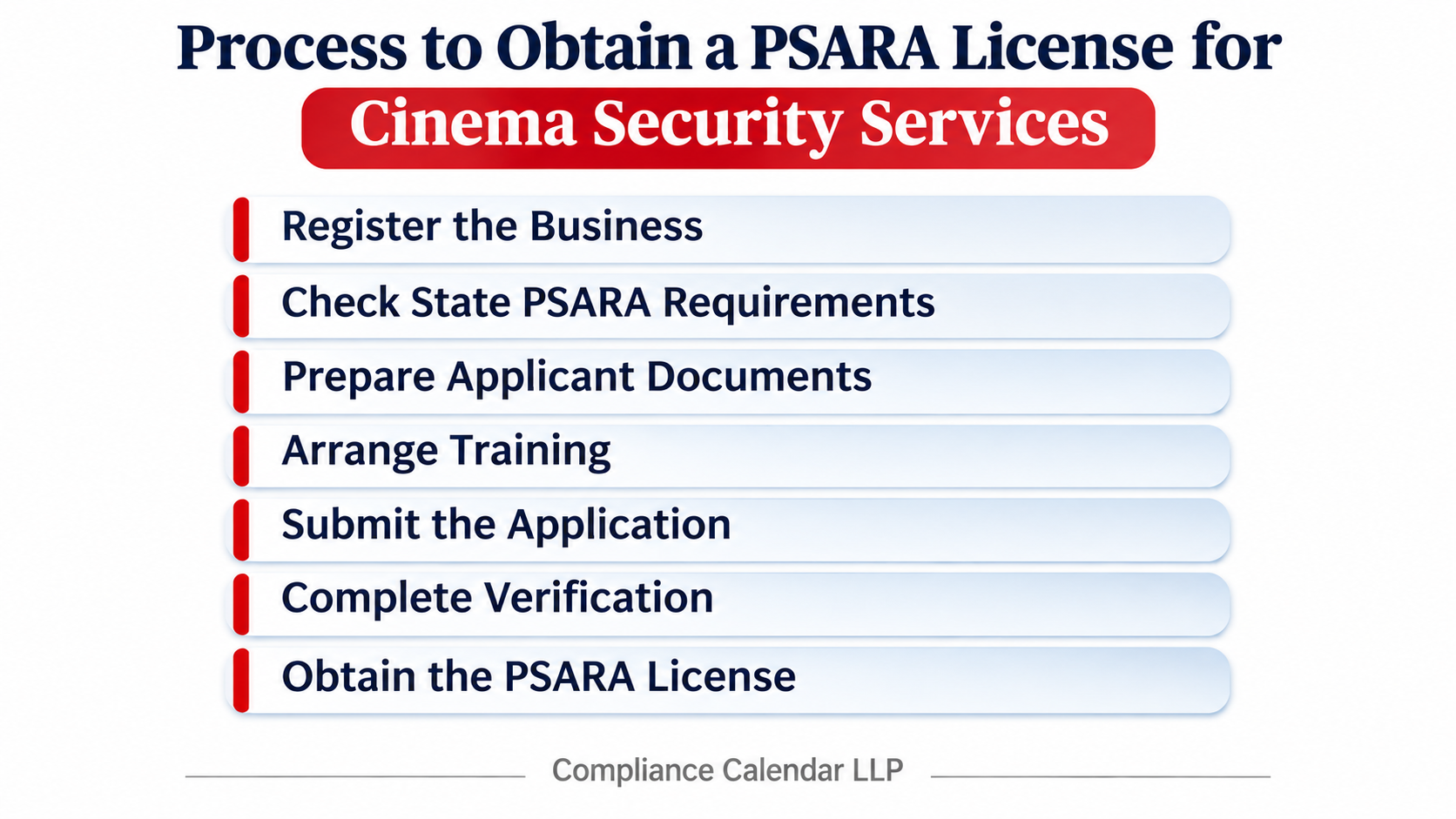
An agency planning to provide security services to cinemas should first obtain the PSARA License applicable to its business. The application is made to the Controlling Authority appointed by the concerned State or Union Territory.
Step 1: Register the Business
Set up the business as a proprietorship, partnership, LLP or company, depending on the chosen business structure.
Step 2: Check State PSARA Requirements
Identify the concerned Controlling Authority and check the applicable application form, fee, documents and State-specific rules.
Step 3: Prepare Applicant Documents
Arrange the identity, address, business registration and other required documents of the applicant, partners or directors.
Step 4: Arrange Training
Make sure the agency has the required training arrangements for security guards and supervisors under the applicable rules.
Step 5: Submit the Application
File the application with the required documents, declarations and applicable government fee.
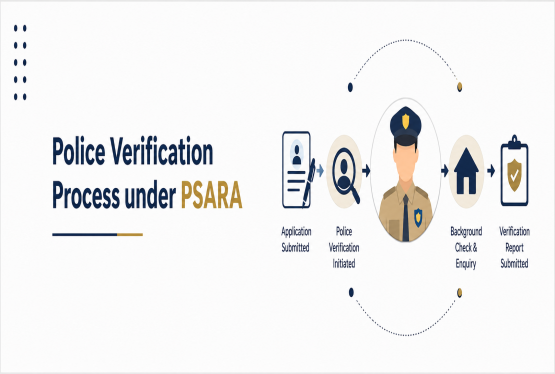
Step 6: Complete Verification
Cooperate with the authority during the required verification process and respond to any queries or objections.
Step 7: Obtain the PSARA License
Once the application is approved, receive the licence and follow its conditions before starting security operations.
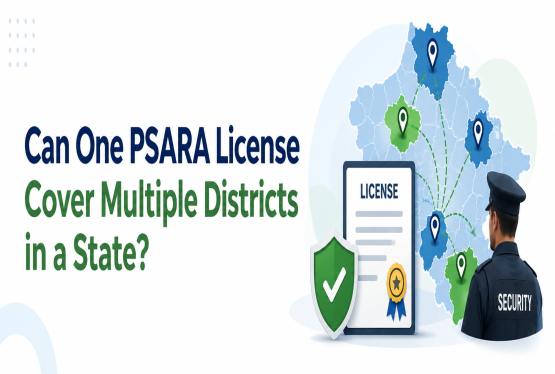
An important point is that a PSARA License is generally linked to the State or Union Territory for which it is granted. An agency planning to provide security services in another State should check the licensing requirements there instead of assuming that one State's licence automatically covers the entire country.
For detailed information visit : How to Start a Security Agency in India?
What Training Should Security Guards Complete Before Working in a Cinema?
Security guards working in cinemas regularly deal with visitors, queues, entry points and different types of public situations. They should know how to communicate with people, follow instructions and respond calmly when a problem occurs.
The PSARA Central Model Rules, 2020 provide training requirements for private security guards and supervisors. Under Rule 8, entry-level training generally includes a minimum of 100 hours of classroom instruction and 60 hours of field training, spread over at least 20 working days. Ex-servicemen and former police personnel are subject to a shorter prescribed training course.
Training under the applicable rules includes subjects such as physical fitness, public conduct, building security, fire fighting, crowd control and checking identity documents.
For cinema-related assignments, the agency and cinema management should also make sure that guards understand:
- How to manage queues without creating unnecessary conflict.
- How to identify and report suspicious activities.
- How to communicate with cinema managers and supervisors.
- How to guide visitors towards designated exits.
- How to follow the cinema's emergency response instructions.
- How to handle disputes without using unnecessary force.
Cinema-specific instructions should be given according to the duties assigned to the guards. A guard responsible for an entrance gate may need different practical instructions from someone deployed in a parking area.
How Many Security Guards Does a Cinema or Multiplex Need?
There is no single fixed number of security guards required for every cinema or multiplex. The requirement depends on the size of the premises, number of screening halls, daily visitor footfall, entry and exit points, parking facilities and operating hours. For example, a multiplex with several screens and a large food court may need more guards than a small cinema with limited seating. The number may also increase during weekends, festivals, movie premieres and the release of popular films.
Before deciding the number of guards, cinema management should check how many screening halls and floors need security coverage, how many visitors enter during peak hours and whether separate guards are needed for entrances, exits and restricted areas. The size of the parking facility and the timing of late-night shows should also be considered while planning shifts. A cinema hosting a special event or expecting a large crowd may need temporary additional security personnel. Therefore, the final deployment plan should be prepared after assessing the actual premises and security requirements rather than choosing an arbitrary number of guards.
What Should a Security Agency Check Before Accepting a Cinema Contract?
Before accepting a cinema security assignment, an agency should understand the client's requirements and the actual work expected from its guards. A contract that simply mentions "complete security management" may create confusion if the exact duties are not explained.
The agency should visit the premises, understand the cinema's layout and discuss the expected responsibilities with the management team.
The following points should be checked before signing the agreement:
|
Area to Check |
What the Agency Should Confirm |
|
Licence |
Whether its PSARA License covers the State where the cinema is located. |
|
Scope of Work |
The exact security duties expected from the guards. |
|
Number of Guards |
The required number of guards for each shift and location. |
|
Working Hours |
Shift timings, weekly offs and replacement arrangements. |
|
Training |
Training and instructions required for the assigned duties. |
|
Employee Verification |
Completion of required character and antecedent verification. |
|
Uniform and Identity |
Uniform, identity cards and reporting arrangements. |
|
Emergency Procedures |
Instructions for evacuation, crowd movement and reporting incidents. |
|
Payment Terms |
Monthly charges, overtime, additional deployment and payment schedule. |
|
Contract Period |
Start date, renewal conditions and termination terms. |
The agency should also make sure that the contract clearly explains who will supervise the guards and who will be responsible for providing site-specific instructions.
What Are the Legal Consequences of Operating Without a PSARA License?
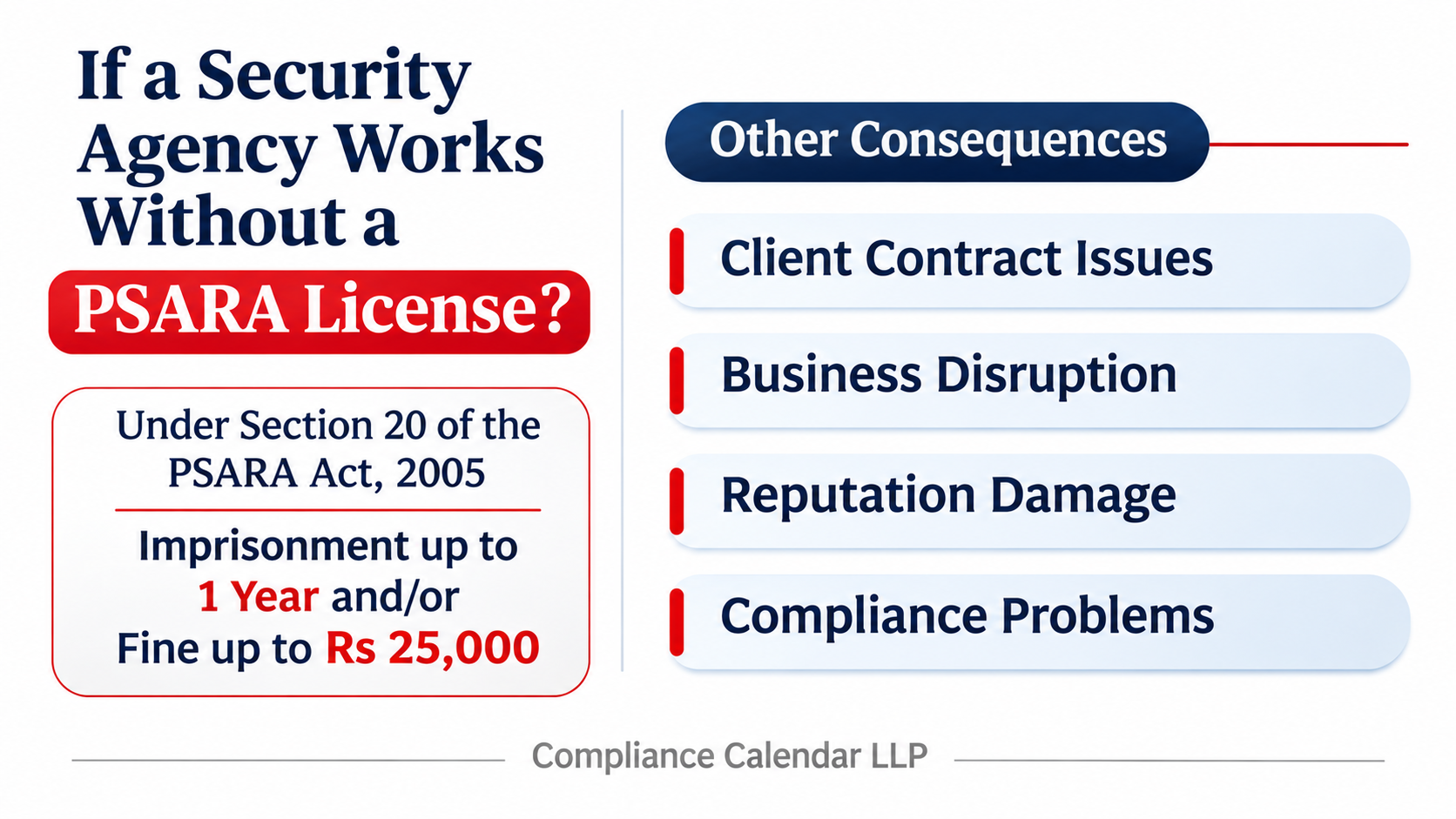
Operating a private security agency without a valid PSARA License can lead to legal action. Section 4 of the PSARA Act, 2005 does not allow a person or business to operate a private security agency without obtaining the required licence from the concerned authority. For example, if a company starts supplying security guards to a multiplex without a PSARA License, it may face action for carrying on an unlicensed security business.
Section 20 of the PSARA Act provides the following punishment for violating Section 4:
|
Type of Penalty |
Punishment |
|
Imprisonment |
Up to 1 year |
|
Fine |
Up to Rs 25,000 |
|
Both |
Imprisonment and fine may apply together |
Apart from the legal penalty, an unlicensed agency may also face business problems. A cinema or multiplex may refuse to hire the agency or terminate an existing contract if it cannot provide valid licensing documents. The agency may also face disruption in its security assignments, damage to its business reputation and questions from the concerned authorities about its operations.
Cinema owners should verify the agency's PSARA License before allowing security guards to start work. They should check the licence details and confirm that it covers the State where the cinema is located. Any separate violation relating to cinema safety, fire requirements or other premises permissions may attract action under the relevant laws.
Practical Example: A Security Agency Planning to Work With a Multiplex
A security company named CityGuard Security Services in Jaipur, Rajasthan. The company wants to provide security guards to a multiplex that has six screening halls, a food court, a ticket counter and a multi-level parking area.
The multiplex needs guards to manage the main entrance, monitor visitor movement, protect restricted areas and support crowd management during evening shows. CityGuard agrees to provide a team of guards under a monthly service contract.
Before starting the assignment, the company checks whether it holds the required PSARA License for Rajasthan. It also arranges the necessary employee verification, training records, uniforms and identity cards. The company then discusses the number of guards, shift timings, supervisor responsibilities and emergency instructions with the multiplex management.
How Compliance Calendar LLP Can Help With PSARA License Requirements
Starting a private security agency or expanding into cinema and multiplex security work involves more than arranging guards and signing contracts. The agency must understand the licensing requirements of the State where it plans to operate and prepare the necessary documents.
Compliance Calendar LLP can assist businesses with the PSARA License process, including:
- Understanding the applicable PSARA licensing requirements.
- Preparing the required application documents.
- Assisting with application filing before the concerned authority.
- Providing guidance on licence conditions and compliance requirements.
- Supporting businesses with queries raised during the application process.
Whether you are planning to start a private security agency or provide security services to cinemas and multiplexes, professional assistance can help you understand the required steps.
For assistance with your PSARA License, contact Compliance Calendar LLP at +91 9988424211 or email info@ccoffice.in
Frequently Asked Questions (FAQs)
1. Is a PSARA License compulsory for a security agency working in a multiplex?
Yes. A private security agency providing guards or private security services to a multiplex must hold the applicable PSARA License for the State or Union Territory where it operates.
2. Does a cinema owner need a PSARA License to hire security guards?
A cinema owner is not automatically required to obtain a PSARA License merely because it directly employs its own security staff. However, if it hires an outside private security agency, that agency must hold the required licence.
3. Can a security agency provide guards to multiple cinemas with one PSARA License?
A licence may cover the agency's operations within the State or Union Territory for which it is issued, subject to its terms and applicable rules. The agency should check the licensing requirements before operating in another State.
4. Can a multiplex hire security guards without checking the agency's PSARA License?
A multiplex should verify the agency's valid licence before engaging it for private security services. It should also check the agency's employee verification, training and other relevant documents.
5. What duties can PSARA-licensed guards perform in a cinema?
They may manage designated entry points, support crowd control, protect cinema property, monitor permitted areas and assist visitors. Their duties must remain within the law and the scope of their assignment.
6. Is PSARA License the same as a cinema operating licence?
No. A PSARA License authorises a private security agency to carry on its security business. A cinema operating licence relates to permission to operate the cinema premises under the applicable State laws.
7. Do cinema security guards need training?
Yes. Private security guards must meet the applicable training requirements under the PSARA Act and Rules. Training includes subjects such as physical fitness, building security, fire fighting and crowd control.
8. How many guards are required for a multiplex?
There is no universal fixed number. The requirement depends on the number of screens, visitor footfall, entry points, parking area, operating hours and other security needs.
9. Can a PSARA-licensed agency work in another State?
An agency should obtain the required licence for each State or Union Territory where it plans to operate. A licence issued in one State should not be treated as automatic permission to operate throughout India.
10. What is the penalty for running a private security agency without a PSARA License?
Under Section 20 of the PSARA Act, contravention of Section 4 may result in imprisonment of up to one year, a fine of up to Rs 25,000, or both.
11. Does a cinema security agency need to verify its guards?
Yes. The agency must follow the applicable character and antecedent verification requirements before employing or engaging security guards and supervisors.
12. Can a security agency start work immediately after submitting its PSARA application?
No. Submitting an application does not itself mean that the agency has received a licence. It should wait for the required approval before starting private security agency operations.
13. Is a separate PSARA License required for every multiplex?
The PSARA License is issued to the private security agency, not separately for each cinema client. However, the agency must follow the licence conditions and check any additional requirements applicable to each assignment.
14. Can a cinema security agency provide armed guards?
The use of armed guards is subject to applicable laws, licensing conditions and arms-related requirements. A PSARA License alone should not be treated as permission to carry or use firearms.
15. How can Compliance Calendar LLP help with PSARA License registration?
Compliance Calendar LLP can assist with understanding the applicable requirements, preparing documents, filing the application and providing guidance during the licensing process.
Article last updated on : 24 Nov 2026.













_learn_crop10_thumb.jpg)