


Imagine Rahul, an electronics manufacturer in Delhi, who has developed a range of Switch Mode Power Supplies (SMPS) for CCTV cameras, Wi-Fi routers and industrial electronic equipment. His products are affordable, work efficiently and have already attracted interest from several distributors. Rahul is preparing to launch his first batch of 5,000 units when one distributor asks, "Do these SMPS units have BIS Certification?"
Rahul is surprised. He believed that because his products operate at low output voltages, they would not require separate safety certification. However, he soon discovers that standalone SMPS with an output voltage of up to 48V fall under India's Compulsory Registration Scheme (CRS). This is where BIS Certification for Standalone SMPS Up to 48V becomes important. Whether you manufacture power supplies in India, import them from China or distribute them under your own brand, understanding BIS requirements is essential for legally supplying covered products in the Indian market.
What Is BIS Certification for Standalone SMPS Up to 48V?
A Switch Mode Power Supply (SMPS) is an electronic device that converts electrical power into the voltage and current required by another device. It uses high-frequency switching technology to regulate power efficiently.
For example, a CCTV camera may require a 12V DC supply, while a networking device may operate on 24V DC. An SMPS converts the incoming electrical supply into the required output. Standalone SMPS refers to power supply units supplied as independent products rather than merely integrated components of another electronic device. The Bureau of Indian Standards (BIS) regulates notified standalone SMPS products through its Compulsory Registration Scheme under Scheme-II of the BIS (Conformity Assessment) Regulations, 2018, as amended.
The category "Standalone Switch Mode Power Supplies (SMPS) with output voltage 48 V (max)" became subject to compulsory registration on 1 April 2021.
For More Information: Read our BIS CRS Registration: Step-by-Step Process for Electronic Products to understand how electronic products are registered in India.
Is BIS Certification Mandatory for Standalone SMPS?
Yes. BIS certification is mandatory for standalone switch mode power supplies with a maximum output voltage of 48V when they fall within the notified product category. This requirement applies to covered products manufactured in India as well as products imported for the Indian market. Importers and brand owners should ensure that the actual manufacturing unit holds the appropriate registration covering the relevant product and brand.
For instance, suppose a business in Noida imports 12V SMPS units from a Chinese factory and sells them under its own brand. The company cannot assume that an international safety certificate or CE marking automatically satisfies Indian CRS requirements. The overseas manufacturer must obtain appropriate BIS registration for the covered product before it is supplied in India.
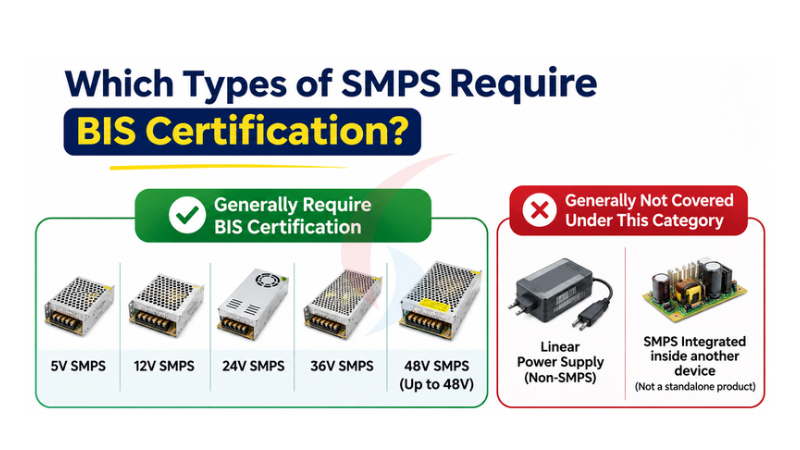
Which Types of SMPS Require BIS Certification?
|
Type of SMPS |
Common Application |
BIS Applicability |
|---|---|---|
|
5V standalone SMPS |
Electronic circuits and devices |
Generally covered |
|
12V standalone SMPS |
CCTV cameras and networking devices |
Generally covered |
|
24V standalone SMPS |
Electronic and control equipment |
Generally covered |
|
36V standalone SMPS |
Specialised electronic equipment |
Generally covered if within scope |
|
48V standalone SMPS |
Telecom and networking systems |
Generally covered |
|
Above 48V SMPS |
Industrial and specialised equipment |
Outside this particular notified voltage category; check other requirements |
|
Integrated SMPS component |
Built into a host device |
Depends on independent-product status and applicable rules |
|
Linear power supply |
Conventional transformer-based supply |
Not covered by the standalone switch mode category |
The table is a general classification guide. Actual applicability depends on the product's construction, function, intended use and applicable government notifications.
MeitY's clarification distinguishes independently manufactured, imported or sold SMPS from power supplies incorporated into a host product. It also confirms that linear power supplies are not covered by this particular SMPS category.
Applicable Indian Standard for Standalone SMPS
Every manufacturer applying for BIS registration must identify the correct Indian Standard before testing the product. Standalone SMPS products were originally notified under IS 13252 (Part 1):2010, which addresses safety requirements for information technology equipment.
India has subsequently introduced migration to IS/IEC 62368 (Part 1):2023, covering safety requirements for audio, video, information and communication technology equipment. The updated standard uses a hazard-based approach, addressing risks involving electrical energy, heat, fire and mechanical hazards.
|
Particulars |
Details |
|---|---|
|
Product category |
Standalone SMPS with output voltage 48V maximum |
|
Certification authority |
Bureau of Indian Standards |
|
Certification scheme |
Compulsory Registration Scheme (Scheme-II) |
|
Earlier Indian Standard |
IS 13252 (Part 1):2010 |
|
Revised Indian Standard |
IS/IEC 62368 (Part 1):2023 |
|
Initial mandatory date |
1 April 2021 |
|
Applicable market |
India |
|
Registration holder |
Actual manufacturer |
Manufacturers should verify the standard and transition conditions applicable on their filing date, rather than assuming an older test report remains sufficient.
Latest BIS Updates and Amendments for SMPS in 2026
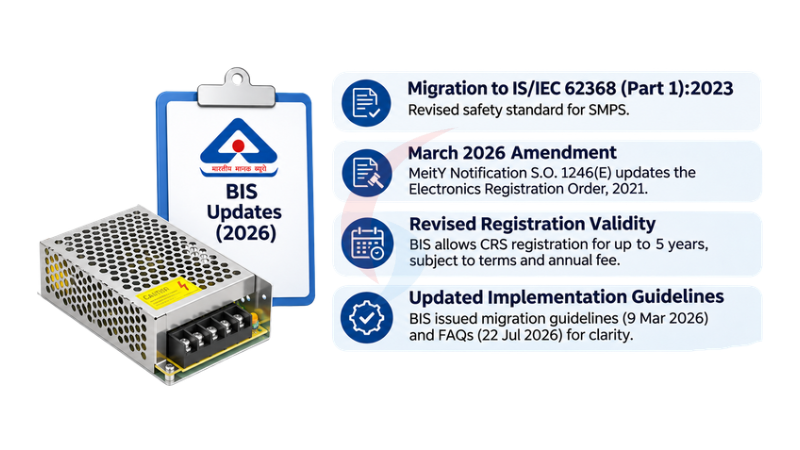
The regulatory position for electronic and IT equipment has changed significantly during 2025 and 2026. Manufacturers who already hold BIS registration should review these developments before launching additional models or renewing their registrations.
Migration to IS/IEC 62368 (Part 1):2023
The migration from older electrical safety standards to IS/IEC 62368 (Part 1):2023 is a major compliance development. The revised standard focuses on identifying possible energy hazards and evaluating the safeguards used to prevent injury, fire and other safety risks. Manufacturers should review insulation, temperature protection, component safety and electrical construction during product development.
The notified concurrent-running period extends to 1 November 2028 for the relevant categories, subject to the applicable implementation guidelines. Businesses should complete required testing and migration within the prescribed period.
March 2026 Amendment to the Electronics Registration Order
MeitY issued Notification S.O. 1246(E), dated 10 March 2026, amending the Electronics and Information Technology Goods (Requirement of Compulsory Registration) Order, 2021. Manufacturers must refer to the amended order and product-specific BIS guidelines while determining the appropriate registration requirements.
Changes to BIS CRS Registration Validity
BIS introduced revised provisions concerning registration validity, renewal and annual fee payments in 2026. Under the amended framework, initial Scheme-II registration may be granted for up to five years, subject to the applicable terms. Manufacturers must also comply with annual payment requirements and continuing conformity obligations.
Updated Migration Guidelines and Clarifications
BIS issued implementation guidelines concerning migration to IS/IEC 62368-1:2023 on 9 March 2026, followed by migration-related FAQs on 22 July 2026. It also published guidance concerning CRS product categories on 13 August 2026.
Important 2026 Compliance Update: Manufacturers should verify their current registration standard, revised testing requirements and migration deadlines before manufacturing or importing additional SMPS models. A registration under an earlier standard should not automatically be treated as sufficient after the relevant transition period.
Step-by-Step BIS Certification Process for Standalone SMPS
Obtaining BIS registration becomes easier when manufacturers understand the process before submitting product samples. The application is generally made by the manufacturing unit rather than a trader or distributor.
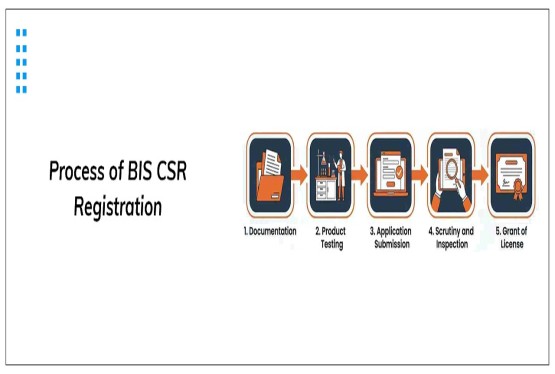
Step 1: Confirm Product Classification
Identify whether the product falls under the notified standalone SMPS category. Check the maximum output voltage, construction, intended application and current Indian Standard.
Step 2: Prepare Technical Documentation
Collect the product specifications, circuit diagrams, component details, manufacturing documents, brand information and other technical records required for testing and registration.
Step 3: Select a BIS-Recognised Laboratory
Arrange testing through a laboratory recognised by BIS for the applicable product category and standard. Testing helps establish conformity with electrical safety requirements.
Step 4: Obtain the Product Test Report
After successful testing, obtain the laboratory report. Under the published CRS application instructions, the test report must generally be no more than 90 days old when the application is submitted.
Step 5: Submit the BIS Application
Visit the official BIS CRS portal, complete the registration application and upload the required documents, verified test report and declarations.
Step 6: Pay the Applicable Fees
Pay the prescribed registration and other applicable charges through the official application process.
Step 7: BIS Verification
BIS examines the application, supporting documents and laboratory results. If discrepancies are identified, the manufacturer may need to provide clarifications or corrected documents.
Step 8: Receive BIS Registration
Once the requirements are satisfied, BIS grants registration for the specified product category, brand and manufacturing location. The manufacturer must then use the prescribed BIS Standard Mark and registration details in accordance with the marking requirements.
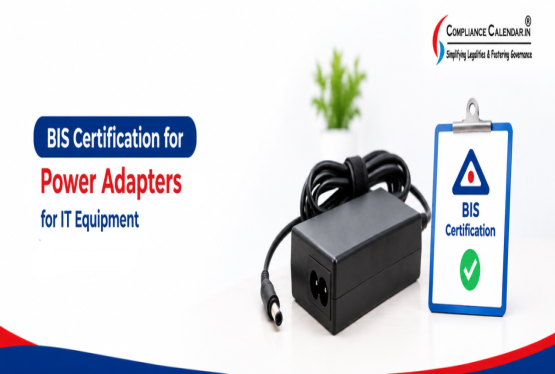
Manufacturers and importers can also read our BIS Certification for Power Adapters for IT Equipment article to understand related product categories and safety requirements.
Documents Required for BIS Certification of SMPS
One common reason for delays is incomplete or inconsistent documentation. Before applying, manufacturers should ensure that the factory address, brand name and model numbers match across their records.
Typical documents include:
-
Manufacturing unit business licence or registration proof.
-
Factory name and address details.
-
Product specifications and model list.
-
Circuit diagrams and relevant component information.
-
Brand registration certificate or brand authorisation, where applicable.
-
BIS-recognised laboratory test report.
-
Authorisation of the application signatory.
-
Prescribed undertaking or declaration of conformity.
-
Authorised Indian Representative (AIR) nomination documents for eligible foreign manufacturers.
-
Any additional documents requested under the current BIS checklist.
For foreign manufacturers without an Indian liaison office or branch office, appointment of an AIR is generally required under the CRS instructions.
BIS Certification Cost and Processing Time for SMPS
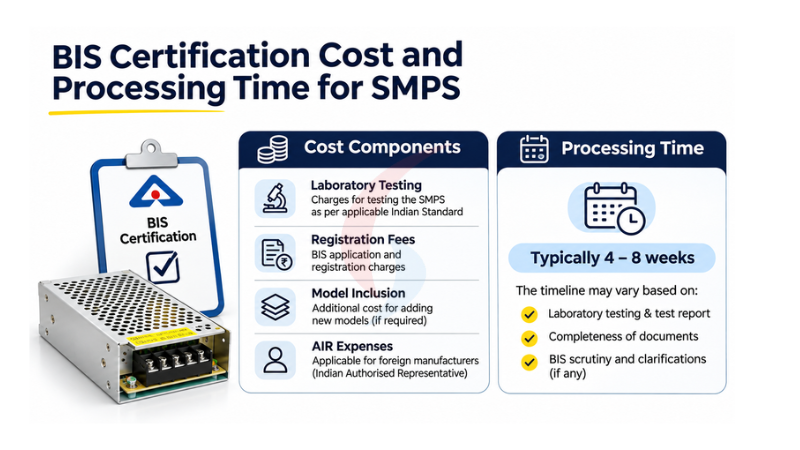
The overall cost depends on the number of models, applicable testing requirements, laboratory charges and registration-related fees.
|
Cost Component |
Description |
|---|---|
|
Laboratory testing |
Charges for testing samples against the applicable Indian Standard |
|
Registration fees |
Prescribed BIS application and registration-related charges |
|
Model inclusion |
Additional charges where new models are added under an existing registration |
|
AIR expenses |
Applicable for foreign manufacturers requiring an Indian representative |
|
Documentation and professional support |
Preparation, coordination and application assistance |
|
Ongoing compliance |
Applicable annual fees, retesting and maintenance expenses |
There is no single fixed total cost suitable for every SMPS manufacturer. A company with one product model may have different expenses from a manufacturer offering several designs under different brands. Processing time also depends on laboratory capacity, test results, document completeness and BIS scrutiny. Manufacturers should begin the procedure before committing to large-scale production or import shipments.
Common Mistakes During BIS Certification for SMPS
Even experienced manufacturers sometimes overlook important details.
-
Incorrect Product Classification: Not every power supply falls under the same BIS category. Manufacturers should distinguish standalone SMPS from integrated power supplies, linear power supplies and other notified adapters.
-
Using an Outdated Standard: Manufacturers should verify the relevant transition rules before arranging testing, especially in view of the migration to IS/IEC 62368 (Part 1):2023.
-
Incorrect Factory Information: Differences between the manufacturing licence, application and laboratory report can lead to queries.
-
Assuming One Registration Covers Everything: Separate manufacturing locations, brands or substantially different models may require additional registration or approval arrangements.
-
Ignoring Model Inclusion: Adding a new product model does not automatically place it within the scope of an existing registration. BIS provides a separate model inclusion procedure.
- Missing Ongoing Compliance: Registration is not the end of the process. Manufacturers must maintain conformity, comply with marking requirements and monitor applicable validity and annual payment obligations.
For a wider understanding of compliance requirements for electronic products, explore BIS CRS Registration for Electronic Products.
Benefits of BIS Certification for SMPS Manufacturers
BIS registration is primarily a legal compliance requirement, but it also offers practical business benefits.
-
Legal Market Access: Valid registration allows covered products to be supplied in the Indian market in accordance with the applicable requirements.
-
Improved Product Safety: Testing helps assess protection against electrical shock, overheating, insulation failure and other relevant hazards.
-
Customer Confidence: Distributors and institutional buyers may prefer products with verifiable compliance documentation.
-
Better Manufacturing Discipline: The certification process encourages manufacturers to maintain technical records, consistent product specifications and appropriate component controls.
-
Reduced Regulatory Risk: Completing registration before launching a covered product helps avoid problems associated with selling or importing goods without the required approval.
Frequently Asked Questions (FAQs)
Q1. Is BIS Certification mandatory for standalone SMPS up to 48V?
Ans. Yes. Standalone switch mode power supplies with an output voltage not exceeding 48V are a notified BIS CRS product category. Manufacturers must obtain the applicable registration before supplying covered products in India.
Q2. Which Indian Standard applies to standalone SMPS in 2026?
Ans. The category was originally notified under IS 13252 (Part 1):2010. BIS now lists IS/IEC 62368 (Part 1):2023 as the revised safety standard. Manufacturers should follow the applicable transition guidelines.
Q3. Does a 12V SMPS require BIS Certification?
Ans. A standalone 12V switch mode power supply generally falls within the notified maximum-voltage category. However, applicability should be confirmed against its product classification, construction and intended use.
Q4. Can SMPS products be imported from China without BIS registration?
Ans. Covered standalone SMPS products generally require appropriate BIS registration before import for the Indian market. The importer should verify that the overseas manufacturer's registration covers the relevant factory, brand and models.
Q5. Who can apply for BIS Certification for standalone SMPS?
Ans. The actual manufacturer generally applies for BIS CRS registration. Foreign manufacturers may be required to appoint an Authorised Indian Representative to fulfil the applicable registration requirements.
Q6. How much does BIS Certification for standalone SMPS cost?
Ans. The total expense depends on laboratory testing, application and registration fees, model coverage, foreign manufacturer requirements and professional assistance. An exact estimate requires a review of the product details.
Q7. How long does BIS registration for SMPS take?
Ans. There is no single processing period that applies to every application. The timeline depends on testing availability, successful test results, complete documentation and BIS scrutiny. Delays can occur if retesting or clarification is required.
Q8. Can one BIS registration cover multiple SMPS models?
Ans. Yes, eligible models of the same product category and brand may be covered through the applicable series or model inclusion procedure. Coverage depends on the technical differences between products and the relevant BIS guidelines.
Q9. What is the validity of BIS CRS registration in 2026?
Ans. Under the revised 2026 provisions, Scheme-II registration may be granted for up to five years, subject to applicable conditions. Manufacturers must verify their actual registration validity and comply with annual fee and continuing conformity requirements.
Q10. What happens if standalone SMPS is sold without BIS Certification?
Ans. Manufacturing, importing or selling a covered product without the required registration may attract regulatory action under the BIS Act and applicable compulsory registration orders. Consequences depend on the nature of the violation.
Article last updated on : 13 Nov 2026.