


Imagine a small consulting company in Bengaluru that has spent three years helping Indian businesses improve their operations. One morning, its founder, Arjun, receives an email from a company in Germany. The German company wants his team to provide business consulting services for an international project worth Rs 35 lakh.
For Arjun, this is a major opportunity. His team has the experience, the contract looks promising, and the client is ready to begin. However, while exploring international business opportunities and export promotion support, Arjun comes across something unfamiliar: SEPC Registration.
He already has GST registration and a business bank account.
- But does he need another registration to export services?
- What is an RCMC?
- Can his company receive government export promotion benefits?
These are questions many Indian service providers face when they begin working with overseas clients.
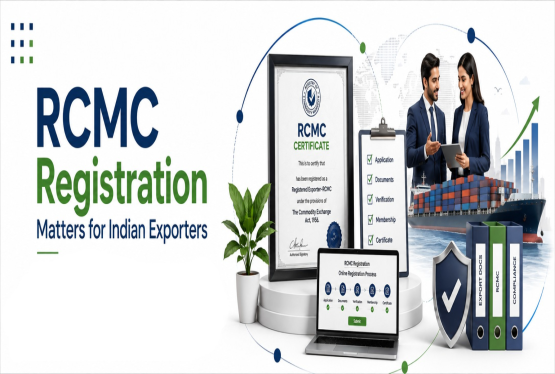
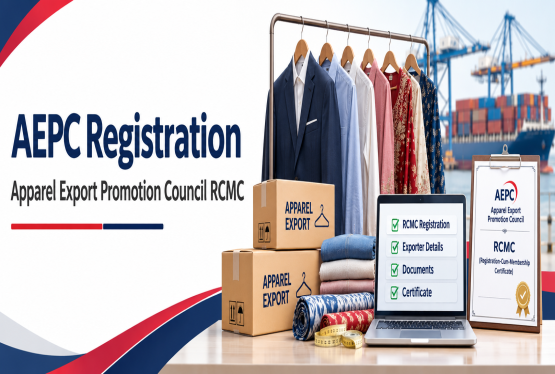
SEPC Registration, or Services Export Promotion Council Registration, allows eligible Indian service exporters to become members of the Council and obtain a Registration-cum-Membership Certificate (RCMC Registration). The Council supports Indian service businesses through international trade promotion, market information, networking opportunities, and assistance with export-related matters.
What is SEPC Registration in India?
The Services Export Promotion Council (SEPC) is an export promotion organisation established by the Ministry of Commerce and Industry, Government of India, to promote India's services sector internationally.
Unlike goods exporters, who generally send physical products overseas, service exporters may provide consulting, healthcare, education, tourism, engineering, research, professional services, and other eligible services to international customers.
For example, an architecture firm in Mumbai preparing designs for a client in Dubai is supplying services internationally. Similarly, a management consultancy advising a company in Singapore may be engaged in cross-border services trade.
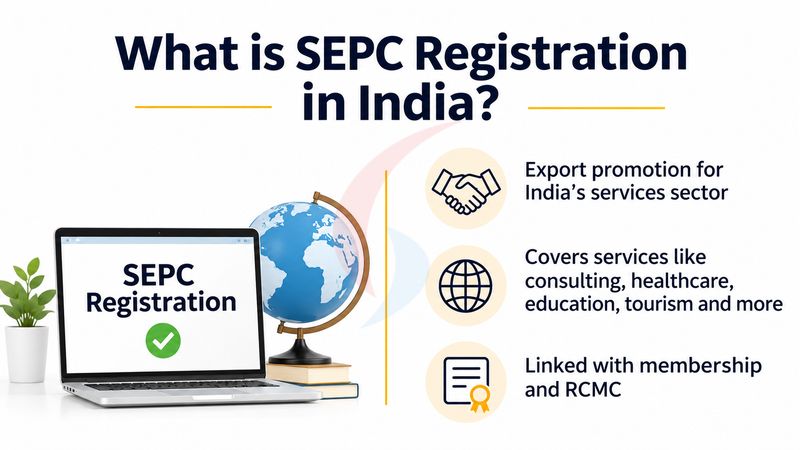
SEPC helps eligible businesses explore overseas markets, understand international opportunities, and participate in trade promotion activities.
Membership and RCMC issuance are connected but should not be confused with a licence to export. SEPC Registration is not automatically mandatory for every service export transaction. Its necessity depends on the applicable Foreign Trade Policy, the nature of the service, the relevant registering authority, and any particular export promotion benefit or authorisation sought.
Who Can Apply for SEPC Registration?
SEPC Registration is available to eligible businesses and organisations providing services covered by the Council's jurisdiction.
Applicants may include proprietorship firms, partnership firms, Limited Liability Partnerships (LLPs), private limited company, public limited companies, startups, and other qualifying organisations.
The Council covers a broad range of services, including professional and business services, healthcare, education, tourism, construction-related services, research and development, financial and related services, and maintenance and technical services.
However, selecting the correct registering authority matters. Certain services, particularly computer software and IT-related exports, may fall within the jurisdiction of another designated Export Promotion Council, such as the Electronics and Computer Software Export Promotion Council.
An applicant should therefore check the official service classification codes and the jurisdiction applicable to its principal export activity before selecting SEPC on the DGFT portal.
Businesses exporting software or technology services can read our guide on Electronics and Computer Software Export Promotion Council Registration.
Laws and Legal Provisions Governing SEPC Registration
SEPC Registration is governed by India's foreign trade regulations, GST laws, and foreign exchange requirements. Service exporters must comply with the relevant legal provisions while applying for Registration-cum-Membership Certificate (RCMC) and conducting international business.
|
Applicable Law or Regulation |
Relevant Sections / Provisions |
Key Legal Requirements |
|---|---|---|
|
Sections 3, 5, 7 and 11 |
Section 3 regulates foreign trade, Section 5 governs Foreign Trade Policy, Section 7 covers IEC requirements, and Section 11 deals with contraventions and penalties. |
|
|
Foreign Trade Policy, 2023 |
Paragraphs 2.56 and 2.57 |
Governs RCMC requirements, recognised registering authorities, and eligibility for specified export promotion benefits and authorisations. |
|
Paragraphs 2.93 and 2.94 |
Provides procedural requirements for RCMC applications, issuance, and related compliance. |
|
|
Sections 2(6) and 16 |
Defines export of services and provides zero-rated treatment for eligible service exports, subject to statutory conditions. |
|
|
Section 54 and applicable rules |
Governs refund claims for eligible unutilised input tax credit and other applicable export-related tax refunds. |
|
|
Sections 7 and 8 |
Regulates export-related foreign exchange obligations, payment realisation, and repatriation requirements. |
|
|
FEMA (Export and Import of Goods and Services) Regulations, 2026 |
Effective from 1 October 2026 |
Provides the updated regulatory framework for export documentation, payment realisation, authorised dealer bank requirements, and applicable reporting obligations. |
Important Note: An SEPC RCMC is generally valid for five financial years, subject to applicable DGFT provisions. However, exporters must also maintain their SEPC membership and pay the applicable annual subscription fees.
For More Information: Explore our EPCES Registration Guide to understand the separate RCMC requirements applicable to Export Oriented Units (EOUs) and Special Economic Zone (SEZ) businesses.
Documents Required for SEPC Registration in 2026
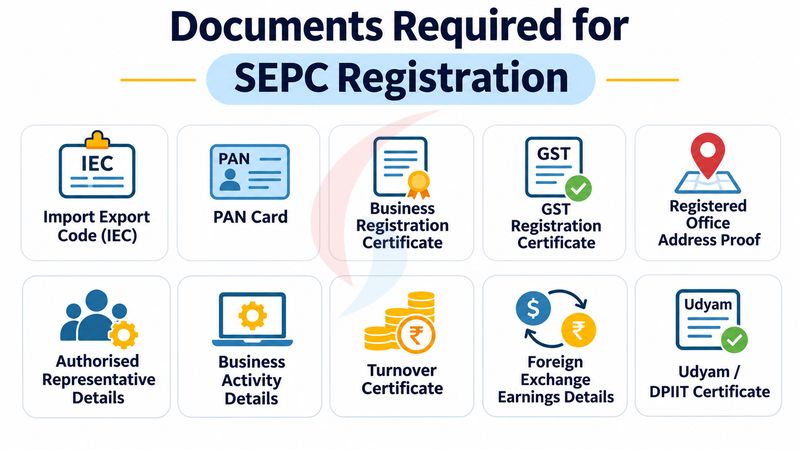
Businesses applying for SEPC Registration must submit the necessary identification, financial, and service-related documents for verification.
|
Documents Required |
Details |
|---|---|
|
Valid IEC issued by DGFT, wherever applicable. |
|
|
PAN Card |
PAN of the applicant business or entity. |
|
Business Registration Certificate |
Certificate of Incorporation, LLP Registration Certificate, or relevant business registration proof. |
|
GST Registration Certificate |
GSTIN and registration details, wherever applicable. |
|
Registered Office Address Proof |
Supporting documents confirming the business address. |
|
Authorised Representative Details |
Contact details and authorisation letter or board resolution, where required. |
|
Business Activity Details |
Information about the services exported or proposed to be exported. |
|
Turnover Certificate |
Self-certified and CA-certified turnover details for the preceding three financial years, as applicable. |
|
Foreign Exchange Earnings Details |
Details of foreign exchange earnings for the preceding three financial years, where available. |
|
Udyam / DPIIT Certificate |
Udyam Registration Certificate or DPIIT Startup Recognition Certificate, where relevant to the membership category. |
Practical Example: A newly incorporated consultancy applying for SEPC Registration may not have three years of financial records. In such cases, the applicant should disclose its actual period of business operations and submit available financial documents as required by SEPC.
SEPC Registration Process Online in 2026
SEPC Registration can be completed online through the DGFT common electronic RCMC platform. Eligible service exporters can submit their applications, upload documents, pay membership fees, and obtain their Registration-cum-Membership Certificate (RCMC) after approval.
|
Steps |
SEPC Registration Process |
|---|---|
|
Step 1: Obtain or Verify IEC |
Ensure the business has a valid Import Export Code (IEC), wherever applicable, and updated details on the DGFT portal. |
|
Step 2: Visit DGFT Portal |
Visit the official DGFT website, log in, and navigate to Services → e-RCMC → Apply for e-RCMC. |
|
Step 3: Select SEPC |
Choose Services Export Promotion Council (SEPC) as the registering authority and select the appropriate service category. |
|
Step 4: Enter Business Details |
Provide business name, PAN, address, service activities, annual turnover, foreign exchange earnings, and authorised representative details. |
|
Step 5: Upload Documents |
Submit the required business registration documents, IEC where applicable, PAN, financial records, and relevant supporting certificates. |
|
Step 6: Pay Membership Fees |
Select the applicable SEPC membership category and pay the prescribed registration fees through the approved payment method. |
|
Step 7: Verification and RCMC Issuance |
SEPC reviews the application and may request clarification. After approval, the electronic RCMC can be accessed through the DGFT portal. |
Important Note: After obtaining SEPC Registration, businesses must maintain their membership, pay applicable annual subscription fees, and update their registration details whenever necessary.
For More Information: Businesses requiring an IEC can read our Procedure for Obtaining Import Export Code to understand the documents and online application process.
SEPC Registration Fees in 2026–27
SEPC has published a financial-year-wise fee structure for 2026–27. Membership fees depend on the relevant category and the applicant's turnover during the preceding financial year.
|
Membership category |
New registration fee (including 18% GST) |
Annual renewal fee (including 18% GST) |
|
Startup (turnover below Rs 2 crore) |
Rs 11,800 |
Rs 8,850 |
|
Micro enterprise (up to Rs 10 crore) |
Rs 15,340 |
Rs 11,800 |
|
Small enterprise (Rs 10–100 crore) |
Rs 35,400 |
Rs 29,500 |
|
Medium enterprise (Rs 100–500 crore) |
Rs 97,350 |
Rs 88,500 |
|
Large company (Rs 500–1,000 crore) |
Rs 6,19,500 |
Rs 5,90,000 |
|
Large company (Rs 1,000–5,000 crore) |
Rs 7,43,400 |
Rs 7,08,000 |
|
Large company (above Rs 5,000 crore) |
Rs 9,32,200 |
Rs 8,85,000 |
These amounts include the one-time admission fee for new registrations and the applicable 18% GST. SEPC also provides separate provisions for overseas members.
Importantly, the startup category is linked with the relevant DPIIT recognition documentation, and MSME applicants must provide their applicable Udyam records. Fee-category eligibility should be confirmed rather than assumed solely from turnover.
Benefits of SEPC Registration for Indian Service Exporters
SEPC Registration offers several advantages to Indian businesses planning to expand their services into international markets. Beyond obtaining an RCMC, registered members can access export promotion activities, market information, business networking opportunities, and advisory support.
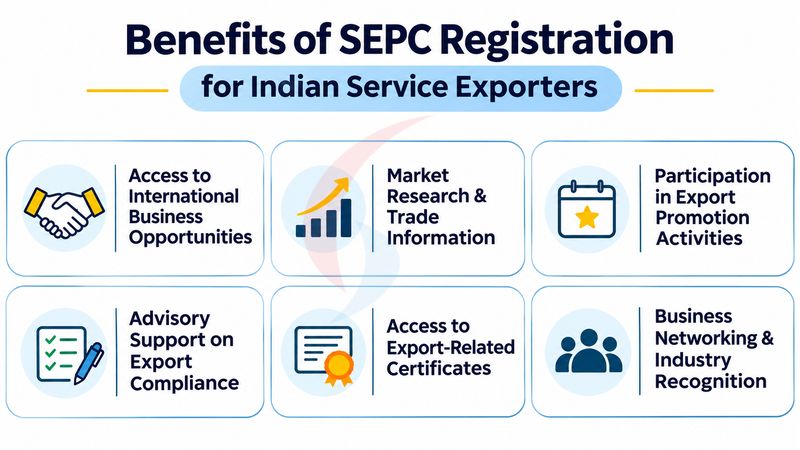
1. Access to International Business Opportunities
SEPC helps eligible service exporters explore overseas markets through trade promotion initiatives, international exhibitions, and business networking events. These activities can help businesses connect with potential clients and partners.
2. Market Research and Trade Information
Registered members may access useful information about international market trends, emerging opportunities, and developments affecting service exports. This helps businesses make informed decisions before entering new markets.
3. Participation in Export Promotion Activities
SEPC organises or facilitates trade delegations, buyer-seller meetings, seminars, and industry events. Eligible members can participate in relevant programmes to promote their services internationally.
4. Advisory Support on Export Compliance
SEPC provides guidance on various regulatory matters affecting service exporters, including:
-
GST and Income-tax requirements.
-
Foreign Trade Policy and DGFT procedures.
-
Customs-related matters, where applicable.
-
Export documentation and relevant regulatory developments.
5. Access to Export-Related Certificates
Eligible SEPC members may obtain Export Performance Certificates and GST Paid Certificates for specified purposes. These documents may support applications for certain benefits, including bank guarantee exemptions under applicable export promotion schemes, subject to eligibility conditions.
6. Business Networking and Industry Recognition
SEPC membership connects service exporters with a broader industry network. Participation in Council activities may help businesses strengthen professional relationships and improve their visibility in international markets.
Practical Example: A healthcare consultancy in Hyderabad planning to expand into Middle Eastern markets may use SEPC's trade information and networking opportunities to identify potential international partners, understand market requirements, and explore new business opportunities.
Latest SEPC Registration Updates in 2026
Service exporters applying for SEPC Registration in 2026 should be aware of the latest membership requirements, DGFT procedures, and foreign exchange regulations. These developments are important for businesses planning to expand their services internationally.
1. Revised SEPC Membership Fees for FY 2026–27
The Services Export Promotion Council has published its membership fee structure for FY 2026–27. The fees vary according to the applicant's business category and turnover.
-
Separate membership categories apply to startups, micro, small, medium, and large businesses.
-
Applicants must submit the prescribed turnover and foreign exchange earnings details.
-
Relevant Udyam Registration or DPIIT Startup Recognition documents may be required.
2. Online Registration Through the DGFT e-RCMC Portal
The DGFT common electronic RCMC platform continues to facilitate SEPC Registration, renewal, and amendments. This enables exporters to complete the application process digitally.
-
Applications can be submitted through the official DGFT portal.
-
Supporting documents and business details must be uploaded online.
-
Applicants should ensure their service classifications and registration information are accurate.
3. New FEMA Regulations Effective from 1 October 2026
The Reserve Bank of India introduced the Foreign Exchange Management (Export and Import of Goods and Services) Regulations, 2026, effective from 1 October 2026. These regulations are particularly relevant to service exporters receiving international payments.
-
Exporters must comply with applicable foreign exchange realisation and repatriation requirements.
-
Required export documentation and reporting must follow the updated regulatory framework.
-
Businesses should coordinate with their authorised dealer banks for relevant FEMA compliance.
4. Verification of the Correct Export Promotion Council
Not every service exporter is required to register with SEPC. The appropriate Export Promotion Council depends on the nature of the services and the applicable DGFT classification.
-
Consulting, tourism, healthcare, and other eligible service providers may apply through SEPC.
-
Software and IT exporters should verify whether another designated council applies.
-
SEZ units and other specialised exporters should check their respective RCMC requirements.
Important Note: Before applying for SEPC Registration, businesses should verify the latest membership fees, service classification, DGFT requirements, and applicable FEMA provisions. This helps reduce application errors and ensures compliance with India's foreign trade regulations.
Why Choose Compliance Calendar LLP ?
Imagine running a growing service business while managing overseas clients, invoices, bank transactions, and domestic statutory filings. Finding time to understand separate DGFT, SEPC, GST, and FEMA requirements can become difficult. At Compliance Calendar LLP, we focus on helping businesses understand the compliance requirements applicable to their commercial activities.
Our professionals can assist with reviewing SEPC eligibility, identifying the appropriate registering authority, preparing application documents, checking financial information, submitting e-RCMC applications, and responding to registration-related queries. For professional assistance, contact info@ccoffice.in or call 9988424211.
Frequently Asked Questions (FAQs)
Q1. What is SEPC Registration?
Ans: SEPC Registration is membership registration with the Services Export Promotion Council. Eligible service exporters can obtain an RCMC through the DGFT platform and access relevant services export promotion activities.
Q2. Is SEPC Registration mandatory for all service exporters?
Ans: No. SEPC Registration is not a universal requirement for every international service transaction. It may be necessary for specified Foreign Trade Policy benefits, authorisations, or other applicable requirements.
Q3. Can a startup apply for SEPC Registration?
Ans: Yes. Eligible startups providing services covered by SEPC can apply. DPIIT-recognised startups should provide the relevant recognition documentation when claiming the applicable startup membership category.
Q4. What is the validity of SEPC RCMC?
Ans: RCMC is generally valid for five financial years unless another applicable rule provides otherwise. Exporters must also comply with SEPC's annual membership renewal and subscription requirements.
Q5. Can an LLP obtain SEPC Registration?
Ans: Yes. An eligible LLP providing covered export services can apply for SEPC membership, subject to the applicable service classification, documentation, and membership conditions.
Q6. How much does SEPC Registration cost in 2026?
Ans: The fees depend on the membership category. For FY 2026–27, published new registration fees start at Rs 11,800 for the startup category and Rs 15,340 for the micro-enterprise category, inclusive of GST.
Q7. Can a business apply for SEPC Registration online?
Ans: Yes. Applications for SEPC e-RCMC can be submitted through the DGFT common electronic RCMC platform, along with supporting documents and applicable payment.
Q8. Is IEC required for SEPC Registration?
Ans: IEC is generally linked to DGFT e-RCMC applications, although certain service exporters may qualify for exemptions under the Foreign Trade Policy. Applicants should verify their position before filing.
Q9. Does SEPC Registration provide GST exemption?
Ans: No. SEPC Registration does not itself provide a GST exemption. Qualifying exports of services may receive zero-rated treatment under Section 16 of the IGST Act, subject to statutory conditions.
Q10. Can a service exporter receive government benefits after SEPC Registration?
Ans: Eligible members may access relevant export promotion initiatives and apply for specified benefits. However, approval depends on the applicable government scheme, its eligibility conditions, and required documentation.
Article last updated on : 13 Nov 2026.