


Imagine a lighting manufacturer in Noida receiving an order to supply 2,000 LED street lights for a municipal road-lighting project. The company has completed its product design, arranged raw materials and calculated its manufacturing cost. However, just before finalising the order, the buyer asks for a valid BIS registration number. The manufacturer suddenly realises that supplying LED street lights involves more than producing energy-efficient lighting equipment. This is a common situation for businesses entering India's LED lighting industry. A product may look reliable, consume less electricity and offer excellent brightness, but it must still comply with the applicable safety regulations. Without the required registration, manufacturers may face problems with product supply, imports and commercial contracts.
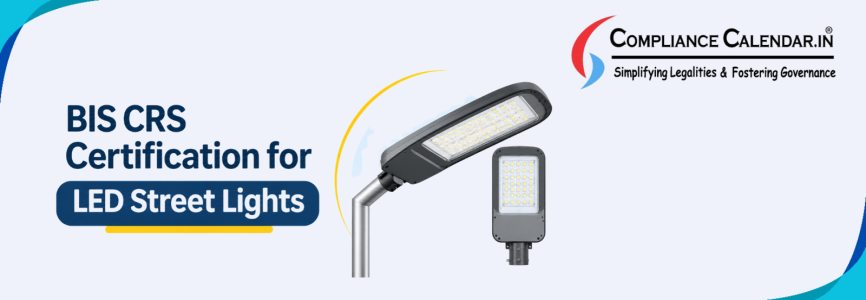
BIS CRS Certification for LED Street Lights is mandatory for covered LED luminaires intended for road and street lighting in India. The Bureau of Indian Standards (BIS) administers this registration under its Compulsory Registration Scheme (CRS). Manufacturers must ensure their products meet the relevant Indian Standard and complete the prescribed registration process.
What Is BIS CRS Certification for LED Street Lights?
BIS CRS Certification is a mandatory registration process for specified electronic and electrical products sold in India. The Compulsory Registration Scheme requires manufacturers to demonstrate that their products conform to the applicable Indian Standards through testing conducted by a BIS-recognised laboratory.
LED street lights are designed for outdoor illumination of roads, highways, residential streets, industrial areas and public spaces. Since these lights operate for long hours and face different weather conditions, their electrical construction and safety are important. Under the CRS, BIS registers the manufacturer for the relevant product category, manufacturing location and approved models. After registration, the manufacturer can use the prescribed BIS Standard Mark with its registration number, subject to the applicable marking requirements.
For example, a company manufacturing LED street lights in Delhi cannot rely only on its GST Registration, factory licence or product warranty. If its products fall within the notified category, it must obtain the required BIS CRS registration before supplying them to the Indian market. The obligation has applied to notified LED luminaires for road and street lighting since 23 May 2018. Planning to manufacture or sell LED lighting products?
Read our detailed guide on Process to Get BIS Certification for LED Lights to understand the registration requirements.
Is BIS Certification Mandatory for LED Street Lights in India?
Yes. LED luminaires for road and street lighting are specifically included in the BIS Compulsory Registration Scheme. The main legal provisions include the Bureau of Indian Standards Act, 2016, the BIS (Conformity Assessment) Regulations, 2018, as amended, and the Electronics and Information Technology Goods (Requirement of Compulsory Registration) Order, 2021, as amended. The requirement applies to covered products manufactured in India and products manufactured overseas for supply to the Indian market. Importers and sellers must ensure that the finished products are covered by an appropriate manufacturer registration.
For example, suppose a company imports LED street lights from China for installation in housing societies. The importer must verify whether the overseas manufacturer has BIS registration for the relevant product category and models. An overseas test certificate alone does not replace the required BIS CRS registration.
Applicable Indian Standard for LED Street Lights
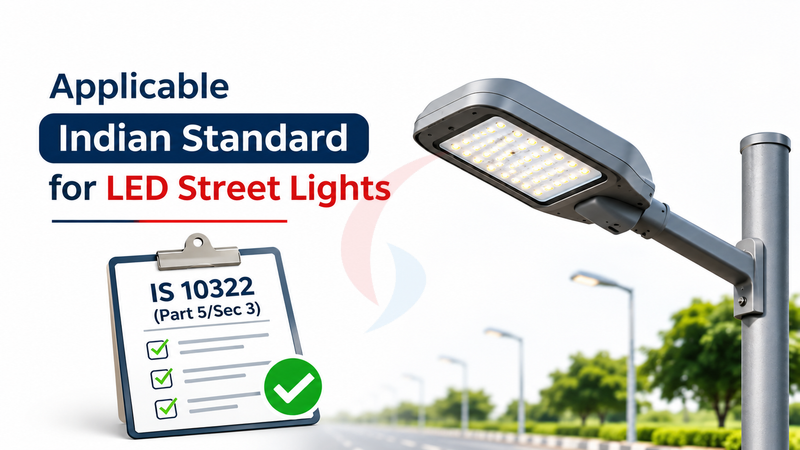
The applicable product category is LED Luminaires for Road and Street Lighting. The relevant standard was IS 10322 (Part 5/Section 3):2012. It was revised in 2026, and the updated version is IS 10322 (Part 5/Section 3):2026, aligned with IEC 60598-2-3:2002, including Amendment 1:2011. The standard addresses particular safety requirements for road and street lighting luminaires. It is read alongside relevant general luminaire safety requirements under IS 10322 (Part 1).
The following table explains the major standards and their relevance.
|
Indian Standard |
Product category |
Relevance |
|
IS 10322 (Part 5/Sec 3):2012 |
Road and street lighting luminaires |
Earlier standard, covered by the transition period |
|
IS 10322 (Part 5/Sec 3):2026 |
Road and street lighting luminaires |
Revised standard introduced in 2026 |
|
IS 10322 (Part 1):2026 |
General luminaire safety requirements |
General requirements and tests, as applicable |
|
IS 10322 (Part 5/Sec 5):2026 |
LED floodlights |
Separate category for qualifying floodlights |
|
IS 10322 (Part 5/Sec 1):2026 |
Fixed general-purpose LED luminaires |
Separate category for qualifying fixed luminaires |
The exact standard depends on the design and intended application of the product. A street light, floodlight and general-purpose luminaire should not automatically be treated as the same product category. BIS lists both the 2012 and 2026 versions for road and street lighting luminaires during the applicable transition.
Latest BIS Updates and Amendments for LED Street Lights in 2026
The year 2026 introduced important changes for LED lighting manufacturers. Businesses holding existing registrations or planning new applications must understand the revised standards and implementation dates.
1. Revised Indian Standards Introduced in February 2026
BIS published revised standards under the IS 10322 series, covering several LED luminaire categories, including road and street lighting, floodlights, recessed luminaires and emergency lighting. The revised standard for LED street lights is IS 10322 (Part 5/Section 3):2026. Manufacturers should assess their product designs and existing test reports against the updated requirements.
2. Implementation Guidelines Issued on 20 March 2026
BIS issued implementation guidelines on 20 March 2026. These explained how existing registered manufacturers, new applicants and manufacturers seeking model inclusion should transition to the revised standards. Existing licence holders must demonstrate conformity with the revised requirements through the applicable testing, declarations and documentation.
3. Deadline Extended to 2 February 2027
One of the most important updates came through the circular dated 31 July 2026, listed on the BIS website on 5 August 2026. BIS extended the concurrent-running period for the old and revised LED luminaire standards from 2 August 2026 to 2 February 2027. This gives manufacturers additional time to complete the required testing and transition activities. However, the extension does not remove the requirement to obtain BIS registration for covered products.
4. Revised CRS Licence Validity and Annual Compliance
The BIS (Conformity Assessment) Amendment Regulations, 2026 also changed the licence validity and annual compliance provisions. The revised provisions provide for a five-year registration period for new registrations and renewals, subject to the applicable conditions. Manufacturers must continue to meet annual payment and production-information requirements.
Important BIS Update 2026 : Manufacturers of LED street lights should review their current BIS registrations and plan the transition to IS 10322 (Part 5/Sec 3):2026 before 2 February 2027. The extended transition date should not be confused with the expiry date printed on an individual registration certificate.
Explore our article on BIS LED Luminaire Standards: Key Update Before 02 August 2026 to understand the important changes.
Which Types of LED Street Lights Require BIS Registration?
Different kinds of LED street lights are used in India. Some are installed on highways, while others illuminate residential streets, industrial roads and public areas. The applicable product category depends on the luminaire's actual design, construction, power source and intended use.
Common examples include:
- Conventional AC-powered LED street lighting luminaires.
- LED road lighting luminaires for highways and major roads.
- LED street lights used within residential societies and industrial premises.
- Smart LED street lights incorporating suitable sensors or controllers.
- Outdoor LED luminaires designed specifically for road and street illumination.
Solar-powered or battery-operated lighting systems may need separate technical classification based on their construction and applicable product notifications. Solar lighting products should not automatically be placed in the same CRS category as conventional AC-powered street lighting luminaires.
Example: A manufacturer produces two products: a 60W road-lighting luminaire and a 100W stadium floodlight. Although both use LED technology, they may be covered under different sections of IS 10322. The manufacturer must verify the correct categories before arranging laboratory testing.
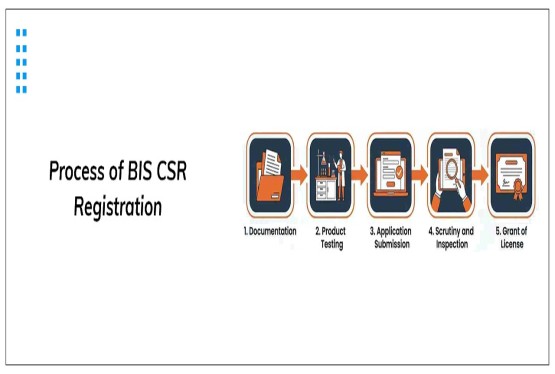
Step-by-Step BIS CRS Registration Process for LED Street Lights
The registration process becomes easier when manufacturers finalise their product specifications and prepare the required documents before testing.
Step 1: Identify the Correct Product Category
The first step is to determine whether the product is classified as an LED luminaire for road and street lighting. Manufacturers must examine its design, application, electrical specifications and available technical information. Correct classification is important because different LED lighting categories are covered under different Indian Standards.
Step 2: Prepare the Manufacturing Documents
The applicant must collect details of the manufacturing facility, legal entity, brand and product models. The documents should accurately identify the factory responsible for manufacturing the LED street lights. Foreign manufacturers must also appoint an eligible Authorised Indian Representative (AIR), where required.
Step 3: Register Through the BIS CRS Portal
The manufacturer must create an account on the official BIS CRS Portal and provide its business and factory information. The name and address mentioned in the application should match the supporting documents to avoid unnecessary clarification requests.
Step 4: Arrange Product Testing
Representative LED street light samples must be tested through a BIS-recognised laboratory under the applicable Indian Standard. The laboratory examines the required safety characteristics and issues a test report. When a manufacturer has multiple models, the applicable BIS series guidelines help determine the testing and model-grouping requirements.
Step 5: Submit the BIS Application
The manufacturer submits the online application with the prescribed test reports, factory documents, product details, declarations and applicable fees. It is important to check the validity and acceptance requirements for laboratory reports before filing the application.
Step 6: BIS Verification and Registration
BIS examines the submitted documents and test reports. If any information is missing or unclear, the authority may request clarification. When the application satisfies the applicable requirements, BIS grants registration for the approved manufacturing facility, product category and models.
Step 7: Maintain Registration and Product Compliance
After approval, the manufacturer must follow the applicable marking requirements and maintain continued product conformity. Changes in model specifications, critical components, manufacturing details or standards may require additional testing, registration updates or approval.
Read our guide on BIS CRS Registration: Step by Step Process for Electronic Products for a clearer understanding.
Documents Required for BIS CRS Certification for LED Street Lights
Documentation plays an important role in the registration process. Incomplete factory information, missing product details or inconsistent brand documents can delay an otherwise straightforward application.
|
Required document |
Purpose |
|
Factory or business registration proof |
Establishes the manufacturer's identity |
|
Factory address proof |
Confirms the manufacturing location |
|
Product specifications |
Provides technical information about the LED street lights |
|
List of product models |
Identifies models proposed for registration |
|
BIS-recognised laboratory test report |
Establishes conformity with the applicable standard |
|
Brand authorisation, if applicable |
Establishes permission to manufacture under a brand |
|
Authorised signatory documents |
Confirms the authority of the applicant |
|
AIR nomination, if applicable |
Required representation for eligible foreign manufacturers |
|
Declarations and undertakings |
Confirms the manufacturer's regulatory responsibilities |
The exact documents depend on the manufacturing arrangement and application type. Applicants should follow the current BIS checklist rather than relying exclusively on older registration guides.
BIS Testing Requirements for LED Street Lights
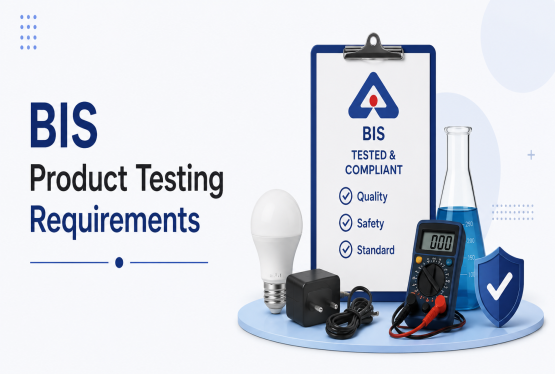
Testing helps establish whether a product meets the applicable safety requirements. Road lighting luminaires operate outdoors and may be exposed to dust, rain, heat, vibration and electrical disturbances. Depending on the relevant requirements and the product's construction, laboratory examination may cover electrical insulation, protection against electric shock, temperature rise, mechanical strength, wiring and terminals, and ingress protection.
For example, a manufacturer may design a street light with a strong aluminium housing but inadequate internal insulation. Although the outer body appears durable, the product may fail an applicable electrical safety test. Manufacturers should also distinguish between BIS CRS safety testing and additional performance tests requested by government tenders or commercial purchasers. Requirements involving luminous efficacy, colour rendering, surge withstand or performance guarantees may be governed by separate standards or procurement specifications.
BIS CRS Certification Fees for LED Street Lights in 2026
The total registration cost depends on the number of product models, laboratory testing requirements, application category and applicable government charges.
|
Fee component |
Cost consideration |
|
Application fee |
As prescribed under current BIS CRS rules |
|
Processing fee |
Depends on the applicable fee provisions |
|
Laboratory testing |
Varies with the recognised laboratory and required tests |
|
Additional test reports |
Charges may apply for additional reports |
|
Model inclusion |
Applicable when extending the approved registration scope |
|
Annual licence charges |
Payable according to current licence conditions |
|
Professional assistance |
Depends on the services required |
The official BIS CRS fee structure has been revised over time, including changes to processing fees and licence administration. Eligible MSMEs and startups should verify whether they qualify for any available concessions.
Common Reasons for Delays in BIS CRS Registration
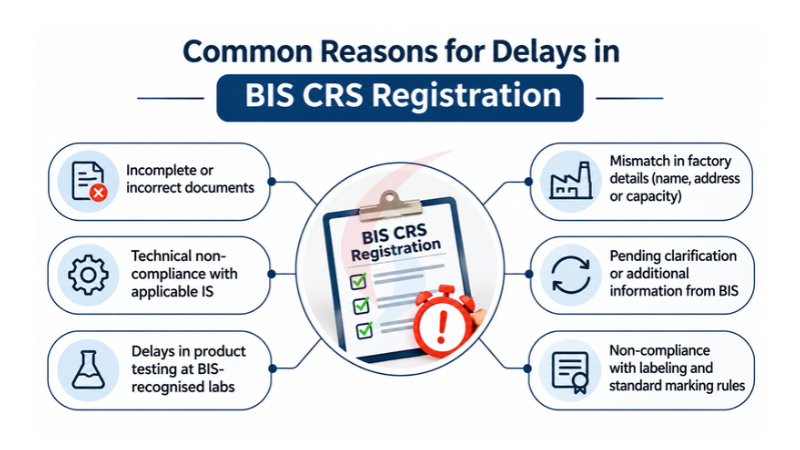
Several issues can delay the registration process.
-
Incorrect Product Classification: A road lighting luminaire may be incorrectly classified as a floodlight or general-purpose luminaire. This can create problems with testing and application processing.
-
Incomplete Documents: Missing factory proof, incorrect brand information or inconsistent manufacturing details may result in clarification requests.
-
Product Testing Failures: Electrical safety defects, inadequate insulation or construction problems may require corrective work and retesting.
-
Incorrect Model Grouping: Manufacturers sometimes assume that several wattages or designs can be covered automatically under one tested model. Model grouping must follow the relevant BIS requirements.
-
Failure to Follow Revised Standards: Existing manufacturers must take account of the 2026 revisions and the applicable transition deadline.
Getting registration is only the beginning. Read our detailed article on CRS Compliance for Manufacturers to understand product conformity, documentation, marking and ongoing compliance responsibilities.
Benefits of BIS CRS Certification for LED Street Light Manufacturers
BIS registration primarily helps businesses meet mandatory regulatory requirements. It also supports better product documentation and compliance management.
-
Legal Market Access: Appropriate BIS registration allows manufacturers to supply covered LED street lights in India in accordance with applicable rules.
-
Electrical Safety: Testing helps identify relevant electrical and construction-related safety risks before products reach the market.
-
Business Credibility: Proper registration can help purchasers, distributors and contractors verify whether a product is covered by an approved manufacturer's registration.
-
Tender Readiness: Many institutional and infrastructure purchasers require evidence of compliance with applicable Indian Standards. BIS registration can therefore be an important part of preparing for procurement opportunities, although it does not guarantee tender eligibility.
-
Better Product Management: Maintaining model records, technical specifications and testing documentation helps manufacturers manage changes to their products.
BIS CRS Registration Renewal and Ongoing Compliance
Manufacturers must continue complying with BIS requirements after obtaining registration. The registered products must remain consistent with the applicable standards and approved registration scope. In 2026, BIS revised its registration validity and annual compliance provisions. Manufacturers should follow their actual licence conditions and complete the required annual payments, production declarations and other obligations.
An important additional responsibility is the transition to revised standards. Manufacturers holding registration under IS 10322 (Part 5/Sec 3):2012 should review the migration requirements for the 2026 edition and complete the necessary work by the applicable deadline of 2 February 2027. Changes to electrical construction, critical components, product models or manufacturing particulars should also be reviewed before implementation.
Manufacturers supplying multiple electronic products can read our article on BIS CRS Certification for LED TVs to understand how registration requirements differ between product categories. Always check the latest standards for each product.
Why Choose Compliance Calendar LLP for BIS CRS Certification for LED Street Lights?
At Compliance Calendar LLP, we understand that manufacturing LED street lights involves technical planning, product testing, business investment and compliance responsibilities. A manufacturer preparing for a large supply order needs clear information about which approvals apply and how to complete them properly.
Our team can help businesses review product specifications, identify the applicable BIS category, prepare application documents and coordinate testing requirements with BIS-recognised laboratories. We also assist with reviewing manufacturer information, brand authorisations, model details and responses to regulatory queries.
For assistance with BIS CRS Registration in India, contact Compliance Calendar LLP at +91 9988424211 or email info@ccoffice.in.
Frequently Asked Questions (FAQs)
Q1. Is BIS CRS certification mandatory for LED street lights in India?
Ans. Yes. LED luminaires for road and street lighting are included under the BIS Compulsory Registration Scheme. Manufacturers supplying covered products in India must obtain the applicable registration and maintain conformity with the prescribed Indian Standard.
Q2. Which Indian Standard applies to LED street lights in 2026?
Ans. The revised standard is IS 10322 (Part 5/Section 3):2026. The earlier edition, IS 10322 (Part 5/Section 3):2012, is covered by the applicable transition arrangements until 2 February 2027.
Q3. Can LED street lights be imported without BIS registration?
Ans. Covered finished LED street lights generally require valid BIS CRS registration for supply to the Indian market. Importers should confirm that the foreign manufacturer holds registration covering the relevant factory, product category, brand and models.
Q4. How long does BIS registration for LED street lights take?
Ans. The timeline depends on laboratory availability, product testing, document readiness and BIS application processing. Testing failures or incomplete information may extend the process. Manufacturers should plan registration before committing to major supply deadlines.
Q5. What documents are needed for BIS CRS registration?
Ans. Common requirements include factory registration documents, manufacturer details, product specifications, model information, laboratory test reports, brand authorisations and applicable declarations. Foreign manufacturers may also require an Authorised Indian Representative.
Q6. Can one BIS registration cover different wattages of LED street lights?
Ans. Multiple wattages or models may be covered under one registration when the applicable series guidelines permit it. The manufacturer must identify the relevant technical differences and meet the prescribed testing and model-inclusion requirements.
Q7. What is the BIS registration validity in 2026?
Ans. Under the revised 2026 provisions, new registrations and renewals generally have a five-year validity period, subject to the applicable conditions. Manufacturers must also comply with annual payment, reporting and continued conformity obligations.
Q8. Are solar LED street lights covered under the same BIS category?
Ans. Not necessarily. Solar street lighting systems may have different technical configurations and applicable requirements. Their classification depends on the design, electrical arrangement and relevant product notifications.
Q9. What happens if LED street lights fail BIS testing?
Ans. The manufacturer must investigate the reported nonconformities and make the necessary corrections. Depending on the testing requirements, fresh samples or retesting may be necessary before a compliant application can proceed.
Q10. What is the latest BIS deadline for LED street light manufacturers?
Ans. The current transition deadline for the revised IS 10322 street lighting standard is 2 February 2027. Manufacturers should complete the applicable testing, declarations and migration requirements before this date.
Article last updated on : 13 Nov 2026.