


Imagine that a manufacturing company in Noida has recently established an Export Oriented Unit to supply electronic components to international buyers. The company has obtained its Import Export Code (IEC), received the necessary permission to operate as an EOU, and started preparing its first major export order.
Everything appears ready until its compliance team begins reviewing the documentation required for export-related concessions. During this review, the team discovers that it also needs a Registration-cum-Membership Certificate from the appropriate Export Promotion Council.
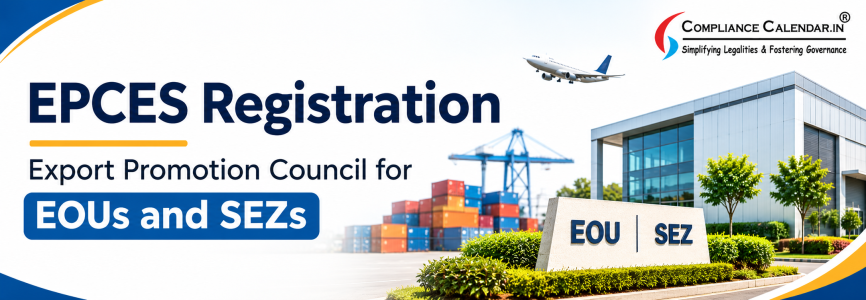
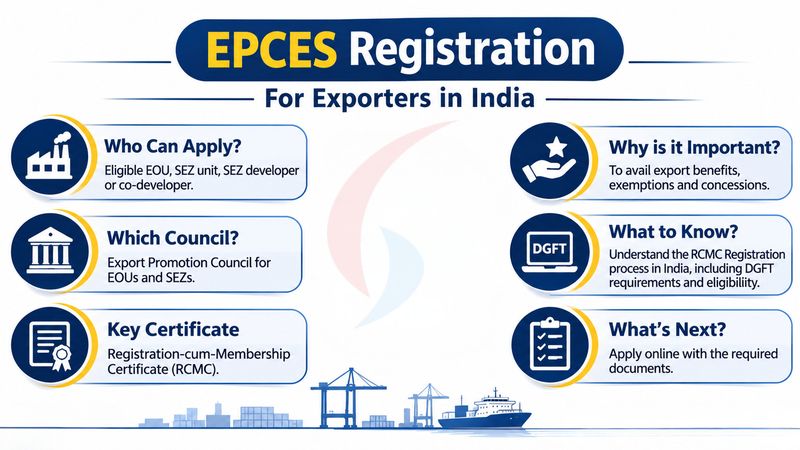
The Export Promotion Council for EOUs and SEZs (EPCES) supports Export Oriented Units, Special Economic Zone units, developers, and co-developers. It represents their interests before government authorities, provides regulatory information, and issues RCMC to eligible entities.
EPCES Registration is particularly important because businesses operating under EOU and SEZ arrangements must follow specialised export, customs, taxation, and regulatory requirements.
What is EPCES Registration?
EPCES Registration refers to the process through which an eligible EOU, SEZ unit, SEZ developer, or co-developer obtains membership of the Export Promotion Council for EOUs and SEZs. The council operates under the broader export promotion arrangements established by the Ministry of Commerce and Industry, Government of India.
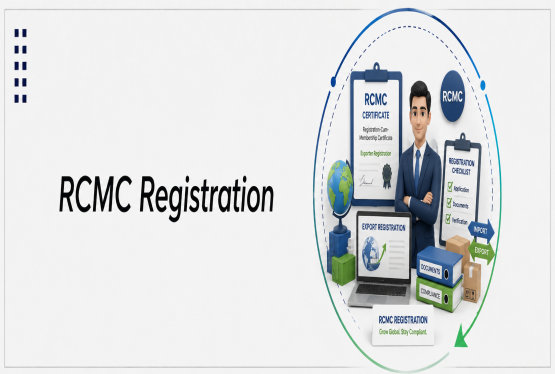
The principal registration document issued through the process is the Registration-cum-Membership Certificate, commonly called RCMC Registration.
An RCMC establishes that the applicant is registered with the recognised council responsible for its export activities. For eligible businesses, this certificate is relevant when applying for prescribed export benefits, exemptions, concessions, and other facilities under applicable laws.
Businesses planning to obtain EPCES membership should first understand the RCMC Registration process in India, including DGFT requirements, eligibility, documents, and online application procedures.
What is the Export Promotion Council for EOUs and SEZs?
The Export Promotion Council for EOUs and SEZs (EPCES) is an organisation that represents businesses operating under India's Export Oriented Unit (EOU) and Special Economic Zone (SEZ) schemes. It supports exporters by addressing industry concerns, sharing regulatory updates and coordinating with government authorities.
|
Particulars |
Details |
|---|---|
|
Full Name |
Export Promotion Council for EOUs and SEZs (EPCES) |
|
Main Purpose |
Represents and supports businesses operating under EOU and SEZ schemes. |
|
Eligible Businesses |
Export Oriented Units (EOUs), SEZ units and other eligible entities under the council's membership rules. |
|
Key Role |
Promotes exports and addresses challenges faced by EOU and SEZ businesses. |
|
Government Coordination |
Raises industry concerns with DGFT, customs authorities and other relevant government departments. |
|
Regulatory Updates |
Shares information about export policies, customs procedures and changes in trade regulations. |
|
Industry Representation |
Makes representations to government authorities regarding common operational and regulatory difficulties. |
|
Practical Example |
If an SEZ manufacturer faces repeated customs documentation issues, EPCES may raise the matter with the relevant authorities on behalf of affected exporters. |
|
Legal Limitations |
EPCES cannot independently grant statutory approvals, customs exemptions or permissions reserved for government authorities. |
Important Note: EPCES acts as an industry representative and export promotion organisation. It does not replace the Development Commissioner, DGFT, customs authorities or other statutory regulators responsible for granting approvals under Indian law.
Legal Provisions Governing EPCES Registration in India
EPCES Registration is governed by several interconnected legal provisions. Understanding these provisions is important because the requirements for EOUs and SEZs are not identical.
Special Economic Zones Act, 2005
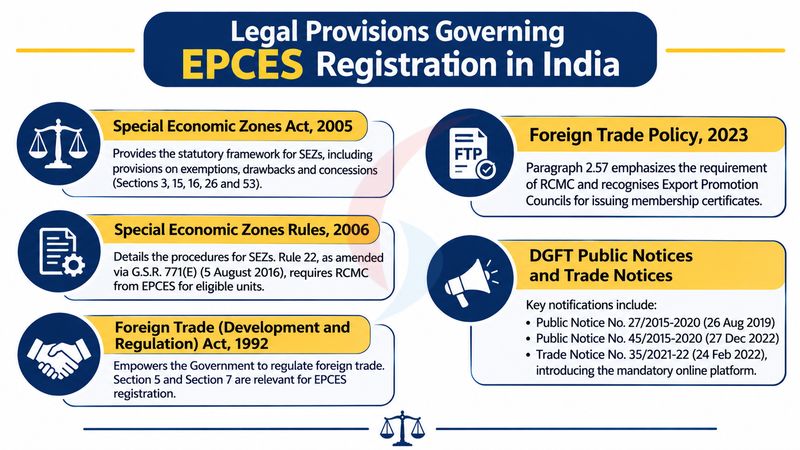
The Special Economic Zones Act, 2005 provides the principal statutory framework for establishing and operating Special Economic Zones in India. Section 3 deals with proposals for establishing Special Economic Zones, while Sections 15 and 16 address the approval of units and cancellation of approvals under the specified circumstances.
Section 26 provides for exemptions, drawbacks, and concessions available to eligible developers and entrepreneurs, subject to the conditions prescribed under applicable law.
Section 53 establishes that an SEZ is deemed to be a territory outside the customs territory of India for the purposes of undertaking authorised operations. This special statutory treatment makes proper registration, documentation, and regulatory compliance particularly important for SEZ businesses.
Special Economic Zones Rules, 2006
The Special Economic Zones Rules, 2006 provide detailed procedures and conditions for implementing the SEZ Act. Rule 22 is especially important because it addresses the conditions for availing exemptions, drawbacks, and concessions. Through Notification G.S.R. 771(E), dated 5 August 2016, amendments were introduced concerning RCMC requirements under the SEZ Rules.
Under the amended provisions, the relevant SEZ unit, developer, or co-developer is required to obtain RCMC from EPCES for availing applicable exemptions, drawbacks, and concessions. Therefore, SEZ entities should not assume that an IEC or Letter of Approval automatically replaces the EPCES membership requirement.
Businesses planning to establish operations within an SEZ can also understand the approval process and regulatory requirements through this guide on setting up an office in GIFT City SEZ.
Foreign Trade (Development and Regulation) Act, 1992
The Foreign Trade (Development and Regulation) Act, 1992 empowers the Central Government to regulate foreign trade and formulate applicable foreign trade policies. Section 5 provides the statutory basis for announcing and amending the Foreign Trade Policy. Section 7 deals with Import Export Code requirements. These provisions are relevant because EPCES membership applications are processed through the DGFT system and linked with the applicant's IEC information.
Foreign Trade Policy, 2023
Paragraph 2.57 of the Foreign Trade Policy, 2023 addresses the requirement for RCMC in specified circumstances, including applications for certain authorisations, benefits, and concessions.
The policy also recognises the role of Export Promotion Councils and other registering authorities in issuing membership certificates. For EOUs and SEZs, the general Foreign Trade Policy provisions must be read together with the specific rules governing their operations.
DGFT Public Notices and Trade Notices
DGFT Public Notice No. 27/2015-2020, dated 26 August 2019, authorised EPCES to issue RCMC to Export Oriented Units. Public Notice No. 45/2015-2020, dated 27 December 2022, further clarified the jurisdiction of EPCES over products and services of EOUs and SEZs.
DGFT Trade Notice No. 35/2021-22, dated 24 February 2022, introduced the mandatory common digital platform for RCMC applications, effective from April 2022. These directions support a more standardised electronic registration process.
Who Needs EPCES Registration in India?
EPCES Registration is primarily relevant to businesses operating under recognised Export Oriented Unit (EOU) and Special Economic Zone (SEZ) schemes. The registration requirements depend on the entity's approved status, authorised activities and applicable export-related benefits.
| Type of Entity | Description | EPCES Registration Requirements |
|---|---|---|
| Export Oriented Units (EOUs) | Businesses approved under the EOU scheme for export-oriented manufacturing, production, processing or eligible services. | EPCES membership or RCMC may be required for applicable Foreign Trade Policy benefits and registration-related conditions. |
| Special Economic Zone (SEZ) Units | Approved units operating within notified SEZs, including IT, pharmaceuticals, electronics, engineering and textiles. | SEZ units should verify their EPCES membership requirements based on authorised operations and applicable benefits. |
| SEZ Developers | Entities responsible for developing and maintaining approved Special Economic Zones under the applicable permissions. | EPCES membership may be relevant where RCMC-related conditions apply to specified benefits or activities. |
| SEZ Co-Developers | Entities undertaking approved infrastructure or development activities in coordination with SEZ developers. | Registration requirements depend on approved activities, applicable permissions and relevant membership conditions. |
Practical Example: An IT Company Operating in an SEZ:
| Particulars | Example |
|---|---|
| Business | Software development company |
| Location | Approved SEZ in Noida, Uttar Pradesh |
| Business Activity | Providing software development and technology services |
| Export Market | United States |
| Nature of Export | Export of services rather than physical goods |
| Regulatory Status | Operates as an approved SEZ unit |
| EPCES Registration | The company should verify its membership and RCMC requirements based on applicable SEZ provisions and benefits. |
| Important Consideration | The company should confirm its registration status before claiming benefits or undertaking activities requiring valid membership details. |
Businesses considering shifting their operations to an SEZ can explore Should You Relocate Your Business to a Special Economic Zone? to understand the potential benefits, regulatory requirements, and practical considerations before making a decision.
Difference Between EOU and SEZ Registration
Export Oriented Units (EOUs) and Special Economic Zone (SEZ) units are both established to promote exports from India. However, they differ in their legal provisions, location requirements, approval processes, tax benefits and compliance obligations.
| Basis of Comparison | Export Oriented Unit (EOU) | Special Economic Zone (SEZ) Unit |
|---|---|---|
| Meaning | A business approved under the EOU scheme to undertake eligible export-oriented activities. | A business approved to carry out authorised operations within a notified SEZ. |
| Governing Law | Foreign Trade Policy, Handbook of Procedures and applicable customs provisions. | Special Economic Zones Act, 2005 and SEZ Rules, 2006. |
| Location | Can operate outside a notified SEZ, subject to applicable approvals. | Must operate within a notified Special Economic Zone. |
| Approval Document | Letter of Permission (LoP). | Letter of Approval (LoA). |
| Approving Authority | Competent Development Commissioner or designated authority under the EOU scheme. | Approval Committee and Development Commissioner under the SEZ provisions. |
| Eligible Activities | Manufacturing, production, processing and permitted service activities. | Manufacturing, trading and authorised service activities, subject to approval. |
| Duty Benefits | Eligible duty exemptions and concessions under applicable customs notifications and scheme conditions. | Eligible customs and GST-related benefits under applicable SEZ and tax provisions. |
| Compliance Requirements | Must comply with applicable export obligations, reporting requirements and EOU scheme conditions. | Must follow authorised operations, reporting requirements and applicable SEZ conditions. |
| EPCES Registration | May require EPCES membership or RCMC for applicable benefits and registration-related requirements. | May require EPCES membership or RCMC depending on approved operations and applicable benefits. |
Important Note: EPCES Registration does not automatically grant EOU or SEZ status to a domestic business. An entity must first obtain the necessary approval under the applicable EOU or SEZ provisions. EPCES membership is a separate requirement and does not replace statutory approvals.
Eligibility Criteria for EPCES Registration
Businesses applying for EPCES Registration in India must meet the following eligibility requirements:
|
Eligibility Criteria |
Requirements |
|---|---|
|
Business Registration |
Legally registered company, LLP, partnership or other eligible entity. |
|
IEC Code |
Active Import Export Code linked with DGFT. |
|
EOU Approval |
Valid Letter of Permission (LoP). |
|
SEZ Approval |
Valid Letter of Approval (LoA). |
|
Developers & Co-Developers |
Relevant SEZ approvals and authorisations. |
|
Business Details |
Registered address, authorised representative and operational details. |
|
Export Turnover |
Applicable turnover records or declarations. |
|
Membership Fees |
Payment of prescribed EPCES membership charges. |
Note: New exporters may also apply without substantial previous export turnover, subject to EPCES membership conditions.
Businesses that have not yet obtained an Import Export Code can explore the procedure for obtaining IEC Registration before applying for EPCES membership.
Documents Required for EPCES Registration
Businesses applying for EPCES Registration must submit certain documents to verify their legal status, export activities, and eligibility. The requirements may vary depending on whether the applicant is an EOU, SEZ unit, developer, or co-developer.
The main documents required for EPCES Registration include:
-
Import Export Code (IEC): A valid IEC issued by DGFT.
-
Letter of Approval (LOA) or Letter of Permission (LOP): Relevant government approval for SEZ or EOU operations.
-
Business Registration Documents: Certificate of Incorporation, LLP registration, or other applicable business proof.
-
PAN and GST Details: PAN of the applicant and GST registration details, where applicable.
-
Export Turnover Proof: Previous financial year's Annual Performance Report (APR) or self-certified export turnover declaration.
-
Banker's Certificate: Certificate of financial soundness issued by the applicant's bank, where required.
-
Authorisation Letter: Authorisation and contact details of the person submitting the application.
-
Membership Fee Proof: Receipt or confirmation of the applicable EPCES membership fee payment.
Applicants should ensure that all documents contain consistent business information, particularly the name, address, IEC, and approval details. Incorrect or incomplete documentation may delay EPCES Registration.
EPCES Registration Process Online in 2026
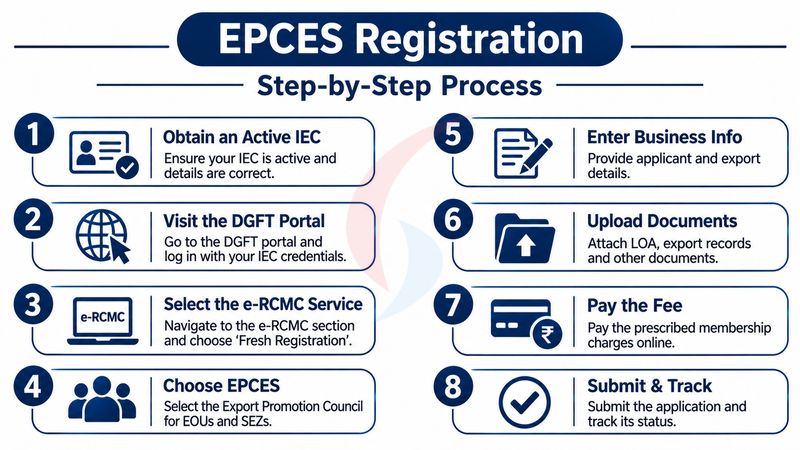
EPCES Registration is completed through the common DGFT e-RCMC platform.
Step 1: Obtain an Active IEC
The applicant should first ensure that its IEC is active and that the business information available on the DGFT portal is accurate. n inactive IEC or outdated business profile may create difficulties during registration.
Step 2: Visit the DGFT Portal
Access the official DGFT e-RCMC portal and log in using the credentials associated with the IEC. New users must complete the required registration and account-linking process.
Step 3: Select the e-RCMC Service
Navigate to the e-RCMC section and choose the option for submitting a fresh registration application.
Step 4: Choose EPCES
Select the Export Promotion Council for EOUs and SEZs as the relevant registering authority. The applicant should also choose the appropriate membership category according to its approved business status.
Step 5: Enter Business Information
Provide the applicant's name, IEC, address, authorised representative details, export turnover, and other information requested by the portal.
Step 6: Upload Supporting Documents
Attach the valid LOA or LOP, export turnover records, financial documents, and other supporting information required for the application.
Step 7: Pay the Membership Fee
Pay the prescribed membership charges using the available online payment methods.
EPCES also provides instructions for advance payment through specified offline banking modes followed by submission of payment details through the portal.
Step 8: Submit and Track the Application
Review all declarations carefully and submit the completed application. The applicant should monitor the dashboard and respond promptly to clarification or deficiency notices. Once the application is approved, the electronic RCMC can be accessed through the applicable DGFT process.
EPCES Registration Fees in India for 2026–27
EPCES Registration fees depend on the type of business and its annual export turnover. As per EPCES Circular No. 492, dated 10 February 2026, the following membership fees apply for FY 2026–27.
Annual Membership Fees for EOUs and SEZ Units:
| Annual Export Turnover | EOU Fees (Including GST) | SEZ Unit Fees |
|---|---|---|
| Up to Rs 5 crore | Rs 7,080 | Rs 6,000 |
| Above Rs 5 crore to Rs 25 crore | Rs 14,750 | Rs 12,500 |
| Above Rs 25 crore | Rs 23,010 | Rs 19,500 |
EOU fees include 18% GST, while the circular specifies no GST on the listed SEZ unit membership fees.
Fees for SEZ Developers and Co-Developers:
| Developer Category | Annual Renewal | New Registration |
|---|---|---|
| Below 1,000 hectares | Rs 19,500 | Rs 45,500 |
| Above 1,000 hectares | Rs 26,000 | Rs 91,000 |
EPCES also offers a three-year membership option for FY 2026–27 to FY 2028–29. For example, the three-year fee is Rs 21,240 for EOUs and Rs 18,000 for SEZ units with exports up to Rs 5 crore.
EPCES RCMC Validity and Renewal
Under the general DGFT rules, an RCMC is ordinarily valid for five licensing years, unless otherwise specified. However, EPCES follows a financial-year-based membership subscription system.
-
Renewal Deadline: EPCES requested members to renew for FY 2026–27 by 31 March 2026.
-
Three-Year Option: Members can pay subscriptions for three financial years together.
-
Membership Status: Businesses should maintain current membership even when their RCMC shows a longer validity period.
-
Non-Renewal: Failure to renew may create difficulties in export-related procedures requiring current EPCES membership.
Benefits of EPCES Registration for Exporters
EPCES membership provides regulatory and industry-related benefits beyond issuance of RCMC.
One important benefit is access to information about changes in foreign trade policy, customs procedures, SEZ regulations, and matters affecting export-oriented businesses.
The council also publishes trade bulletins, newsletters, industry news, and other information to help members remain informed.
Through government representations, EPCES raises issues affecting the EOU and SEZ sector. These may include policy implementation concerns, procedural difficulties, or operational challenges faced by members.
Members may also receive information concerning international trade developments, business opportunities, export promotion initiatives, and relevant industry programmes.
However, EPCES membership does not automatically guarantee export incentives, tax exemptions, financial assistance, or international orders. Individual benefits remain subject to their applicable legal conditions.
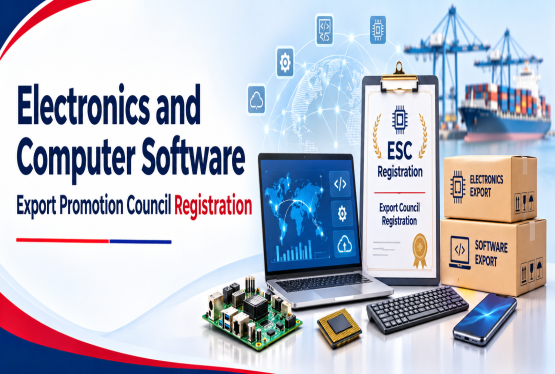
Exporters interested in other council arrangements can also explore Electronics and Computer Software Export Promotion Council Registration, which explains the registration framework relevant to eligible electronics and IT exporters operating outside the specialised EPCES context.
Latest EPCES Registration Updates in 2026
EPCES Renewal Circular for FY 2026–27
On 10 February 2026, EPCES issued Circular No. 492 concerning RCMC renewal for financial year 2026–27. The circular provided the current membership fees for EOUs, SEZ units, developers, and co-developers.
It also allowed eligible members to pay subscriptions for three financial years, extending through FY 2028–29. The circular reaffirmed the requirement to use the DGFT common e-RCMC platform and referred to the relevant government instructions governing EPCES membership.
September 2026 RCMC Exemption for Small Export Consignments
One important development for Indian exporters came through DGFT Notification No. 36/2026-27, dated 15 September 2026. The notification amended Paragraph 2.57 of the Foreign Trade Policy, 2023 by introducing a limited exemption from RCMC or Certificate of Registration requirements for export consignments having an FOB value not exceeding Rs 3 lakh.
For example, a qualifying exporter sending a trial consignment worth Rs 2.5 lakh may be exempt from the Foreign Trade Policy's RCMC requirement for that consignment. However, this exemption should not automatically be interpreted as removing the separate EPCES membership conditions applicable to SEZ units, developers, or co-developers under the SEZ Rules.
Continued Use of Digital RCMC Applications
The DGFT electronic system remains the prescribed route for EPCES RCMC applications, amendments, and renewals. The digital process helps centralise registration records and facilitates electronic interaction between exporters and the registering council. However, successful electronic submission does not eliminate the need for genuine supporting documents, accurate business information, and compliance with the council's membership requirements.
Why Choose Compliance Calendar LLP for EPCES Registration?
EPCES Registration may seem simple, but selecting the correct membership category, preparing documents, and completing the DGFT application can be challenging. Even small errors may delay approval or create compliance difficulties.
Our team provides professional assistance with RCMC Registration, DGFT-related procedures, documentation, and other business compliance services.
Here's how we can help your business:
-
Expert Guidance: Assistance in understanding EPCES eligibility, membership categories, and registration requirements.
-
Documentation Support: Preparing and reviewing IEC, LOA/LOP, turnover declarations, and supporting documents.
-
End-to-End Registration Assistance: Support with application preparation, DGFT portal filing, and procedural follow-ups.
-
RCMC and Export Compliance: Guidance on applicable membership renewal requirements and related export compliance matters.
-
Personalised Support: Practical assistance based on your business structure, export activities, and specific requirements.
Our experience in handling business registrations and compliance-related matters helps us understand the documentation and procedural challenges exporters may encounter. Whether you are establishing a new EOU, operating an SEZ unit, or managing an existing export business, we aim to make the registration process more organised and straightforward.
Looking for EPCES Registration assistance? Contact Compliance Calendar LLP for professional guidance on RCMC Registration and related export compliance requirements. Connect with our experts on WhatsApp: +91 9988424211 for professional assistance.
Frequently Asked Questions (FAQs)
Q1. What is EPCES Registration in India?
Ans: EPCES Registration is the process through which eligible Export Oriented Units, SEZ units, developers, and co-developers obtain membership and RCMC from the Export Promotion Council for EOUs and SEZs. It supports compliance with applicable foreign trade and SEZ requirements.
Q2. Is EPCES Registration mandatory for all EOUs and SEZ units?
Ans: EPCES identifies membership as mandatory for EOUs and SEZ entities under the applicable government instructions. SEZ units, developers, and co-developers must particularly consider Rule 22 of the SEZ Rules concerning RCMC for specified exemptions, drawbacks, and concessions.
Q3. How can I apply for EPCES Registration online?
Ans: Applicants can visit the DGFT e-RCMC portal, log in using their IEC-linked account, select EPCES, complete the membership application, upload supporting documents, and pay the prescribed charges. The application is processed by the council.
4. What are the EPCES Registration fees in 2026?
Ans: For FY 2026–27, annual EOU membership fees range from Rs 7,080 to Rs 23,010, including GST. SEZ unit fees range from Rs 6,000 to Rs 19,500. Separate fee categories apply to developers and co-developers.
Q5. Which documents are required for EPCES Registration?
Ans: Common documents include an active IEC, valid Letter of Approval or Letter of Permission, export turnover evidence, business details, and authorised representative information. Additional financial or supporting documents may be required depending on the membership category.
Q6. What is the validity of EPCES RCMC?
Ans: The general DGFT RCMC validity rule provides for five licensing years unless otherwise specified. EPCES also requires members to maintain applicable financial-year membership subscriptions. Applicants should check their issued certificate and current council renewal instructions.
Q7. Can an SEZ service company apply for EPCES Registration?
Ans: Yes. Eligible SEZ service units, including IT and software service businesses, may fall within EPCES jurisdiction. Their eligibility depends on the relevant SEZ approval and council membership requirements rather than whether they export physical goods.
Q8. Is EPCES Registration required for exports below Rs 3 lakh in 2026?
Ans: DGFT Notification No. 36/2026-27 provides an exemption from specified RCMC requirements for export consignments with FOB value up to Rs 3 lakh. However, this does not automatically remove separate EPCES membership obligations arising under SEZ regulations.
9. What happens if EPCES membership is not renewed?
Ans: Failure to renew membership may affect the status of RCMC records and create difficulties where valid membership is required for prescribed benefits or transactions. The consequences depend on the applicable laws, regulatory conditions, and individual circumstances.
10. Can Compliance Calendar LLP assist with EPCES Registration?
Ans: Yes. Compliance Calendar LLP can assist businesses with assessing registration requirements, identifying the appropriate membership category, preparing supporting documents, and completing the relevant RCMC application process. Approval remains subject to the competent authority.
Article last updated on : 13 Nov 2026.