


Imagine running a small leather bag manufacturing unit in Kanpur. Your workshop employs 20 skilled workers who make wallets, handbags and travel accessories. For years, you have supplied products to wholesalers across India, but international business has always seemed out of reach.
One afternoon, a buyer from Germany contacts you after seeing your leather bags at a trade exhibition. The buyer wants 1,000 customised handbags and asks whether your company can export directly.
You are excited about the opportunity, but several questions arise.
- Do you need an Import Export Code? What is Council for Leather Exports Registration?
- Is CLE RCMC compulsory for exporting leather products? How much does registration cost in 2026?
These questions are important because international trade involves more than finding buyers and shipping products. Businesses must understand customs requirements, foreign trade regulations, product standards and relevant export promotion memberships.
Council for Leather Exports (CLE) Registration allows eligible Indian leather, footwear and related product exporters to obtain membership and a Registration-cum-Membership Certificate (RCMC Registration) from the Council for Leather Exports.
What Is Council for Leather Exports (CLE) Registration?
The Council for Leather Exports (CLE) is an Export Promotion Council sponsored by the Ministry of Commerce and Industry, Government of India. It represents India's leather, footwear and related product export sectors. CLE works with exporters, government departments and international trade organisations to promote Indian products in overseas markets.
The council supports trade fairs, buyer-seller meetings, market development, policy representation and other activities intended to strengthen leather exports.
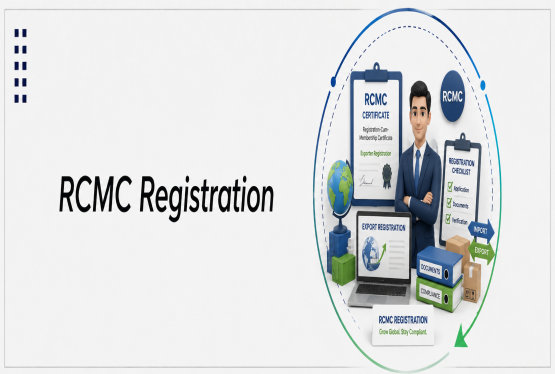
RCMC stands for Registration-cum-Membership Certificate. It confirms that an eligible exporter is registered with a recognised Export Promotion Council. When a business completes CLE membership registration and receives an RCMC, it can use the certificate for applicable Foreign Trade Policy purposes.
Understanding CLE Registration Through an Example
Meet Aditi, a fictional entrepreneur who operates Aditi Leather Crafts in Kanpur. Her company manufactures leather handbags and wallets. Until recently, her customers were Indian wholesalers and retail businesses. After receiving an international order, Aditi obtains an IEC and begins researching export procedures. She discovers that CLE is the relevant council for many leather goods and footwear categories.
She applies for membership because she wants to understand the registration requirements and explore opportunities to participate in overseas exhibitions. For Aditi, CLE membership becomes one part of developing her business from domestic manufacturing into international trade.
To understand the general concept, exporters can also read RCMC Registration Online in India.
Is Council for Leather Exports Registration Mandatory?
One of the most common misconceptions is that every leather exporter must obtain CLE RCMC before sending any goods outside India.CLE RCMC is not automatically mandatory for every ordinary leather export shipment. Under Paragraph 2.57 of the Foreign Trade Policy, 2023, an RCMC is generally required for specified authorisations, benefits or concessions unless an exemption applies.
First-time leather exporters should understand why RCMC Registration matters for Indian exporters, especially when applying for eligible export benefits, concessions and trade-related authorisations.
For example, Aditi may export freely exportable leather handbags after complying with the applicable IEC, customs, tax and product requirements without obtaining RCMC solely for making an ordinary shipment. However, if she seeks an authorisation or benefit that requires RCMC, she must fulfil the applicable registration requirements.
|
Registration or approval |
Main purpose |
|
Business identification for import-export activities |
|
|
CLE RCMC |
Export Promotion Council membership and applicable FTP requirements |
|
Compliance with applicable GST provisions |
|
|
Customs-related banking arrangements |
|
|
Access to relevant electronic customs services |
|
|
Product-specific approvals |
Compliance with export restrictions, quality standards and destination-country rules |
Latest 2026 Update: RCMC Exemption for Exports up to Rs 3 Lakh
On 15 September 2026, the Directorate General of Foreign Trade issued Notification No. 36/2026-27, introducing Paragraph 2.57(c) into the Foreign Trade Policy, 2023.
The new provision exempts export consignments with a Free-on-Board (FOB) value not exceeding Rs 3,00,000 from the RCMC or Certificate of Registration requirement wherever that requirement would otherwise apply under Paragraph 2.57.
Suppose Aditi receives an initial trial order for leather wallets worth Rs 2,40,000. The exemption may allow her to undertake that consignment without obtaining RCMC for the otherwise applicable FTP requirement.
However, if her next export consignment is worth Rs 8,00,000, the normal RCMC requirement will continue wherever prescribed. Importantly, this exemption does not remove IEC, customs, foreign exchange or product-specific legal obligations.
Laws Governing Council for Leather Exports RCMC Registration
CLE Registration operates within India's foreign trade legal system. The principal laws and procedures are explained below:
Foreign Trade (Development and Regulation) Act, 1992
The Foreign Trade (Development and Regulation) Act, 1992 provides the statutory foundation for regulating India's imports and exports.
Section 3 empowers the Central Government to regulate imports and exports. Section 5 concerns formulation and amendment of Foreign Trade Policy, and Section 7 governs Importer Exporter Code requirements, subject to prescribed exemptions. The Act provides the broader authority under which India's export policy and procedures operate.
Foreign Trade Policy, 2023
Paragraph 2.56 deals with registration through the appropriate Export Promotion Council or other specified registering authority. Paragraph 2.57 explains RCMC requirements for applicable Foreign Trade Policy purposes. The September 2026 amendment added the low-value consignment exemption under Paragraph 2.57(c).
DGFT Handbook of Procedures
The DGFT Handbook of Procedures contains the general provisions governing RCMC applications, validity, amendments and other procedural matters. It also addresses the obligation to notify changes in business details, de-registration and relevant appeal procedures.
Customs Act, 1962
Section 50 of the Customs Act, 1962 governs entry of goods for exportation, including the relevant shipping bill or bill of export requirements. Leather exporters must ensure that their goods are correctly classified and satisfy any applicable export policy conditions.
IGST Act, 2017
Section 16 of the Integrated Goods and Services Tax Act, 2017 governs zero-rated supplies, including exports, subject to the applicable conditions.
Eligible exporters may use the prescribed GST procedures for exporting under a Letter of Undertaking or on payment of IGST and claiming refunds, as legally permitted.
Foreign Exchange Management Act, 1999
FEMA and the applicable RBI directions govern export-related foreign exchange transactions, including the realisation and repatriation of export proceeds. CLE membership does not replace compliance with these requirements.
Environmental and Product-Specific Regulations
Leather tanning and manufacturing activities may attract environmental requirements under the Water (Prevention and Control of Pollution) Act, 1974, the Air (Prevention and Control of Pollution) Act, 1981, and applicable waste management rules. Relevant tanning or processing units may require consent from the State Pollution Control Board and compliance with hazardous waste obligations.
Who Can Apply for Council for Leather Exports Registration?
CLE membership is available to eligible exporters working in the leather, footwear and related product sectors. The council recognises eligible proprietors, firms, companies, Hindu Undivided Families, cooperative societies and other qualifying entities under its membership rules.
Membership is generally divided into Associate Members and Ordinary Members:
Associate Members
Associate Membership applies to eligible businesses with previous-year export FOB value below Rs 15 lakh, including qualifying new exporters. This category is particularly relevant to smaller leather exporters beginning international operations.
Ordinary Members
Ordinary Membership applies to exporters with previous-year FOB export value above Rs 15 lakh, subject to the council's prescribed rules. Membership subscription slabs increase according to export turnover.
Example: Manufacturer Exporter vs Merchant Exporter
Aditi manufactures handbags through her own production unit in Kanpur. Her friend Rahul operates a trading business in Delhi. Rahul purchases leather footwear from established Indian manufacturers and exports it to buyers in the UAE.
Both may apply for CLE membership, although their documents and business details will differ. Aditi must provide relevant manufacturing evidence. Rahul must correctly identify his merchant exporter activity and submit the prescribed business and export details.
Which Products Are Covered Under CLE Registration?
The Council for Leather Exports represents different product categories within the leather and footwear industry.
|
Product category |
Examples |
|
Finished Leather |
Processed leather meeting applicable specifications |
|
Leather Footwear |
Leather shoes, sandals and boots |
|
Footwear Components |
Soles, uppers and other components |
|
Leather Goods |
Handbags, wallets, belts and travel accessories |
|
Leather Garments |
Leather jackets, coats and other garments |
|
Saddlery and Harness |
Equestrian products and related equipment |
|
Non-Leather Footwear |
Eligible synthetic and other non-leather footwear |
|
Other Covered Products |
Specified related products under CLE's jurisdiction |
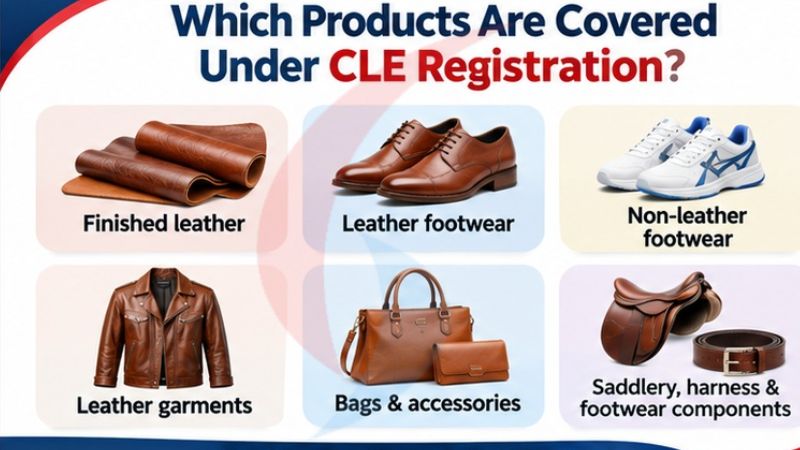
Before applying, exporters should identify the correct ITC (HS) classification and check whether the products fall within CLE's jurisdiction.
For example, Aditi's leather handbags generally fall under leather goods, while Rahul's footwear products require the appropriate classification based on their materials and construction.
Products subject to special export restrictions require additional attention. Exporters should not assume that CLE membership automatically permits exporting restricted leather materials or wildlife-derived products.
Documents Required for Council for Leather Exports Registration
Before submitting an application, exporters should prepare the documents needed to verify their business identity, export activity and membership category. The exact requirements can differ between manufacturers, merchant exporters, companies, partnership firms and proprietorship businesses.
|
Document |
Purpose |
|
Import Export Code |
Identification of the exporter |
|
PAN |
Tax identification |
|
GST Registration Certificate |
Verification of applicable GST details |
|
Udyam Registration Certificate |
MSME status and manufacturing evidence, where relevant |
|
Industrial Licence or IEM |
Manufacturing evidence, where applicable |
|
Bank Certificate |
Verification of previous-year export performance |
|
Certificate of Incorporation |
Proof of company or LLP registration |
|
Partnership Deed |
Required for relevant partnership applicants |
|
Memorandum and Articles of Association |
Company constitution documents, where applicable |
|
Authorised Signatory Details |
Identification of the person submitting the application |
|
Export Turnover Declaration |
Determination of the appropriate membership category |
CLE's registration instructions refer to IEC, PAN, GST, manufacturing documents and bank-certified export performance details. For nil-export applicants, the council permits reporting nil export performance in the applicable application process.
Example: Aditi's Document Preparation
Aditi has a registered leather manufacturing business, but she has not previously exported. She prepares her IEC, PAN, GST details, Udyam certificate and other applicable business documents.
Because she has no previous export turnover, she reports her export performance accordingly rather than submitting an invented turnover figure.
Before uploading the documents, she checks that her business name and address match across the records. This simple verification can prevent unnecessary clarification requests.
For an additional guide, read the RCMC Registration Checklist for New Export Businesses.
Council for Leather Exports RCMC Registration Process Online in 2026
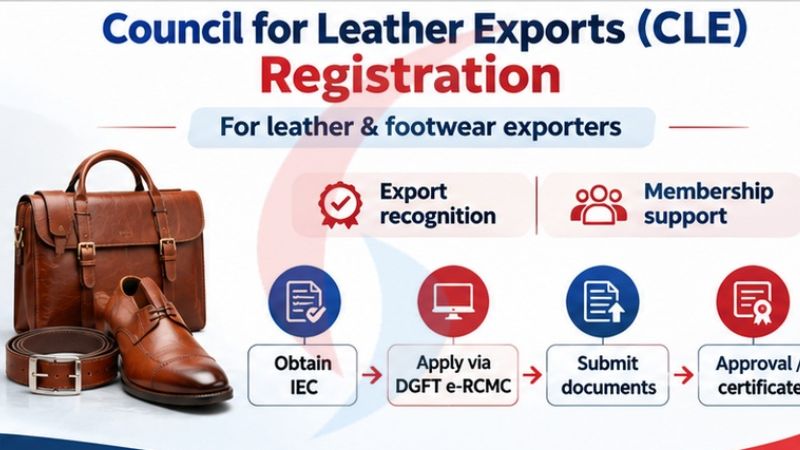
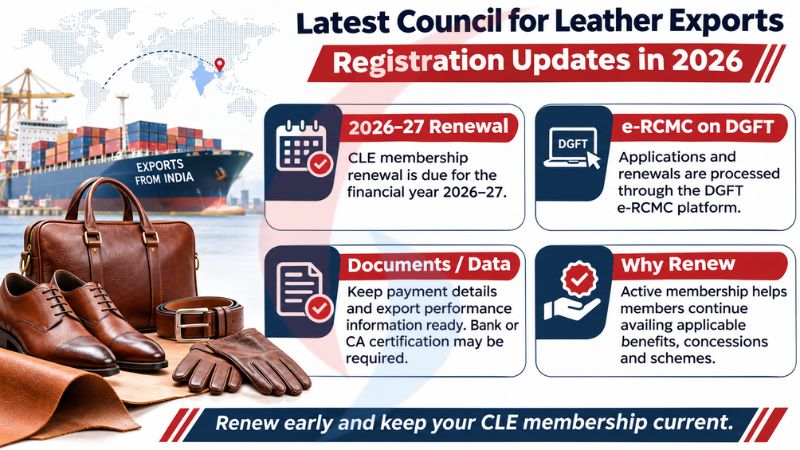
CLE applications for new RCMC and membership renewal are processed through the DGFT e-RCMC system. The council's March 2026 renewal circular confirms that applicants must use the DGFT portal and that CLE verifies the application before issuing the electronic certificate.
CLE also operates a member portal for supplementary membership and export performance information.
Step-by-Step CLE RCMC Registration Process:
|
Step |
Registration process |
What the exporter should do |
|
1 |
Obtain IEC |
Apply for an IEC and ensure that the business details are correct. |
|
2 |
Visit DGFT Portal |
Log in through the official DGFT website. |
|
3 |
Open e-RCMC Service |
Select Services and access the e-RCMC application option. |
|
4 |
Choose CLE |
Select Council for Leather Exports as the registering authority. |
|
5 |
Select Membership Category |
Choose the appropriate Associate or Ordinary Member category. |
|
6 |
Enter Business Details |
Complete the application with IEC, products and export information. |
|
7 |
Upload Documents |
Attach the applicable certificates and supporting records. |
|
8 |
Complete Authentication |
Authenticate the application using an approved DSC or Aadhaar-based method. |
|
9 |
Pay Membership Fees |
Pay the applicable amount through the DGFT portal. |
|
10 |
Submit and Track |
Track the application and respond to any CLE clarification. |
|
11 |
Complete CLE Portal Requirements |
Provide supplementary information through the CLE member portal where required. |
|
12 |
Obtain RCMC |
Download the electronically issued certificate after approval. |
The council's current renewal instructions specifically refer to the DGFT e-RCMC system and the separate CLE membership portal for relevant records.
Aditi's First CLE Application
After obtaining her IEC, Aditi logs in to the DGFT portal and selects Council for Leather Exports. She chooses the relevant membership category and identifies leather handbags as her principal export products. Next, she uploads the required documents, completes electronic authentication and pays the applicable membership charges.
If CLE requests additional information about her manufacturing activity, she submits the requested clarification. Once the application is verified and approved, she can access her electronic RCMC. The processing time depends on the completeness of the application and verification requirements. Exporters should not assume that every application will be approved within a guaranteed number of days.
Council for Leather Exports Registration Fees in 2026–27
CLE membership fees are based on the applicant's membership category and previous-year FOB export value. The council's official renewal circular dated 25 March 2026 provides the membership renewal charges for FY 2026–27.
CLE Membership Renewal Fees for FY 2026–27:
|
Previous-year FOB export value |
Membership fee |
Total including 18% GST |
|
Below Rs 15 lakh – Associate Member |
Rs 5,000 |
Rs 5,900 |
|
Above Rs 15 lakh to Rs 1 crore |
Rs 8,000 |
Rs 9,440 |
|
Above Rs 1 crore to Rs 5 crore |
Rs 20,000 |
Rs 23,600 |
|
Above Rs 5 crore to Rs 10 crore |
Rs 25,000 |
Rs 29,500 |
|
Above Rs 10 crore to Rs 50 crore |
Rs 40,000 |
Rs 47,200 |
|
Above Rs 50 crore to Rs 100 crore |
Rs 60,000 |
Rs 70,800 |
|
Above Rs 100 crore to Rs 200 crore |
Rs 80,000 |
Rs 94,400 |
|
Above Rs 200 crore to Rs 300 crore |
Rs 1,00,000 |
Rs 1,18,000 |
|
Above Rs 300 crore |
Rs 1,25,000 |
Rs 1,47,500 |
|
Above Rs 500 crore |
Rs 1,50,000 |
;Rs 1,77,000 |
What Are the Fees for Fresh CLE Registration?
Fresh membership and annual renewal are different transactions. CLE's previously published FY 2025–26 fresh membership schedule provided a concession for eligible MSME applicants with previous-year exports below Rs 15 lakh, under which the total fresh membership fee was Rs 1,180 including GST.
For low-turnover merchant exporters, the published FY 2025–26 fresh membership fee was Rs 10,030 including GST, including the entrance charge.
These historical amounts should not be presented as verified FY 2026–27 fresh registration fees. The available 2026–27 official circular verifies renewal charges, but does not establish the complete fresh-membership schedule.
New applicants should confirm the current fresh registration fee, including any eligible MSME concession and entrance fee, on the DGFT portal or directly with CLE.
Example: Fee for an Existing Small Exporter
Suppose Rahul is already an Associate Member of CLE and his previous-year FOB exports were Rs 10 lakh. Under the published FY 2026–27 renewal schedule, his annual renewal fee would be Rs 5,000 plus Rs 900 GST. His total renewal charge would therefore be Rs 5,900. This is an annual renewal example, not the amount necessarily payable for fresh registration.
CLE RCMC Validity and Membership Renewal
The general RCMC validity period is five licensing years, unless otherwise specified. For example, an RCMC issued during FY 2026–27 would generally cover the licensing period from 1 April 2026 to 31 March 2031. However, CLE's membership rules require annual renewal. Under Article 13 of the council's Articles of Association, the 2026–27 membership renewal became due on 1 April 2026. The council's official circular also states that continued RCMC validity is subject to renewal of membership every financial year.
What Happens if an Exporter Does Not Renew Membership?
Failure to maintain the annual subscription may affect the exporter's active membership status and continued use of the RCMC for relevant purposes. Businesses should therefore maintain separate records for the certificate's stated validity and annual membership payments.
Exporters must also update relevant changes in business particulars with DGFT and CLE. Under the general RCMC procedures, changes involving the business name, ownership, constitution or address should be intimated to the registering authority within one month.
Benefits of Council for Leather Exports Registration
When Aditi completes her first shipment to Germany, she begins considering new markets. She receives enquiries from buyers in Italy and the Netherlands, but they want information about leather quality, chemical restrictions and production standards.
She also wants to attend an international leather exhibition, although the participation cost seems high for her small business. CLE membership can help businesses access information about relevant events, export policy updates and eligible government support programmes.
|
Benefit |
How it helps exporters |
|
Export Promotion Council Membership |
Establishes recognised sector-specific membership |
|
International Trade Exhibitions |
Provides access to eligible trade fairs and delegations |
|
Buyer-Seller Meetings |
Creates opportunities to meet potential overseas buyers |
|
Market Information |
Helps exporters understand international demand |
|
Government Scheme Information |
Provides guidance on relevant export promotion programmes |
|
Policy Representation |
Allows industry concerns to be represented before authorities |
|
Certificates and Documentation Support |
Provides certain certificate-related services to eligible members |
|
Exporter Assistance |
Helps members understand selected procedural and trade issues |
Financial Assistance for First-Time MSE Exporters
CLE's March 2026 circular highlights the Capacity Building of First Time MSE Exporters (CBFTE) scheme under the Ministry of MSME's International Cooperation Scheme.
Under the published conditions, eligible first-time micro and small exporters may receive 75% reimbursement of RCMC fees, up to Rs 20,000.
Important eligibility conditions include Udyam Registration, an IEC not older than three years and proof of qualifying export shipments during the same financial year. This assistance is not automatic and remains subject to the current scheme rules and approval.
For example, if Aditi meets the scheme conditions and pays an eligible membership charge, she may explore reimbursement through the prescribed process rather than assuming that CLE will automatically deduct the assistance from her application fee.
Latest Council for Leather Exports Registration Updates in 2026
1. RCMC Exemption for Low-Value Export Consignments
DGFT Notification No. 36/2026-27, dated 15 September 2026, introduced an exemption for qualifying consignments with FOB value up to Rs 3 lakh.
This change is particularly relevant to first-time exporters sending small trial orders through postal, courier or other export channels. The exemption applies only to the RCMC or Certificate of Registration requirement covered by the notification.
2. Updated CLE Membership Renewal Fees
CLE issued its FY 2026–27 membership renewal circular on 25 March 2026. The circular confirms the applicable subscription categories, GST calculations and online renewal process. It also introduces information about government support programmes and the council's e-Facilitation Centre in Chennai.
3. India's Leather and Footwear Exports Reached US$4.75 Billion
According to the Ministry of Commerce and Industry's announcement dated 8 June 2026, India's leather and footwear exports reached approximately US$4.75 billion during FY 2025–26. The government also highlighted the industry's employment potential, export opportunities and production targets for 2030.
4. Relaxation of Certain Leather Export Testing and Port Restrictions
DGFT Notification No. 15/2025-26, dated 26 May 2025, removed certain port restrictions and the specified CLRI testing and certification requirement for exports of finished leather, wet blue leather, crust leather and EI-tanned leather.
This remains a relevant regulatory development in 2026. However, the relaxation should not be interpreted as eliminating all product quality requirements, customs checks or foreign buyer testing obligations.
5. TRACE Support for Testing and Certification
Under the Export Promotion Mission, the Trade Regulations, Accreditation and Compliance Enablement (TRACE) component provides support for eligible testing, inspection and certification expenses.
CLE's circular dated 18 August 2026 refers to DGFT Trade Notice No. 09/2026-27, which notified a consolidated list of 462 eligible testing, inspection and certification items.
Leather and footwear exporters should examine whether their specific testing requirements qualify for assistance.
6. Revised Export Proceeds Realisation Period
CLE's circular dated 12 June 2026 highlighted an RBI circular dated 5 June 2026, which reduced the general realisation and repatriation period for export proceeds from 15 months to nine months.
Exporters should check the applicable RBI rules, transaction dates and any specific relaxation before determining their payment deadlines.
7. Market Access Support Through Niryat Disha
CLE's 2026–27 renewal circular describes the Export Promotion Mission's Niryat Disha market access initiative.
For relevant supported events, the circular identifies conditions such as a valid IEC, at least six months' prior membership with the organising agency, exclusion from the Denied Entity List and creation of a Source from India profile.
This means a business planning to participate in an international exhibition should check the assistance conditions well before the event rather than applying at the last moment.
Legal Compliance After CLE Registration
Obtaining CLE RCMC is not the final step in exporting leather products. Suppose Aditi's German buyer wants leather handbags manufactured using materials that comply with the relevant European chemical restrictions. Even if Aditi holds a valid RCMC, she must still ensure that her products meet the applicable standards and contractual specifications.
Customs and Export Documentation
Under the Customs Act, 1962, exporters must complete the applicable export declarations and customs clearance procedures. Common documents include a commercial invoice, packing list, shipping bill, transport documents and any required product-specific certificates. Correct classification under the ITC (HS) system is essential because leather goods, footwear, finished leather and other products may be subject to different regulatory requirements.
For related procedures, read ICEGATE Registration for Import Export Business.
GST and Export Refund Compliance
Under Section 16 of the IGST Act, 2017, exports are generally treated as zero-rated supplies. Eligible exporters may use the prescribed GST export and refund procedures, subject to statutory conditions.
FEMA and Banking Compliance
Exporters must comply with applicable RBI directions concerning foreign exchange receipts, export documentation and repatriation of export proceeds. Banks and exporters should maintain accurate transaction records and follow relevant reporting requirements.
Environmental Compliance
Leather processing units may require consent to establish, consent to operate and other applicable environmental permissions. Tanneries must also comply with relevant effluent treatment and hazardous waste management requirements. The specific obligations depend on the nature and location of the manufacturing activity.
Product Testing and Quality Requirements
Exporters should identify product requirements imposed by importing countries. These may include chemical restrictions, labelling obligations, material standards and product safety rules. For instance, a leather handbag intended for the European market may need to meet applicable REACH restrictions. Footwear exporters should also check relevant EU product and labelling requirements.
Common Mistakes During CLE RCMC Registration
|
Common mistake |
Practical example |
How to avoid it |
|
Selecting the wrong council |
An exporter chooses a council without checking product jurisdiction. |
Verify the ITC (HS) classification. |
|
Choosing the wrong membership category |
A new exporter uses an incorrect previous-year export turnover slab. |
Check the applicable Associate or Ordinary Member rules. |
|
Incomplete documents |
A manufacturer submits an application without manufacturing evidence. |
Prepare the current prescribed checklist. |
|
Using outdated fees |
An applicant relies on a previous financial year's fresh membership fee. |
Check the current DGFT application amount. |
|
Ignoring annual renewal |
A member assumes a five-year RCMC requires no annual payment. |
Renew CLE membership every financial year. |
|
Ignoring product regulations |
A footwear exporter assumes RCMC replaces product certification. |
Check the relevant Indian and overseas legal requirements. |
Aditi avoids these problems by preparing the necessary documents before applying and keeping separate records for her RCMC, customs filings, buyer specifications and annual membership obligations.
Conclusion
When Aditi received her first international order, she believed the biggest challenge would be producing leather handbags that met the buyer's expectations.
But she soon learned that exporting also involves IEC, customs procedures, product classification, membership requirements, documentation and international quality standards.
Council for Leather Exports Registration in India helps eligible leather and footwear exporters obtain recognised council membership and RCMC for applicable Foreign Trade Policy purposes.
The 2026 developments, particularly the RCMC exemption for qualifying small consignments, updated annual membership fees and export promotion initiatives, create important opportunities for businesses entering international markets.
Whether a business manufactures leather shoes, handbags, garments or other covered products, understanding the legal requirements and maintaining accurate records can make the export process more organised and reliable.
Frequently Asked Questions (FAQs)
Q1. What is Council for Leather Exports Registration?
Ans: Council for Leather Exports Registration allows eligible leather, footwear and related product exporters to obtain membership and RCMC from CLE. The certificate supports applicable Foreign Trade Policy requirements, while membership provides access to relevant trade promotion activities.
Q2. Is CLE RCMC mandatory for leather exporters?
Ans: CLE RCMC is generally required for specified Foreign Trade Policy benefits or authorisations unless exempted. It is not automatically mandatory for every ordinary export shipment. Qualifying consignments with FOB value up to Rs 3 lakh benefit from the September 2026 RCMC exemption.
Q3. How can I apply for CLE RCMC online?
Ans: Visit the DGFT portal, open the e-RCMC service and select Council for Leather Exports. Enter the required business details, select the membership category, upload documents and pay the applicable charges. CLE issues the electronic certificate after verification and approval.
Q4. What are the CLE Registration fees in 2026?
Ans: CLE's published FY 2026–27 annual renewal fee starts at Rs 5,900 including GST for Associate Members with previous-year exports below Rs 15 lakh. Fresh registration fees may include different concessions or entrance charges and should be confirmed on the DGFT portal.
Q5. What documents are required for CLE RCMC Registration?
Ans: Common documents include IEC, PAN, GST registration details, business constitution documents and previous-year export performance information. Manufacturer exporters may require Udyam Registration or other applicable industrial registration documents.
Q6. Can a new leather exporter apply for CLE membership?
Ans: Yes. Eligible new exporters can apply for CLE Associate Membership. Applicants should hold the necessary IEC, select the appropriate product category and fulfil the prescribed documentation requirements.
Q7. What is the validity of CLE RCMC?
Ans: CLE RCMC generally has a validity of five licensing years, unless otherwise specified. However, continued membership requires annual renewal under the council's rules. Exporters should monitor both the certificate validity and annual subscription obligations.
Q8. Can merchant exporters apply for CLE Registration?
Ans: Yes. Eligible merchant exporters engaged in leather, footwear or other products within CLE's jurisdiction may apply for membership. They do not necessarily need to own manufacturing facilities but must satisfy the applicable business and export registration requirements.
Q9. Can MSMEs obtain reimbursement of CLE membership fees?
Ans: Eligible first-time micro and small exporters may receive reimbursement of 75% of qualifying RCMC fees, subject to a maximum of Rs 20,000, under the relevant CBFTE scheme. Applicants must satisfy the prescribed Udyam, IEC and export shipment conditions.
Q10. What are the latest CLE Registration updates in 2026?
Ans: Important updates include FY 2026–27 membership renewal fees, the Rs 3 lakh RCMC exemption, government support for eligible testing and certification, Niryat Disha market access assistance and the revised RBI export proceeds realisation period.
Article last updated on : 11 Nov 2026.