


Imagine Meera, a small business owner from Jaipur who sells handmade wooden boxes, decorative trays and traditional home accessories. She works with local artisans and sells most of her products through exhibitions and online platforms. One day, a boutique retailer from London places an order for 500 handcrafted decorative boxes. It is Meera's first international order, but she soon discovers that exporting involves more than manufacturing products and arranging transportation.
While researching export requirements, Meera comes across EPCH Registration, IEC, customs documentation and RCMC. She wonders whether registration with the Export Promotion Council for Handicrafts is compulsory and how a small business can complete the process.
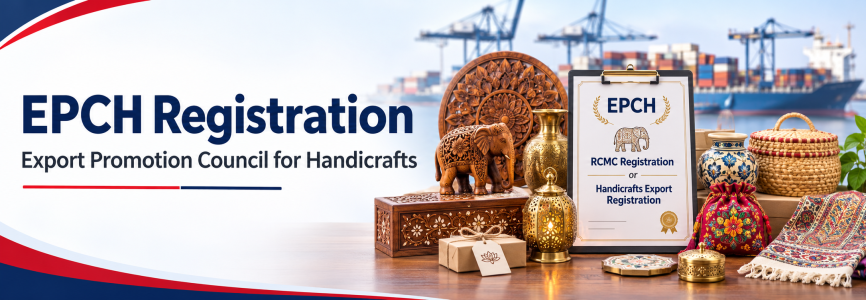
EPCH Registration in India allows eligible handicraft exporters to obtain membership and a Registration-cum-Membership Certificate (RCMC Registration) from the Export Promotion Council for Handicrafts. The certificate supports applicable Foreign Trade Policy requirements, while membership offers access to relevant export promotion activities.
What Is EPCH Registration in India?
The Export Promotion Council for Handicrafts (EPCH) was established in 1986–87 to promote Indian handicrafts in international markets. It represents exporters dealing in wooden handicrafts, metalware, handmade textiles, decorative products and other eligible handicraft categories.
EPCH supports exporters through international exhibitions, buyer-seller meetings, trade information, product development initiatives and industry representation.
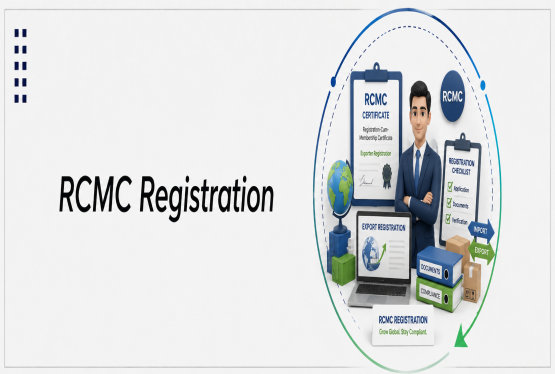
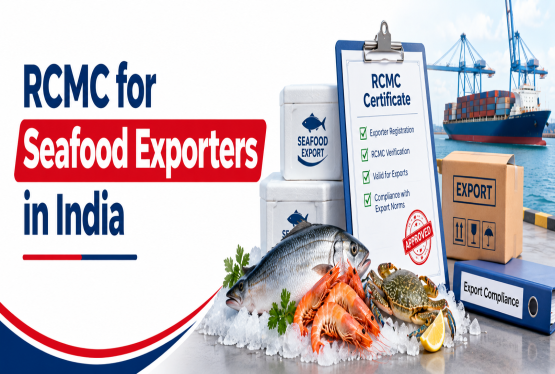
An RCMC confirms that an eligible exporter is registered with the appropriate Export Promotion Council. EPCH membership and RCMC are related but distinct, with membership forming the basis for obtaining the council's RCMC.
Is EPCH Registration Mandatory for Handicraft Exporters?
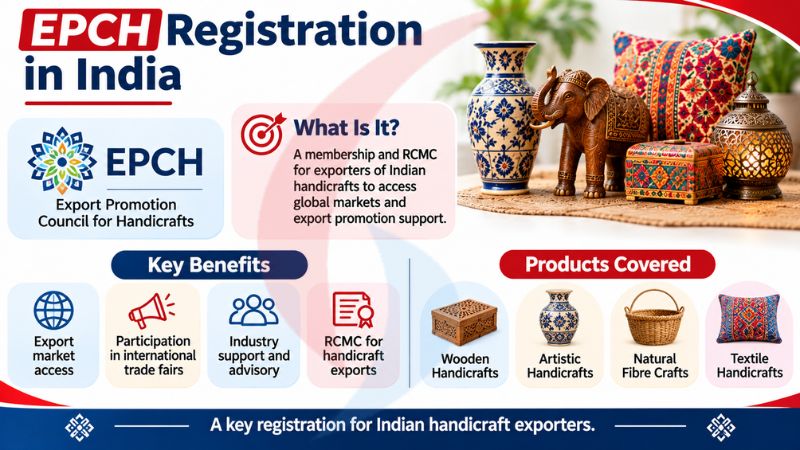
EPCH RCMC is not automatically mandatory for every ordinary handicraft export shipment. Under Paragraph 2.57 of the Foreign Trade Policy, 2023, RCMC is generally required for specified Foreign Trade Policy authorisations, benefits or concessions unless an exemption applies.
For example, Meera may export freely exportable wooden decorative items after completing the applicable IEC, customs and other statutory formalities without needing RCMC solely for that shipment.However, exporters seeking benefits or authorisations that require RCMC must satisfy the relevant conditions.
Understanding why RCMC Registration matters for Indian exporters can help new businesses distinguish ordinary export requirements from scheme-specific obligations.
Latest 2026 Update: RCMC Exemption up to Rs 3 Lakh
DGFT Notification No. 36/2026-27, dated 15 September 2026, introduced an exemption for export consignments with a Free-on-Board (FOB) value not exceeding Rs 3 lakh, wherever RCMC or a Certificate of Registration would otherwise be required under the relevant Foreign Trade Policy provision.
Suppose Meera sends a trial shipment worth Rs 2.5 lakh. She may benefit from this exemption, but she must still comply with applicable customs, tax and product-specific rules.
Which Products Are Covered Under EPCH Registration?
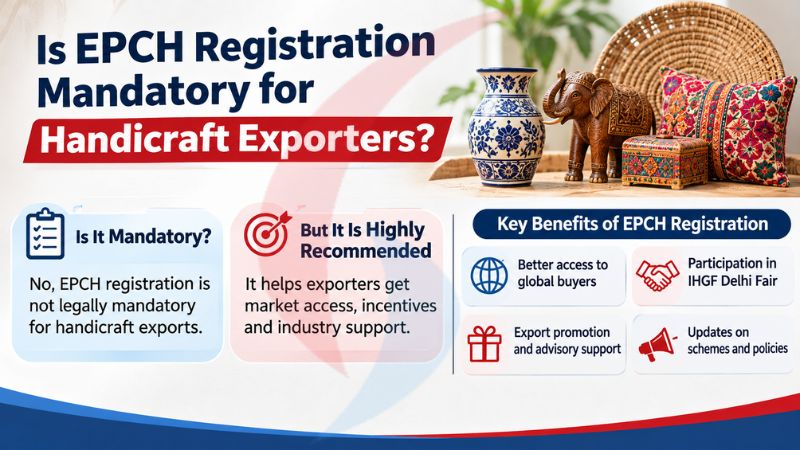
EPCH covers a wide range of handicraft products. Exporters should confirm the correct product classification before applying.
|
Product category |
Examples |
|
Wooden Handicrafts |
Carved boxes, decorative furniture and wooden gifts |
|
Art Metalware |
Brassware, metal lamps and decorative articles |
|
Handmade Textiles |
Handprinted furnishings and embroidered items |
|
Glassware |
Handmade glass décor and accessories |
|
Stone and Pottery |
Decorative pottery, sculptures and stone craft |
|
Fashion Accessories |
Eligible handmade bags and lifestyle accessories |
|
Miscellaneous Handicrafts |
Other products within EPCH's recognised jurisdiction |
For example, Meera's wooden decorative boxes may fall within EPCH's product coverage. However, carpets, readymade garments and certain other textile products may fall under different Export Promotion Councils. The correct registering authority should be identified using the product's ITC (HS) classification and applicable DGFT rules.
Who Can Apply for EPCH Registration?
EPCH membership is available to eligible proprietorships, partnerships, LLP Registration , companies and other qualifying businesses engaged in handicraft exports. Applicants may operate as merchant exporters, manufacturer exporters or merchant-cum-manufacturer exporters.A merchant exporter purchases finished handicraft products from artisans or suppliers and sells them overseas. A manufacturer exporter produces goods through its own manufacturing arrangements. Businesses undertaking both activities may apply under the appropriate combined classification.
EPCH also recognises two principal membership categories for FY 2026–27:
|
Membership category |
Eligibility |
|
Associate Member |
Average annual handicraft exports below Rs 10 lakh during FY 2024–25 and FY 2025–26 |
|
Ordinary Member |
Average annual handicraft exports of Rs 10 lakh or more during those financial years |
These categories follow EPCH's membership amendments effective from 1 November 2025. Before applying, businesses must obtain an active IEC. First-time exporters can review the requirements for IEC Registration.
Laws Governing EPCH RCMC Registration in India
EPCH Registration operates under India's foreign trade laws. Exporters must understand these provisions because RCMC does not replace other statutory registrations.
Foreign Trade (Development and Regulation) Act, 1992
Section 3 empowers the Central Government to regulate imports and exports. Section 5 deals with the Foreign Trade Policy, while Section 7 governs IEC requirements, subject to applicable exemptions.
Foreign Trade Policy, 2023
Paragraphs 2.56 and 2.57 cover recognised registering authorities and RCMC requirements. The September 2026 amendment introduced relief for qualifying low-value export consignments.
Customs Act, 1962
Section 50 governs the entry of goods for exportation, including shipping bills, bills of export and applicable declarations.
IGST Act, 2017
Section 16 treats exports as zero-rated supplies, subject to applicable conditions. Eligible exporters may follow the prescribed GST refund procedures.
FEMA, 1999
The Foreign Exchange Management Act and applicable RBI directions regulate export-related foreign exchange transactions, including realisation and repatriation of export proceeds. Handicraft exporters must also check product-specific restrictions involving timber, wildlife materials, chemicals, labelling and destination-country standards.
Documents Required for EPCH Registration
Before applying, Meera prepares her business records and checks that the details match her IEC information.
The following documents are commonly relevant:
|
Document |
Purpose |
|
IEC Certificate |
Exporter identification |
|
PAN |
Business tax identification |
|
GST Details |
Verification where applicable |
|
Certificate of Incorporation |
Company or LLP registration |
|
Partnership Deed |
Partnership business verification |
|
Udyam Registration or IEM |
Manufacturing evidence, where applicable |
|
Export Performance Details |
Membership classification |
|
Authorised Signatory Documents |
Application authorisation |
|
Code of Conduct |
EPCH membership declaration |
Exact requirements depend on business structure and exporter classification.
First-time exporters can use the RCMC Registration Checklist for New Export Businesses to prepare documents and avoid common registration mistakes.
How to Apply for EPCH RCMC Registration Online in 2026
EPCH RCMC applications are processed through the DGFT electronic registration system. Applicants should also follow the council's current membership instructions.
|
Step |
Registration process |
|
1. Obtain IEC |
Obtain an active IEC and verify business particulars. |
|
2. Visit DGFT |
Log in to the official DGFT portal. |
|
3. Select e-RCMC |
Open the Registration-cum-Membership Certificate service. |
|
4. Choose EPCH |
Select Export Promotion Council for Handicrafts. |
|
5. Enter Details |
Provide business, product and membership information. |
|
6. Upload Documents |
Attach the prescribed documents and declarations. |
|
7. Authenticate |
Complete the permitted electronic authentication. |
|
8. Pay Fees |
Pay the applicable membership and entrance charges. |
|
9. Submit Application |
Track the application and respond to clarification requests. |
|
10. Obtain RCMC |
Access the electronic certificate after approval. |
Exporters can refer to the RCMC Registration Online in India guide for additional information about the DGFT application process.
What Happened During Meera's Application?
Meera selected EPCH and entered her handicraft product details. However, one document showed an outdated business address. Before completing the application, she corrected the details and ensured her records were consistent. This practical example shows why accurate documentation matters. Incomplete or inconsistent information can lead to clarification requests and registration delays.
EPCH Registration Fees in 2026–27
EPCH charges an entrance fee for applicable fresh memberships and annual membership subscriptions. Its published standard initial Associate Membership fee structure is:
|
Fee particulars |
Amount |
|
One-time entrance fee |
Rs 2,500 |
|
Annual subscription |
Rs 5,000 |
|
GST at 18% |
Rs 1,350 |
|
Total initial fee |
Rs 8,850 |
The official FY 2026–27 annual renewal charges are:
|
Membership category |
Annual renewal including GST |
|
Associate Member |
Rs 5,900 |
|
Ordinary Member |
Rs 8,850 |
Fresh applicants should verify their current membership classification and payable charges on the DGFT portal before submitting payment.
EPCH RCMC Validity and Renewal
EPCH RCMC generally remains valid for five licensing years, unless otherwise specified. For example, an RCMC issued during FY 2026–27 would ordinarily remain valid until 31 March 2031, subject to applicable conditions. However, annual EPCH membership renewal is separate from RCMC validity. Membership subscriptions generally become payable on 1 April, with renewal ordinarily required by 30 June. Exporters must also update relevant changes in business name, ownership, constitution or address under the applicable DGFT procedures.
Benefits of EPCH Registration for Handicraft Exporters
EPCH Registration offers several benefits to Indian handicraft exporters planning to expand their businesses internationally. Apart from providing membership and RCMC for applicable Foreign Trade Policy purposes, the Export Promotion Council for Handicrafts helps eligible businesses explore overseas markets, understand industry trends and connect with potential buyers.
Key Benefits of EPCH Registration:
-
International Market Access: EPCH helps exporters explore overseas markets through international trade fairs, exhibitions and promotional activities.
-
Buyer-Seller Meetings: Members can participate in eligible business networking events and connect with potential international buyers.
-
Trade Fair Participation: Exporters may participate in events such as the Indian Handicrafts and Gifts Fair (IHGF), subject to applicable conditions.
-
Market Research and Information: EPCH provides information about international handicraft demand, emerging product trends and export opportunities.
-
Product Development Support: The council organises relevant workshops and initiatives that help exporters understand product design, quality and changing buyer preferences.
-
Government Export Promotion Schemes: Eligible members may receive information about government export promotion programmes and financial assistance opportunities, subject to scheme conditions.
-
Industry Representation: EPCH represents handicraft exporters' concerns before relevant government authorities and supports discussions on trade-related issues.
Benefits of EPCH Registration at a Glance:
|
Benefits |
How It Helps Handicraft Exporters |
|---|---|
|
International Trade Exhibitions |
Provides opportunities to showcase handicraft products to overseas buyers. |
|
Buyer-Seller Meetings |
Helps exporters establish contacts with potential international customers. |
|
Market Information |
Provides insights into global demand, product preferences and export trends. |
|
Product Development |
Supports awareness of improved designs, packaging and product quality. |
|
Export Promotion Schemes |
Helps eligible exporters understand available government assistance programmes. |
|
Industry Representation |
Provides a platform for raising export-related concerns through the council. |
|
Business Networking |
Creates opportunities to connect with other exporters, buyers and industry professionals. |
Practical Example: For example, a handicraft exporter from Jaipur planning to expand into Germany, France and the UAE can benefit from EPCH's trade promotion activities, international exhibitions and opportunities to connect with potential overseas buyers.
Important Note: EPCH membership does not automatically guarantee export orders, government subsidies, buyer connections or exhibition participation. These opportunities depend on the applicable eligibility conditions, availability and approval procedures.
Latest EPCH Registration Updates in 2026
Several important developments in 2026 have affected EPCH membership, RCMC requirements and handicraft export opportunities in India.
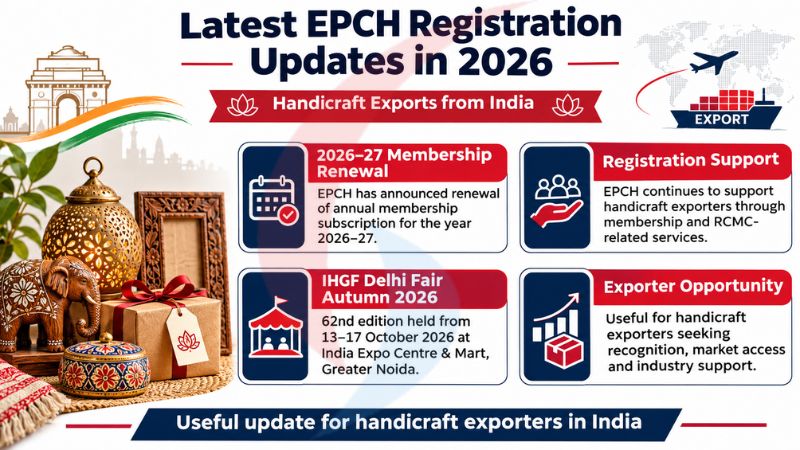
|
Latest Update |
Important Details |
Impact on Handicraft Exporters |
|---|---|---|
|
1. Revised Membership Categories |
EPCH's revised membership rules became effective on 1 November 2025 and apply to FY 2026–27. |
Exporters are classified as Associate or Ordinary Members based on their average annual export performance. |
|
2. RCMC Exemption up to Rs 3 Lakh |
DGFT Notification No. 36/2026-27, dated 15 September 2026, introduced an exemption for qualifying consignments with FOB value not exceeding Rs 3 lakh. |
Reduces RCMC-related requirements for eligible small-value export shipments. |
|
3. Handicraft Export Performance |
EPCH reported handicraft exports of approximately Rs 33,168.48 crore during FY 2025–26, excluding hand-knotted carpets. |
Highlights the scale of India's international handicraft market. |
|
4. 62nd IHGF Delhi Fair |
EPCH organised the Autumn 2026 fair from 13–17 October 2026 at India Expo Centre & Mart, Greater Noida. |
Provided opportunities for eligible exporters to showcase products and connect with international buyers. |
What Do These Updates Mean for Exporters?
These developments can benefit small handicraft manufacturers, artisans and merchant exporters planning to enter international markets. The revised membership rules help businesses identify their correct EPCH category, while the Rs 3 lakh exemption provides relief for qualifying small export consignments. At the same time, India's handicraft export performance and international trade exhibitions highlight opportunities for businesses to explore overseas markets, understand changing customer preferences and build relationships with potential buyers.
Compliance Requirements After EPCH Registration
Obtaining EPCH Registration and an RCMC certificate is an important step for handicraft exporters, but it does not complete all legal requirements. Exporters must continue complying with customs laws, GST regulations, foreign exchange rules and applicable product standards to conduct international trade smoothly.
1. Customs and Export Documentation
Under Section 50 of the Customs Act, 1962, exporters must complete the applicable customs declarations before shipping handicraft products internationally. Important documents include commercial invoices, packing lists, shipping bills and relevant transport documents. Exporters can also understand the ICEGATE Registration process for import export businesses to manage applicable electronic customs procedures.
2. GST and Export Tax Compliance
Under Section 16 of the IGST Act, 2017, exports are treated as zero-rated supplies, subject to applicable conditions. Eligible handicraft exporters may export under a Letter of Undertaking (LUT) without payment of integrated tax or follow the permitted IGST payment and refund procedure. Exporters must maintain proper invoices, GST returns and supporting documents for applicable refund claims.
3. FEMA and Foreign Exchange Compliance
Handicraft exporters must comply with the Foreign Exchange Management Act, 1999, and applicable RBI directions concerning export payments and realisation of export proceeds. Businesses should also understand the AD Code Registration for relevant customs and banking procedures. Accurate banking and shipping records help exporters meet their reporting obligations.
4. Product Quality and International Standards
Handicraft products must comply with applicable Indian export restrictions and destination-country product requirements. Depending on the product, these may include packaging, labelling, chemical safety, timber legality and other quality standards. For example, exporters shipping wooden handicrafts to European countries may need to verify applicable timber sourcing and product safety requirements before dispatch.
5. EPCH Membership Renewal and Business Updates
EPCH members must maintain their annual membership subscriptions even though RCMC generally remains valid for five licensing years. For FY 2026–27, the published annual renewal fees are Rs 5,900 for Associate Members and Rs 8,850 for Ordinary Members, including GST. Exporters must also report relevant changes in their business name, ownership, constitution or address within the prescribed period under DGFT procedures.
Important Note: EPCH RCMC does not replace IEC, customs clearance, GST compliance, FEMA obligations or product-specific approvals. Handicraft exporters should maintain accurate records and review applicable legal requirements before every international shipment.
Conclusion
Meera's journey from selling handicrafts locally to receiving an international order shows that exporting requires more than creativity and quality products. Businesses must understand IEC, customs procedures, product regulations, RCMC requirements and overseas buyer expectations.
EPCH Registration in India provides eligible handicraft exporters with recognised council membership and an RCMC for applicable Foreign Trade Policy purposes. With the updated 2026 membership rules, annual fees and Rs 3 lakh RCMC exemption, new exporters and MSMEs should review their eligibility before applying. Proper registration, accurate documents and continued legal compliance can help Indian handicraft businesses build a stronger foundation for international trade.
Frequently Asked Questions (FAQs)
Q1. What is EPCH Registration, and why is it required?
Ans: EPCH Registration allows eligible handicraft exporters to obtain membership and an RCMC from the Export Promotion Council for Handicrafts. It is relevant for specified Foreign Trade Policy benefits and helps exporters access trade promotion activities.
Q2. Is EPCH RCMC mandatory for handicraft exporters in India?
Ans: No. EPCH RCMC is not compulsory for every ordinary handicraft export shipment. However, it may be required for specific Foreign Trade Policy authorisations, benefits or concessions, unless an exemption applies.
Q3. How can I apply for EPCH Registration online in 2026?
Ans: Visit the DGFT portal, select the e-RCMC service and choose EPCH as the registering authority. Enter your business details, upload the required documents, complete payment and submit the application for approval.
Q4. What is the EPCH Registration fee in India in 2026?
Ans: EPCH's published standard fresh Associate Membership fee is Rs 8,850 including GST. For FY 2026–27, annual renewal fees are Rs 5,900 for Associate Members and Rs 8,850 for Ordinary Members. Fresh applicants should verify their applicable charges.
Q5. What documents are required for EPCH RCMC Registration?
Ans: Applicants generally need an IEC, PAN, relevant business registration documents and prescribed declarations. Manufacturer exporters may also require Udyam Registration, IEM or other acceptable manufacturing evidence.
Q6. Can I export handicrafts from India without EPCH Registration?
Ans: Yes. Eligible businesses can export freely exportable handicrafts without EPCH RCMC where no applicable rule requires it. However, they must comply with IEC, customs, GST, FEMA and relevant product-specific requirements.
7. What is the validity of an EPCH RCMC certificate?
Ans: An EPCH RCMC certificate is generally valid for five licensing years, unless otherwise specified. Exporters must also renew their EPCH membership annually to maintain their membership status and applicable certificate benefits.
Q8. Can a small business or first-time exporter apply for EPCH Registration?
Ans: Yes. Small businesses, startups and first-time handicraft exporters can apply for EPCH membership after obtaining an active IEC. Eligibility depends on their business activities, exporter classification and applicable documentation requirements.
Q9. What are the benefits of EPCH Registration for handicraft exporters?
Ans: EPCH membership provides access to relevant trade fairs, buyer-seller meetings, market information and export promotion initiatives. Eligible exporters may also explore government assistance schemes, subject to their specific conditions.
Q10. What are the latest EPCH Registration rules and updates in 2026?
Ans: Major updates include revised EPCH membership categories and annual renewal fees for FY 2026–27. DGFT also introduced an RCMC exemption for qualifying export consignments with an FOB value not exceeding Rs 3 lakh from 15 September 2026.
Article last updated on : 11 Nov 2026.