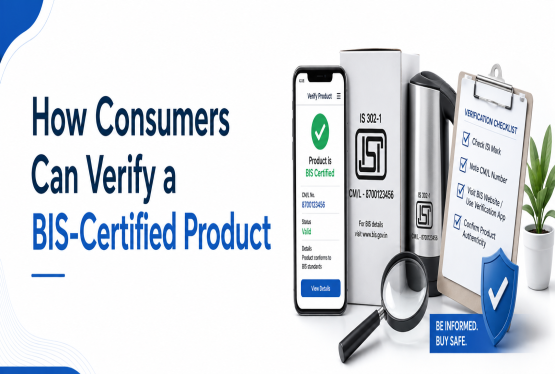



Starting an inverter manufacturing business involves more than developing a product and finding customers. For example, Rahul, a small electronics manufacturer in Delhi, has developed a range of home inverters and is ready to supply them to local distributors. His products have passed internal quality checks, and the first orders are already confirmed. However, before dispatching the products, a distributor asks him to provide a BIS registration certificate. Rahul is surprised because he assumed that successful product testing was enough to begin selling. He soon learns that certain UPS and inverter products must meet mandatory BIS requirements before entering the Indian market.
This is why BIS Certification for UPS and Inverters Up to 5 kVA is important for manufacturers and businesses dealing in power backup equipment. The Bureau of Indian Standards (BIS), under its Compulsory Registration Scheme (CRS), requires covered products to comply with prescribed Indian safety standards. Whether you manufacture UPS systems, import inverters, or market products under your own brand, understanding the BIS Registration process can help you meet legal requirements, avoid unnecessary delays, and bring your products to market with greater confidence.
What is BIS Certification for UPS and Inverters Up to 5 kVA?
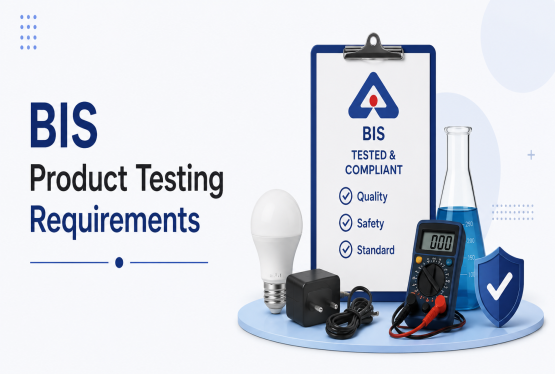
BIS Certification for UPS and Inverters Up to 5 kVA is a mandatory product conformity requirement for the notified category of Uninterruptible Power Supply (UPS) systems and inverters. It falls under the BIS Compulsory Registration Scheme, which requires manufacturers to obtain product testing from a BIS-recognised laboratory and register the product with BIS. Once registration is approved, the manufacturer can use the prescribed BIS Standard Mark with a unique registration number, commonly known as the R-number, on the registered product.
For example, a company manufacturing a 3 kVA UPS for offices cannot rely only on its own testing or a general quality certificate. If its product falls within the notified CRS category, it must meet the relevant BIS standard and registration requirements.
Important: Although this article focuses on products up to 5 kVA, BIS also separately lists UPS/inverters up to 10 kVA under CRS. Therefore, products rated above 5 kVA are not automatically exempt.
Why is BIS Registration Important for UPS and Inverters?
UPS and inverters are widely used in homes, hospitals, offices, banks, schools, and commercial establishments. These products provide backup electricity, but defective equipment can create serious electrical safety risks. A poorly designed inverter may overheat, suffer insulation failure, or expose users to electric shock. BIS requirements help ensure that notified equipment meets minimum safety standards.
The main reasons BIS registration matters include:
-
Electrical Safety: Helps reduce risks associated with electric shock, overheating, insulation failure, and unsafe construction.
-
Legal Compliance: Ensures that covered products meet India's compulsory registration requirements.
-
Consumer Confidence: Gives customers greater confidence that products have undergone prescribed safety testing.
-
Market Access: Helps manufacturers and importers meet applicable requirements for selling products in India.
-
Business Credibility: Provides documentary evidence of registration for distributors, institutional purchasers, and business customers.
For More Information: Read our learn article on BIS CRS Registration: Step-by-Step Process for Electronic Products to understand how electronic products are registered in India.
Applicable Laws and BIS Standards for UPS and Inverters
The registration requirement comes from India's BIS legal framework and the compulsory registration orders applicable to electronic and IT goods.
|
Law or Standard |
Important Provision |
Applicability |
|
BIS Act, 2016 |
Sections 16 and 17 |
Compulsory use of Standard Mark and restrictions relating to notified goods |
|
BIS (Conformity Assessment) Regulations, 2018 |
Scheme II |
Registration and conformity assessment procedure |
|
Electronics and Information Technology Goods (Requirement of Compulsory Registration) Order, 2021 |
Notified product schedule |
Mandatory registration of covered electronic products |
|
IS 16242 (Part 1):2014 |
General and Safety Requirements for UPS |
Earlier applicable safety standard |
|
IS 16242 (Part 1):2025 |
Revised UPS safety standard |
New standard subject to BIS transition requirements |
The revised 2025 standard is aligned with IEC 62040-1:2017, including Amendments 1:2021 and 2:2022. The transition deadline is particularly important for manufacturers in November 2026.
Which UPS and Inverters Require BIS Certification?
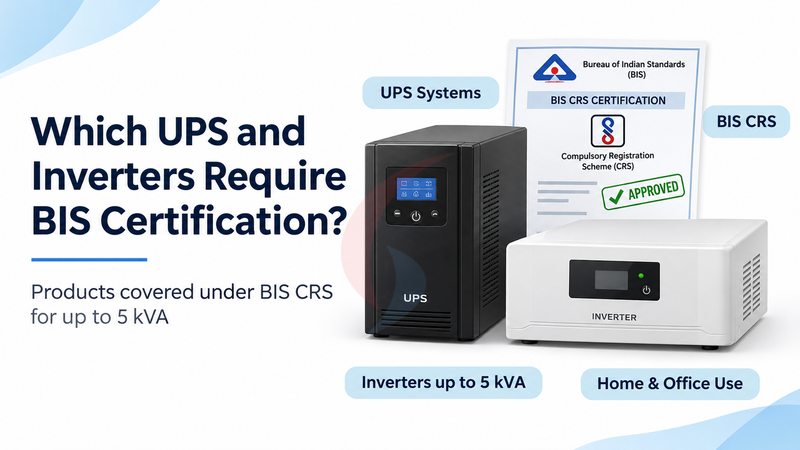
BIS CRS applies to notified standalone UPS and inverter equipment. The product's rated capacity, construction, intended purpose, and technical features determine its classification.
Common examples include home power backup inverters, office UPS systems, online UPS equipment, offline UPS equipment, and certain commercial backup power systems.
|
Product |
Example |
BIS Requirement |
|
Home inverter |
1 kVA inverter |
CRS registration where covered |
|
Office UPS |
2 kVA UPS |
CRS registration |
|
Online UPS |
3 kVA system |
CRS registration |
|
Commercial UPS |
5 kVA system |
CRS registration |
|
Higher-capacity UPS |
7.5 kVA or 10 kVA |
Check separately notified up-to-10-kVA category |
|
Solar PV inverter |
Grid-connected solar inverter |
Separate applicable solar inverter standards may apply |
BIS's official product list includes both the up-to-5-kVA category and the up-to-10-kVA category. The correct classification must be established before arranging laboratory testing.
Example: A Home Inverter Manufacturer
Suppose a Jaipur-based company manufactures 1 kVA and 2 kVA inverters for residential electricity backup. Before introducing these products into the market, the manufacturer must determine the applicable BIS category, arrange testing, and secure registration.
If the models are technically similar, they may qualify for grouping under BIS series guidelines. However, different models cannot automatically be covered by the same test report.
Who Can Apply for BIS Certification?
The BIS CRS registration is normally issued to the actual manufacturer rather than the distributor or importer.
-
Indian Manufacturers: A factory manufacturing UPS or inverter equipment in India applies in its own name and provides manufacturing-unit details.
-
Foreign Manufacturers: Overseas manufacturers supplying covered UPS or inverters to India must follow BIS CRS requirements and generally appoint an Authorised Indian Representative (AIR) where applicable.
-
Importers: Importers need to ensure that products sourced from overseas manufacturers have valid and applicable BIS registration.
-
Brand Owners: Businesses selling products manufactured by another company should coordinate with the actual factory to ensure the correct brand and models are covered.
For example, if an Indian brand purchases UPS systems from a manufacturing factory in China, the registration would ordinarily be obtained by the foreign manufacturer with the necessary Indian representative and brand documentation.
Documents Required for BIS Certification of UPS and Inverters
Manufacturers should prepare their documents before sending product samples for testing. Missing technical information or incorrect factory details can delay the registration.
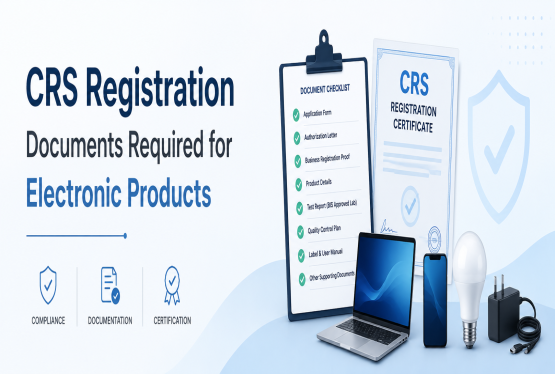
Common Documents Required
- Manufacturing business registration or factory licence, as applicable.
- Complete manufacturing unit name and address.
- Product model numbers, brand name, and technical specifications.
- Circuit diagrams and PCB layout details.
- Power transformer design and relevant component details.
- Battery type, rating, and battery bus voltage information.
- Product photographs, rating labels, and user manuals.
- BIS-recognised laboratory test report.
- Required declarations, undertakings, and authorisation documents.
- AIR appointment documents for eligible foreign manufacturer applications.
For example, a manufacturer selling three UPS models under one brand should ensure that the model descriptions, rated input and output voltages, and manufacturing address are consistent across technical documents, laboratory reports, and BIS applications.
Related Reading: Manufacturers can also refer to CRS Application: Important Details to Check to understand common document mismatches and how to avoid registration queries.
BIS Certification Process for UPS and Inverters: Step-by-Step
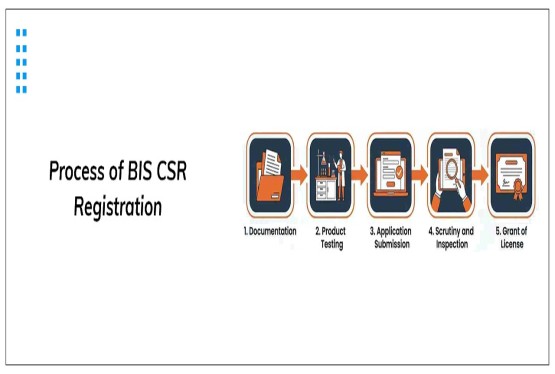
The BIS CRS registration procedure involves product classification, technical testing, online application filing, and verification by the Bureau of Indian Standards.
Step 1: Identify the Product Category
First, confirm whether your product falls under the UPS/inverter category notified under BIS CRS. Examine its rated capacity, electrical specifications, construction, and intended use.
Step 2: Identify the Applicable Indian Standard
Determine the standard that applies to the product and the relevant transition date. In November 2026, manufacturers must pay particular attention to IS 16242 (Part 1):2025.
Step 3: Prepare the Product Sample
Select a representative model for testing. If multiple models are proposed under one series, verify that they satisfy the BIS series approval guidelines.
Step 4: Get Testing Done at a BIS-Recognised Laboratory
Submit the UPS or inverter sample to an eligible BIS-recognised laboratory for testing against the applicable Indian Standard. The laboratory examines relevant electrical safety, construction, insulation, and other prescribed characteristics.
Step 5: Collect the Test Report
After successful testing, collect the laboratory report and check that the manufacturer's name, factory address, product model, brand, and technical ratings are correct. For a new CRS application, the test report generally must not be older than 90 days at the time of submission.
Step 6: Submit the Online Application
Visit the official BIS CRS Portal and submit the application with the laboratory report, prescribed documents, and applicable fees.
Step 7: Respond to BIS Queries
BIS may ask questions relating to technical specifications, brand ownership, documentation, or testing. The manufacturer should provide clear and accurate responses within the prescribed timeline.
Step 8: Receive BIS Registration
After satisfactory verification, BIS grants registration. The manufacturer may then use the prescribed Standard Mark and registration number on products covered by the registration.
Note: Submission of an application does not itself authorise the manufacturer to use the BIS Standard Mark.
BIS Testing Requirements for UPS and Inverters
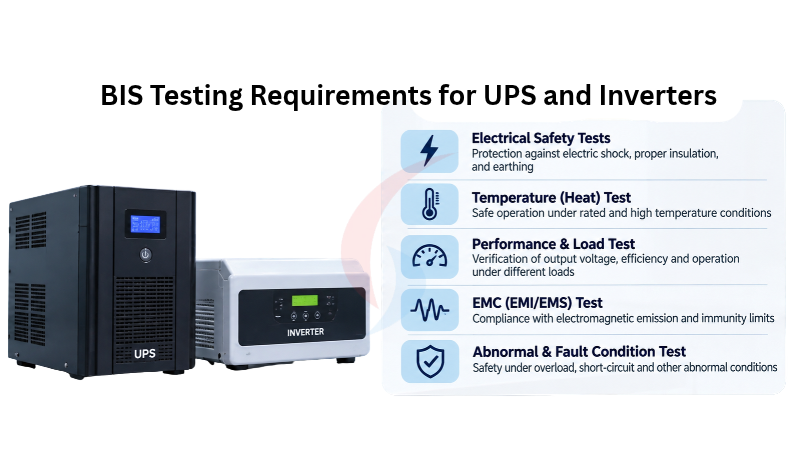
The purpose of BIS testing is to check whether the UPS or inverter meets the applicable electrical safety requirements. Testing is carried out by a BIS-recognised laboratory, not merely by the manufacturer's internal quality department.
Important testing areas include:
-
Electric Shock Protection: Checks safeguards against accidental contact with hazardous electrical parts.
-
Insulation Safety: Evaluates insulation between electrical components and accessible surfaces.
-
Temperature and Heating: Examines whether components become excessively hot during prescribed operating conditions.
-
Mechanical Construction: Checks enclosures, wiring arrangements, and relevant physical safety requirements.
-
Electrical Components: Evaluates relevant transformers, protective devices, wiring, and safety-critical components.
-
Marking and Instructions: Verifies required electrical ratings, warnings, and safety information.
The precise tests depend on the applicable edition of IS 16242 (Part 1), equipment design, and laboratory assessment.
Can Multiple UPS Models Be Registered Together?
Yes, BIS permits eligible UPS and inverter models to be grouped into a series when they meet the prescribed technical conditions. Important similarities include rated input and output voltages, frequency, number of phases, cabinet construction, transformer design, PCB layout, and battery bus voltage.
For example, a manufacturer selling 1 kVA, 2 kVA, and 3 kVA UPS systems should not assume they qualify as one series merely because they belong to the same brand. Their technical construction must satisfy the applicable grouping guidelines.
Latest BIS Updates for UPS and Inverters in 2026
Important deadline: 19 November 2026 : BIS extended the implementation deadline for the revised UPS safety standard, IS 16242 (Part 1):2025, to 19 November 2026 through its circular dated 15 October 2025.
The revised standard is aligned with IEC 62040-1:2017 and its 2021 and 2022 amendments. Manufacturers with existing registrations under IS 16242 (Part 1):2014 should review the transition requirements, including updated testing and supporting undertakings, as applicable. Businesses applying for new registration should coordinate with their BIS-recognised laboratory to ensure that the appropriate standard edition is used.
Another important development in 2026 concerns the CRS licence validity, renewal, and annual fee framework. BIS issued revised provisions on 27 May 2026, introducing a five-year validity framework along with annual fee and production reporting obligations. Manufacturers should confirm the operative transition provisions for their particular registration.
For More Information: Visit our BIS CRS Registration service page for guidance on registration, documentation, testing, renewal, and compliance.
BIS Registration Fees and Timeline
The total cost depends on the product category, number of models, laboratory testing, and application requirements.
|
Fee Component |
Details |
|
Application fee |
Rs 1,000 under the published BIS CRS fee schedule |
|
Application processing fee |
Rs 50,000, including one test report, under the published revised schedule |
|
Additional test report |
Rs 20,000 per report under that schedule |
|
Annual licence fee |
Rs 1,000 under the published schedule |
|
Laboratory testing |
Separate charges depending on testing scope |
|
Professional assistance |
Depends on documentation and application complexity |
BIS's published revised fee schedule dates from 2018, while further fee-related provisions were issued in 2026. Therefore, the latest payable amount should be checked on the official BIS portal before filing. Taxes and other applicable charges may be additional.
How long does registration take? There is no guaranteed single timeline for every UPS or inverter application. Laboratory availability, test results, documentation, BIS queries, and standard-transition requirements can affect completion.
Common Mistakes During UPS and Inverter BIS Registration
Even experienced manufacturers can face registration difficulties when they overlook small compliance requirements.
-
Incorrect Product Classification: A company may choose the wrong standard or confuse ordinary UPS products with separately regulated solar inverter categories.
-
Incomplete Technical Documents: Missing circuit diagrams, transformer details, or product ratings can affect laboratory testing and document scrutiny.
-
Incorrect Series Grouping: Manufacturers sometimes attempt to cover technically different models under one test report without meeting BIS guidelines.
-
Outdated Test Reports: Reports that do not satisfy the applicable validity or standard requirements may cause application difficulties.
-
Ignoring Standard Amendments: Continuing with an outdated standard without completing the prescribed transition can affect registration validity and market access.
Related Learn Article - Read Important Details Checked During CRS Registration for practical guidance on avoiding application errors.
Post-Registration Compliance for UPS and Inverters
Receiving BIS registration is only the beginning of the manufacturer's compliance responsibility. The manufacturer must continue producing registered products in conformity with the applicable Indian Standard and use the Standard Mark correctly. If important components, electrical ratings, manufacturing locations, brands, or model specifications change, the manufacturer should assess whether additional testing, model inclusion, or other BIS formalities are required.
Manufacturers must also maintain relevant records, follow renewal and fee requirements, and cooperate with applicable BIS surveillance procedures. Non-compliance can result in regulatory action, including suspension or cancellation of registration and penalties under the applicable provisions of the BIS Act and related regulations.
Why Choose Compliance Calendar LLP for BIS Certification?
At Compliance Calendar LLP, we understand that manufacturers are often more concerned about launching their products on time than understanding complicated technical compliance rules. For example, when a manufacturer approaches our team with multiple UPS or inverter models, our first priority is to understand the product specifications, manufacturing arrangements, and applicable BIS category rather than simply starting an application.
Our team can assist with product classification, document review, coordination with BIS-recognised laboratories, preparation of registration applications, responses to BIS queries, and post-registration formalities. We also help businesses understand the practical implications of standard changes, including the transition to IS 16242 (Part 1):2025.
For expert assistance, contact Compliance Calendar LLP at +91 9988424211 or email info@ccoffice.in.
Frequently Asked Questions (FAQs)
Q1. Is BIS Certification mandatory for UPS and inverters up to 5 kVA?
Ans. Yes. UPS and inverters falling under the notified CRS category require BIS registration under the applicable Indian Standard. Manufacturers must complete the prescribed testing and registration requirements before placing covered products on the Indian market.
Q2. Which BIS standard applies to UPS and inverters?
Ans. IS 16242 (Part 1) applies to the relevant UPS/inverter categories. The revised 2025 edition is subject to a transition deadline of 19 November 2026, after which the earlier edition is to be withdrawn under the announced transition arrangements.
Q3. Can a 1 kVA home inverter require BIS registration?
Ans. Yes. A standalone 1 kVA home inverter falling within the notified product category generally requires BIS CRS registration. Its technical characteristics and classification must be checked before filing.
Q4. Is BIS Certification required for UPS systems above 5 kVA?
Ans. Yes, covered UPS/inverter equipment up to 10 kVA is separately listed under BIS CRS. Products above that rating require examination of other applicable standards and mandatory certification requirements.
Q5. Can an importer obtain BIS registration for an inverter?
Ans. BIS CRS registration is normally granted to the actual manufacturer. Importers must ensure that the overseas manufacturing unit has the required registration covering the product and brand.
Q6. Can one BIS certificate cover several UPS models?
Ans. Yes, eligible models may be included under one registration when the relevant series guidelines and other BIS conditions are satisfied. Different electrical specifications or construction features may require separate testing.
Q7. Is BIS laboratory testing compulsory?
Ans. Yes. The manufacturer must obtain a compliant test report from a BIS-recognised laboratory according to the applicable standard and registration procedure.
Q8. How long is BIS CRS registration valid?
Ans. The CRS framework was amended in 2026 to introduce five-year validity provisions, along with annual fees and production reporting. Manufacturers should confirm which provisions and transition rules apply to their particular registration.
Q9. What happens if UPS equipment fails BIS testing?
Ans. The manufacturer must investigate the reasons for failure and make necessary technical corrections. The product may need further laboratory testing before it can support a compliant BIS registration application.
Q10. What is the difference between BIS CRS and an ISI licence?
Ans. BIS CRS is a registration-based conformity assessment scheme for notified products, involving recognised laboratory testing and manufacturer declaration of conformity. ISI certification generally refers to licensing under a different BIS conformity assessment scheme. The correct scheme depends on the notified product requirements.
Article last updated on : 13 Nov 2026.