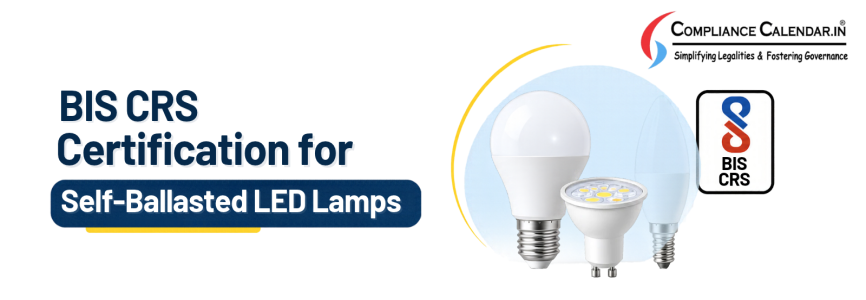



Self-ballasted LED lamps have become a common lighting choice in Indian homes, offices, shops, and commercial buildings because they consume less electricity, provide effective illumination, and are convenient to install. With increasing demand, many manufacturers and importers are introducing different LED bulb models, including warm-white lamps, cool-white lamps, and high-wattage lighting products. However, before selling these products in India, businesses must ensure that they comply with the applicable safety standards prescribed by the Bureau of Indian Standards (BIS). Manufacturing a functional LED bulb or conducting internal quality checks does not replace mandatory BIS registration.
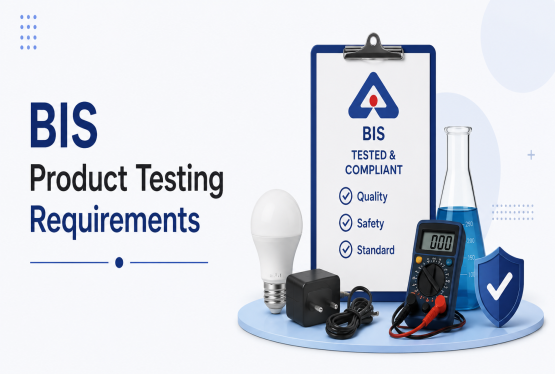
This is where BIS CRS Certification for Self-Ballasted LED Lamps becomes important. The Bureau of Indian Standards regulates these products under the Compulsory Registration Scheme (CRS). Manufacturers must ensure compliance with the applicable Indian Standard, IS 16102 (Part 1), and obtain BIS registration before placing covered products on the Indian market. This requirement has been mandatory since 13 September 2015.
What is BIS CRS Certification for Self-Ballasted LED Lamps?
BIS CRS Certification is a mandatory product registration requirement that helps ensure that covered electrical and electronic products meet prescribed Indian safety standards. A self-ballasted LED lamp is an LED lighting product that incorporates the components necessary for its operation, including the electronic control circuitry, within the lamp assembly. These products are generally designed for connection to a suitable electrical supply without requiring separate external controlgear.
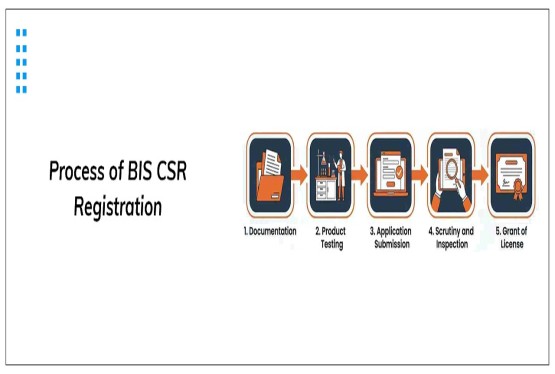
Under the Compulsory Registration Scheme, the manufacturer gets representative samples tested by a BIS-recognised laboratory. After obtaining a satisfactory test report, the manufacturer submits the prescribed application to BIS. Once the application is approved, the manufacturer receives a registration number and can use the prescribed CRS Standard Mark on products covered by the registration.
For example, a manufacturer producing 9W, 12W, and 15W LED bulbs in Noida must ensure that its products meet the relevant safety requirements. Having a GST Certificate, factory registration, or trademark does not eliminate the need for BIS CRS registration.
Is BIS CRS Certification Mandatory for Self-Ballasted LED Lamps?
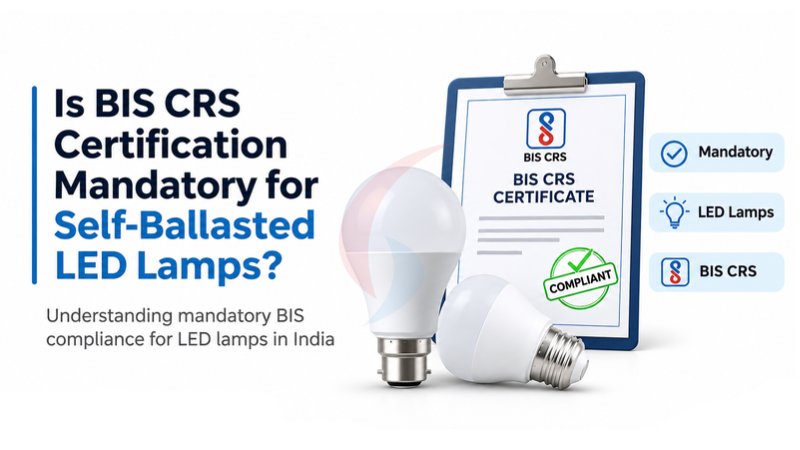
Yes. Self-ballasted LED lamps for general lighting services are included in the compulsory BIS registration list. The requirement applies to covered products manufactured domestically and those supplied by overseas manufacturers to the Indian market.
|
Particulars |
Details |
|---|---|
|
Regulatory authority |
Bureau of Indian Standards |
|
Certification scheme |
Compulsory Registration Scheme |
|
Product category |
Self-Ballasted LED Lamps for General Lighting Services |
|
Previous standard |
IS 16102 (Part 1):2012 |
|
Revised standard |
IS 16102 (Part 1):2026 |
|
Mandatory registration since |
13 September 2015 |
|
Revised standard transition deadline |
2 February 2027 |
|
Official portal |
The revised standard introduces updated safety requirements. Manufacturers holding existing registrations must ensure that their products are brought into conformity with the revised requirements within the prescribed transition period.
Why is BIS Certification Important for Self-Ballasted LED Lamps?
LED lamps may look simple, but they contain electrical drivers, electronic components, insulation materials, and heat-sensitive parts. Poor construction or defective components can increase the risk of overheating, electric shock, or electrical failure. BIS certification helps assess whether these products meet the applicable safety requirements. It is important for manufacturers because it supports lawful market entry, product conformity, and confidence among distributors and customers. For importers, verification of the foreign manufacturer's BIS registration can also help reduce the risk of customs delays and non-compliant stock.
For example, if a company imports thousands of LED lamps without confirming their BIS registration status, the entire consignment may face compliance-related difficulties.
Visit Our Learn Article Manufacturers entering the lighting industry can read our Process to Get BIS Certification for LED Lights guide to understand the requirements for testing, documentation, and registration.
Which Types of Self-Ballasted LED Lamps Require BIS Certification?
The requirement applies to products falling within the notified category of self-ballasted LED lamps for general lighting services.
Common examples may include:
-
Standard LED Bulbs: LED lamps designed for general household and commercial illumination.
-
Warm-White LED Lamps: Bulbs producing warmer-coloured light for residential and hospitality applications.
-
Cool-White LED Lamps: Lamps commonly used in offices, shops, and workspaces.
-
High-Wattage LED Bulbs: Higher-output self-ballasted lamps falling within the scope of the applicable standard.
-
Dimmable LED Lamps: Products with dimming functionality, where covered by the notified category and applicable technical standard.
Manufacturers should not assume that every LED lighting product belongs to the same BIS category. For instance, LED streetlights, floodlights, LED modules, and fixed luminaires may fall under different notified product categories and standards.
Applicable BIS Standard for Self-Ballasted LED Lamps
The applicable standard is IS 16102 (Part 1), which addresses safety requirements for self-ballasted LED lamps used for general lighting services. The earlier edition, IS 16102 (Part 1):2012, has been revised to IS 16102 (Part 1):2026.
The revised edition includes updated safety provisions, including changes relating to fault-condition testing and certain marking requirements. Important testing areas include protection against electric shock, electrical insulation, heat resistance, mechanical construction, resistance to relevant abnormal operating conditions, and prescribed safety markings.
Important Testing Requirements
|
Testing area |
Purpose |
|---|---|
|
Electrical safety |
Protection against electric shock |
|
Insulation resistance |
Evaluates electrical insulation |
|
Temperature and heat resistance |
Checks safety under prescribed thermal conditions |
|
Mechanical strength |
Assesses construction integrity |
|
Fault-condition testing |
Evaluates specified abnormal conditions |
|
Marking requirements |
Verifies prescribed product information and warnings |
For example, an LED bulb may provide proper illumination but still fail a safety test because its insulating components do not meet the prescribed requirements. The manufacturer would need to correct the non-conformity before obtaining a satisfactory test report.
Laws and Legal Provisions Governing BIS CRS Certification
BIS registration for self-ballasted LED lamps is governed by India's compulsory product conformity framework.
Bureau of Indian Standards Act, 2016
Section 16 empowers the Central Government to notify goods requiring compulsory conformity assessment. Section 17 restricts specified activities involving notified goods that do not meet the applicable requirements. Sections 29 and 30 contain provisions relating to offences and penalties.
BIS (Conformity Assessment) Regulations, 2018
Scheme II of Schedule II provides the framework for compulsory registration, including product conformity and registration requirements.
Electronics and Information Technology Goods (Requirement of Compulsory Registration) Order, 2021, as amended
The order governs compulsory registration for notified electrical and electronic products.
Who Can Apply for BIS CRS Certification?
The actual manufacturer is responsible for obtaining BIS CRS registration.
-
Indian Manufacturers: Businesses manufacturing LED lamps within India can apply for registration covering the appropriate factory, product category, brand, and models.
-
Foreign Manufacturers: Overseas companies manufacturing LED lamps for the Indian market can obtain registration. Where required, they must appoint an Authorised Indian Representative (AIR).
-
Importers and Brand Owners: Importers and private-label businesses must ensure that the actual manufacturing facility has the necessary BIS registration covering their products and brand.
For example, if a Delhi-based lighting company imports LED bulbs from a Chinese factory under its own brand name, it should verify that the foreign manufacturer's BIS registration covers that brand and the relevant models.
Visit Our Learn Article Businesses manufacturing outdoor lighting products can explore our BIS CRS Certification for LED Flood Lights guide for product-specific certification information.
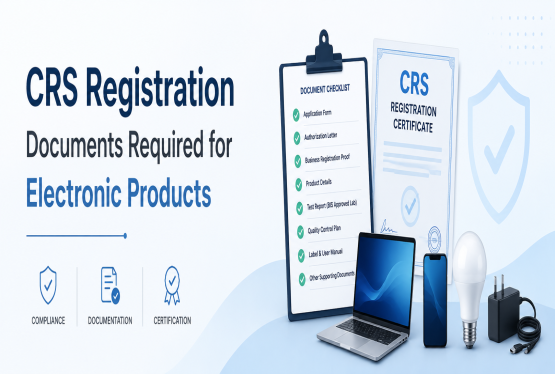
Documents Required for BIS CRS Certification for Self-Ballasted LED Lamps
Manufacturers should prepare their factory documents, product specifications, and testing records before filing the application.
Generally required documents include:
-
Manufacturer's business registration certificate.
-
Factory address and manufacturing facility details.
-
Product specifications, wattage ratings, and model numbers.
-
Brand ownership or authorisation documents.
-
Test report issued by a BIS-recognised laboratory.
-
Product photographs and label details.
-
Authorised signatory identification and authorisation.
-
Applicable declarations and undertakings.
-
AIR nomination documents for foreign manufacturers, where required.
-
Additional technical documents requested by BIS.
The exact checklist depends on the manufacturing arrangement, product category, and current BIS instructions. Manufacturers should ensure that the brand, model numbers, factory address, and product specifications are consistent throughout the application.
Step-by-Step BIS CRS Registration Process for Self-Ballasted LED Lamps
The BIS registration process involves technical testing, documentation, application submission, and regulatory approval.
Step 1: Confirm product classification
Check whether the LED lamp falls under the notified self-ballasted LED lamp category and identify the applicable Indian Standard.
Step 2: Prepare technical documents
Collect factory details, product specifications, brand information, model numbers, and relevant declarations.
Step 3: Arrange laboratory testing
Submit representative product samples to a BIS-recognised laboratory with the required testing scope.
Step 4: Obtain the test report
Ensure that the product meets applicable requirements under the selected permitted edition of IS 16102 (Part 1).
Step 5: Submit the BIS application
Apply through the official BIS CRS portal, upload the prescribed documents and test report, and pay the applicable fees.
Step 6: Respond to BIS queries
BIS examines the application and may seek additional documents, corrections, or technical clarifications.
Step 7: Receive registration
After approval, the manufacturer receives the registration authorisation and may use the prescribed CRS Standard Mark on the products included in its scope.
BIS CRS Certification Fees for Self-Ballasted LED Lamps
The overall cost depends on laboratory testing requirements, registration charges, the number of models, and whether the manufacturing facility is located in India or overseas.
|
Expense |
Details |
|---|---|
|
BIS application fee |
As prescribed under the current fee schedule |
|
Registration and processing fees |
Applicable BIS charges |
|
Laboratory testing |
Depends on the laboratory and testing scope |
|
Model inclusion |
Additional fees may apply |
|
Foreign manufacturer requirements |
AIR-related costs where applicable |
|
Professional assistance |
Based on the services required |
Testing under the revised 2026 standard may also create additional costs for existing manufacturers transitioning from the earlier edition.
Latest BIS CRS Updates for Self-Ballasted LED Lamps in 2026
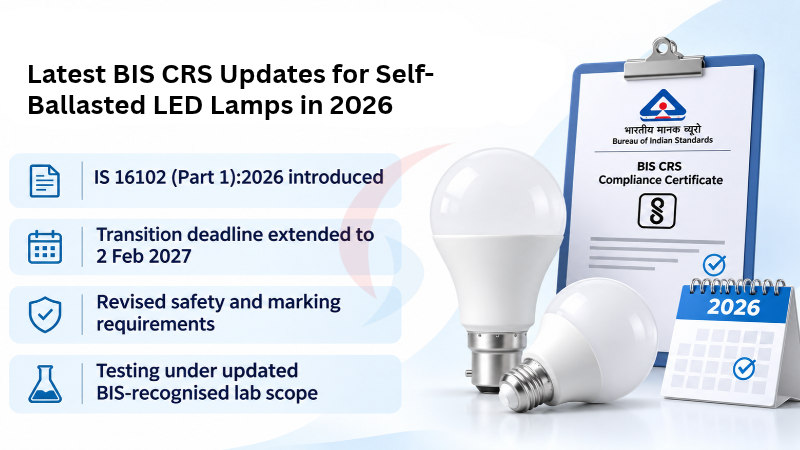
The most important development in 2026 is the revision of the applicable Indian Standard.
1. Introduction of IS 16102 (Part 1):2026
On 24 February 2026, BIS issued guidelines for implementing the revised standard, IS 16102 (Part 1):2026, replacing the 2012 edition. The revised requirements include updated safety testing provisions and additional marking considerations.
2. Implementation Deadline Extended to 2 February 2027
BIS initially specified 2 August 2026 as the last date for implementing the revised standard. Through a circular dated 31 July 2026, published in its August updates, BIS extended the implementation deadline to 2 February 2027.
Existing registered manufacturers must complete the transition by the revised deadline. The February guidelines require relevant test reports for lead models and an undertaking concerning conformity of applicable series models. Manufacturers who do not complete the required transition may face deletion of models from their registration scope or cancellation proceedings.
3. Revised CRS Licence Validity and Renewal Provisions
On 27 May 2026, BIS issued revised provisions relating to registration validity, renewal, and annual fee payment. Manufacturers should review these requirements when maintaining or renewing their registrations rather than relying on older renewal guidance.
4. Product Classification Guidance
BIS also published guidance on CRS product categories on 13 August 2026. This is useful for manufacturers supplying several types of lighting products because different LED lamps, modules, and luminaires may be subject to different product categories.
Visit Our Learn Article Manufacturers can read our BIS Certification for LED Lights article to understand product certification and the requirements for different lighting products.
Penalties for Selling Self-Ballasted LED Lamps Without BIS Registration
Manufacturing, importing, or selling covered self-ballasted LED lamps without meeting applicable compulsory registration requirements can expose businesses to regulatory action. Section 17 of the BIS Act restricts specified activities involving notified products without the required conformity assessment and Standard Mark.
Violations may attract penalties under Section 29, including imprisonment and fines, depending on the nature of the contravention. Non-compliant products may also face seizure, customs restrictions, or interruption of market distribution. Businesses should therefore verify certification before manufacturing covered products for sale, importing them, or supplying them to distributors.
Common Mistakes During BIS CRS Certification
Manufacturers sometimes face avoidable delays because they do not identify the correct product category, submit incomplete factory documentation, or overlook important testing requirements. One common mistake is assuming that all LED lighting products can be included under one BIS registration. Self-ballasted LED lamps, floodlights, streetlights, and other luminaires may have different certification requirements. Another mistake is using outdated test reports or failing to monitor changes in the applicable Indian Standard. In 2026, manufacturers should pay particular attention to the transition from IS 16102 (Part 1):2012 to IS 16102 (Part 1):2026. Maintaining accurate product records, testing documents, and registration details can help businesses avoid unnecessary compliance issues.
Why Choose Compliance Calendar LLP for BIS CRS Certification?
Getting BIS CRS Certification for Self-Ballasted LED Lamps involves identifying the correct Indian Standard, preparing technical documents, arranging laboratory testing, filing the application, and monitoring changes in BIS requirements.
At Compliance Calendar LLP, we understand the practical difficulties manufacturers and importers face while obtaining product certification. You may have developed several LED bulb models but still be unsure which products require testing, whether different wattages can be grouped under one registration, or how to implement the revised 2026 standard.
For professional assistance, explore our Compliance Calendar LLP services or contact us at info@ccoffice.in or +91 9988424211.
Frequently Asked Questions (FAQs)
Q1. Is BIS CRS Certification mandatory for self-ballasted LED lamps?
Ans. Yes. Self-ballasted LED lamps for general lighting services fall under the BIS Compulsory Registration Scheme. Covered products must comply with the applicable Indian Standard and registration requirements before being sold in India.
Q2. Which BIS standard applies to self-ballasted LED lamps?
Ans. IS 16102 (Part 1) is the applicable safety standard. The earlier 2012 edition has been revised to IS 16102 (Part 1):2026, with a transition period extending to 2 February 2027.
Q3. What is the latest BIS amendment for LED lamps in 2026?
Ans. BIS introduced the revised IS 16102 (Part 1):2026 and issued implementation guidelines on 24 February 2026. The implementation deadline was subsequently extended to 2 February 2027.
Q4. Can LED lamps be imported without BIS CRS registration?
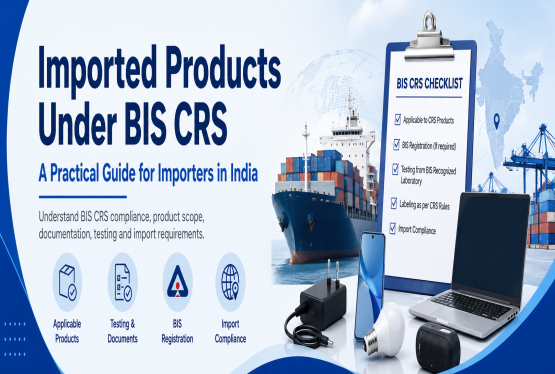
Ans. Covered self-ballasted LED lamps cannot ordinarily be imported for commercial sale without complying with mandatory BIS registration requirements. The importer must verify that the actual manufacturer holds the appropriate registration.
Q5. Who can apply for BIS CRS Certification for LED lamps?
Ans. The actual manufacturer applies for BIS CRS registration. Both Indian and foreign manufacturers are eligible, subject to the prescribed conditions and appointment of an Authorised Indian Representative where required.
Q6. How much does BIS CRS Certification for LED lamps cost?
Ans. The cost depends on government charges, laboratory testing, product models, and professional assistance. Manufacturers should check the latest BIS fee schedule before submitting their applications.
Q7. How long does BIS CRS registration take?
Ans. The timeline depends on product testing, document preparation, BIS scrutiny, and any technical clarifications. Failed testing or incomplete records may extend the process.
Q8. Can one BIS registration cover different LED bulb wattages?
Ans. Yes, eligible models with different wattages may be included under an appropriate registration, subject to the applicable BIS grouping guidelines, brand, factory, and testing requirements.
Q9. Is BIS CRS Certification different from BEE Star Labelling?
Ans. Yes. BIS CRS focuses on conformity with prescribed product standards, including safety requirements. BEE Star Labelling addresses energy-efficiency ratings under a separate regulatory framework. A business may need to comply with both where applicable.
Q10. What happens if an LED lamp fails BIS testing?
Ans. The manufacturer must identify the non-conformity, make necessary technical corrections, and arrange additional testing as required. A satisfactory test report is necessary for BIS registration.
Article last updated on : 13 Nov 2026.