


A manufacturer in Delhi is ready to launch a new range of electric rice cookers. The products have been tested for performance, packaging is complete, and distributors are prepared to place their orders. However, just before the products enter the market, the manufacturer learns that electric rice cookers must meet specific BIS safety requirements. Without the necessary certification, even a well-designed and fully functional product may face restrictions on its sale in India. This raises an important question:
This is where BIS CRS Certification for Electric Rice Cookers becomes essential. The Bureau of Indian Standards (BIS) regulates these appliances under the Compulsory Registration Scheme (CRS) to ensure that they meet prescribed electrical safety requirements. Manufacturers must get their products tested according to IS 302 (Part 2/Sec 15): 2009 and obtain BIS Registration before selling covered electric rice cookers in India. This requirement applies to both domestic and foreign manufacturers and has been mandatory since 1 April 2021. Understanding the certification process, required documents, testing standards, and compliance obligations can help businesses launch their products without unnecessary legal or regulatory difficulties.
What is BIS CRS Certification for Electric Rice Cookers?
BIS CRS Certification is a mandatory product registration requirement for electric rice cookers sold in India. Under this system, manufacturers submit their products to a BIS-recognised laboratory for safety testing. Once the product meets the applicable Indian Standard and the registration application is approved, BIS grants a registration number permitting the manufacturer to use the prescribed Standard Mark. Unlike the traditional ISI certification route, CRS primarily operates through product testing and the manufacturer's declaration of conformity, subject to BIS verification and ongoing compliance. It is administered under Scheme II of Schedule II of the BIS (Conformity Assessment) Regulations, 2018.
For example, if a company manufactures electric rice cookers in Noida and intends to distribute them across India, the manufacturer must obtain the applicable BIS registration before placing those products on the market. Similarly, an Indian importer sourcing rice cookers from China must ensure that the overseas manufacturing unit holds the required BIS registration covering the relevant product and brand.
Why is BIS Certification Mandatory for Electric Rice Cookers?
Electric rice cookers use electrical heating elements to cook food. Because these appliances involve electricity, heat, and moisture, improper design or poor manufacturing can create safety risks, including electric shock, overheating, insulation failure, and fire hazards. BIS certification helps establish that covered appliances have been evaluated against specified safety requirements. It also gives regulators, distributors, and customers a way to identify products associated with a registered manufacturer. For businesses, BIS compliance is more than a certificate. It supports lawful market entry, reduces the risk of non-compliant stock, and helps build confidence among distributors and customers.
Manufacturers can explore our BIS CRS Registration for Microwave Ovens guide to understand safety testing and certification requirements for kitchen appliances.
Which Electric Rice Cookers Require BIS Certification?
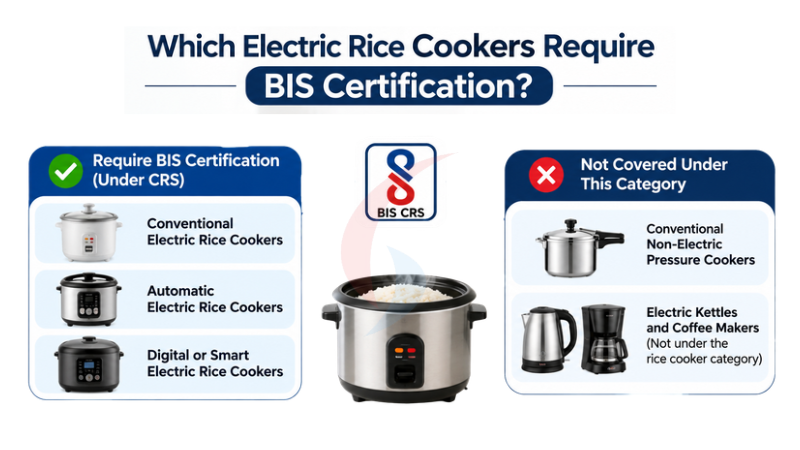
The compulsory registration requirement applies to products falling within the notified electric rice cooker category. The Ministry of Electronics and Information Technology (MeitY) has specifically clarified that electric rice cookers are covered, whereas electric kettles and coffee makers are not included merely because they also heat liquids.
|
Product category |
BIS CRS applicability |
|---|---|
|
Conventional electric rice cookers |
Mandatory |
|
Automatic electric rice cookers |
Mandatory |
|
Digital or smart electric rice cookers |
Mandatory when classified as electric rice cookers |
|
Multifunction electric rice cookers |
Depends on product classification and functions |
|
Conventional non-electric pressure cookers |
Not covered under the electric rice cooker CRS category |
|
Electric kettles and coffee makers |
Not covered under the rice cooker category; separate requirements may apply |
A manufacturer should examine the product's intended use, operating principle, technical specifications, and applicable notifications before deciding its classification.
Businesses importing electronic appliances can read our BIS Certification for Power Adapters article to understand product testing, registration and manufacturer responsibilities.
Applicable Indian Standard for Electric Rice Cookers
The applicable standard listed under BIS CRS is IS 302 (Part 2/Sec 15): 2009, concerning safety requirements for household and similar electrical appliances used for heating liquids. This standard addresses electrical and thermal safety considerations relevant to the design and operation of the appliance. The testing laboratory evaluates the product against applicable clauses to determine whether it meets prescribed requirements.
Important testing areas may include:
-
Protection against electric shock and accessible live parts.
-
Heating performance and temperature rise.
-
Insulation resistance and electric strength.
-
Moisture resistance and leakage current.
-
Abnormal operation and overheating protection.
-
Mechanical construction, wiring, and component safety.
-
Required markings and safety instructions.
For example, if the external body of a rice cooker becomes excessively hot during normal operation, or its electrical insulation fails during testing, the manufacturer may need to modify the design before obtaining a satisfactory test report.
Laws and Legal Provisions Governing BIS CRS Certification
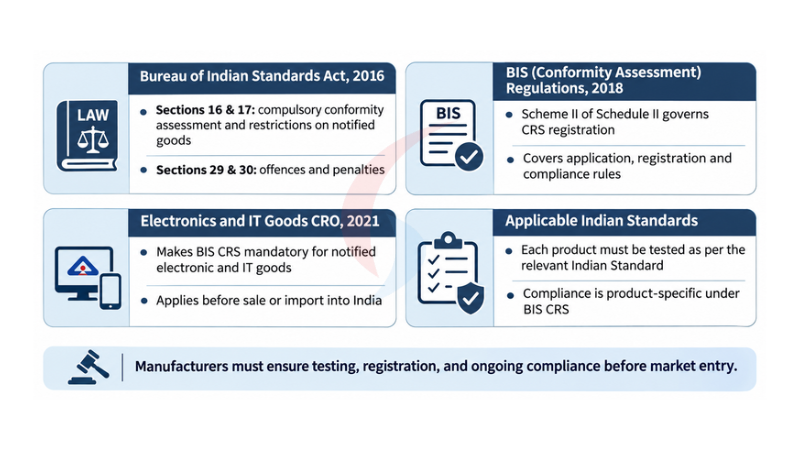
BIS registration for electric rice cookers operates within India's product safety and compulsory certification.
|
Law or regulation |
Important provisions |
Relevance |
|---|---|---|
|
Bureau of Indian Standards Act, 2016 |
Sections 16 and 17 |
Mandatory conformity and restrictions concerning specified goods |
|
BIS Act, 2016 |
Sections 29 and 30 |
Offences and penalties for specified violations |
|
BIS (Conformity Assessment) Regulations, 2018 |
Scheme II of Schedule II |
Registration and conformity assessment |
|
Electronics and Information Technology Goods (Requirement of Compulsory Registration) Order, 2021, as amended |
Notified product requirements |
Mandatory registration for covered products |
|
IS 302 (Part 2/Sec 15): 2009 |
Product safety requirements |
Applicable testing standard for electric rice cookers |
The original compulsory registration framework began under MeitY's 2012 Order, with subsequent product additions and replacement by the 2021 Order. Electric rice cookers remain listed under mandatory CRS requirements.
Who Can Apply for BIS CRS Registration?
The manufacturer operating the factory is responsible for obtaining BIS CRS registration. Applications may be submitted by manufacturers located in India or overseas. An Indian brand that purchases finished rice cookers from another factory cannot ordinarily obtain the manufacturer's registration simply by acting as a seller. The actual manufacturing unit must be appropriately registered, with the applicable brand and models covered.
For overseas manufacturers without an Indian liaison or branch office, an Authorised Indian Representative (AIR) must be appointed according to BIS requirements. Separate registration requirements also apply where products are manufactured at different factory locations or under different brands.
For a better understanding of certification requirements for electronic products, refer to our BIS Certification for Webcams
Documents Required for BIS CRS Certification of Electric Rice Cookers
Before beginning the application, manufacturers should prepare their company, factory, product, and testing documents. Complete and consistent information can help avoid unnecessary objections.
Commonly required documents include:
-
Manufacturing unit registration and valid factory address proof.
-
Manufacturer's legal identity and business details.
-
Product description, technical specifications, and model numbers.
-
Brand ownership documents or applicable brand authorisation.
-
Valid test report issued by a BIS-recognised laboratory.
-
Applicable declarations and undertakings.
-
Details of the authorised signatory.
-
AIR nomination documents for eligible foreign manufacturers.
-
Product labels and marking details.
-
Additional documents requested through the BIS portal.
BIS may require different supporting documents depending on the factory location, applicant category, product configuration, and application type.
Step-by-Step BIS CRS Registration Process for Electric Rice Cookers
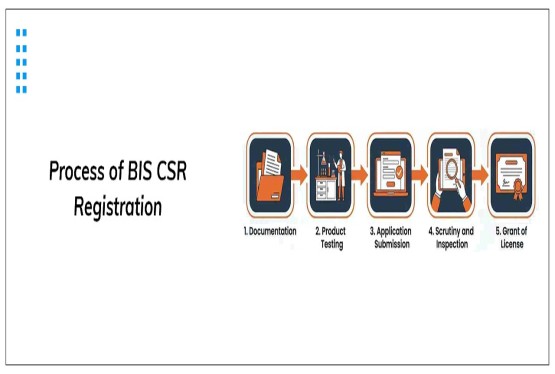
Manufacturers can apply through the official BIS CRS portal. The process involves product testing, preparation of documents, submission of the application, and approval by BIS.
Step 1: Identify the applicable standard
Confirm that the product falls under the electric rice cooker category and identify the applicable Indian Standard, IS 302 (Part 2/Sec 15): 2009.
Step 2: Prepare the product for testing
Check the appliance's electrical design, heating elements, insulation, wiring, and safety instructions before submitting samples.
Step 3: Get the product tested
Submit representative samples to a BIS-recognised laboratory and obtain a satisfactory test report.
Step 4: Register on the BIS portal
Create the manufacturer's profile and provide the factory details, product information, brand details, and authorised signatory information.
Step 5: Submit the application
Upload the required documents and test report, complete the prescribed application, and pay the applicable fees. BIS guidance states that the test report should not be more than 90 days old when the application is submitted.
Step 6: BIS reviews the application
BIS examines the submitted information and may request clarifications, corrections, or additional documents.
Step 7: Receive BIS registration
Once approved, the manufacturer receives registration authorisation with a unique registration number. The prescribed CRS Standard Mark can then be used on products covered by that registration.
BIS CRS Certification Fees for Electric Rice Cookers
The overall cost depends on testing charges, government fees, the number of models, and whether the manufacturer requires technical or professional assistance.
|
Expense |
Fee details |
|---|---|
|
BIS application fee |
As per current BIS fee schedule |
|
Processing and registration fees |
Applicable BIS-prescribed charges |
|
Laboratory testing |
Depends on laboratory and testing scope |
|
Additional model inclusion |
Additional charges may apply |
|
Professional assistance |
Depends on the scope of services |
BIS previously published a fee schedule showing Rs 28,000 plus applicable taxes for a new registration involving one test report, excluding laboratory testing. However, this older schedule should not be treated as the final fee quotation for November 2026 because BIS subsequently issued revised CRS fee and renewal-related provisions. Manufacturers should verify the payable government fee through the current portal before submitting payment.
Manufacturers supplying electrical lighting equipment can explore our BIS CRS Certification for LED Flood Lights guide for product testing and registration information.
Latest BIS CRS Updates for Electric Rice Cookers in 2026
As of November 2026, electric rice cookers remain listed under BIS CRS with IS 302-2-15: 2009 as the applicable product standard.
BIS has also issued several broader CRS updates during 2026 that manufacturers should review:
-
27 May 2026: Revised provisions concerning CRS licence validity, renewal, and annual fee payment.
-
13 August 2026: Guidance relating to product categories covered under CRS.
-
10 March 2026: Amendments to the Electronics and Information Technology Goods (Requirements for Compulsory Registration) Order, 2021, referenced in the BIS product schedule.
These developments should be checked when applying for a new licence, updating product coverage, or maintaining an existing registration. The 2026 renewal circular is particularly important because older BIS guidance describes a two-year registration and renewal cycle, which should not automatically be relied upon without reviewing the revised provisions.
BIS CRS Compliance Requirements After Registration
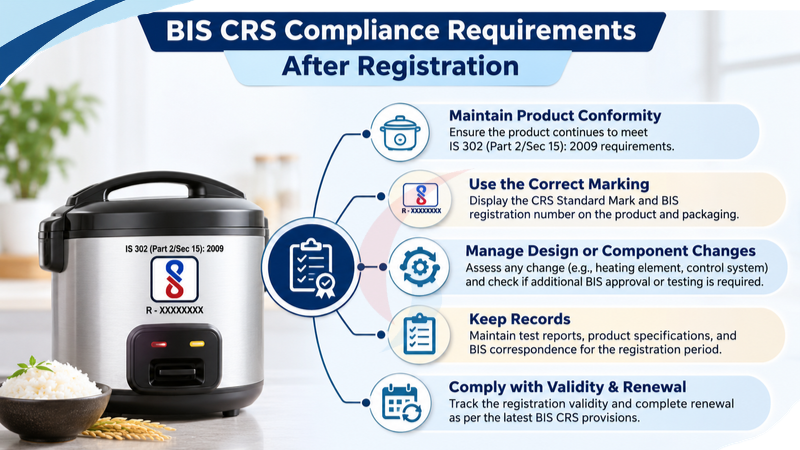
Obtaining registration is only the first part of the manufacturer's responsibility. Products manufactured and marketed under the registration must continue to comply with the applicable safety requirements. Manufacturers should ensure that the approved product configuration is maintained, the correct registration marking is used, and changes in product design or manufacturing details are assessed for their effect on certification.
For example, suppose a registered manufacturer changes the heating element supplier or modifies the electrical control system. The manufacturer should assess whether the change affects conformity or requires additional testing or BIS approval. Records of testing, product specifications, and registration correspondence should also be maintained for compliance purposes.
Penalties for Selling Electric Rice Cookers Without BIS Certification
Selling or importing covered electric rice cookers without mandatory compliance can expose businesses to regulatory action. Under Section 17 of the BIS Act, 2016, certain activities involving notified products without the prescribed Standard Mark and valid authorisation are prohibited.
Section 29(3) provides penalties for contravention of Section 17, including imprisonment of up to two years, fines starting at Rs 2 lakh for a first contravention and Rs 5 lakh for subsequent contraventions, subject to the statutory provisions and applicable limits. Non-compliance may also result in product seizure, supply disruptions, marketplace restrictions, and reputational damage.
Common Mistakes During BIS CRS Registration
Some manufacturers experience avoidable delays because they begin the process without checking the technical and documentation requirements. Common mistakes include using test reports from laboratories not recognised for the required scope, submitting outdated reports, providing inconsistent factory details, selecting the wrong product category, and assuming that one manufacturer's registration covers another manufacturing location. Another frequent misunderstanding involves importers and private-label sellers. A brand owner may have a strong distribution network, but that does not automatically mean it qualifies as the manufacturer for CRS purposes. Checking these matters before starting the registration process can reduce unnecessary costs and delays.
For related regulatory guides, explore BIS CRS Certification for Solar PV Modules covering product approvals, statutory registrations, and manufacturing compliance in India.
Why Choose Compliance Calendar LLP for BIS CRS Certification?
Imagine you are preparing to introduce a new electric rice cooker brand, but you are unsure whether your products need separate testing, which factory documents are required, or how to proceed with a foreign manufacturer. These questions can become difficult when your launch date is approaching and distributors are expecting stock.
At Compliance Calendar LLP, we focus on making the compliance process easier to understand and manage. Rather than simply providing a list of documents, our approach begins with understanding your product, manufacturing arrangement, brand, and intended Indian market. Our team can assist with product-category assessment, document preparation, coordination for BIS-recognised laboratory testing, application filing, and responses to registration-related queries. We also help businesses understand model inclusion, marking requirements, and ongoing compliance obligations.
For professional assistance, explore our BIS Registration Services or contact Compliance Calendar LLP at +91 9988424211 or info@ccoffice.in.
Frequently Asked Questions (FAQs)
Q1. Is BIS CRS Certification mandatory for electric rice cookers in India?
Ans. Yes. Electric rice cookers are covered under the BIS Compulsory Registration Scheme. Manufacturers must obtain the applicable registration for covered products before marketing them in India.
Q2. What is the applicable BIS standard for electric rice cookers?
Ans. The applicable standard listed by BIS is IS 302 (Part 2/Sec 15): 2009. It addresses safety requirements for household and similar electrical appliances used for heating liquids.
Q3. Can electric rice cookers be imported without BIS registration?
Ans. Covered electric rice cookers cannot ordinarily be imported for sale in India without complying with the mandatory BIS CRS requirements. The overseas manufacturer must hold the appropriate registration covering the product.
Q4. Can a foreign manufacturer apply for BIS CRS Certification?
Ans. Yes. Overseas manufacturers can apply for BIS CRS registration. Those without an eligible Indian office must appoint an Authorised Indian Representative according to BIS requirements.
Q5. How much does BIS CRS Certification cost for electric rice cookers?
Ans. The cost includes government fees, laboratory testing charges, and any professional service fees. The final amount depends on the applicable fee schedule, testing requirements, and product models.
Q6. How long does BIS CRS registration take?
Ans. The timeline depends on laboratory testing, document readiness, application accuracy, and BIS examination. Manufacturers should allow sufficient time for possible technical corrections or additional queries.
Q7. Is BIS CRS registration different from ISI Certification?
Ans. Yes. BIS CRS operates under Scheme II and uses the prescribed registration marking system. Traditional ISI Certification generally operates under Scheme I and follows a different conformity assessment procedure.
Q8. Can one BIS registration cover multiple electric rice cooker models?
Ans. Multiple models may be covered within the applicable registration scope, subject to BIS grouping, testing, and inclusion requirements. Manufacturers should verify whether additional test reports or approvals are necessary.
Q9. Is BIS Certification required for electric kettles and coffee makers?
Ans. Electric kettles and coffee makers are not automatically covered under the notified rice cooker product category. Their independent classification and applicable certification requirements must be assessed separately.
Q10. What happens if an electric rice cooker fails BIS testing?
Ans. The manufacturer should examine the reasons for failure, correct the product's design or manufacturing issues, and arrange further testing as necessary. A satisfactory test report is required for registration.
Article last updated on : 13 Nov 2026.