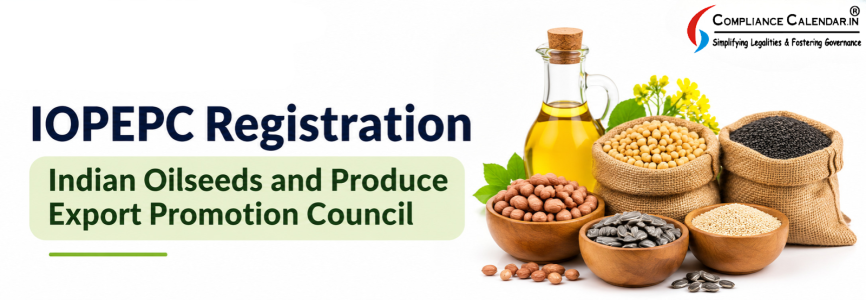



India's agricultural export industry is not limited to rice, wheat, tea, and spices. Oilseeds and edible oils also connect Indian farmers, processors, traders, and manufacturers with international markets. Products such as sesame seeds, groundnut oil, mustard seeds, and other eligible oilseed commodities are traded with overseas buyers, creating opportunities for both established exporters and new businesses.
A small sesame seed processor in Gujarat receiving its first export enquiry from a European buyer. The company has sufficient stock, a competitive price, and an experienced logistics provider. However, before finalising the shipment, the buyer requests quality test reports and information about the exporter's regulatory status. The company then discovers that the product may require specific testing, documentation, and registration procedures.
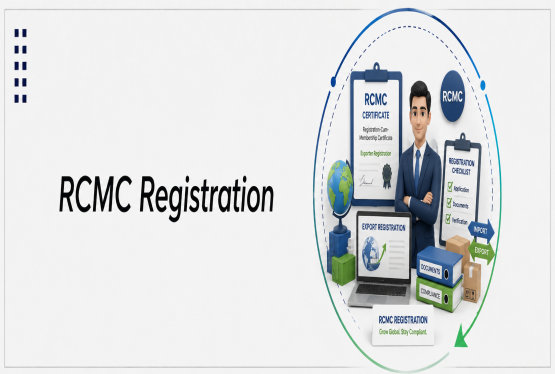
IOPEPC provides membership and Registration-cum-Membership Certificates (RCMC Registration) for eligible products under its jurisdiction. It also supports exporters through trade information, industry representation, export promotion activities, and product-specific guidance.
What is IOPEPC Registration?
IOPEPC Registration is the process through which an eligible exporter obtains membership of the Indian Oilseeds and Produce Export Promotion Council. The council issues Registration-cum-Membership Certificates for commodities falling within its jurisdiction under India's Foreign Trade Policy.
The RCMC establishes that the business is registered with the appropriate Export Promotion Council. It is relevant when exporters apply for specified authorisations, benefits, or concessions for which RCMC is prescribed.
For example, a business exporting sesame seeds may seek IOPEPC membership to meet applicable Foreign Trade Policy requirements and access information about international trade opportunities.
Exporters who are unfamiliar with the broader registration system can first explore the RCMC Registration Online in India to understand how Export Promotion Councils issue certificates through the DGFT portal.
What is the Indian Oilseeds and Produce Export Promotion Council?
The Indian Oilseeds and Produce Export Promotion Council is an organisation concerned with promoting India's exports of eligible oilseeds, edible oils, and related commodities.
The organisation originated in 1956 and was formerly known as the Indian Oilseeds and Produce Exporters' Association (IOPEA). It subsequently developed into the present council representing businesses involved in the oilseed and oil export industry.
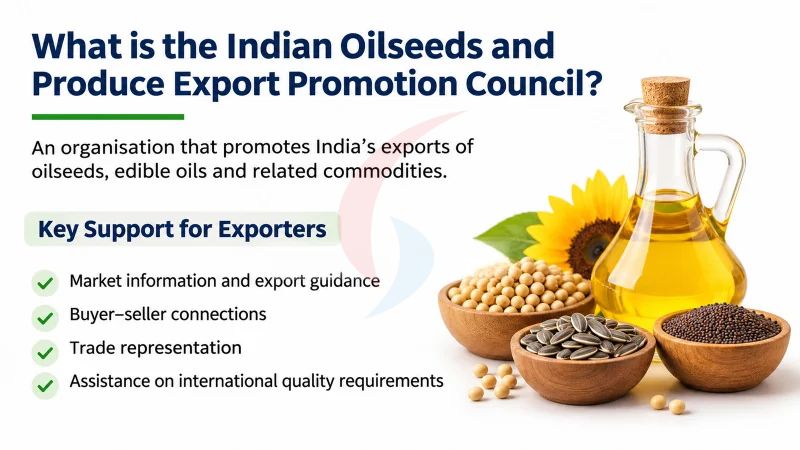
IOPEPC supports exporters through market information, buyer-seller connections, trade representation, and communication concerning international quality requirements.
The council also provides guidance relating to exports of certain commodities to markets such as the European Union, the United States, and China.
Nevertheless, IOPEPC is not the same as DGFT, Indian Customs, FSSAI , or the importing country's food safety authority. Each regulator performs a separate legal function.
Is IOPEPC Registration Mandatory for Every Oilseed Exporter?
IOPEPC Registration is not an unconditional legal requirement for every oilseed export shipment. Under the Foreign Trade Policy, RCMC is required for specified authorisations, benefits, and concessions unless an exemption applies.
The legal position therefore depends on the product, transaction, and relevant scheme:
|
Export Situation |
IOPEPC RCMC Requirement |
|
Exporting Goods Without Claiming an RCMC-Linked Benefit |
Not necessarily required, unless another applicable condition mandates it |
|
Claiming Specified Export Benefits |
Required where the scheme or authorisation expressly prescribes RCMC |
|
Export Consignment Up to Rs 3 Lakh |
May qualify for the September 2026 exemption under the Foreign Trade Policy |
|
Applying for Certain DGFT Authorisations |
Required where the particular authorisation specifies valid RCMC |
|
Food Safety or Customs Compliance |
Separate legal requirements continue to apply regardless of RCMC status |
Exporters should also verify the product's export policy classification because RCMC does not override export restrictions or prohibitions.
Laws and Legal Provisions Governing IOPEPC Registration
IOPEPC Registration operates under India's foreign trade laws, supported by customs, food safety, taxation, and foreign exchange regulations.
Foreign Trade (Development and Regulation) Act, 1992
The Foreign Trade (Development and Regulation) Act, 1992 provides the primary statutory basis for regulating imports and exports from India.
Section 3 empowers the Central Government to make provisions concerning the development and regulation of foreign trade, including restrictions on particular goods. Section 5 authorises the Central Government to formulate and amend the Foreign Trade Policy.
Section 7 deals with Import Export Code requirements. An exporter generally needs an active IEC to undertake commercial export activities, unless a specified exemption applies.
Foreign Trade Policy, 2023
The Foreign Trade Policy, 2023, as amended, regulates RCMC requirements and recognises Export Promotion Councils as important export promotion institutions.
Paragraph 2.56 addresses the recognition and functioning of Export Promotion Councils as registering authorities. Paragraph 2.57 specifies when an exporter needs an RCMC or Certificate of Registration for prescribed authorisations, benefits, or concessions.
Handbook of Procedures, 2023
The DGFT Handbook of Procedures explains how exporters obtain and maintain RCMC. Paragraph 2.77 deals with registering authorities, while Paragraph 2.79 addresses the procedure for obtaining RCMC. Paragraph 2.80 concerns the exporter's main line of business and the appropriate registering authority.
Paragraph 2.81 provides the general RCMC validity period. Paragraph 2.82 deals with changes in business particulars, while Paragraphs 2.83 and 2.84 address de-registration and appeals. These provisions are important because exporters must select the correct council and maintain accurate membership information.
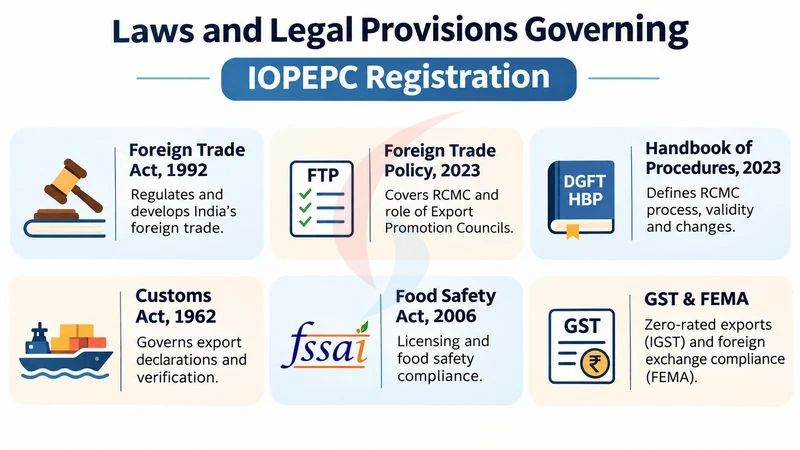
Customs Act, 1962
Exporters of oilseeds and edible oils must comply with customs law. Section 50 of the Customs Act, 1962 governs the filing of export declarations through the prescribed Shipping Bill or Bill of Export.
Section 17 deals with self-assessment of duty, where applicable. Customs authorities may verify the description, classification, quantity, value, export restrictions, and supporting documents relating to goods.
Food Safety and Standards Act, 2006
Many oilseed and edible oil products are intended for human consumption. Businesses dealing with these products must consider the Food Safety and Standards Act, 2006. Section 31 establishes the licensing and registration requirements for food businesses.
Exporters engaged in regulated food business activities must obtain the appropriate FSSAI authorisation and comply with applicable hygiene, processing, storage, and quality requirements.
Food exporters can also refer to FSSAI License for Exporters to understand licensing requirements and documentation.
GST and FEMA Requirements
Oilseed exporters must also consider the Integrated Goods and Services Tax Act, 2017 and the Foreign Exchange Management Act, 1999. Section 16 of the IGST Act provides for zero-rated supplies, including qualifying exports, subject to applicable conditions and procedures.
Which Products Are Covered Under IOPEPC?
IOPEPC's activities relate to specified oilseeds, oils, and related agricultural commodities. Applicants should verify whether their main export product falls within the council's current DGFT jurisdiction.
|
Product Category |
Examples |
|
Sesame Seeds |
Natural sesame seeds, hulled sesame seeds, black sesame seeds, and other eligible varieties |
|
Groundnut Products |
Eligible groundnut oil and related products falling under IOPEPC jurisdiction |
|
Mustard and Rapeseed |
Mustard seeds, rapeseed, and eligible mustard or rapeseed oils |
|
Sunflower Products |
Sunflower seeds and sunflower oil, where covered by the council |
|
Safflower Products |
Safflower seeds and safflower oil |
|
Other Eligible Oilseeds |
Niger seeds and other commodities specifically covered by IOPEPC |
Certain products may fall under APEDA, SHEFEXIL, or another Export Promotion Council or Commodity Board. For example, groundnuts and groundnut products may involve APEDA-specific requirements, while certain oil-related products have separate council allocations.
Benefits of IOPEPC Registration for Exporters
IOPEPC membership offers advantages beyond issuance of the RCMC certificate.
Access to Export Promotion Activities
IOPEPC facilitates trade promotion initiatives that can help Indian exporters connect with buyers and understand international business opportunities.
For example, a sesame seed exporter looking to expand beyond an existing market may benefit from industry information and buyer-related programmes supported by the council. Participation in specific events remains subject to their applicable terms and fees.
Industry Representation
The council represents concerns affecting the oilseed and oil export industry before relevant authorities. Issues concerning trade barriers, product testing, export procedures, and market access may be raised through industry representations. This is particularly useful when regulatory changes affect multiple exporters within the same product category.
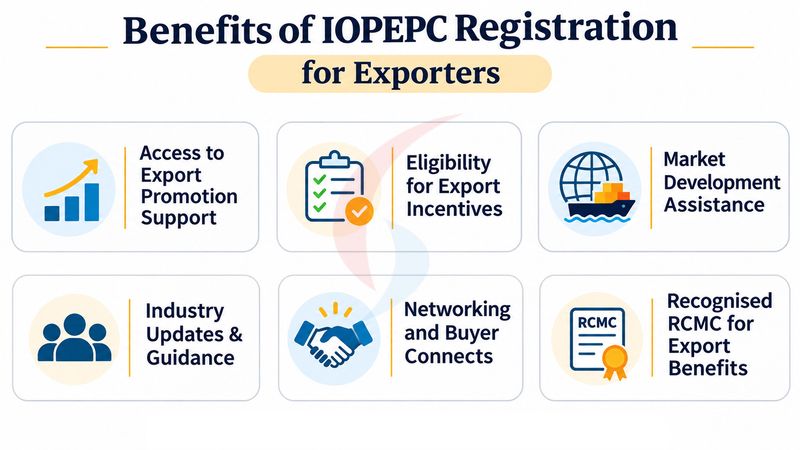
Market Information and Trade Updates
International agricultural markets are influenced by food safety regulations, customer preferences, production conditions, and government trade policies. IOPEPC provides information that may help exporters monitor relevant developments and adapt their commercial plans.
Export Documentation Support
The council offers services concerning certificates of origin and product-specific export procedures. Exporters may use these services where the relevant transaction requires them, subject to the council's conditions.
Support for Applicable Trade Benefits
An IOPEPC RCMC can help exporters satisfy membership-related conditions when applying for prescribed Foreign Trade Policy authorisations or concessions. However, IOPEPC membership does not automatically guarantee a subsidy, duty exemption, financial benefit, or approval.
Documents Required for IOPEPC Registration
The documents required for IOPEPC Registration depend on whether the applicant operates as a proprietorship, partnership, company, trust, cooperative society, or manufacturer exporter.
The council lists PAN and an original bank certificate among its general application requirements:
|
Document |
Purpose |
|
Establishes the applicant's IEC details for export activities |
|
|
PAN Card |
Confirms the applicant's tax identification |
|
Original Bank Certificate |
Provides the financial or banking confirmation required by IOPEPC |
|
Business Constitution Documents |
Certificate of Incorporation, MOA, AOA, Partnership Deed, Trust Deed, or relevant bylaws |
|
Directors or Partners Details |
Identifies persons managing or representing the business |
|
Board Resolution or Authorisation |
Confirms authority to apply and sign on behalf of the entity |
|
Manufacturing Evidence |
DIC, SSI, or other acceptable certification, where manufacturer-exporter status is claimed |
|
Export Performance Certificate |
Supports Ordinary Membership eligibility where applicable |
|
Membership Application and Payment Details |
Records the membership request and applicable subscription payment |
Applicants should ensure that their name, address, IEC, PAN, and bank details are consistent.
For example, if a partnership firm changes its business name but continues using outdated DGFT records, it should correct the discrepancy before applying.
IOPEPC Registration Process Online in 2026
IOPEPC provides membership application facilities through its official website. Electronic RCMC issuance, renewal, and amendment are processed through the DGFT common e-RCMC platform.
The applicant should follow the current instructions issued by both organisations:
|
Step |
IOPEPC Registration Process |
|
Step 1: Obtain IEC |
Ensure the business has an active IEC issued by DGFT |
|
Step 2: Check Product Eligibility |
Verify whether the proposed export commodity falls under IOPEPC jurisdiction |
|
Step 3: Select Membership Category |
Choose Associate, B Ordinary, or A Ordinary Membership as applicable |
|
Step 4: Complete Membership Application |
Enter business details, export activity, IEC, authorised-person information, and membership particulars |
|
Step 5: Prepare Documents |
Submit PAN, bank certificate, business constitution documents, and category-specific records |
|
Step 6: Pay Membership Fees |
Pay the applicable entrance fee, annual subscription, and GST |
|
Step 7: Apply Through DGFT e-RCMC |
Select IOPEPC as the registering authority and complete the electronic application |
|
Step 8: Obtain the Certificate |
Respond to verification queries and download the approved RCMC |
Applicants can access the official IOPEPC website and the DGFT e-RCMC portal.
Businesses that have not yet obtained IEC can also understand the procedure for obtaining an Import Export Code before proceeding with IOPEPC membership.
Practical Example: A Sesame Exporter in Gujarat
Suppose an agricultural trading company in Rajkot receives an export enquiry for 20 tonnes of sesame seeds. The company has a valid IEC but has never applied for an Export Promotion Council membership.
Before selecting a registering authority, its compliance manager checks the product classification and confirms whether IOPEPC is the appropriate council.
The manager then prepares the business documents, bank certificate, and membership application, and completes the required e-RCMC formalities.
IOPEPC Registration Fees in India for 2026–27
IOPEPC publishes a membership fee structure covering admission charges, annual subscriptions, and GST. The following amounts are displayed on its official membership page as checked in November 2026.
|
Membership Category |
Entrance Fee |
Annual Subscription |
Total Including 18% GST |
|
Associate Member |
Rs 17,500 |
Rs 10,000 |
Rs 32,450 |
|
Ordinary Member |
Rs 25,000 |
Rs 15,000 |
Rs 47,200 |
The entrance fee is a one-time charge included in the new membership calculation.
IOPEPC Annual Membership Renewal Fees
|
Membership Category |
Annual Subscription |
GST at 18% |
Total Renewal Fee |
|
Associate Member |
Rs 10,000 |
Rs 1,800 |
Rs 11,800 |
|
Ordinary Member |
Rs 15,000 |
Rs 2,700 |
Rs 17,700 |
Important: IOPEPC's currently accessible online registration application still displays a fee heading referring to FY 2024–25, while its main membership page displays the same amounts without a clearly updated 2026–27 schedule.
IOPEPC RCMC Validity and Renewal
Under Paragraph 2.81 of the DGFT Handbook of Procedures, RCMC is generally valid for five licensing years beginning on 1 April of the licensing year of issuance, unless otherwise specified.
For example, an RCMC issued during FY 2026–27 would ordinarily remain valid until 31 March 2031, subject to the certificate's terms and applicable council requirements. However, IOPEPC follows an annual membership subscription system.
Its official renewal instructions require members to renew their subscriptions before 30 April of the current financial year.
The council also states that non-renewal of membership results in automatic cancellation of RCMC. Businesses should therefore not assume that a longer validity period printed on their certificate removes the requirement to maintain annual membership. Existing exporters should regularly review their subscription status, IEC details, and RCMC information.
Latest IOPEPC and Export Compliance Updates in 2026
Several regulatory developments in 2026 have affected RCMC requirements and export procedures for oilseed exporters. The important updates are summarised below.
|
Latest Update |
Details |
|---|---|
|
RCMC Exemption – September 2026 |
DGFT Notification No. 36/2026-27, dated 15 September 2026, amended Paragraph 2.57 of FTP 2023, exempting qualifying export consignments with an FOB value up to Rs 3 lakh from the specified RCMC requirement. |
|
Relief for Small Exporters |
The exemption reduces registration-related compliance requirements for eligible small businesses, first-time exporters, and businesses using postal or courier export channels. Other applicable export regulations still apply. |
|
DGFT e-RCMC System |
DGFT's common electronic RCMC platform continues to be used in 2026 for new registrations, amendments, and renewals. Applicants must follow the applicable IOPEPC membership procedures. |
|
Product-Specific Export Requirements |
Oilseed exporters must comply with applicable product testing, food safety, documentation, and traceability requirements for markets such as the EU, USA, and China. |
|
IOPEPC Membership Fees |
No separately verified IOPEPC-specific fee revision for November 2026 was identified. Applicants should confirm the latest membership charges through the official IOPEPC portal before payment. |
Example: A sesame seed exporter shipping a qualifying consignment worth Rs 2.5 lakh may benefit from the September 2026 RCMC exemption. However, applicable IEC, FSSAI, customs, phytosanitary, and destination-country requirements must still be followed.
Compliance Requirements After IOPEPC Registration
Businesses obtaining IOPEPC membership must continue to comply with the council's requirements and other applicable export laws.
Annual Membership Renewal
Members must renew their subscriptions within the period prescribed by IOPEPC. Failure to maintain membership can affect the status of their RCMC.
Quarterly Export Returns
IOPEPC provides a system for submitting quarterly export returns, including NIL returns. Members should maintain accurate export records and submit the required information through the council's prescribed process. Even businesses without exports during a reporting period should review the NIL return requirement.
IEC Updation
Under the Foreign Trade Policy, IEC holders must update or confirm their IEC particulars during the prescribed April–June period each year. Incorrect or outdated IEC records can lead to deactivation until the prescribed updating process is completed.
Businesses can explore IEC Registration and Updation requirements to understand these continuing obligations.
Changes in Business Information
Paragraph 2.82 of the DGFT Handbook of Procedures requires RCMC holders to inform the registering authority about changes in ownership, constitution, name, or address within one month. An exporter converting its partnership into an LLP, for example, should review the corresponding changes to its IEC, council membership, banking records, and tax registrations.
Customs Documentation
Exporters must maintain accurate invoices, packing lists, Shipping Bills, transport documents, and relevant product certificates. The electronic customs process operates through ICEGATE.
Businesses can refer to ICEGATE Registration for Import Export Business to understand customs filing and electronic documentation.
Why Choose Compliance Calendar LLP ?
At Compliance Calendar LLP, we simplify IOPEPC Registration for new and existing oilseed exporters. Our team assists with eligibility assessment, documentation, DGFT e-RCMC applications, membership renewal, and export compliance guidance.
Whether you are a merchant exporter or an established oilseed manufacturer, we provide personalised support to make the registration process easier.
Need help with IOPEPC Registration? Connect with our experts on WhatsApp: +91 9988424211 for professional assistance.
Frequently Asked Questions (FAQs)
Q1. What is IOPEPC Registration in India?
Ans: IOPEPC Registration is the process of obtaining membership from the Indian Oilseeds and Produce Export Promotion Council. Eligible exporters receive a Registration-cum-Membership Certificate (RCMC), which helps satisfy applicable export registration requirements and provides access to council-related trade promotion services.
Q2. Is IOPEPC Registration mandatory for oilseed exporters?
Ans: IOPEPC Registration is required where an applicable Foreign Trade Policy authorisation, benefit, or concession specifically requires RCMC. It is not automatically mandatory for every oilseed export shipment. Exporters should check their product category and applicable DGFT requirements before applying.
Q3. What are the IOPEPC Registration fees in 2026?
Ans: IOPEPC's published new membership fees are Rs 32,450 for Associate Membership and Rs 47,200 for Ordinary Membership, including 18% GST. These amounts include the applicable entrance fee and annual subscription. Applicants should confirm the current charges with IOPEPC before making payment.
Q4. What documents are required for IOPEPC Registration?
Ans: Applicants generally need a valid Import Export Code (IEC), PAN, bank certificate, and applicable business registration documents. Companies and partnerships may need additional constitution and authorisation records. Manufacturer exporters may also be required to provide acceptable proof of manufacturing activities.
Q5. How can I apply for IOPEPC Registration online?
Ans: Exporters can begin the membership application through the official IOPEPC website and complete the required RCMC process on the DGFT portal. They must select the correct membership category, provide business information, submit supporting documents, and pay the applicable fees. Approval is subject to verification.
Q6. What is the validity of IOPEPC RCMC?
Ans: Under the general DGFT rules, IOPEPC RCMC is ordinarily valid for five licensing years, unless otherwise specified. However, exporters must renew their IOPEPC membership annually before 30 April. Failure to renew membership may result in cancellation of the RCMC.
Q7. Can new exporters apply for IOPEPC Registration?
Ans: Yes, new and prospective exporters can apply for IOPEPC Associate Membership if they meet the council's eligibility requirements. They should have the necessary business documents and an IEC for commodities covered by IOPEPC. A substantial export turnover is not required for Associate Membership.
Q8. Is an FSSAI licence required for oilseed exports?
Ans: Businesses exporting oilseeds and edible oils intended for human consumption must comply with applicable FSSAI licensing requirements. Exporters may also need laboratory testing, quality certificates, and other documents depending on the product and destination country. IOPEPC membership does not replace food safety compliance.
Q9. Is IOPEPC RCMC required for exports below Rs 3 lakh in 2026?
Ans: Under DGFT Notification No. 36/2026-27, qualifying export consignments with an FOB value not exceeding Rs 3 lakh are exempt from the specified RCMC requirement. However, exporters must still comply with applicable IEC, customs, food safety, and destination-country regulations.
Q10. Can Compliance Calendar LLP help with IOPEPC Registration?
Ans: Yes, Compliance Calendar LLP provides professional assistance with IOPEPC Registration, documentation, DGFT e-RCMC applications, and membership renewal guidance. Our team helps exporters understand the applicable requirements and complete the registration process
Article last updated on : 13 Nov 2026.