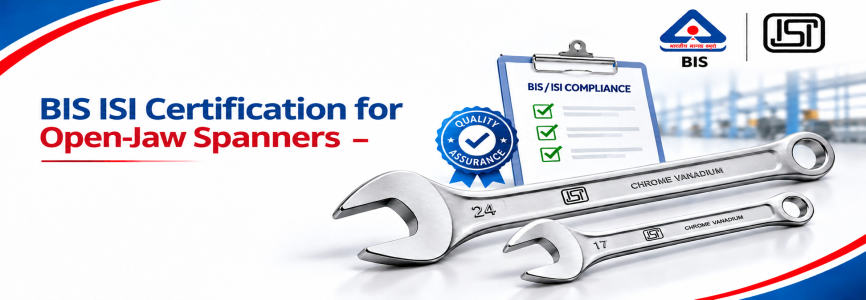



Open-jaw spanners are among the most commonly used hand tools in automobile workshops, manufacturing units, construction sites and mechanical repair centres. Whether a mechanic is repairing a vehicle or a technician is assembling machinery, open-jaw spanners help tighten and loosen nuts and bolts. However, if a spanner is made from poor-quality steel or does not have the correct dimensions, it may slip, bend or break during use.
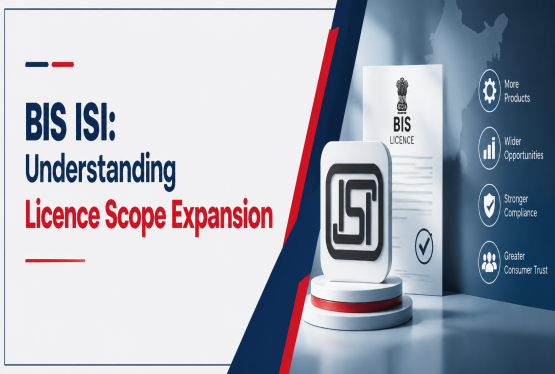
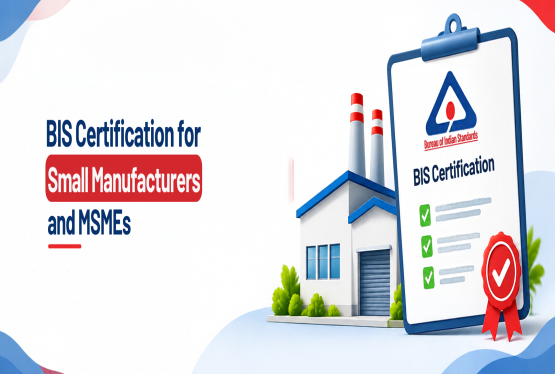
To maintain the quality and safety of these tools, the Bureau of Indian Standards (BIS) has established specific requirements for open-jaw spanners. Earlier, these requirements were covered under IS 2028:2004. The standard has since been revised to IS 2028:2026, which is referenced in the Hand Tools (Quality Control) Order, 2026. Under the latest notification, manufacturers of covered open-jaw spanners must obtain BIS ISI Certification and ensure that their products comply with the applicable Indian Standard from the relevant implementation date.
For a broader understanding, you can also read our BIS ISI Certification for Hand Tools in India – Complete Guide.
What Is BIS ISI Certification for Open-Jaw Spanners?
BIS ISI Certification is a product certification process through which the Bureau of Indian Standards verifies whether a manufacturer's open-jaw spanners meet the applicable Indian quality and performance requirements. An open-jaw spanner is a hand tool with an open-ended jaw designed to grip nuts and bolts. It is widely used in automobile servicing, industrial maintenance, machinery installation and general mechanical work.
For example, imagine a manufacturer named Ravi who produces open-jaw spanners for automobile repair shops. His products may look strong and attractive, but appearance alone cannot establish their quality. The spanners must also meet the prescribed requirements for material, dimensions, hardness and torque performance. BIS certification helps establish that the manufacturer's products conform to the applicable Indian Standard. Once BIS grants the required licence, the manufacturer can use the ISI Mark on products covered by that licence.
What Is IS 2028:2004 for Open-Jaw Spanners?
IS 2028:2004 was the Indian Standard titled Open Jaw Wrenches (Spanners) — Specification. It covered technical requirements for forged open-jaw spanners, including their dimensions, material, hardness, workmanship and torque performance.
The standard covered different types of open-jaw spanners used in mechanical and industrial applications.
|
Type of Open-Jaw Spanner |
Common Application |
|---|---|
|
Single-Ended Open-Jaw Spanners |
General mechanical and maintenance work |
|
Double-Ended Open-Jaw Spanners |
Automobile repairs and workshop activities |
|
General-Purpose Open-Jaw Spanners |
Industrial and everyday mechanical applications |
|
Engineers' Double-Headed Spanners |
Engineering and equipment maintenance |
IS 2028:2004 referred to IS 6131 for several requirements, including hardness, workmanship and torque testing. It also specified relevant steel material requirements through IS 3748.
Important Update: IS 2028:2004 has been revised to IS 2028:2026. Manufacturers applying for certification should obtain and follow the current edition rather than relying only on the older requirements.
Is BIS ISI Certification Mandatory for Open-Jaw Spanners in India?
Yes. Open-jaw spanners are covered under the Hand Tools (Quality Control) Order, 2026, issued by the Department for Promotion of Industry and Internal Trade (DPIIT) on 9 October 2026. The order requires covered hand tools to conform to the relevant Indian Standards and bear the BIS Standard Mark under a valid licence from the applicable implementation dates.
BIS Certification Mandatory Dates for Open-Jaw Spanners
|
Business Category |
Implementation Date |
|---|---|
|
General Enterprises |
1 April 2027 |
|
Small Enterprises |
1 July 2027 |
|
Micro Enterprises |
1 October 2027 |
These deadlines allow manufacturers additional time to prepare their production processes, testing facilities and certification applications. The order also provides specified exemptions, including for domestically manufactured goods intended for export and limited imports for research and development under prescribed conditions. Manufacturers should therefore check their enterprise category and product coverage before determining the applicable certification deadline.
Who Needs BIS ISI Certification for Open-Jaw Spanners?
BIS certification is primarily relevant to manufacturers producing open-jaw spanners covered under the applicable Indian Standard.
The following businesses should examine their certification requirements:
|
Business Category |
Certification Requirement |
|---|---|
|
Indian Manufacturers |
Must obtain BIS certification for covered products within the applicable deadline. |
|
Foreign Manufacturers |
Must follow the applicable BIS certification procedure for covered products supplied to India. |
|
Small and Micro Manufacturers |
Must comply within their respective implementation timelines. |
|
Importers |
Must ensure that covered imported products satisfy the applicable BIS requirements, unless exempted. |
|
Traders and Distributors |
Must ensure that regulated products are sourced from appropriately licensed manufacturers. |
For example, if a company imports open-jaw spanners from an overseas manufacturer for sale in India, the relevant products must meet the applicable Indian requirements. The foreign manufacturing unit may need certification through the relevant BIS procedure. Simply importing tools from a well-known international supplier does not automatically satisfy Indian BIS requirements.
Technical Requirements for Open-Jaw Spanners Under IS 2028
The quality of an open-jaw spanner depends on more than its external appearance. A properly manufactured tool should grip fasteners correctly and withstand the specified working forces.
The following are the main technical areas addressed under IS 2028:2004. Manufacturers must refer to IS 2028:2026 for the currently applicable specifications.
-
Material Requirements : Open-jaw spanners must be manufactured using suitable steel that provides the required strength and durability. Material selection is important because weak or unsuitable steel may cause the tool to deform during use.
-
Dimensional Accuracy : The opening of a spanner must fit the specified nut or bolt size. Incorrect dimensions can reduce grip and increase the possibility of slipping. Manufacturers must check the prescribed dimensions and tolerances for each product type and size.
-
Hardness Requirements : The spanner must have suitable hardness to withstand mechanical stress during normal use. Hardness testing helps verify whether the material and heat treatment provide the required performance.
-
Torque Resistance : A spanner is subjected to rotational force whenever it tightens or loosens a fastener. Torque testing helps determine whether it can withstand the required force without unacceptable damage or deformation.
-
Workmanship and Finish : The product should have proper finishing and should be free from defects that affect its usability or performance. Poor workmanship may create sharp edges, surface defects or other quality problems.
-
Product Marking : Certified spanners must comply with the applicable marking requirements. The ISI Mark can be used only after BIS grants a valid licence covering the relevant product.
These technical controls help manufacturers maintain consistent product quality across production batches.
Documents Required for BIS ISI Certification for Open-Jaw Spanners
Before applying for BIS ISI Certification, manufacturers should prepare their factory records, business documents, manufacturing details and product testing information.
Proper documentation helps BIS understand how the manufacturer produces the spanners and whether the factory has suitable facilities to maintain consistent quality.
|
Required Documents |
Purpose |
|---|---|
|
Business Registration Certificate |
Establishes the legal identity of the manufacturer |
|
Factory Address Proof |
Confirms the manufacturing location |
|
PAN and GST Details |
Provides business identification details, as applicable |
|
Manufacturing Process Flow Chart |
Explains the production process |
|
Machinery and Equipment List |
Shows the available manufacturing facilities |
|
Testing Equipment Details |
Establishes the factory's testing capabilities |
|
Raw Material Details |
Identifies the materials used for manufacturing |
|
Product Specifications |
Provides information about types, sizes and models |
|
Quality Control Records |
Shows how product quality is monitored |
|
Authorisation Letter |
Authorises the relevant person to handle the application |
BIS may request additional documents depending on the manufacturing arrangement, certification scheme and product scope. Manufacturers should ensure that the information submitted in the application matches their actual factory operations.
BIS ISI Certification Process for Open-Jaw Spanners
Manufacturers can apply for BIS ISI Certification through the official BIS Manak online portal. The process involves application submission, documentation, product testing and factory assessment.
Step 1: Identify the Applicable Indian Standard
First, determine whether the products fall under IS 2028:2026. Manufacturers should identify their spanner types, nominal sizes, intended applications and other product specifications.
Step 2: Prepare the Manufacturing Facility
The factory should have suitable manufacturing machinery, quality control arrangements and testing facilities. Manufacturers should ensure that their products meet the prescribed requirements before submitting the application.
Step 3: Arrange the Required Documents
Collect the business documents, manufacturing process details, machinery lists, testing equipment information and product specifications required for the application.
Step 4: Submit the BIS Application Online
Visit the official BIS Manak Online Portal and submit the application under the applicable certification scheme with the prescribed documents and fees.
Step 5: Factory Inspection and Product Testing
BIS examines the factory's manufacturing and testing arrangements. Product samples are tested as required to verify conformity with the applicable Indian Standard.
Step 6: Address BIS Queries
If BIS identifies missing documents, testing issues or non-conformities, the manufacturer must provide the necessary clarifications or take corrective action.
Step 7: Obtain the BIS Licence
After satisfactory verification of the application, factory assessment and product conformity, BIS may grant the certification licence.
Step 8: Use the ISI Mark
Once certified, the manufacturer may use the ISI Mark on products covered by the approved licence, subject to BIS marking and ongoing compliance requirements.
Testing Requirements for Open-Jaw Spanners Under IS 2028
Product testing is an important part of BIS certification because it helps determine whether the spanners meet the prescribed performance requirements.
The earlier BIS product manual for IS 2028:2004 identified several important tests.
|
Test |
Purpose |
|---|---|
|
Dimensional Test |
Verifies the size and dimensional accuracy of the spanner |
|
Hardness Test |
Checks the hardness of the manufactured tool |
|
Torque Test |
Examines the spanner's ability to withstand specified rotational force |
|
Workmanship and Finish Examination |
Checks the manufacturing quality and surface finish |
|
Material Verification |
Establishes conformity with the applicable steel requirements |
For example, consider a manufacturer producing 17 mm open-jaw spanners. The products must have suitable dimensions for gripping the intended fasteners and must withstand the prescribed torque without unacceptable damage.
The April 2020 BIS product manual for IS 2028:2004 specified a sample size of six pieces and provided grouping guidelines for product coverage. However, manufacturers should use the current BIS product manual and IS 2028:2026 when preparing their testing arrangements.
BIS Certification Fees for Open-Jaw Spanners
The total cost of BIS ISI Certification depends on the product scope, testing requirements, inspection arrangements and applicable BIS charges.
|
Fee Component |
Description |
|---|---|
|
Application Fee |
Fee for submitting the certification application |
|
Product Testing Charges |
Charges for the required laboratory tests |
|
Inspection Charges |
Applicable charges for factory inspection |
|
Licence Fee |
Charges associated with the certification licence |
|
Marking Fee |
Applicable charges for using the BIS Standard Mark |
|
Additional Expenses |
Costs relating to corrective actions, additional testing or other requirements |
There is no single fixed total certification cost suitable for every manufacturer. Expenses may vary according to the number of product varieties, factory location and the applicable certification procedure. Manufacturers should verify the latest fees through the official BIS portal before applying.
Benefits of BIS ISI Certification for Open-Jaw Spanners
BIS certification helps manufacturers demonstrate product conformity and build customer confidence. It also supports compliance with mandatory quality requirements.
Some important benefits are explained below.
-
Compliance with Indian Regulations: Manufacturers can meet the applicable BIS requirements under the Hand Tools (Quality Control) Order, 2026.
-
Improved Product Quality: Standardised manufacturing and testing help maintain consistent quality across production batches.
-
Better Customer Confidence: The ISI Mark helps customers identify products manufactured under a recognised product certification scheme.
-
Reduced Product Failure Risks: Proper material selection, dimensional accuracy and performance testing help reduce risks associated with poor-quality tools.
-
Better Business Opportunities: Certification may help manufacturers meet procurement requirements of industrial customers, distributors and institutional buyers.
-
Stronger Quality Control: Regular inspection and testing arrangements encourage manufacturers to maintain quality throughout their production process.
Latest BIS Updates for Open-Jaw Spanners in 2026
One of the most important recent developments is the revision of the applicable Indian Standard and the introduction of the Hand Tools (Quality Control) Order, 2026.
Revision from IS 2028:2004 to IS 2028:2026
The earlier edition, IS 2028:2004, has been replaced by IS 2028:2026 for the purposes of the latest Quality Control Order.
Manufacturers should review the complete revised standard to identify any changes affecting their products, testing procedures, materials, dimensions or marking requirements. The full technical differences should be checked against the official BIS standard rather than assumed from the change in edition year.
Hand Tools (Quality Control) Order, 2026
DPIIT issued notification S.O. 5561(E), dated 9 October 2026, introducing the Hand Tools (Quality Control) Order, 2026.
The order supersedes the earlier 2025 order, subject to its provisions concerning previous actions and omissions.
The revised compliance deadlines are:
-
1 April 2027 for general enterprises.
-
1 July 2027 for small enterprises.
-
1 October 2027 for micro enterprises.
The order also provides that the latest versions of the listed Indian Standards, including applicable BIS amendments, shall apply.
Manufacturers can refer to the BIS List of Products Under Compulsory Certification for related regulatory information.
Difference Between IS 2028:2004 and IS 2028:2026
Manufacturers should understand the difference between the older and revised standards before preparing their certification applications.
|
Particulars |
IS 2028:2004 |
IS 2028:2026 |
|---|---|---|
|
Standard |
Earlier edition |
Revised edition |
|
Product Category |
Open-jaw wrenches (spanners) |
Open-jaw wrenches (spanners) |
|
Certification Reference |
Earlier BIS product manual and requirements |
Latest applicable standard and BIS requirements |
|
Quality Control Order 2026 |
Superseded edition |
Edition listed in the 2026 Order |
|
Manufacturer's Action |
Review historical requirements where relevant |
Follow current technical requirements and applicable amendments |
Manufacturers who have previously developed their production and testing procedures around IS 2028:2004 should review them against IS 2028:2026.
Common Mistakes Manufacturers Should Avoid
Manufacturers sometimes face certification delays because they begin the application without checking their technical requirements or preparing their factory records.
The following mistakes should be avoided.
|
Common Mistake |
How to Avoid It |
|---|---|
|
Following the old IS 2028:2004 edition alone |
Obtain and follow the revised IS 2028:2026 |
|
Submitting incomplete documents |
Prepare and verify the application documents |
|
Ignoring testing requirements |
Complete the applicable product testing before or during certification as required |
|
Using unsuitable raw materials |
Verify material conformity with the relevant standard |
|
Incorrect product dimensions |
Maintain appropriate dimensional inspections |
|
Not preparing the factory for inspection |
Maintain machinery, testing facilities and quality records |
|
Using the ISI Mark without a valid licence |
Use the mark only after receiving the required BIS approval |
A manufacturer should treat BIS certification as part of ongoing product quality management rather than simply a one-time application.
How Compliance Calendar LLP Can Help
Compliance Calendar LLP provides professional assistance to manufacturers seeking BIS ISI Certification for Open-Jaw Spanners under IS 2028:2026. Our team helps businesses understand the applicable BIS requirements, prepare the necessary documents, complete the online application and organise information required for factory inspection and product testing. We also guide manufacturers in understanding the latest Quality Control Order and relevant compliance deadlines.
From application preparation to responding to BIS queries, Compliance Calendar LLP supports manufacturers throughout the certification process. Our services include documentation assistance, coordination related to testing requirements, application follow-ups and guidance on post-certification compliance. With professional assistance, manufacturers can reduce avoidable documentation errors and manage the certification process more efficiently.
Frequently Asked Questions (FAQs)
Q1. What is BIS ISI Certification for Open-Jaw Spanners?
Ans. BIS ISI Certification is a product certification process conducted by the Bureau of Indian Standards. It verifies whether manufactured open-jaw spanners meet the applicable Indian Standard. After receiving the required licence, manufacturers can use the ISI Mark on certified products.
Q2. What is the latest Indian Standard for Open-Jaw Spanners?
Ans. The latest standard referenced in the Hand Tools (Quality Control) Order, 2026 is IS 2028:2026. It replaces the earlier IS 2028:2004 edition. Manufacturers should refer to the revised standard and applicable amendments when preparing their certification applications.
Q3. Is BIS ISI Certification mandatory for Open-Jaw Spanners?
Ans. Yes. Covered open-jaw spanners require BIS certification under the Hand Tools (Quality Control) Order, 2026, from the applicable implementation dates. Manufacturers must obtain the required BIS licence before supplying regulated products to the domestic market once the relevant deadline applies.
Q4. When does BIS Certification become mandatory for Open-Jaw Spanners?
Ans. The implementation dates are 1 April 2027 for general enterprises, 1 July 2027 for small enterprises and 1 October 2027 for micro enterprises. Manufacturers should verify their enterprise category and check whether any specific exemption applies.
Q5. What tests are required for Open-Jaw Spanners?
Ans. The earlier IS 2028:2004 product manual identified dimensional checks, hardness testing, torque testing and workmanship examination. Manufacturers should refer to the revised IS 2028:2026 and current BIS guidance for the exact applicable testing requirements.
Q6. Who can apply for BIS ISI Certification for Open-Jaw Spanners?
Ans. Indian and foreign manufacturers producing covered open-jaw spanners can apply through the applicable BIS certification procedure. Importers and distributors must ensure that the products they supply comply with the relevant regulatory requirements.
Q7. How much does BIS ISI Certification for Open-Jaw Spanners cost?
Ans. The certification cost depends on the applicable application fees, product testing, factory inspection, marking fees and other related expenses. The final amount may vary depending on the product range and certification requirements.
Q8. Can manufacturers use the ISI Mark without BIS Certification?
Ans. No. Manufacturers cannot legally use the BIS Standard Mark on products without the required valid licence. The licence must also cover the particular products and varieties on which the mark is used.
Q9. What is the difference between IS 2028:2004 and IS 2028:2026?
Ans. IS 2028:2004 is the earlier edition of the Indian Standard for open-jaw spanners, while IS 2028:2026 is the revised edition referenced in the latest Quality Control Order. Manufacturers should review the full revised standard to understand the applicable technical changes.
Q10. How can manufacturers apply for BIS ISI Certification online?
Ans. Manufacturers can submit their applications through the official BIS Manakonline portal. The process generally involves preparing documents, submitting the application, arranging product testing, undergoing factory assessment and receiving the BIS licence after satisfactory verification.
Article last updated on : 09 Nov 2026.