


Imagine running a textile manufacturing unit in Surat, Gujarat. For the past five years, you have been producing polyester fabrics and supplying them to garment manufacturers across India.
Your factory has modern machinery, trained workers, and regular domestic customers. Business is going well, but you want to enter international markets.
One afternoon, you receive an enquiry from a textile importer in Germany. The buyer wants 25,000 metres of polyester fabric for a new clothing collection. The order is worth approximately Rs 42 lakh.
Everything looks promising until the buyer asks about your export documentation, product specifications, and experience with international shipments.
You already have GST registration and a business bank account, but you are unfamiliar with export promotion councils and RCMC requirements.
During your research, you discover MATEXIL Registration, which provides eligible exporters of manmade and technical textiles with membership in India's specialised textile export promotion council.
- But is MATEXIL Registration compulsory?
- What are the registration fees in 2026?
- Can a new exporter apply?
- What documents are required, and how does the DGFT registration process work?
These are practical questions for textile manufacturers and merchant exporters planning to expand beyond India.
What is MATEXIL Registration in India?
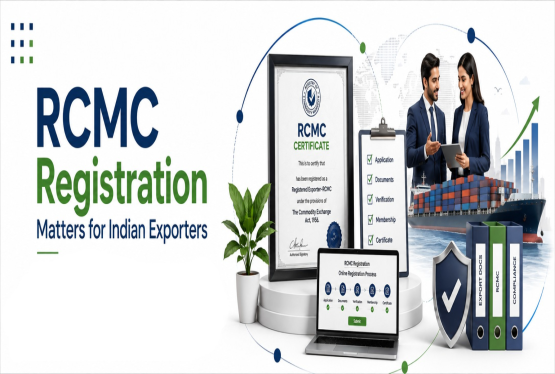
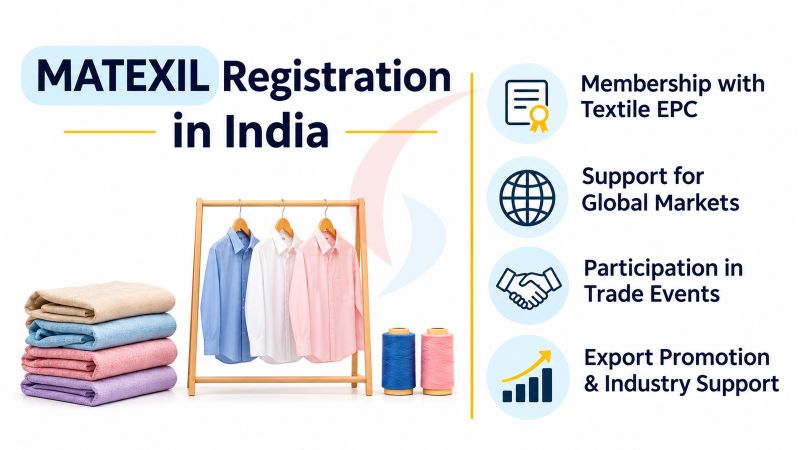
MATEXIL Registration is the process through which eligible exporters of manmade and technical textile products obtain membership and a Registration-cum-Membership Certificate (RCMC Registration) from the Manmade and Technical Textiles Export Promotion Council (MATEXIL).
MATEXIL was formerly known as the Synthetic and Rayon Textiles Export Promotion Council (SRTEPC). Established in 1954 under the Ministry of Textiles, Government of India, the Council promotes Indian textile exports in international markets.
The Council supports exporters through trade promotion programmes, market research, international buyer connections, exhibitions, trade delegations, and assistance with foreign trade-related issues.
Its responsibilities extend to specified manmade and technical textile products, including synthetic fibres, yarns, fabrics, and relevant technical textile categories.
For example, a company exporting polyester yarn to Bangladesh or industrial filtration fabric to Germany may consider MATEXIL membership, provided its products fall within the Council's jurisdiction.
MATEXIL RCMC is not the same as an export licence. It establishes registration with the relevant export promotion council and supports compliance with applicable Foreign Trade Policy requirements.
Products Covered Under MATEXIL Registration
MATEXIL primarily represents exporters dealing in manmade and technical textiles. Its product coverage includes various synthetic and artificial textile materials used in clothing, industrial applications, infrastructure, healthcare, and other sectors.
Common product categories include polyester and viscose fibres, synthetic filament yarns, manmade spun yarns, synthetic and blended fabrics, and specified technical textile products.
For instance, a company manufacturing geotextile fabric used in road construction is producing a technical textile. Similarly, industrial filter fabrics, certain protective textiles, and specialised automotive textile materials may fall within relevant technical textile classifications.
Exporters dealing in powerloom fabrics and other eligible textile products can also explore our PDEXCIL Registration to understand the Council's product coverage and eligibility requirements.
However, exporters must check their product's ITC (HS) classification and the Council's recognised jurisdiction under DGFT rules.
A business primarily exporting cotton textiles may need registration with TEXPROCIL instead of MATEXIL.
Also Learn about the registration requirements for cotton exporters in our TEXPROCIL Registration .
Is MATEXIL Registration Mandatory for Textile Exporters?
A common misconception is that every manufacturer exporting polyester yarn, synthetic fabrics, or technical textiles must obtain MATEXIL RCMC before shipping goods internationally.
Under Paragraph 2.57 of the Foreign Trade Policy, 2023, an RCMC is generally required when an exporter applies for specified authorisations, benefits, or concessions under the policy, unless an exemption applies.
An exporter sending freely exportable textile products may therefore be able to complete an ordinary export shipment without MATEXIL RCMC, provided all other applicable legal requirements are satisfied.
However, when an exporter applies for a Foreign Trade Policy benefit or authorisation that requires RCMC, registration with the appropriate council becomes relevant.
Important 2026 Update: RCMC Exemption for Exports Up to Rs 3 Lakh
On 15 September 2026, DGFT issued Notification No. 36/2026-27, introducing a small-value export exemption under Paragraph 2.57(c) of the Foreign Trade Policy.
Under this amendment, an RCMC or Certificate of Registration is not required for an export consignment with a Free-on-Board (FOB) value of up to Rs 3 lakh where the relevant FTP requirement would otherwise apply.
Laws and Legal Provisions Governing MATEXIL Registration
MATEXIL Registration operates within India's foreign trade framework. Exporters must also consider customs, taxation, quality standards, and foreign exchange regulations.
|
Applicable Law or Regulation |
Relevant Provisions |
Key Requirements |
|
Sections 3, 5, 7 and 11 |
Provides the legal framework for foreign trade regulation, IEC requirements, and action against violations. |
|
|
Paragraphs 2.56 and 2.57, as amended |
Governs recognition of Export Promotion Councils and applicable RCMC requirements. |
|
|
Chapter 2 and relevant e-RCMC provisions |
Prescribes procedures for issuance, renewal, validity, and amendment of RCMC. |
|
|
Sections 17 and 50, among others |
Covers assessment, export declarations, shipping bills, and customs clearance. |
|
|
Sections 2(5) and 16 |
Defines export of goods and provides the legal framework for zero-rated export supplies. |
|
|
Sections 7 and 8 |
Governs applicable export-related foreign exchange obligations and realisation of export proceeds. |
|
|
Applicable product standards and QCOs |
Requires compliance with mandatory Indian Standards where a product falls under an applicable Quality Control Order. |
The Foreign Trade Policy, 2023, remains applicable in 2026, subject to subsequent amendments. Export Promotion Councils are recognised under Paragraph 2.56, while Paragraph 2.57 addresses circumstances requiring RCMC.
Exporters must also verify relevant GST treatment, banking requirements, ITC (HS) codes, destination-country regulations, and any applicable product-specific controls.
For More Information: Read our RCMC Registration Online in India guide to understand the DGFT legal framework and registration procedure.
Eligibility Criteria for MATEXIL Registration
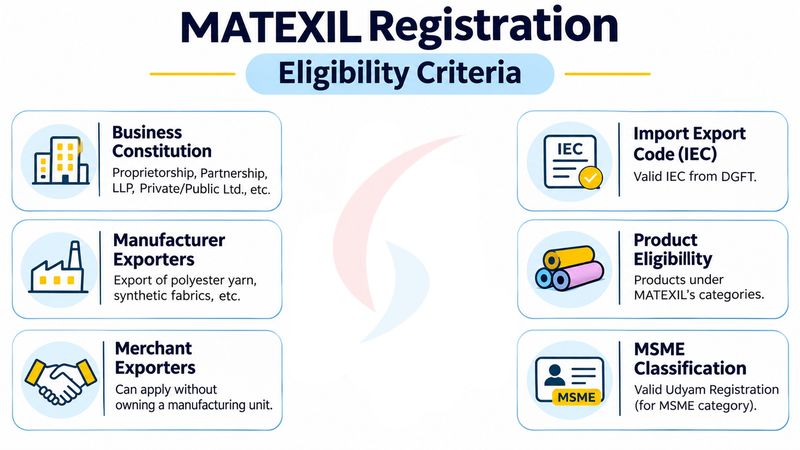
MATEXIL Registration is available to eligible Indian businesses involved in exporting manmade and technical textile products. Both manufacturers and merchant exporters can apply for membership, provided they meet the Council's prescribed requirements.
|
Eligibility Criteria |
Requirements |
|---|---|
|
Business Constitution |
Proprietorship firms, partnership firms, LLPs, private limited companies, public limited companies, and other legally recognised business entities can apply. |
|
Manufacturer Exporters |
Businesses manufacturing and exporting polyester yarn, synthetic fabrics, manmade fibres, and technical textiles are eligible, subject to product classification. |
|
Merchant Exporters |
Exporters purchasing eligible textile products from Indian manufacturers and selling them to international buyers can apply without owning a manufacturing facility. |
|
Import Export Code (IEC) |
Applicants should generally have a valid IEC issued by DGFT and updated business details. |
|
Product Eligibility |
Exported products must fall within MATEXIL's recognised product categories and applicable ITC (HS) classifications. |
|
Business Documents |
Applicants must provide PAN, business registration details, and supporting documents required for membership verification. |
|
MSME Classification |
Businesses applying under an eligible small-scale or MSME membership category should provide a valid Udyam Registration Certificate supporting their classification. |
Practical Example: A Surat-based manufacturer exporting polyester fabrics to Dubai may apply for MATEXIL Registration. Similarly, a Mumbai-based merchant exporter purchasing technical textiles from Indian manufacturers and supplying them to European buyers may also qualify without owning a manufacturing unit.
Documents Required for MATEXIL Registration in 2026
Before submitting an application, businesses should prepare documents establishing their identity, constitution, product classification, and export activities.
|
Documents Required |
Purpose |
|
Identification of the applicant for international trade. |
|
|
PAN Card |
Verification of business tax identification. |
|
GST Registration Certificate |
Verification of GST details, wherever applicable. |
|
Business Registration Proof |
Certificate of Incorporation, LLP Registration , partnership deed, or other relevant document. |
|
Registered Office Address |
Verification of the business address and contact details. |
|
Udyam Registration Certificate |
Supporting evidence for the applicable MSME membership category. |
|
Product Details and ITC (HS) Codes |
Identification of the textile products proposed to be exported. |
|
Export Turnover Information |
Previous export performance and financial information, wherever required. |
|
Authorisation Letter |
Authorisation of the representative submitting the application, where applicable. |
|
Bank and Manufacturing Details |
Additional verification records where requested by MATEXIL. |
A newly established textile exporter may not have previous export turnover. In that situation, the applicant should disclose its actual business position rather than providing estimated figures as completed exports.
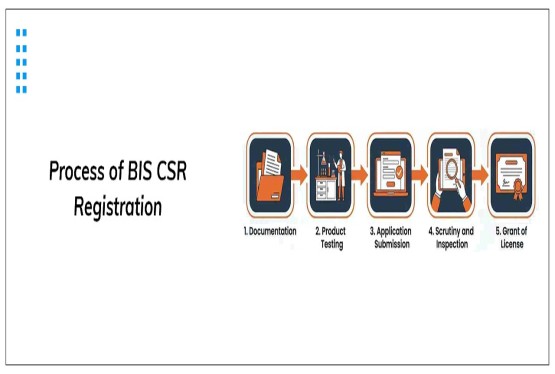
MATEXIL Registration Process Online in 2026
MATEXIL RCMC applications are processed through the DGFT common electronic RCMC platform. The Council's membership instructions identify the online application process and require applicants to select MATEXIL as their registering authority.
|
Step |
MATEXIL Registration Process |
|
Step 1: Obtain IEC |
Obtain an active Import Export Code and verify the business details on the DGFT portal. |
|
Step 2: Visit DGFT Portal |
Open the official DGFT website and log in using the registered credentials. |
|
Step 3: Select e-RCMC |
Navigate to Services → e-RCMC → Apply for e-RCMC and start a fresh application. |
|
Step 4: Choose MATEXIL |
Select Manmade and Technical Textiles Export Promotion Council (formerly SRTEPC). |
|
Step 5: Enter Business Details |
Provide business constitution, address, exporter category, product classification, and other requested information. |
|
Step 6: Upload Documents |
Upload IEC, registration records, relevant financial details, and supporting certificates. |
|
Step 7: Pay Membership Fees |
Pay the applicable admission, subscription, and other prescribed charges through the approved payment process. |
|
Step 8: Obtain RCMC |
Submit the application, respond to verification queries, and access the electronic certificate after approval. |
This guide explains the eligibility criteria, required documents, government fees, and step-by-step DGFT application process, helping new textile exporters obtain their IEC and prepare for international trade.
Businesses without an IEC can refer to our Procedure for Obtaining Import Export Code before applying for MATEXIL Registration.
Practical Example: A Textile Manufacturer in Surat
Suppose Rohan operates a small polyester yarn manufacturing unit in Surat. His first overseas customer places an order worth Rs 18 lakh.
Rohan already has an IEC and GST registration. He checks the product classification, confirms MATEXIL's jurisdiction, and prepares his business documents and Udyam Registration Certificate.
He then logs in to the DGFT portal, chooses MATEXIL, fills out the application, uploads the records, and pays the applicable membership fee. After verification and approval, he receives his RCMC.
For Rohan, membership can also provide an opportunity to explore further overseas buyers instead of depending on one international customer.
MATEXIL Registration Fees in 2026
MATEXIL's publicly available membership page provides different fee categories for eligible small-scale units and other businesses.
|
Membership Category |
New Membership Including GST |
Annual Renewal Including GST |
|
Small-scale / SSI category |
Rs 9,499 |
Rs 8,201 |
|
Non-SSI category |
Rs 13,629 |
Rs 12,331 |
These are the amounts published on the Council's membership page, which refers to an older fee schedule. The Council's 2024–25 renewal circular also listed the renewal amounts shown above and required valid Udyam documentation for eligible small-scale units.
A separate, confirmed FY 2026–27 fee circular was not established from the official material reviewed. Accordingly, the figures should be treated as published reference amounts, not independently verified current fees. Applicants should confirm the amount displayed by MATEXIL or the DGFT portal before making payment.
Validity and Renewal of MATEXIL RCMC
An RCMC is generally valid for five financial years, beginning on 1 April of the licensing year in which it is issued and ending on 31 March of the fifth year, unless otherwise specified. However, MATEXIL membership subscriptions must be maintained according to the Council's annual renewal conditions. For example, an RCMC issued during FY 2026–27 would ordinarily remain valid until 31 March 2031, subject to applicable rules and maintenance of membership.
Benefits of MATEXIL Registration for Textile Exporters
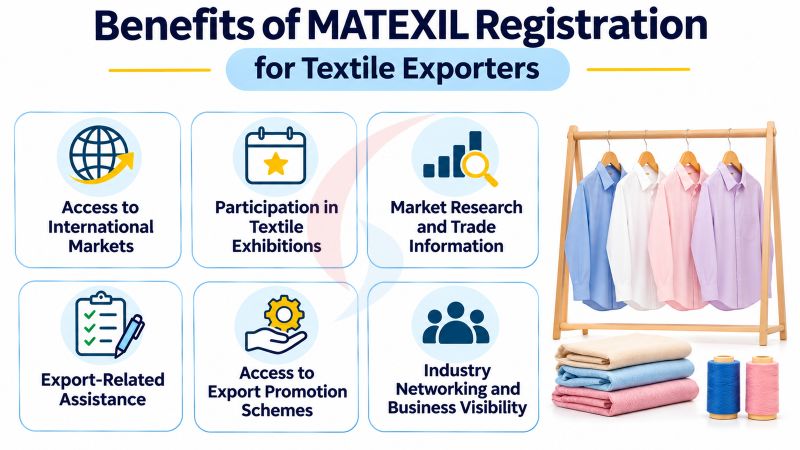
MATEXIL Registration offers several advantages to Indian textile manufacturers and merchant exporters planning to expand into international markets. Beyond obtaining an RCMC, members can access export promotion activities, market information, business networking opportunities, and assistance with export-related matters.
|
Benefits |
Description |
|---|---|
|
1. Access to International Markets |
MATEXIL helps exporters explore overseas markets and connect with potential international buyers through trade promotion initiatives. |
|
2. Participation in Textile Exhibitions |
Eligible members can participate in international exhibitions, buyer-seller meetings, and trade delegations organised or facilitated by MATEXIL. |
|
3. Market Research and Trade Information |
Members receive information about global textile demand, emerging export opportunities, international trade trends, and regulatory developments. |
|
4. Export-Related Assistance |
MATEXIL provides guidance on foreign trade procedures, shipping, transport, export documentation, and relevant regulatory matters. |
|
5. Access to Export Promotion Schemes |
A valid MATEXIL RCMC may help eligible exporters meet registration requirements under applicable DGFT export promotion schemes, subject to scheme conditions. |
|
6. Industry Networking and Business Visibility |
Membership creates opportunities to connect with textile manufacturers, exporters, industry experts, and potential overseas business partners. |
Practical Example: A Coimbatore-based technical textile manufacturer producing industrial filtration fabrics wants to export its products to Germany. Through MATEXIL's trade promotion activities and market information, the company may identify potential international buyers, understand market requirements, and explore new export opportunities.
Exporters exploring other industries can also read our PEPC Registration to understand how RCMC requirements differ for overseas project exports.
Latest MATEXIL Registration and Textile Export Updates in 2026
-
Formal Recognition of the MATEXIL Name
DGFT Public Notice No. 13/2025-26, dated 25 June 2025, amended Appendix 2T to recognise the Manmade and Technical Textiles Export Promotion Council (MATEXIL) in place of the previous council name.
This remains relevant in 2026 because applicants must identify MATEXIL correctly when selecting their RCMC registering authority.
-
RCMC Exemption for Small Export Consignments
DGFT Notification No. 36/2026-27, dated 15 September 2026, exempts consignments with FOB value up to Rs 3 lakh from RCMC requirements under the relevant Foreign Trade Policy provisions.
This may reduce compliance burdens for eligible small exporters making trial shipments.
-
Union Budget 2026–27 Textile Sector Initiatives
The Union Budget 2026–27 announced measures targeting textile sector competitiveness, including a proposed National Fibre Scheme covering manmade and new-age fibres.
These measures may support investment, manufacturing capacity, and innovation in India's textile sector. However, announcements should not be treated as automatic financial benefits available merely through MATEXIL Registration.
-
Technical Textiles and Export Promotion
MATEXIL continues to play an export promotion role in the technical textiles sector under the Ministry of Textiles' initiatives.
The Council also circulates information about international textile exhibitions, production-linked incentive developments, trade-related policy changes, and industry concerns.
Why Choose Compliance Calendar LLP ?
Exporting textile products involves more than finding an international buyer. Businesses must understand registration requirements, identify the appropriate Export Promotion Council, prepare documents, and maintain their compliance records.
Compliance Calendar LLP assists eligible textile exporters with understanding MATEXIL registration requirements, reviewing documents, verifying product classifications, preparing e-RCMC applications, and addressing registration-related queries.
Our professionals can also assist businesses with related services, including IEC Registration, RCMC Registration, GST compliance, and other applicable business regulatory requirements. For assistance with MATEXIL Registration, contact info@ccoffice.in or call 9988424211.
Frequently Asked Questions (FAQs)
Q1. What is MATEXIL Registration in India?
Ans: MATEXIL Registration allows eligible exporters of manmade and technical textile products to obtain membership and an RCMC from the Manmade and Technical Textiles Export Promotion Council. It supports applicable Foreign Trade Policy requirements and provides access to export promotion activities.
Q2. Is MATEXIL Registration mandatory for all textile exporters?
Ans: No. MATEXIL RCMC is not automatically mandatory for every ordinary textile export shipment. It is generally required for specified authorisations, benefits, or concessions under the Foreign Trade Policy, subject to applicable exemptions.
Q3. Can a new textile exporter apply for MATEXIL Registration?
Ans: Yes. Eligible new businesses involved in manmade or technical textile exports may apply for membership. They must provide the required business details, IEC, supporting documents, and applicable registration fees.
Q4. What are the MATEXIL Registration fees in 2026?
Ans: MATEXIL's publicly available fee schedule lists new membership charges of Rs 9,499 for eligible small-scale units and Rs 13,629 for other units, including GST. These are historical published amounts; the current 2026–27 payable fees should be confirmed directly with MATEXIL.
Q5. What documents are required for MATEXIL Registration?
Ans: Common documents include IEC, PAN, GST details where applicable, business registration records, product classifications, Udyam Registration where relevant, and authorised representative details. Additional documents may be requested during verification.
6. How can I apply for MATEXIL RCMC online?
Ans: Visit the DGFT portal, select Services → e-RCMC → Apply for e-RCMC, and choose MATEXIL as the registering authority. Complete the application, upload documents, pay the applicable fees, and submit it for approval.
Q7. Can a merchant exporter obtain MATEXIL Registration?
Ans: Yes. Eligible merchant exporters dealing in products covered by MATEXIL may apply for membership without necessarily owning a textile manufacturing facility. They must satisfy the applicable membership and documentation requirements.
Q8. What is the validity of MATEXIL RCMC?
Ans: MATEXIL RCMC is generally valid for five financial years, unless otherwise specified. Exporters must also maintain the annual membership subscription and comply with relevant Council requirements.
Q9. Is MATEXIL Registration required for exports below Rs 3 lakh?
Ans: Under DGFT Notification No. 36/2026-27, qualifying export consignments having an FOB value not exceeding Rs 3 lakh are exempt from RCMC requirements under the relevant Foreign Trade Policy provisions. Other applicable export compliance requirements remain in force.
Q10. What is the difference between MATEXIL and TEXPROCIL?
Ans: MATEXIL promotes exports of manmade and technical textiles, whereas TEXPROCIL primarily focuses on cotton textile products. Businesses should select the appropriate council based on their principal export products and applicable ITC (HS) classifications.
Article last updated on : 13 Nov 2026.