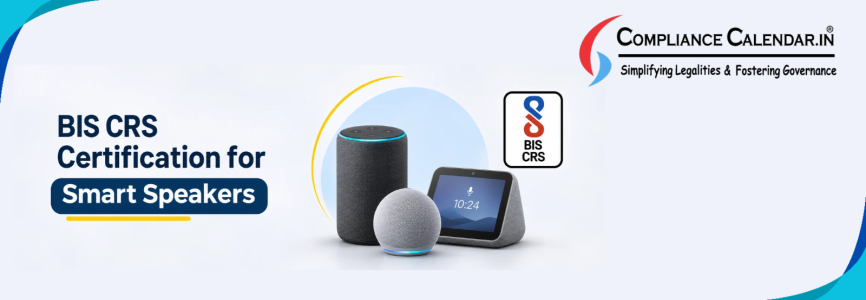



Imagine a startup in Bengaluru developing a smart speaker that can play music, answer questions, control home appliances and respond to voice commands. The founders finalise the design, identify a manufacturer and prepare to launch their product on Amazon and Flipkart. Everything looks ready until their importer asks one important question: “Do we have BIS CRS Certification for Smart Speakers?” The founders realise that developing a smart product is only one part of bringing it to the Indian market. They must also ensure that the product meets applicable safety standards and registration requirements.
This situation is common among electronics manufacturers, startups and importers. Smart speakers are becoming popular in Indian homes because they combine voice assistants, wireless connectivity and entertainment features in one device. However, their electronic components, power supply systems and internal circuits must comply with applicable safety requirements. In India, smart speakers, whether equipped with a display or not, are covered under the Bureau of Indian Standards BIS CRS (Compulsory Registration Scheme).
What is BIS CRS Certification for Smart Speakers?
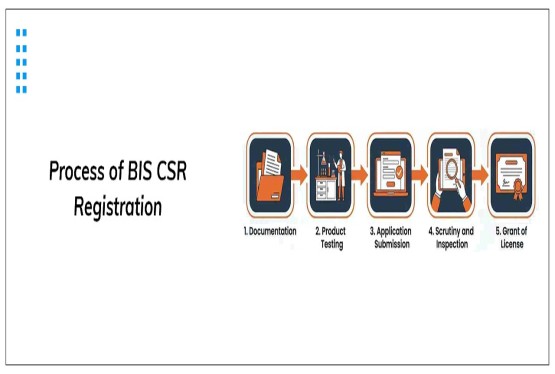
BIS CRS Certification for Smart Speakers is a mandatory product registration requirement administered by the Bureau of Indian Standards. Under this scheme, manufacturers must establish that their notified smart speaker models conform to the applicable Indian safety standard before placing them on the Indian market. The manufacturer sends representative product samples to a BIS-recognised laboratory for testing. After obtaining the required test report, the manufacturer submits an application with technical details, manufacturing information and supporting documents.
BIS examines the application and may grant registration if the applicable requirements are satisfied. Once approved, the manufacturer can use the prescribed BIS Standard Mark with its registration number on the registered products. This is not simply a marketing certificate. It is a legal requirement linked to the manufacturer, product category, brand, models and manufacturing location.
Why is BIS Registration Important for Smart Speakers?
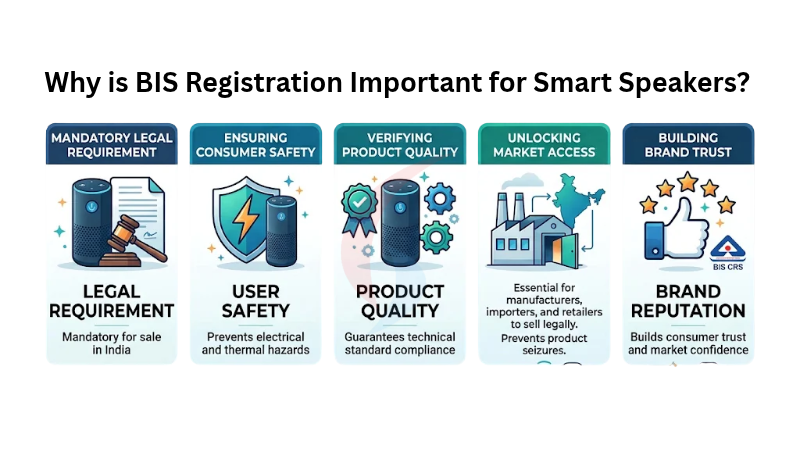
A smart speaker may appear to be a small electronic device, but it contains several components that can create safety risks if improperly designed. These may include circuit boards, audio amplifiers, wireless modules, power adapters, batteries and charging components.
For example, suppose a company imports 5,000 smart speakers that have not undergone the required BIS registration. The consignment may face customs difficulties, causing delays, additional storage expenses and disruption to planned sales. BIS registration helps manufacturers demonstrate compliance with prescribed safety requirements and reduces the risk of non-compliant products reaching consumers. It also supports responsible product development and better manufacturing controls.
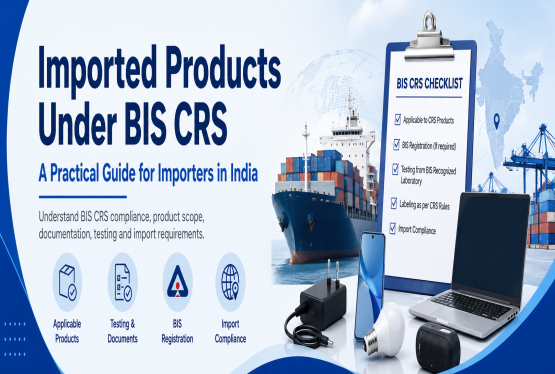
Before launching an electronic product, explore our detailed guide on BIS CRS Registration: Step-by-Step Process for Electronic Products to understand the overall registration procedure.
Applicable Indian Standard for Smart Speakers in 2026
One of the most important developments in BIS certification is the transition to IS/IEC 62368 (Part 1): 2023, which covers safety requirements for audio/video, information and communication technology equipment.
Earlier BIS product lists and documentation referred to IS 13252 (Part 1): 2010 or IS 616: 2017 for relevant electronic equipment. Under the revised regulatory framework, IS/IEC 62368 (Part 1): 2023 is the updated standard for smart speakers. The government has provided a transition period for existing standards, with concurrent operation permitted until 1 November 2028 for the relevant existing product categories.
|
Particulars |
Details |
|---|---|
|
Product |
Smart Speakers (with and without Display) |
|
Certification Authority |
Bureau of Indian Standards |
|
Certification Scheme |
Compulsory Registration Scheme (CRS) |
|
Updated Indian Standard |
IS/IEC 62368 (Part 1): 2023 |
|
Earlier applicable standards |
IS 13252 (Part 1): 2010 / IS 616: 2017, as applicable |
|
Transition deadline |
1 November 2028 |
|
Registration holder |
Actual manufacturer |
A manufacturer planning a new smart speaker model in 2026 should assess the revised standard before starting product testing. This can help avoid unnecessary retesting and difficulties when the earlier standards are withdrawn.
Want to know how BIS requirements apply to other solar equipment? Read Government Mandates BIS Certification for Solar Water Heaters.
Legal Provisions Governing BIS CRS Registration
The legal framework for smart speaker registration comes from the Bureau of Indian Standards Act, 2016, the BIS Conformity Assessment Regulations, 2018, and the Electronics and Information Technology Goods (Requirement of Compulsory Registration) Order, 2021, as amended.
Important provisions include:
-
Section 13 of the BIS Act, 2016: Provides for licensing and conformity assessment arrangements relating to the Standard Mark.
-
Section 14: Enables the Central Government to notify products requiring compulsory conformity with Indian Standards.
-
BIS Conformity Assessment Regulations: Establish registration, testing, surveillance, validity and renewal procedures.
-
MeitY Compulsory Registration Order, 2021: Covers notified electronics and IT products, including smart speakers.
These laws make compliance compulsory for notified products. Importers, manufacturers and brand owners should therefore verify the registration requirements before commercial sale or import.
Which Types of Smart Speakers Require BIS Registration?
Smart speakers are available in different designs, but BIS specifically includes products with and without displays. The correct classification depends on the product's actual features, intended use and notified category.
|
Smart Speaker Type |
Main Features |
Registration Consideration |
|---|---|---|
|
Voice-controlled smart speaker |
Voice assistant, music and Wi-Fi |
Covered smart speaker category |
|
Smart speaker with display |
Screen, voice assistant and audio functions |
Covered smart speaker category |
|
Smart home speaker |
Voice-based control of connected devices |
Covered where classified as a smart speaker |
|
Portable smart speaker |
Rechargeable battery and smart assistant |
Product and battery requirements must be assessed |
|
Ordinary Bluetooth speaker |
Wireless audio playback |
Separately notified Bluetooth speaker category |
A normal Bluetooth speaker and a smart speaker may look similar, but they should not automatically be treated as the same product category. The manufacturer must check the correct BIS classification before selecting a testing laboratory.
Read our article on BIS CRS Registration for Bluetooth Speakers to understand the registration requirements for Bluetooth speakers.
Who Can Apply for BIS CRS Certification?
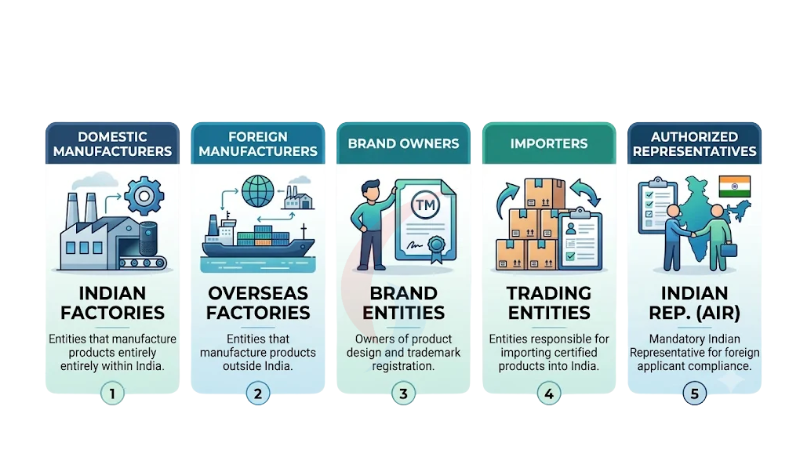
BIS CRS registration is issued to the actual manufacturer, not simply the importer or distributor. If a company manufactures smart speakers at its own factory in India, that manufacturing entity applies for registration. However, when products are manufactured outside India, the foreign manufacturer generally appoints an Authorised Indian Representative (AIR) to coordinate the application and comply with relevant responsibilities.
For example, an Indian electronics brand may order smart speakers from a factory in China and sell them under its own trademark. The Chinese manufacturer is the applicant for BIS registration, while the Indian company may act as the AIR or arrange another eligible representative. A separate registration may be necessary where manufacturing locations, brands or product categories differ. Multiple eligible models can be included within the same registration scope where BIS series guidelines permit.
Documents Required for BIS CRS Certification for Smart Speakers
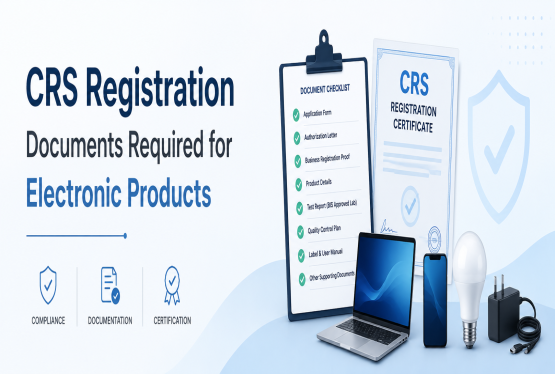
Preparing accurate documents is one of the most important parts of registration. Even when a smart speaker passes laboratory testing, incomplete documents or mismatched product information can lead to BIS queries.
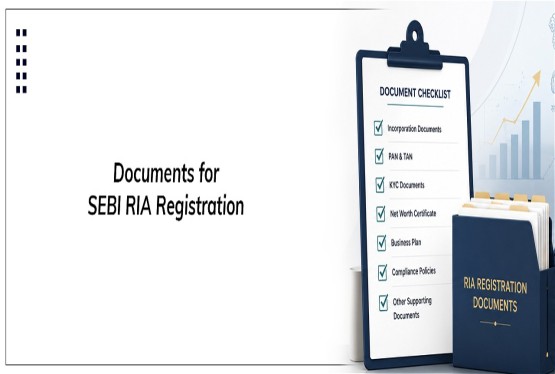
The commonly required documents include:
-
Manufacturer's business registration and factory address details.
-
Completed BIS application and authorisation documents.
-
Product technical specifications and user manual.
-
Construction Data Form (CDF) and Critical Component List (CCL), where applicable.
-
Product model numbers, brand name and rating labels.
-
Test report issued by a BIS-recognised laboratory.
-
Trademark ownership or brand authorisation documents.
-
Authorised signatory identification and authorisation letter.
-
AIR nomination, identity and business documents for foreign manufacturers.
-
Required declarations, undertakings and government fee payment details.
For example, if the manufacturer mentions model number SS-100 in the test report but SS-100A in the BIS application, the discrepancy may need clarification. Similarly, differences in factory addresses, brand names or electrical ratings can delay processing.
Step-by-Step BIS CRS Registration Process for Smart Speakers
The registration process becomes easier when manufacturers complete the technical preparations before submitting the application.
Step 1: Identify the Correct Product Category
First, determine whether the device qualifies as a smart speaker with or without a display. Review its voice assistant functions, audio features, connectivity, power source and other technical characteristics. This classification matters because different electronic products may be listed separately under the CRS, even when they share similar components.
Step 2: Select the Applicable Indian Standard
The manufacturer must identify the correct safety standard and applicable transition provisions. For smart speakers in 2026, particular attention should be given to the migration towards IS/IEC 62368 (Part 1): 2023.
Step 3: Choose a BIS-Recognised Laboratory
The manufacturer must select a laboratory recognised by BIS for the relevant testing scope. The laboratory should confirm the required samples, documents, testing methods and applicable standard before receiving the product.
Step 4: Complete Product Testing
Samples are tested to determine whether they satisfy the applicable safety requirements. If the sample fails a test, the manufacturer must investigate the issue, make necessary changes and arrange appropriate retesting.
Step 5: Submit the BIS Application
After testing, the manufacturer submits the application through the official BIS CRS portal with the required test reports, declarations, model information and prescribed fees. The application details must accurately match the tested product and manufacturing documents.
Step 6: Respond to BIS Queries
BIS reviews the submitted information and may request clarification about factory details, brand ownership, technical specifications or test results. The applicant should respond within the prescribed period and provide the necessary supporting documents.
Step 7: Obtain Registration and Complete Marking
Once the application is approved, BIS issues the registration covering the approved scope. The manufacturer can then use the prescribed BIS Standard Mark and registration number on applicable products. However, registration does not end the compliance responsibility. The manufacturer must continue ensuring that production models match the approved specifications.
BIS Testing Requirements for Smart Speakers
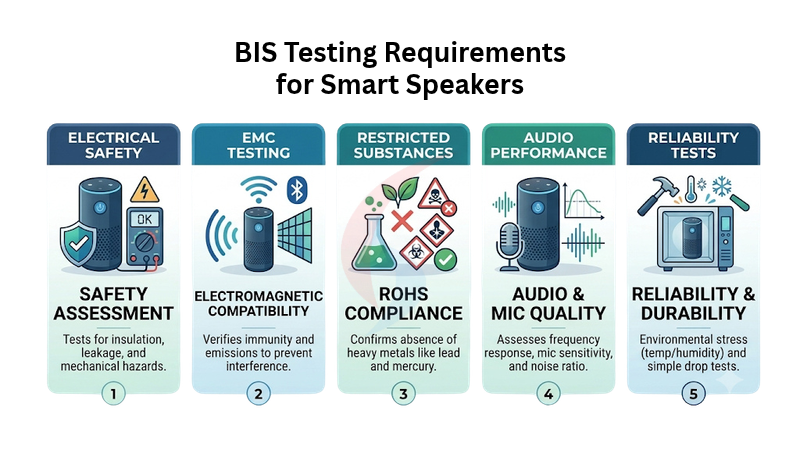
Smart speaker testing focuses on applicable electrical and product safety requirements. The exact tests depend on the product's construction, power supply, components and selected Indian Standard. Common areas examined during testing include electrical insulation, protection against electric shock, temperature rise, fire hazards, mechanical construction and abnormal operating conditions. For battery-operated smart speakers, the laboratory may also examine relevant battery-related safety arrangements. Where an external power adapter or battery is separately covered by compulsory registration requirements, its own compliance status must be checked.
For example, suppose a smart speaker uses a poorly designed power circuit that causes excessive heating during prolonged operation. The laboratory may identify the problem during safety testing. The manufacturer would then need to correct the design before proceeding with a compliant product.
Learn how the updated safety requirements affect electronic manufacturers in our article, Electronics Brands, Are You Ready for BIS 62368-1 Migration?.
BIS CRS Certification Fees for Smart Speakers in 2026
The BIS (Conformity Assessment) Amendment Regulations, 2026 introduced important changes to government fees and licence administration.
Under the amended Scheme II fee provisions, the application fee, annual licence fee and renewal application fee are Rs 1,000 each. The annual processing fee is ?25,000, subject to applicable concessions. Testing expenses and other charges are additional.
|
Fee Particulars |
Applicable Amount |
|---|---|
|
Application fee |
Rs 1,000 |
|
Annual licence fee |
Rs 1,000 |
|
Annual processing fee |
Rs 25,000 |
|
Renewal application fee |
Rs 1,000 |
|
Additional test report fee, where applicable |
Rs 20,000 per additional report |
|
Inclusion of additional models/scope, where applicable |
Rs 30,000 per application |
|
Laboratory testing charges |
As quoted by the recognised laboratory |
The 2026 regulations also provide processing-fee concessions until 31 May 2029 for eligible enterprises: 80% for micro enterprises or startups, 50% for small enterprises and 20% for medium enterprises, subject to the applicable definitions and conditions.
These figures are statutory fee components, not a fixed total quotation. The final expenditure will depend on testing, the number of models, eligibility for concessions and other applicable requirements.
Latest BIS CRS Updates and Amendments in 2026
Manufacturers should particularly understand three developments.
1. Migration to IS/IEC 62368-1:2023
The transition from earlier audio/video and IT equipment standards is a major change. The government permits concurrent running of the previous standards for relevant products until 1 November 2028. Businesses developing new products should plan their testing and compliance strategy around this migration.
2. Revised Licence Validity and Renewal
Under the 2026 amendments, Scheme II licences may initially be granted for up to five years and renewed for a further period of up to five years. Annual advance fee payment requirements apply to continued operation. Manufacturers should no longer assume that the older two-year validity arrangement necessarily governs new registrations.
3. Annual Payments and Continued Compliance
The 2026 framework strengthened requirements relating to advance annual fee payment and submission of production information. Failure to comply may lead to suspension or cancellation under the applicable rules.
BIS also published additional CRS guidance during 2026, including product-category guidance in August and migration FAQs in July. Manufacturers should monitor the official BIS circulars for relevant clarifications.
Practical Case Study: A Smart Speaker Startup Entering India
The following is an illustrative business situation, not an actual client case.
A startup named VoiceNest Electronics plans to sell smart speakers in India. Its first product can play music, answer questions and connect with home automation devices. The founders intend to manufacture the product through an overseas factory. Initially, the founders believe that Bluetooth connectivity approval and ordinary product testing will be sufficient. However, during their compliance review, they discover that smart speakers fall within a notified BIS CRS category.
The company takes the following approach: it identifies the correct product classification, coordinates with the overseas manufacturer, appoints an eligible AIR and arranges testing with a BIS-recognised laboratory. During documentation review, a mismatch is identified between the manufacturing address in the business licence and the application records. The documents are corrected before final submission. The manufacturer then completes the registration process and prepares compliant product labels for the approved models.
The lesson: checking regulatory requirements before placing a manufacturing order can help avoid expensive corrections, delayed launches and unnecessary shipment problems.
Common Reasons for Delays in BIS CRS Registration
Smart speaker manufacturers often face registration delays because of avoidable errors. One frequent problem is testing under the wrong product category or standard. Another is submitting incomplete CDF, CCL or manufacturer documents. Brand ownership issues, incorrect model declarations and inconsistent factory information can also result in queries.
Some businesses submit the application without ensuring that the tested sample matches the final commercial product. Others change important components after completing testing without reviewing whether the change affects registration. To reduce these risks, businesses should finalise product specifications before laboratory testing, verify technical records and review the entire application before submission.
Understand common certification challenges through our guide on BIS CRS Registration for Microwave Ovens, which explains documentation, testing and compliance requirements for another notified product category.
Post-Registration Compliance and Penalties
After receiving BIS registration, the manufacturer must ensure continued conformity with the applicable standard. Registered models must carry the prescribed marking, and changes to important product components, manufacturing details or registered scope should be reviewed under BIS procedures.
BIS may conduct market surveillance, examine products or require additional information. Manufacturers must also comply with applicable annual fee, production reporting and renewal obligations. Manufacturing, importing or selling notified products without the required compliance may attract action under the BIS Act, 2016. Depending on the violation, consequences can include restrictions on sale, seizure, monetary penalties, prosecution or action against the registration.
Why Choose Compliance Calendar LLP for BIS CRS Certification?
At Compliance Calendar LLP, we understand that BIS registration can be confusing for a business launching its first electronic product. Manufacturers often know how to develop and manufacture their products but may need guidance in identifying the correct Indian Standard, preparing technical documents or responding to BIS queries. Our approach is to understand the product before discussing the application. For a smart speaker manufacturer, this means reviewing the product features, manufacturing location, brand details, model specifications and applicable registration requirements.
We assist businesses with product classification, BIS documentation, coordination with recognised laboratories, AIR-related documentation, application filing, responses to queries and post-registration compliance. Our objective is to help identify documentation gaps early and support an organised registration process rather than simply filing an application without checking its details.
For professional assistance, contact us at info@ccoffice.in or call +91 9988424211.
Frequently Asked Questions (FAQs)
Q1. Is BIS CRS Certification mandatory for smart speakers in India?
Ans. Yes. Smart speakers, with and without displays, are included in the notified BIS CRS product list. Manufacturers must obtain the required registration before placing covered products on the Indian market.
Q2. Which Indian Standard applies to smart speakers in 2026?
Ans. The updated standard is IS/IEC 62368 (Part 1): 2023. Earlier applicable standards are subject to the notified transition arrangements, including the concurrent-running period until 1 November 2028.
Q3. Can an importer apply for BIS CRS Registration?
Ans. The registration is granted to the actual manufacturer. An importer may coordinate the process and, where eligible, act as the Authorised Indian Representative for a foreign manufacturer.
Q4. Do smart speakers with displays require BIS Registration?
Ans. Yes. The notified category expressly includes smart speakers with and without displays. Manufacturers must ensure that the exact models and their applicable technical requirements are properly covered.
Q5. How long does BIS CRS Registration take?
Ans. The timeline depends on laboratory testing, documentation completeness, BIS scrutiny and any queries raised. There is no guaranteed approval period applicable to every smart speaker application.
Q6. What is the BIS CRS Registration fee for smart speakers?
Ans. The amended 2026 regulations prescribe a ?1,000 application fee and ?25,000 annual processing fee, along with applicable annual licence and other charges. Concessions may apply to eligible businesses.
Q7. How long is BIS CRS Registration valid?
Ans. Under the amended Scheme II framework, an initial licence may be granted for up to five years and renewed for a further period of up to five years, subject to annual payments and continued compliance.
Q8. Can several smart speaker models be covered under one BIS Registration?
Ans. Yes, where the models qualify under the applicable product grouping and series guidelines. The manufacturer must ensure that the models, brand, standard and factory details are appropriately covered.
Q9. Can smart speakers be imported without BIS Registration?
Ans. Notified smart speakers generally require the applicable BIS compliance before commercial import and sale in India. Importers should verify registration before dispatch to avoid customs and market-access difficulties.
Q10. What happens if a smart speaker fails BIS testing?
Ans. The manufacturer must identify the cause of failure and correct the product where necessary. Appropriate retesting may then be required before a compliant test report can support the registration application.
Article last updated on : 13 Nov 2026.