


Imagine a startup in Delhi planning to launch its own range of HD webcams. The founders have selected a manufacturer, finalised the product design and prepared to sell through Amazon, Flipkart and electronics stores. Everything looks ready until their supplier asks an important question: Do these webcams need BIS Certification before entering the Indian market?
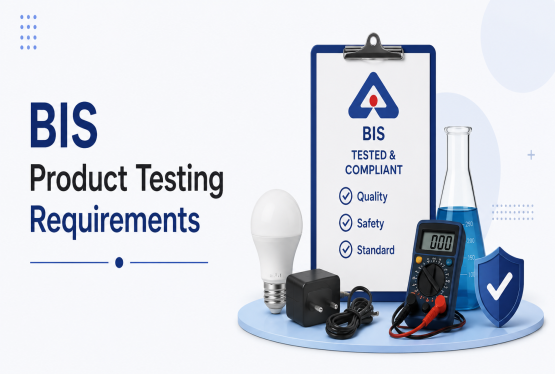
This is where many electronics businesses face their first compliance challenge. Whether a company manufactures webcams in India or imports finished devices from another country, it must understand the applicable product safety requirements before selling them. BIS Certification for Webcams helps ensure that covered finished webcams meet the prescribed Indian safety standard. It is mandatory under the Compulsory Registration Scheme (CRS), administered by the Bureau of Indian Standards (BIS). The requirements apply to manufacturers supplying covered products to the Indian market.
Important: Finished webcams are covered under the BIS Compulsory Registration Scheme. Manufacturers must obtain the applicable registration before supplying covered products in India.
What Is BIS Certification for Webcams?
BIS certification is a product conformity system introduced to ensure that specified products meet Indian safety and quality requirements. The Bureau of Indian Standards operates several certification schemes, including the Compulsory Registration Scheme for notified electronic and IT products.
For webcams, this registration mainly focuses on electrical and electronic safety. Manufacturers must arrange product testing through a BIS-recognised laboratory and submit the required information for approval. Once BIS grants registration, the manufacturer can use the prescribed Standard Mark with its registration number on the covered products, subject to applicable marking requirements.
For example, suppose a company named VisionTech Electronics manufactures USB webcams for online meetings. Before selling its finished webcams in India, it must determine the relevant CRS coverage, complete the required testing and secure BIS registration.
Manufacturers planning to launch webcams in India can explore our BIS CRS Registration services to understand product testing, documentation and application requirements.
Is BIS Certification Mandatory for Webcams in India?
Yes. The official BIS list specifically includes Webcam (Finished Product) under the Compulsory Registration Scheme.
The principal legal provisions are:
-
Bureau of Indian Standards Act, 2016, particularly Sections 16 and 17.
-
BIS (Conformity Assessment) Regulations, 2018, as amended.
-
Electronics and Information Technology Goods (Requirement of Compulsory Registration) Order, 2021, as amended.
The scheme applies to notified products manufactured in India and finished products manufactured abroad for the Indian market. Importing a finished webcam does not automatically exempt it from registration.
The registration is generally issued in the name of the manufacturing unit rather than merely the trading company or online seller.
Which Types of Webcams Require BIS Registration?
Different webcams are available for personal, educational and professional use. Their features may differ, but the principal question is whether the device falls within the notified finished-webcam category.
|
Type of webcam |
Typical application |
BIS CRS applicability |
|---|---|---|
|
USB webcam |
Desktop computers and laptops |
Covered as a finished webcam |
|
HD/Full HD webcam |
Online meetings and classes |
Covered as a finished webcam |
|
4K webcam |
Professional video conferencing |
Covered as a finished webcam |
|
Webcam with microphone |
Video calls and streaming |
Covered when classified as a finished webcam |
|
Wireless webcam |
Remote video communication |
Assess under finished-webcam coverage |
|
Webcam module |
Component integrated into another device |
Separate product classification required |
A standalone webcam should not be confused with a CCTV camera, laptop's integrated camera module or industrial imaging component. These products may fall under different categories or require a separate applicability assessment.
Example: A business imports 500 USB webcams from China for sale under its own brand. Since the products are finished webcams, the company must ensure the manufacturer has an appropriate BIS registration covering the products before they are supplied to the Indian market.
Webcams and CCTV cameras should not be confused for compliance purposes. Read our article on CCTV Security Essential Requirements under BIS CRS to understand the additional rules applicable to covered CCTV products.
Applicable Indian Standard for Webcams
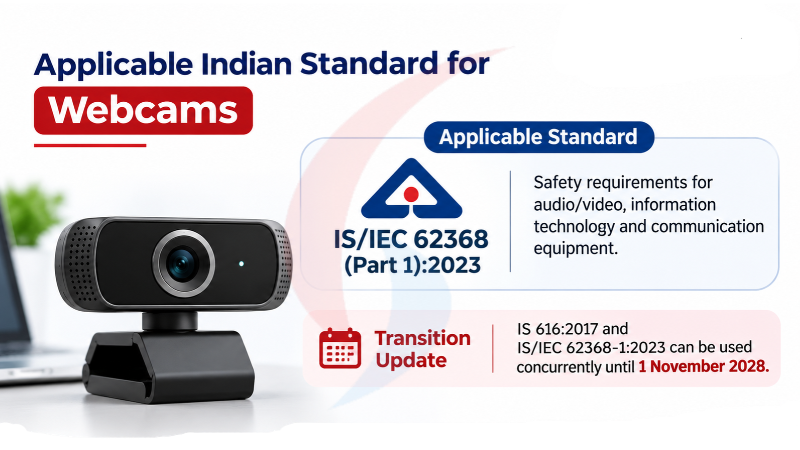
BIS identifies IS/IEC 62368 (Part 1):2023 as the updated safety standard applicable to finished webcams.
This standard addresses safety requirements for audio/video, information technology and communication technology equipment. It focuses on protecting users against potential hazards arising from electrical energy, excessive heat, mechanical parts and other relevant sources of harm.
Earlier, webcams were covered under IS 616:2017. The Government has introduced a transition to the newer IS/IEC 62368 standard, with a specified concurrent-running period for relevant products.
Key Highlight: BIS certification examines applicable product safety requirements. It does not automatically certify webcam picture quality, resolution, recording performance or compatibility with video-calling software.
To understand the transition to the revised safety standard, explore our article on BIS IS/IEC 62368-1:2023 Migration and its implications for electronics manufacturers.
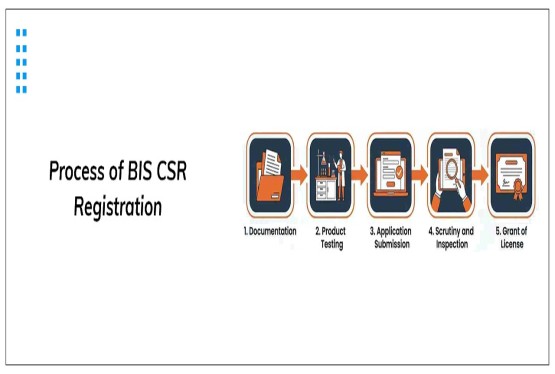
Step-by-Step BIS CRS Registration Process for Webcams
The process becomes easier when manufacturers prepare their technical documents and product samples before starting the application.
Step 1: Identify the Product and Manufacturer
First, determine whether the device falls within the finished-webcam category. Identify the actual manufacturing facility, brand names and product models that require coverage. If the webcam is manufactured outside India, the foreign manufacturer must also arrange an eligible Authorised Indian Representative (AIR), where required.
Step 2: Create an Account on the BIS CRS Portal
The manufacturer must register through the official BIS CRS Portal and provide its business and factory information. The registration details should match the manufacturing documents. Incorrect factory addresses or inconsistent manufacturer names can create difficulties during application processing.
Step 3: Generate a Test Request and Submit Samples
The applicant generates a test request and selects a BIS-recognised laboratory. Representative product samples are submitted for examination under the applicable Indian Standard. The laboratory checks the prescribed safety requirements and prepares the test report. Where multiple models are involved, the applicable model-series guidelines determine the testing approach.
Step 4: Submit the BIS Application
After receiving the laboratory report, the manufacturer submits the online application with the verified test report and supporting documents. BIS currently instructs applicants to apply using the verified report within 90 days of its issue. Applicants should therefore coordinate testing and documentation carefully.
Step 5: Verification and Grant of Registration
BIS examines the application and may request clarification or additional information. If the submitted details and product compliance are satisfactory, BIS grants registration. The manufacturer must then follow the applicable marking requirements for covered products.
Step 6: Maintain Ongoing Compliance
Registration does not end the manufacturer's responsibilities. The company must maintain product conformity, keep relevant records, complete annual obligations and obtain necessary approvals for changes in product scope or registration particulars.
If you are new to BIS registration, read our detailed guide on BIS CRS Registration for Electronic Products to understand the application process, product testing and approval requirements.
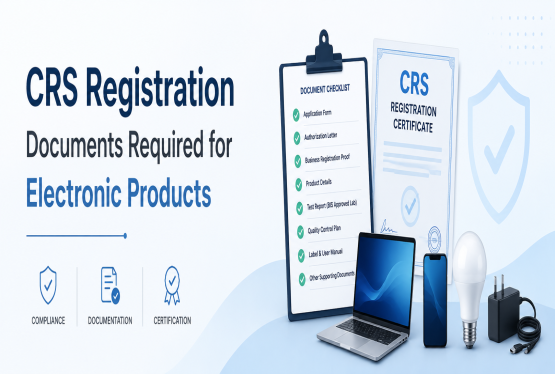
Documents Required for BIS Certification of Webcams
Documentation is an important part of the BIS CRS registration process. The exact checklist can vary depending on whether the manufacturer is Indian or foreign.
|
Document |
Purpose |
|---|---|
|
Business or factory licence |
Establishes manufacturing identity and address |
|
Manufacturer's address proof |
Confirms the manufacturing location |
|
Product specifications |
Identifies technical details and features |
|
Product model list |
Defines models proposed for registration |
|
BIS-recognised laboratory test report |
Demonstrates conformity with the applicable standard |
|
Brand authorisation, where required |
Establishes permission to use the relevant brand |
|
Authorised signatory documents |
Establishes authority to submit the application |
|
AIR nomination documents, if applicable |
Supports representation of a foreign manufacturer |
|
Required declarations and undertakings |
Confirms the manufacturer's compliance obligations |
For example, if a foreign company manufactures webcams in Shenzhen and sells them through an Indian distributor, the manufacturer must provide its factory documents and arrange the required Indian representation. The distributor cannot assume that its own GST Registration or Import Export Code replaces BIS registration.
BIS Certification Fees for Webcams in 2026
The total cost depends on government charges, laboratory testing, number of models and other applicable requirements.
The BIS (Conformity Assessment) Amendment Regulations, 2026 revised the Scheme-II fee provisions.
|
Fee component |
Amount |
|---|---|
|
Application fee |
Rs 1,000 |
|
Processing fee |
Rs 25,000 per application per year |
|
Annual licence fee |
Rs 1,000 |
|
Each additional test report |
Rs 20,000 |
|
Inclusion of new models or extension of scope |
Rs 30,000 per application |
|
Laboratory testing |
Depends on laboratory and testing requirements |
Amounts exclude applicable taxes. MSME/startup concessions may apply where eligibility conditions are satisfied. Confirm the payable amount through the official BIS portal before filing.
For a standard initial application with one test report, the listed first-year BIS charges total Rs 27,000 before applicable taxes and laboratory fees. Additional reports or other services increase the cost.
The 2026 amendments also provide processing-fee concessions for eligible micro, small and medium enterprises and startups. Applicants should verify their category and eligibility before claiming a concession.
Latest BIS Updates and Amendments for Webcams in 2026
Several developments are particularly important for manufacturers planning new registrations or managing existing licences.
1. Transition to IS/IEC 62368-1:2023
Through notification S.O. 4997(E), dated 29 October 2025, the Government introduced migration from earlier standards, including IS 616:2017, to IS/IEC 62368-1:2023. For relevant product categories, including finished webcams, the notified transition allows concurrent use of the older and revised standards until 1 November 2028, subject to applicable implementation guidelines. Manufacturers should plan future testing accordingly.
2. Revised Registration Validity and Fees
The 2026 amendments introduced an initial licence period of up to five years, with annual payment obligations. However, a manufacturer's actual validity depends on the period granted by BIS and the applicable conditions. Businesses should follow their licence document rather than rely on older general portal instructions referring to two-year validity.
3. Updated Series Guidelines
Revised series guidelines were circulated in May 2026 for products covered by IS/IEC 62368-1:2023. These are important for manufacturers selling multiple webcam models with related components, construction or configurations.
4. Further BIS Clarifications
BIS also published FAQs on migration to IS/IEC 62368-1:2023 on 22 July 2026 and guidance on CRS product categories on 13 August 2026. Manufacturers should check these instructions when determining product classification and planning model registration.
2026 Compliance Highlight: Manufacturers should review their existing webcam registrations against the revised standard, current fees, model coverage and annual licence obligations rather than assuming earlier conditions remain unchanged.
Case Study: How a Webcam Startup Prepared for BIS Registration
Consider the example of ClearView Technologies, a fictional startup based in Noida. The company planned to introduce two webcam models: a basic HD webcam for students and a premium 4K webcam for corporate professionals. Initially, the founders believed that importing webcams from an established overseas manufacturer would automatically satisfy Indian compliance requirements. However, while preparing their product launch, they discovered that finished webcams were covered under BIS CRS.
The company contacted its manufacturer and requested details of the factory's existing BIS registration. During the review, it became clear that the new models were not yet covered under the manufacturer's approved registration scope. Instead of rushing the shipment, ClearView coordinated with the manufacturer to identify the correct product standard, organise documents and arrange the required testing. The manufacturer then followed the applicable BIS procedure to obtain registration coverage for the products.
Common Mistakes to Avoid During BIS Registration
Even experienced electronics businesses can face difficulties when product details and compliance documents are not properly coordinated.
-
Incorrect Product Classification: Some applicants confuse finished webcams with CCTV cameras or camera modules. Selecting the wrong product category can complicate registration.
-
Incomplete Factory Documents: Business licences, factory addresses and manufacturer details should be consistent across the supporting documents.
-
Unapproved Product Changes: Alterations involving critical components, electrical design or other relevant specifications may require evaluation and approval.
-
Incorrect Model Coverage: Manufacturers must ensure the models they intend to sell are included within the registration scope.
-
Ignoring Annual Compliance: Failure to maintain applicable licence payments, declarations and product conformity can affect the continuing validity of the registration.
-
Important Reminder: A BIS registration number is not a blanket approval for every product sold under the same brand. Manufacturers and sellers should verify the factory, product category and covered models.
Manufacturers should also understand their ongoing responsibilities through our article on CRS Compliance for Manufacturers, covering product conformity, regulatory obligations and registration maintenance
Benefits of BIS Certification for Webcam Manufacturers
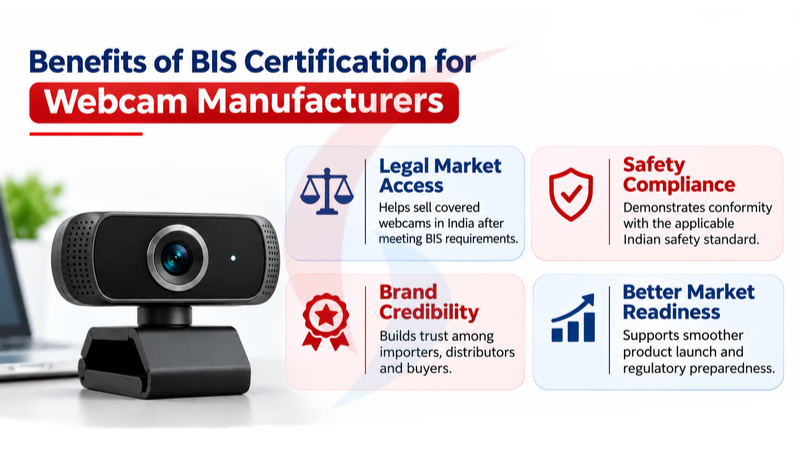
BIS certification is primarily a legal compliance obligation, but completing it properly can also support a business's commercial operations.
First, it helps manufacturers demonstrate that covered products have undergone the prescribed safety assessment. This is important when supplying electronic equipment for everyday use in homes, schools and offices.
Second, it helps importers and distributors verify the registration status of products before placing them in the Indian market. Maintaining the appropriate registration can reduce avoidable compliance disputes.
Finally, registration planning encourages businesses to maintain better technical documentation, model records and change-control procedures. These practices become especially useful when a company expands its product range.
Why Choose Compliance Calendar LLP for BIS Certification for Webcams?
At Compliance Calendar LLP, we understand that manufacturers and importers often find BIS registration confusing, especially when they are introducing electronic products to the Indian market for the first time. Our approach is to understand the product before recommending the registration process. We examine the webcam category, manufacturing information, model specifications and available documents to identify the applicable compliance requirements.
Whether you are an Indian manufacturer introducing a new webcam or an importer working with an overseas factory, our team can assist you with documentation, BIS CRS application preparation, coordination with recognised testing laboratories, regulatory queries and ongoing compliance requirements.
For assistance with BIS registration for webcams, contact Compliance Calendar LLP at +91 9988424211 or info@ccoffice.in.
Frequently Asked Questions (FAQs)
Q1. Is BIS certification mandatory for webcams in India?
Ans. Yes. Finished webcams are included under the BIS Compulsory Registration Scheme. Manufacturers supplying covered webcams in India must comply with the applicable registration requirements. The obligation also applies to covered imported finished webcams.
Q2. Which BIS standard applies to webcams in 2026?
Ans. The updated standard is IS/IEC 62368 (Part 1):2023. It addresses safety requirements for audio/video and information technology equipment. A transition period from the earlier IS 616:2017 standard applies under the relevant government notification.
Q3. Can I import webcams without BIS registration?
Ans. Covered finished webcams generally require valid BIS registration before import for the Indian market. Importers should verify that the foreign manufacturing facility holds the appropriate registration and that the relevant product models are covered.
Q4. How long does BIS certification for webcams take?
Ans. The timeline depends on laboratory availability, product testing, document readiness and BIS application processing. Additional testing or clarification requests may extend the process. Businesses should complete registration planning before fixing their commercial launch date.
Q5. What is the cost of BIS registration for webcams?
Ans. Under the revised 2026 fee provisions, the basic first-year BIS charges for one application with one test report total Rs 27,000 before taxes and laboratory testing. Additional models, test reports and other services may increase the total cost.
Q6. Can one BIS registration cover multiple webcam models?
Ans. Multiple models may be covered where the applicable series guidelines and registration conditions permit. Their construction, critical components and technical differences must be evaluated. Manufacturers should not assume that one approved model automatically covers every model.
Q7. Is BIS registration required for webcams manufactured in China?
Ans. Yes, if the finished webcams are covered products intended for the Indian market. The foreign manufacturer must meet BIS requirements and arrange an eligible Authorised Indian Representative where applicable. Registration is linked to the manufacturing facility and approved product scope.
Q8. What is the validity of BIS CRS registration in 2026?
Ans. The 2026 amendments provide for an initial registration period of up to five years, subject to the licence granted and applicable conditions. Manufacturers must also comply with annual payment and continuing conformity obligations.
Q9. Is BIS certification required for a webcam built into a laptop?
Ans. A camera integrated into a laptop is not automatically treated as a separately marketed finished webcam. The complete laptop falls under its applicable BIS product category. Separate camera modules require an assessment of their classification and supply arrangement.
Q10. What happens if a manufacturer sells webcams without mandatory BIS registration?
Ans. Supplying covered products without the required registration may lead to enforcement action under the BIS Act and applicable rules. Depending on the circumstances, products may face restrictions, seizure or other statutory consequences.
Article last updated on : 12 Nov 2026.