


India's engineering and construction companies are increasingly participating in overseas infrastructure, power, industrial, and consultancy projects. From building highways in Africa to installing industrial machinery in the Middle East, Indian businesses are finding opportunities to deliver complete projects outside India.
However, exporting an engineering project is different from exporting ordinary goods. A company may need to send machinery, deploy engineers, arrange performance guarantees, manage foreign currency payments, and obtain approvals under RBI and foreign trade regulations.
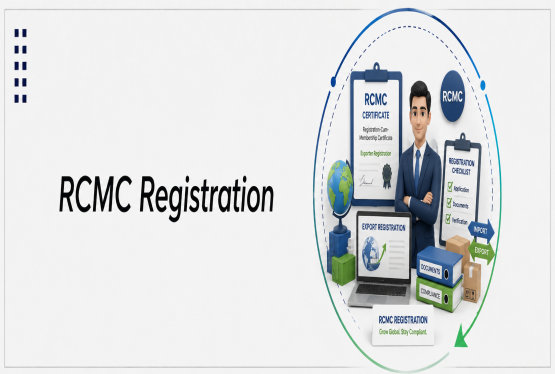
One important registration for eligible businesses is PEPC Registration, which allows exporters to become members of the Project Exports Promotion Council of India and obtain a Registration-cum-Membership Certificate (RCMC Registration).
What is PEPC Registration?
PEPC Registration is the process through which an eligible business becomes a member of the Project Exports Promotion Council of India. The council issues a Registration-cum-Membership Certificate (RCMC) to qualifying members under the applicable Foreign Trade Policy provisions.
The certificate confirms that the exporter is registered with the relevant Export Promotion Council for project-related goods or services. It is useful when applying for specified Foreign Trade Policy authorisations, benefits, or concessions that require RCMC.
PEPC Registration is particularly relevant to companies undertaking overseas construction, turnkey engineering projects, project-related consultancy, and exports of equipment intended for infrastructure projects.
For example, an Indian engineering company supplying machinery and technical services for a cement plant in Kenya may require PEPC membership depending on its export activities and intended regulatory benefits.
Exporters can also understand the RCMC Registration process in India before applying for membership with the appropriate council.
What is the Project Exports Promotion Council of India?
The Project Exports Promotion Council of India was established by the Government of India in 1984 as the Overseas Construction Council of India. It subsequently developed into the Project Exports Promotion Council of India, commonly known as PEPC.
The council promotes Indian companies undertaking international construction, engineering, consultancy, and project-related export activities.
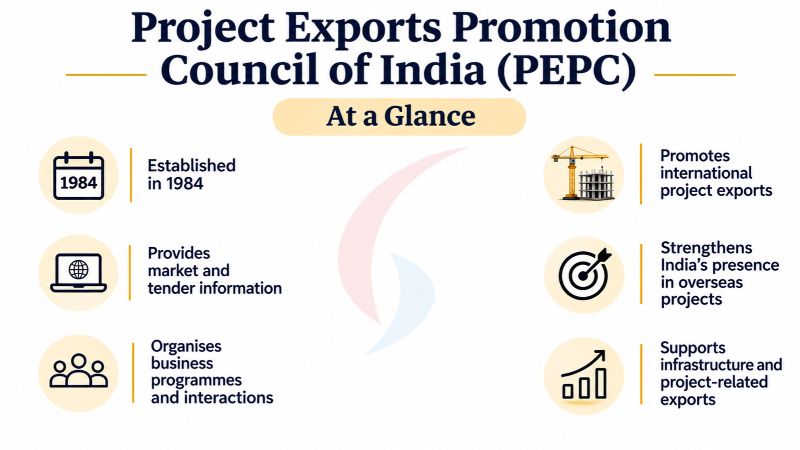
Its objective is to strengthen the participation of Indian businesses in overseas infrastructure development and related projects.
PEPC provides information about international business opportunities, project tenders, trade exhibitions, government policies, and industry developments.
It also organises business programmes and supports interaction between Indian exporters, overseas project authorities, and other stakeholders.
Laws and Legal Provisions Governing PEPC Registration
PEPC Registration is governed by India's foreign trade regulations. Businesses undertaking overseas projects must also comply with relevant customs, taxation, foreign exchange, and banking requirements.
|
Applicable Law or Regulation |
||
|
Sections 3, 5, 7 and 11 |
Regulates foreign trade, IEC, export restrictions, and penalties |
|
|
Paragraphs 2.56 and 2.57 |
Governs Export Promotion Councils and applicable RCMC requirements |
|
|
Paragraphs 2.77 and 2.79–2.84 |
Covers RCMC issuance, validity, amendments, de-registration, and appeals |
|
|
Section 7 and applicable RBI directions |
Regulates export declarations, foreign exchange transactions, and overseas project receipts |
|
|
RBI Project Export Directions |
Applicable RBI Master Directions and PEM instructions |
Governs project-export approvals, banking arrangements, and monitoring |
|
Sections 17, 50, 113 and 114 |
Regulates export declarations, assessment, confiscation, and penalties |
|
|
Section 16 |
Provides zero-rated treatment for qualifying exports, subject to applicable conditions |
Under the Foreign Trade Policy, 2023, PEPC RCMC is required for specified export authorisations, benefits, and concessions, subject to applicable exemptions. However, PEPC membership does not replace separate RBI approvals, customs documentation, or other statutory requirements for overseas projects.
What Types of Projects Are Covered Under PEPC?
PEPC represents businesses engaged in project exports and related engineering activities. Its published membership categories cover construction and turnkey engineering projects, process and engineering consultancy, and project construction items.
|
Project Category |
Examples |
|
Construction Projects |
Roads, bridges, buildings, industrial facilities, and infrastructure construction |
|
Turnkey Engineering Projects |
Power plants, cement plants, factories, and complete industrial installations |
|
Engineering Consultancy Services |
Project design, engineering consultancy, technical planning, and related services |
|
Process Consultancy |
Industrial process development, plant design, and technical advisory services |
|
Project Construction Items |
Machinery, equipment, and eligible goods supplied for project execution |
The appropriate PEPC category depends on the company's principal export activity and the relevant council requirements. For example, a contractor constructing a highway overseas has different commercial responsibilities from a manufacturer exporting equipment for the project.
Although both businesses may participate in international infrastructure development, their membership categories, documents, and regulatory obligations may differ.
Who Needs PEPC Registration in India?
PEPC Registration is relevant to Indian companies involved in executing overseas projects or exporting eligible project-related goods and services.
Construction and Infrastructure Companies
Businesses undertaking road construction, bridges, buildings, industrial complexes, and other infrastructure projects abroad may apply for PEPC membership. These companies often require careful coordination between foreign exchange approvals, equipment movement, guarantees, and project payments.
Turnkey Engineering Contractors
Turnkey contractors undertake responsibility for delivering a complete project according to agreed technical specifications. For example, a company may be responsible for designing, supplying, installing, testing, and commissioning a power generation facility in another country. Such businesses may fall within PEPC's construction and turnkey engineering category.
Engineering and Technical Consultancy Firms
Indian engineering consultancy businesses providing project design, process engineering, technical supervision, and related services overseas may also qualify. They should select the correct consultancy membership category rather than assuming that every engineering business belongs to the construction category.
Exporters of Project Construction Items
Companies supplying eligible equipment, machinery, and project-related construction goods may apply under the appropriate PEPC category. The precise product coverage should be verified before selecting PEPC as the registering authority.
New and Prospective Project Exporters
PEPC's official guidance confirms that businesses with nil export performance can also apply for membership. Therefore, a company does not necessarily need to complete an overseas project before seeking membership, provided it satisfies the council's eligibility and documentation requirements.
Eligibility Criteria for PEPC Registration
Applicants must satisfy the council's membership requirements and establish that their business activities fall within PEPC's jurisdiction.
The principal eligibility conditions are:
-
Legally Established Business: The applicant should be an eligible company, LLP, partnership firm, or another permitted entity with valid constitution documents.
-
Active Import Export Code: Applicants should generally hold an active IEC issued by DGFT and maintain accurate business information.
-
Relevant Project Activity: The business should undertake or propose eligible construction, turnkey engineering, consultancy, or project goods exports.
-
Financial Information: Applicants must provide relevant turnover records and a solvency certificate from their bank.
-
Project Experience: The council requests details of up to five recent projects and information about the company's activities and specialisation.
-
Membership Classification: Applicants must select the correct category according to their principal activities and relevant turnover.
A company without previous exports may apply, but its proposed activities must genuinely fall within the council's scope.
Documents Required for PEPC Registration
PEPC publishes a specific documentation checklist for new membership applications.
|
Document |
Purpose |
|
Membership-cum-RCMC Application |
Formal request for PEPC membership |
|
Confirms the applicant's DGFT identification |
|
|
PAN and GST Details |
Establish business identification and applicable tax records |
|
Bank Solvency Certificate |
Provides financial soundness information |
|
Previous Year's Turnover |
Helps determine the membership fee category |
|
Details of Five Recent Projects |
Establishes relevant project experience, where available |
|
Company Profile |
Explains business activities, expertise, and specialisation |
|
Required where applicable for the relevant membership category |
|
|
Memorandum or Constitution Documents |
Establishes the applicant's authorised business objects |
|
Member Information Form and Product List |
Provides membership and RCMC product or service details |
PEPC instructs applicants to provide duly signed and stamped documents. For new companies without five completed projects, the applicant should provide accurate available information and clarify its position with the council rather than inventing project experience. Applicants should also ensure that the IEC, PAN, GST, company name, and registered address match across all records.
PEPC Registration Process Online in 2026
PEPC uses the DGFT common electronic RCMC platform for membership applications, renewals, and amendments. The council confirms that online filing through DGFT is mandatory.
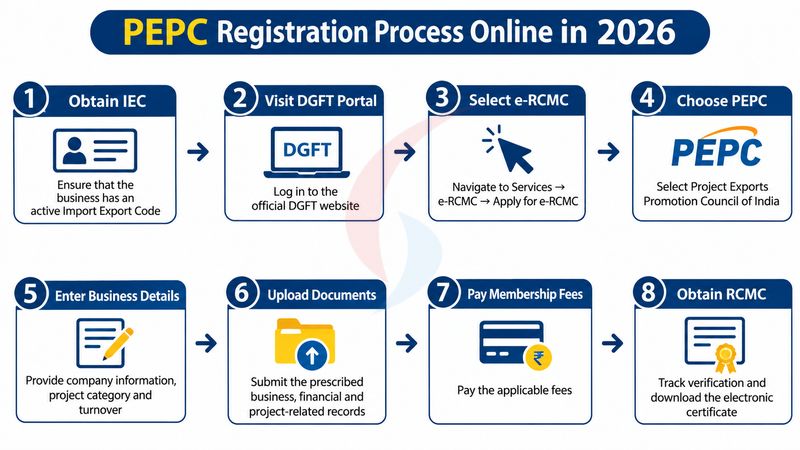
|
Step |
PEPC Registration Process |
|
Step 1: Obtain IEC |
Ensure that the business has an active Import Export Code |
|
Step 2: Visit DGFT portal |
Log in to the official DGFT website |
|
Step 3: Select e-RCMC |
Navigate to Services → e-RCMC → Apply for e-RCMC |
|
Step 4: Choose PEPC |
Select Project Exports Promotion Council of India |
|
Step 5: Enter Business Details |
Provide company information, project category, turnover, and authorised representative details |
|
Step 6: Upload Documents |
Submit the prescribed business, financial, and project-related records |
|
Step 7: Pay Membership Fees |
Pay the applicable entrance fee, subscription, web promotion charges, and GST |
|
Step 8: Obtain RCMC |
Track verification and download the electronic certificate after approval |
Businesses planning to undertake overseas projects must obtain a valid IEC from DGFT.
Read our guide on the Procedure for Obtaining Import Export Code to understand the required documents and online registration process before applying for PEPC Registration.
Practical Example: An Engineering Company in Pune
Suppose a Pune-based engineering company receives an overseas contract enquiry for installing industrial equipment in Kenya.
The company has technical expertise but has never completed a project outside India.
Its management first reviews the contract scope, banking arrangements, IEC status, and applicable RBI requirements.
The company then prepares its PEPC membership application, including financial information and a note explaining its technical specialisation.
It also contacts its authorised dealer bank to determine whether project-export approval will be required after the contract is awarded.
This early preparation helps the business understand its obligations before making binding commercial commitments.
PEPC Registration Fees in India for 2026–27
PEPC membership fees depend on the applicant's business category and annual turnover during the preceding financial year. The council's published schedule provides separate charges for construction and turnkey projects, engineering consultancy, and project construction items.
Annual Membership Fees for Construction and Turnkey Projects
|
Annual Turnover |
Membership Subscription |
|
Up to Rs 25 crore |
Rs 50,000 |
|
Above Rs 25 crore |
Rs 75,000 |
|
Above Rs 250 crore |
Rs 1,00,000 |
|
Above Rs 500 crore |
Rs 1,25,000 |
The one-time admission fee for a new member is equivalent to the applicable annual membership subscription. Annual web promotion charges of Rs 5,000 and applicable GST are additional.
The council publishes overlapping descriptions of the higher turnover bands, so applicants should confirm the exact fee bracket shown by the official application system.
Annual Membership Fees for Engineering Consultancy
|
Annual Turnover |
Membership Subscription |
|
Up to Rs 5 crore |
Rs 20,000 |
|
Above Rs 5 crore to Rs 10 crore |
Rs 30,000 |
|
Above Rs 10 crore to Rs 25 crore |
Rs 50,000 |
|
Above Rs 25 crore |
Rs 75,000 |
Higher turnover categories are subject to subscriptions reaching Rs 1,00,000 or Rs 1,25,000 under the council's published schedule. For new consultancy members, the one-time admission fee is equivalent to one year's applicable subscription. Annual web promotion charges of Rs 3,000 and GST are additional.
Membership Fees for Project Construction Items
For exporters of project construction items, the published subscription begins at Rs 7,500 for the lowest turnover category and increases through higher turnover bands to Rs 35,000.
The council lists a one-time admission fee of Rs 5,000 and annual web promotion charges of Rs 1,000 for this category, with GST as applicable.
Important: These figures come from PEPC's accessible official membership schedule. A separately verified FY 2026–27 revised fee circular was not identified. Applicants should confirm the current amount before payment rather than assuming the published figures represent a new fee notification.
PEPC RCMC Validity and Annual Renewal
Under the general DGFT Handbook of Procedures, an RCMC is ordinarily valid for five licensing years beginning on 1 April of the licensing year in which it is issued, unless another period is specified. However, PEPC membership subscriptions are payable annually.
The council states that membership fees become due on 1 April and should be paid by 30 June each year. Its published instructions provide for a late fee of Rs 5,000 from 1 July where annual renewal is delayed.
PEPC also states that membership subscription cannot be paid in advance for multiple years under its existing arrangements. Businesses should therefore maintain both their RCMC validity and annual PEPC membership status.
Benefits of PEPC Registration for Exporters
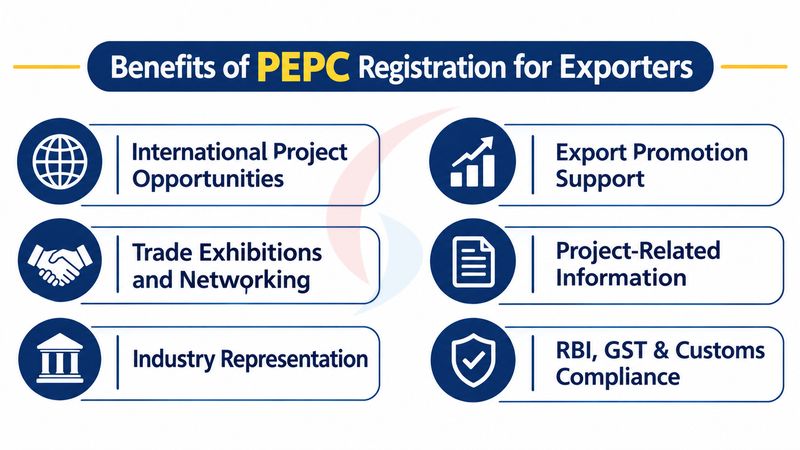
PEPC Registration helps Indian engineering and construction companies explore overseas project opportunities while ensuring compliance with applicable RBI, GST, customs, and project-export requirements.
|
Particulars |
Key Details |
|---|---|
|
International Project Opportunities |
Provides information about overseas tenders, infrastructure projects, and business opportunities. |
|
Trade Exhibitions and Networking |
Supports international events, trade delegations, and buyer-seller meetings. |
|
Industry Representation |
Represents project exporters before government authorities on trade and regulatory matters. |
|
Export Promotion Support |
Provides information about eligible government schemes and export assistance programmes. |
|
Project-Related Information |
Offers market insights, technical updates, and overseas project opportunities. |
|
RBI Approval Requirements |
Qualifying turnkey, civil construction, and deferred-payment engineering projects require post-award approval through an AD Category-I Bank or Exim Bank before execution. |
|
Screening Committee Clearance |
Certain overseas projects may require separate clearance under applicable PEPC guidelines. |
|
Customs Compliance |
Section 50 of the Customs Act, 1962 governs export declarations and Shipping Bills for goods. |
|
GST Compliance |
Section 16 of the IGST Act provides zero-rated treatment for qualifying exports, subject to applicable conditions. |
|
Export Documentation |
Exporters must maintain contracts, invoices, packing lists, shipping documents, and relevant banking records. |
Practical Example: An Indian construction company securing a bridge project in Africa may need RBI post-award approval, applicable Screening Committee Clearance, and customs documentation before commencing the project. PEPC membership supports its export activities but does not replace these approvals.
For more information, read our guide on ICEGATE Registration for Import Export Business to understand electronic customs filing and export documentation.
Latest PEPC Registration and Project Export Updates in 2026
Several developments remain important for project exporters as of November 2026.
|
Latest Update |
Key Details |
|
RCMC Exemption – September 2026 |
DGFT introduced an exemption for qualifying export consignments with FOB value up to Rs 3 lakh |
|
DGFT e-RCMC System |
PEPC applications, amendments, and renewals continue through the common electronic platform |
|
Annual PEPC Renewal |
Membership subscriptions are due from 1 April and ordinarily payable by 30 June |
|
RBI Project Export Approval |
Qualifying project contracts continue to require post-award approval through AD Category-I banks or Exim Bank |
|
Membership Fee Verification |
Applicants should verify the current PEPC fee category and payable amount before applying |
September 2026 RCMC Exemption
DGFT Notification No. 36/2026-27, dated 15 September 2026, amended Paragraph 2.57 of the Foreign Trade Policy, 2023. The amendment exempts qualifying export consignments with a Free-on-Board value not exceeding Rs 3 lakh from the specified RCMC or Certificate of Registration requirement.
However, this exemption does not remove RBI project-export approval requirements or other legal obligations. It also should not automatically be applied to an entire construction or consultancy contract merely because an individual component or payment is relatively small. The exemption must be assessed against the relevant export consignment and the applicable legal provision.
Why Choose Compliance Calendar LLP ?
International project exports involve several regulatory procedures, including IEC, PEPC membership, DGFT e-RCMC filing, financial documentation, and applicable foreign exchange requirements.
At Compliance Calendar LLP, we understand the registration and documentation challenges faced by construction companies, engineering consultants, and project exporters. Our team provides assistance with business registrations, RCMC applications, and related compliance requirements.
|
Our Services |
How We Can Help |
|
Eligibility Assessment |
Guidance on PEPC membership eligibility and exporter categories |
|
Documentation Support |
Assistance with IEC, PAN, GST, bank certificates, and project documents |
|
RCMC Application |
Support with preparing and filing the DGFT e-RCMC application |
|
Renewal Guidance |
Assistance with membership renewal, amendments, and related compliance |
|
Personalised Support |
Guidance based on the company's project activities and business structure |
Whether you operate an engineering consultancy or a construction business entering international markets, we aim to make the registration process easier to understand. For professional assistance, explore our RCMC Registration services or contact Compliance Calendar LLP on 91 9988424211 or info@ccoffice.in Final PEPC membership approval, RCMC issuance, and any separate regulatory approvals remain subject to the respective competent authorities.
Frequently Asked Questions (FAQs)
Q1. What is PEPC Registration in India?
Ans: PEPC Registration is the process of obtaining membership from the Project Exports Promotion Council of India. Eligible exporters receive an RCMC for applicable project-related goods and services. The certificate supports compliance with specified Foreign Trade Policy requirements and provides access to council services.
Q2. Is PEPC Registration mandatory for project exporters?
Ans: PEPC membership is not automatically mandatory for every overseas construction or engineering contract. RCMC is required where an applicable authorisation, benefit, or concession specifies it. Separate RBI project-export approvals may still be required, depending on the contract.
Q3. What are the PEPC Registration fees in 2026?
Ans: PEPC's published annual subscription starts at Rs 50,000 for construction and turnkey projects, Rs 20,000 for engineering consultancy, and Rs 7,500 for project construction items. Admission fees, web promotion charges, and GST are additional. Applicants should verify the latest payable fees.
4. What documents are required for PEPC Registration?
Ans: Applicants generally need IEC, PAN, GST details, a bank solvency certificate, turnover information, and business constitution documents. PEPC also requests project experience details, a company profile, a membership information form, and a product list. Additional documents may apply to specific categories.
Q5. How can I apply for PEPC Registration online?
Ans: Applicants can visit the DGFT portal, open the e-RCMC service, and select PEPC as the registering authority. They must complete the application, upload documents, and pay the applicable charges. After verification and approval, the electronic RCMC can be downloaded.
Q6. What is the validity of PEPC RCMC?
Ans: Under general DGFT rules, an RCMC is ordinarily valid for five licensing years unless otherwise specified. However, PEPC membership fees must be paid annually. Members should maintain their subscriptions and check the certificate's validity and council renewal requirements.
Q7. Can a new company apply for PEPC Registration?
Ans: Yes. PEPC's official guidance confirms that businesses with nil export performance may apply for membership. However, the applicant must satisfy the relevant eligibility conditions and provide genuine information about its activities, financial position, and available project experience.
Q8. What is the PEPC membership renewal deadline?
Ans: PEPC membership subscriptions become due on 1 April and should generally be paid by 30 June every year. The council's published instructions provide for a late fee of Rs 5,000 from 1 July. Members should confirm the current renewal instructions before payment.
Q9. Is RBI approval required for overseas construction projects?
Ans: Qualifying turnkey projects, civil construction contracts, and engineering exports on deferred payment terms require post-award approval under applicable RBI directions. The approval is handled through an AD Category-I bank or Exim Bank. PEPC membership does not replace this requirement.
Q10. Can Compliance Calendar LLP assist with PEPC Registration?
Ans: Yes. Compliance Calendar LLP provides assistance with RCMC documentation, PEPC membership applications, DGFT filing procedures, and renewal guidance. Businesses can contact our team for support based on their project-export activities.
Article last updated on : 13 Nov 2026.