


India is known for its IT companies, software developers and growing electronics manufacturing industry. From mobile components made in Noida to software developed in Bengaluru, Indian businesses serve customers across the world. However, receiving an international order is only one part of becoming an exporter. Understanding the applicable registrations and legal requirements is equally important.
Consider Rohan, who runs a small software development company in Pune. His team builds inventory management software for Indian retailers. One day, a business owner from Singapore approaches him to develop a customised software application. The contract is worth Rs 12 lakh, and Rohan is excited about his first international client.
While preparing the agreement, he comes across Electronics and Computer Software Export Promotion Council Registration, commonly known as ESC Registration. He wants to know whether his business needs RCMC, what documents are required and how much membership costs.
ESC Registration allows eligible electronics, computer software and IT-enabled service exporters to obtain membership and a Registration-cum-Membership Certificate (RCMC Registration) from the Electronics and Computer Software Export Promotion Council. This article explains the registration process, legal requirements, fees, validity and important 2026 updates.
What Is Electronics and Computer Software Export Promotion Council Registration?
The Electronics and Computer Software Export Promotion Council (ESC India) is an Export Promotion Council sponsored by the Government of India. It promotes Indian electronics, software and IT-enabled services in international markets. ESC helps exporters through international exhibitions, buyer-seller meetings, market information, trade enquiries and policy representation.
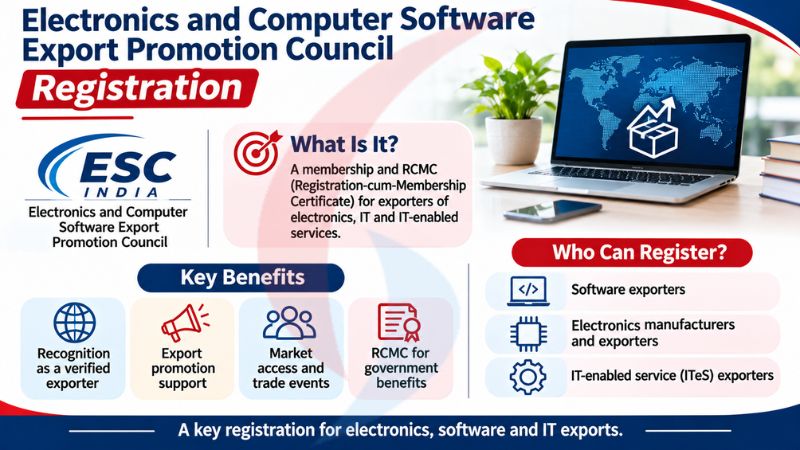
It confirms that a business is registered with an appropriate Export Promotion Council for its principal export activities. For Rohan, ESC membership could help him understand overseas business opportunities and participate in relevant trade promotion events.
Is ESC Registration Mandatory for Software and Electronics Exporters?
ESC RCMC is not automatically compulsory for every ordinary software or electronics export. Under Paragraph 2.57 of the Foreign Trade Policy, 2023, RCMC is generally required for specified authorisations, benefits and concessions, unless exempted.
For example, Rohan may provide software development services to his Singapore client without obtaining RCMC solely for that transaction, provided he meets the other applicable legal requirements.
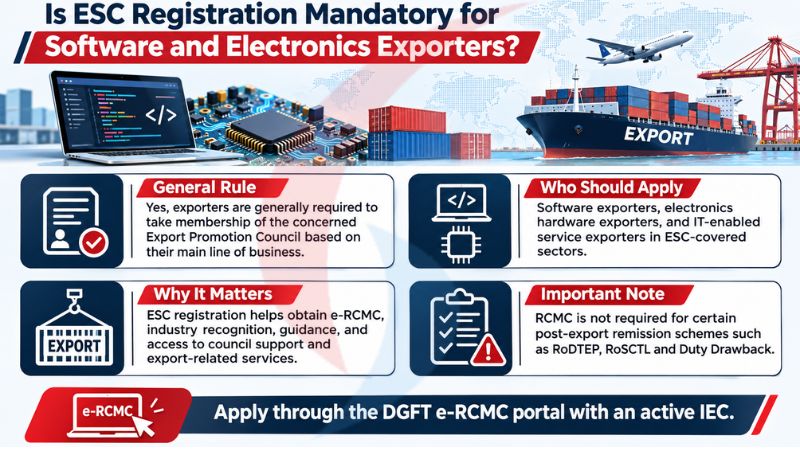
An important distinction applies to the Import Export Code (IEC). Under the FTP, IEC is generally required for goods exports, but for services or technology exports it is required when the provider seeks FTP benefits or deals in specified services or technologies, subject to applicable rules.
Exporters should understand why RCMC Registration matters for Indian exporters before applying for relevant export benefits.
Who Can Apply for ESC India Registration?
ESC membership is available to eligible businesses exporting electronics hardware, software products and IT-enabled services. Proprietorships, partnerships, LLPs, companies and qualifying startups may apply under the applicable membership rules.
The council's product and service coverage includes:
|
Export category |
Examples |
|
Electronics Hardware |
Electronic components, consumer electronics and equipment |
|
Computer Hardware |
Computers, peripherals and related products |
|
Telecom Equipment |
Communication devices and components |
|
Software Products |
Applications, platforms and packaged software |
|
Software Development |
Customised software solutions |
|
IT-Enabled Services |
BPO, KPO, LPO and other qualifying services |
Manufacturer exporters and merchant exporters must select the appropriate classification. ESC's membership guidelines also recognise prospective exporters, subject to the applicable registration conditions.
Laws Governing ESC RCMC Registration in India
Several Indian laws are relevant to electronics and software exporters.
-
Foreign Trade (Development and Regulation) Act, 1992: Section 3 empowers the Central Government to regulate imports and exports. Section 5 deals with Foreign Trade Policy, while Section 7 governs IEC requirements, subject to exemptions.
-
Foreign Trade Policy, 2023: Paragraphs 2.56 and 2.57 address recognised registering authorities and applicable RCMC requirements.
-
DGFT Handbook of Procedures: Paragraphs 2.93 and 2.94 cover RCMC registration and application procedures. Manufacturer exporters must provide appropriate evidence of manufacturing activity.
-
Customs Act, 1962: Section 50 governs export declarations for goods, including relevant shipping bills and customs formalities.
-
IGST Act, 2017: Section 16 governs zero-rated supplies, including eligible exports of goods and services. Software exporters must satisfy the statutory conditions for a supply to qualify as an export of services.
-
FEMA, 1999: Exporters must comply with applicable RBI directions concerning foreign exchange receipts, export reporting and realisation of proceeds.
Electronics exporters must also check applicable BIS Quality Control Orders, electronic waste requirements and destination-country technical standards. Software exporters should examine contractual obligations, data protection requirements and applicable tax provisions. ESC RCMC does not replace these obligations.
Documents Required for ESC Registration
Before applying, businesses should prepare their identification and registration documents. The exact checklist depends on the type of exporter and business structure.
|
Document |
Purpose |
|
Exporter identification for the e-RCMC application |
|
|
PAN |
Business tax identification |
|
Verification where applicable |
|
|
Certificate of Incorporation |
|
|
Partnership Deed |
Partnership business details |
|
MSME or manufacturing evidence, where relevant |
|
|
Manufacturing Proof |
Required for applicable manufacturer exporter applications |
|
Export Turnover Details |
Membership fee classification |
|
Authorised Signatory Details |
Application verification |
ESC's current membership guidance specifically mentions IEC, GST registration and manufacturing evidence where relevant. Rohan prepares his company's IEC-linked information, PAN, GST particulars and incorporation records. He also checks that the company name and registered address match across the documents.
New exporters can follow the RCMC Registration Checklist for New Export Businesses to avoid incomplete applications.
How to Apply for ESC RCMC Registration Online in 2026
Applications for ESC e-RCMC are submitted through the DGFT portal. Exporters should confirm their membership category and supporting documents before starting.
|
Step |
Registration process |
|
1. Prepare IEC |
Obtain an active IEC and update the DGFT profile. |
|
2. Visit DGFT |
Log in to the DGFT portal. |
|
3. Open e-RCMC |
Select Services → e-RCMC → Apply for e-RCMC. |
|
4. Choose ESC |
Select Electronics and Computer Software Export Promotion Council. |
|
5. Enter Details |
Provide business, product, service and export information. |
|
6. Upload Documents |
Attach required certificates and declarations. |
|
7. Authenticate |
Complete the permitted digital signature or Aadhaar e-sign process. |
|
8. Pay Fees |
Pay the applicable membership charges. |
|
9. Submit Application |
Track the application and respond to clarification requests. |
|
10. Obtain RCMC |
Access the electronic certificate after approval. |
The RCMC Registration Online in India guide explains the broader DGFT application process.
ESC Registration Fees in 2026
ESC's official membership website publishes annual charges based on export performance.
|
Export performance slab |
Annual fee including 18% GST |
|
Up to Rs 10 lakh |
Rs 11,800 |
|
Rs 10 lakh to Rs 50 lakh |
Rs 18,290 |
|
Rs 50 lakh to Rs 1 crore |
Rs 25,665 |
|
Rs 1 crore and above |
Rs 34,220 |
|
Eligible institutions and trade associations |
Rs 23,600 |
ESC RCMC Validity and Renewal
ESC RCMC generally remains valid for five licensing years, unless otherwise specified. For example, an RCMC issued during FY 2026–27 would ordinarily remain valid until 31 March 2031.
However, membership fees and renewal obligations must be maintained separately. Exporters should update changes in their business constitution, address or ownership under the applicable DGFT procedures. ESC also requires members to submit export turnover information through the prescribed reporting process.
Benefits of ESC Registration for Exporters
ESC membership offers practical opportunities beyond obtaining RCMC.
|
Benefit |
How it helps |
|
International Exhibitions |
Opportunities to showcase products and services |
|
Buyer-Seller Meetings |
Connections with potential overseas customers |
|
Market Information |
Insights into international technology markets |
|
Trade Enquiries |
Access to relevant business leads and tenders |
|
Policy Representation |
Support with industry-level trade concerns |
|
Government Programmes |
Information about eligible export promotion assistance |
For instance, after completing his Singapore project, Rohan may explore ESC-supported events such as INDIASOFT to present his software to international customers.
Latest ESC Registration Updates in 2026
The following table highlights important regulatory changes, software export growth and government initiatives relevant to electronics and software exporters in India.
|
Latest Update |
Key Details |
Impact on Exporters |
|---|---|---|
|
1. RCMC Exemption for Small Consignments |
DGFT Notification No. 36/2026-27, dated 15 September 2026, exempts qualifying export consignments with FOB value not exceeding Rs 3 lakh from applicable RCMC requirements under Paragraph 2.57 of FTP 2023. |
Reduces RCMC-related requirements for eligible small-value goods shipments. The exemption should not automatically be applied to software service contracts. |
|
2. Growth in Software Exports |
According to RBI's survey released on 18 September 2026, India's software services exports reached US$221.4 billion in FY 2025–26, excluding sales through overseas commercial presence, reflecting 8.2% annual growth. |
Highlights growing international demand and opportunities for Indian software companies, IT service providers and technology exporters. |
|
3. Export Market Support |
ESC highlights the TRACE initiative for eligible testing and certification expenses and an India–USA trade facilitation platform for member exporters. |
Helps eligible exporters explore compliance assistance, international market access and business opportunities, subject to applicable scheme conditions. |
Compliance Requirements After ESC Registration
Electronics exporters must maintain accurate invoices, shipping bills, product classifications and applicable customs records.
They can review ICEGATE Registration for Import Export Business for electronic customs procedures.
For relevant goods exports, businesses should also understand AD Code Registration and applicable banking requirements.Software exporters must maintain contracts, invoices, foreign remittance records and documentation supporting the tax treatment of their services. They should also check data protection obligations and any applicable RBI or STPI reporting requirements.
Conclusion
Rohan's first international software project shows how overseas opportunities can encourage small Indian businesses to expand beyond domestic markets. However, exporters must understand registrations, tax rules, foreign exchange requirements and industry-specific compliance before growing internationally.
Electronics and Computer Software Export Promotion Council Registration helps eligible businesses obtain recognised membership and RCMC for applicable Foreign Trade Policy purposes. With the latest 2026 developments, exporters should check their eligibility, prepare accurate documents and complete registration through the prescribed DGFT process.
Frequently Asked Questions (FAQs)
Q1. What is ESC RCMC Registration in India?
Ans: ESC RCMC Registration allows eligible electronics, computer software and IT-enabled service exporters to obtain membership with the Electronics and Computer Software Export Promotion Council. It supports applicable Foreign Trade Policy requirements and provides access to export promotion activities.
Q2. Is ESC Registration mandatory for software exporters in India?
Ans: No. ESC Registration is not compulsory for every software export transaction. However, exporters may require an RCMC when applying for specified Foreign Trade Policy benefits, authorisations or concessions, unless exempted.
Q3. What is the ESC Registration fee in India in 2026?
Ans: ESC's published annual membership charges start at Rs 11,800, including 18% GST. The actual amount depends on the exporter's turnover category, while fresh registration may involve additional admission charges.
Q4. Can a software startup apply for ESC RCMC Registration?
Ans: Yes. Eligible software startups, IT companies and new exporters can apply for ESC membership. Applicants must fulfil the relevant DGFT e-RCMC requirements and provide the documents prescribed for their business category.
Q5. What is the validity of an ESC RCMC certificate?
Ans: ESC RCMC is generally valid for five licensing years, unless otherwise specified. Exporters must also maintain their membership subscription and update their business information according to the applicable council and DGFT requirements.
Q6. How can I apply for ESC Registration online through DGFT?
Ans: Visit the official DGFT portal, open the e-RCMC service and select ESC India as the registering authority. Complete the application, upload the required documents, pay the applicable membership fees and submit it for approval.
Q7. What documents are required for ESC RCMC Registration?
Ans: Common documents include IEC, PAN, GST details where applicable, business registration documents and export turnover information. Manufacturer exporters may also need Udyam Registration or other acceptable manufacturing evidence.
Q8. Can IT service companies export software without ESC Registration?
Ans: Yes. Eligible IT companies can provide software development and other permitted services to overseas clients without ESC RCMC where no applicable rule requires it. They must still comply with relevant GST, FEMA and other legal requirements.
Q9. What are the benefits of Electronics and Computer Software Export Promotion Council Registration?
Ans: ESC membership provides access to relevant international exhibitions, buyer-seller meetings, market information and trade promotion activities. Eligible exporters may also explore government assistance programmes, subject to their specific eligibility conditions.
Q10. What are the latest ESC Registration rules and updates in 2026?
Ans: Important 2026 developments include DGFT's RCMC exemption for qualifying goods export consignments with an FOB value not exceeding Rs 3 lakh. Exporters should also check ESC's current membership fees, electronic application requirements and applicable export promotion schemes.
Article last updated on : 11 Nov 2026.