


Imagine a silk manufacturer in Varanasi who has spent years producing beautiful Banarasi silk sarees for Indian customers. One day, a fashion boutique in Paris discovers the manufacturer's collection through an online exhibition and places an order worth Rs 12 lakh. The manufacturer is excited about entering the international market, but while arranging the export documentation, an important question arises: Is ISEPC Registration required for exporting silk products from India?
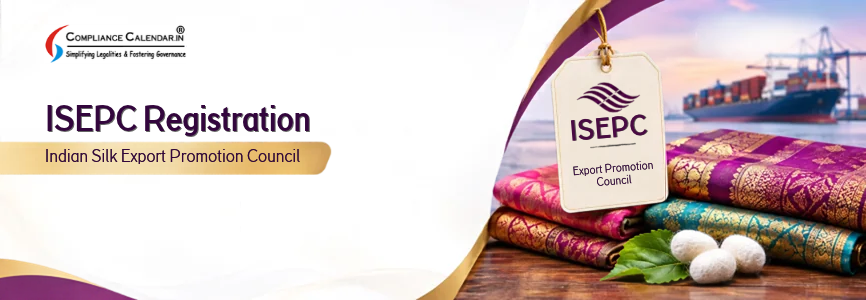
This is a common situation for Indian silk manufacturers, traders and first-time exporters. Producing high-quality silk products is only one part of international business. ISEPC Registration, also known as Indian Silk Export Promotion Council Registration, helps eligible silk exporters obtain membership with the Council and an RCMC (Registration-cum-Membership Certificate). The Council supports the development of India's silk exports through international trade promotion, buyer-seller meetings, market information and representation of industry concerns.
If you are entering the international silk market for the first time, explore our guide on Planning to Export? Start with RCMC Registration.
What is ISEPC Registration?
The Indian Silk Export Promotion Council (ISEPC) is an export promotion organisation established to support and promote the export of Indian silk and silk-based products in international markets. It operates as a sector-specific Export Promotion Council, helping connect Indian exporters with overseas buyers and providing industry-level trade support. ISEPC Registration refers to obtaining membership with the Council. Eligible exporters can also receive a Registration-cum-Membership Certificate through the DGFT's electronic RCMC system.
The Council is relevant to businesses exporting silk fabrics, silk garments, silk accessories and other eligible silk products. It supports Indian exporters by organising and facilitating international exhibitions, buyer-seller meetings, export awareness programmes and trade-related activities.
For example, a company in Bengaluru manufacturing silk scarves may already have an Importer Exporter Code (IEC). However, when the company starts exploring export promotion schemes and international exhibitions, ISEPC membership can provide additional industry-specific support.
If you want to understand the complete registration process, required documents and application steps, read our detailed guide on How to Apply for RCMC Registration Online in India.
Why is the Indian Silk Export Promotion Council Important?
India has a long history of silk manufacturing, weaving and textile craftsmanship. Products such as Banarasi silk sarees, Kanchipuram silk fabrics, silk scarves, silk stoles and designer silk garments have demand among overseas customers.
However, international buyers may require consistent quality, clear product specifications, reliable delivery schedules and proper documentation. Small manufacturers sometimes find it difficult to identify genuine international buyers or understand overseas trade requirements. ISEPC helps bridge this gap by supporting export promotion and facilitating interaction between Indian businesses and foreign markets.
Its activities include international trade exhibitions, reverse buyer-seller meets, market intelligence, export-related seminars and representation of trade concerns before appropriate authorities. Membership may also provide access to certain promotional opportunities, subject to applicable conditions.
To understand how Export Promotion Council membership supports Indian exporters, read our article on Why RCMC Registration Matters for Indian Exporters.
Who Needs ISEPC Registration in India?
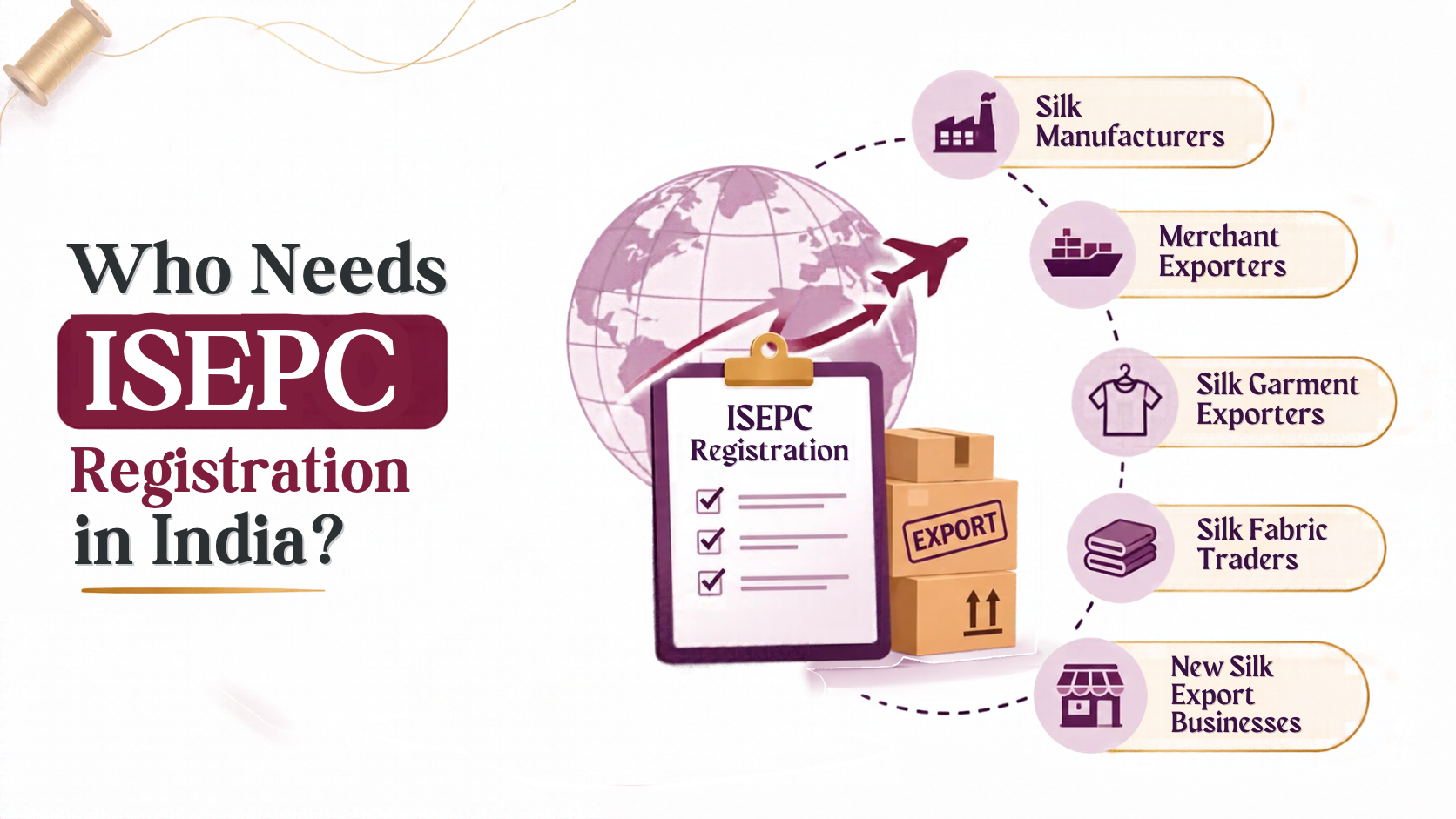
ISEPC membership is relevant to manufacturers, merchant exporters and businesses dealing in eligible silk products. Both established exporters and businesses planning to enter international markets may consider registration.
|
Type of business |
Example |
Relevance of ISEPC |
|
Silk manufacturers |
A Varanasi unit producing silk sarees |
Industry membership and export promotion support |
|
Merchant exporters |
A Delhi trader sourcing silk fabrics from weavers |
RCMC and overseas buyer networking |
|
Silk garment exporters |
A Bengaluru company exporting silk dresses |
Trade exhibitions and market information |
|
Silk accessories exporters |
A Jaipur business exporting silk scarves |
International market development |
|
Silk fabric wholesalers |
A Surat supplier selling silk blends overseas |
Relevant council membership and RCMC |
|
New silk export businesses |
A startup selling silk stoles internationally |
Guidance and future export opportunities |
A manufacturer does not necessarily need to operate a large factory to become an exporter. A merchant exporter can purchase eligible silk products from domestic suppliers and sell them internationally, subject to applicable laws and documentation. The important consideration is whether the business's main line of export activity falls within the Council's jurisdiction.
Is ISEPC Registration Mandatory for Silk Exporters?
ISEPC Registration is not automatically mandatory merely because a business sells silk products outside India. For exporters whose principal products fall under the jurisdiction of ISEPC, the Council is generally the relevant authority for obtaining an RCMC.
Example: A Kolkata company exporting silk fabrics worth Rs 18 lakh may need an appropriate RCMC when applying for an FTP authorisation or concession that requires one. However, the company should examine the specific scheme requirements rather than assume that every shipment is prohibited without ISEPC membership.
A silk exporter already holding a valid RCMC from the appropriate council does not ordinarily need separate certificates from every council simply because it diversifies into additional products. Important Legal Point: An RCMC requirement depends on the applicable Foreign Trade Policy provisions, the export product and the particular authorisation or benefit involved. Exporters should distinguish between the legal requirements for making an export and the conditions for accessing specific export promotion schemes.
Latest DGFT Update 2026: RCMC Exemption for Exports up to Rs 3 Lakh
An important development for small exporters was introduced through DGFT Notification No. 36/2026-27, dated 15 September 2026.
Consider a small business in Mysuru exporting handmade silk scarves worth Rs 2.40 lakh to a buyer in Singapore. If the consignment qualifies under the notification, the exporter can benefit from the RCMC exemption for that shipment.
However, if the business subsequently receives an order worth Rs 7 lakh, the exemption will not apply to that consignment, and the usual RCMC requirements must be considered wherever applicable. The exemption does not remove separate obligations relating to IEC, customs declarations, GST, product restrictions or destination-country regulations.
2026 Regulatory Highlight: Export consignments with an FOB value of up to Rs 3 lakh are exempt from the specified RCMC requirement under DGFT Notification No. 36/2026-27. This is a consignment-value exemption, not a general exemption from all export regulations.
Documents Required for ISEPC Registration
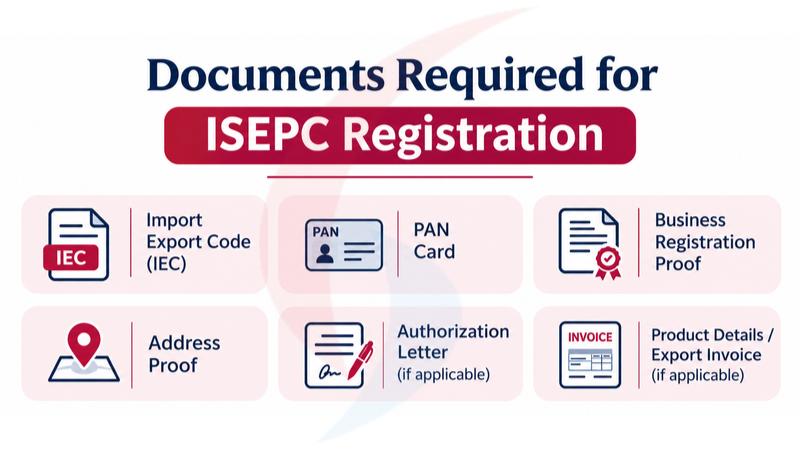
Before beginning the application, exporters should prepare their business identification and export-related records. The precise documents requested can vary according to the business constitution and the Council's verification requirements.
Commonly relevant documents include:
- Importer Exporter Code (IEC) issued by DGFT.
- PAN details of the applicant business.
- GST Registration Certificate, where applicable.
- Certificate of Incorporation, Partnership Deed or other constitution document, as relevant.
- Registered business address and contact details.
- Details of the proprietor, partners, directors or authorised representative.
- Product details and relevant export classifications.
- Previous export turnover information, where applicable.
- Authorisation letter or board resolution, where required.
- Relevant supporting documents requested on the DGFT portal or by ISEPC.
For a manufacturer-exporter, additional evidence of manufacturing activity may be required when applying under that category.
For example, a private limited company exporting silk garments may need to ensure that its company name, PAN, IEC and registered address are consistent. Differences between the IEC profile and the supporting documents can lead to queries or delays.
If you are planning to start a silk export business, read our RCMC Registration Checklist for New Export Businesses to understand the important requirements before applying.
Step-by-Step ISEPC Registration Process Through DGFT
ISEPC Registration and RCMC-related applications are handled through the DGFT common e-RCMC platform. DGFT Trade Notice No. 35/2021-22 introduced mandatory electronic filing for RCMC issuance, renewal and amendment from 1 April 2022.
Step 1: Obtain an Importer Exporter Code
Before applying, the exporter should have an active IEC issued by DGFT. The IEC identifies the business for import-export purposes and forms the basis for accessing several foreign trade services.
Step 2: Visit the DGFT Portal
Open the official DGFT portal and log in using the registered credentials. First-time users must complete the relevant registration requirements.
Step 3: Update the IEC Profile
Verify the business name, registered address, contact details and authorised representative information. Any changes requiring an IEC profile update should be addressed before proceeding.
Step 4: Select the e-RCMC Service
Navigate to Services → e-RCMC → Apply for e-RCMC. Start a fresh application or continue an existing draft, depending on the business's position.
Step 5: Choose ISEPC as the Council
Select The Indian Silk Export Promotion Council as the registering authority where appropriate. Enter the relevant membership information and export product details.
Step 6: Provide Business and Product Details
Complete the requested information concerning the exporter's business, products, authorised representatives and export markets. Ensure that the declared products correspond to the actual export activities.
Step 7: Upload Supporting Documents
Upload the required documents in the format and file size permitted by the system. Check whether all mandatory attachments have been submitted.
Step 8: Sign and Pay the Applicable Fees
Review the application summary, complete the declaration, digitally authenticate the application using the supported method and pay the applicable charges.
Step 9: Application Verification
The application is processed by the competent registering authority. ISEPC may seek clarification, corrected information or additional documents when necessary.
Step 10: Receive the e-RCMC
After approval, the electronically issued RCMC can be accessed through the relevant DGFT services. The exporter should verify the certificate details and maintain the applicable membership subscription.
The process follows ISEPC's published e-RCMC instructions, although individual screen labels and authentication options may change.
ISEPC Registration Fees and Membership Renewal Charges
ISEPC membership fees depend on the applicable subscription category. The Council's published circular for FY 2025–26 specified the following annual renewal charges based on export turnover.
|
Previous export turnover |
Basic annual fee |
GST at 18% |
Total |
|
Up to Rs 1 crore |
Rs 7,000 |
Rs 1,260 |
Rs 8,260 |
|
Above Rs 1 crore and up to Rs 5 crore |
Rs 9,500 |
Rs 1,710 |
Rs 11,210 |
|
Above Rs 5 crore |
Rs 12,000 |
Rs 2,160 |
Rs 14,160 |
If you are entering the international silk market for the first time, explore our guide on Planning to Export? Start with RCMC Registration.
For new membership, an earlier ISEPC circular stated a basic fee of Rs 7,000 plus a one-time registration charge of Rs 1,000 and 18% GST, totalling Rs 9,440. That amount is historical and should not be treated as a confirmed 2026 quotation. Exporters must verify the applicable current new-registration or renewal fees on the DGFT portal or directly with ISEPC before making payment. Professional consultancy charges, where applicable, are separate from the Council's official subscription.
ISEPC RCMC Validity and Renewal Requirements
However, RCMC validity and annual council membership renewal are different matters. A business may hold a certificate with a multi-year validity period while still being required to pay annual membership subscriptions and satisfy the Council's conditions.
For example, a company obtaining an RCMC in the 2026–27 licensing year would ordinarily have a certificate validity extending to 31 March 2031, subject to the applicable rules. It should not assume this removes annual subscription obligations.
Benefits of ISEPC Registration for Silk Exporters
The value of ISEPC membership extends beyond obtaining an RCMC. For export-oriented silk businesses, several benefits may be commercially significant.
-
Access to international exhibitions: Members may have opportunities to participate in trade fairs, exhibitions and promotional programmes. Subsidised participation or reimbursements depend on the relevant event and eligibility conditions.
-
Buyer-seller meetings: ISEPC organises and facilitates interactions between Indian exporters and overseas buyers, helping businesses explore potential export relationships.
-
Market information: Access to trade-related publications, market intelligence and industry developments can help exporters understand changing buyer requirements.
-
Policy representation: The Council communicates relevant industry concerns to government authorities and may facilitate discussions concerning trade barriers and export-related issues.
-
Training and guidance: Seminars, webinars and capacity-building programmes can help exporters become familiar with international trade practices.
-
Support for certain FTP benefits: A valid RCMC may be relevant when applying for specified benefits or authorisations, subject to the conditions of the individual scheme.
ISEPC membership does not automatically qualify every exporter for subsidies, duty exemptions or reimbursements. Eligibility must be established separately.
Case Study: How a Varanasi Silk Exporter Prepared for Its First Major Overseas Order
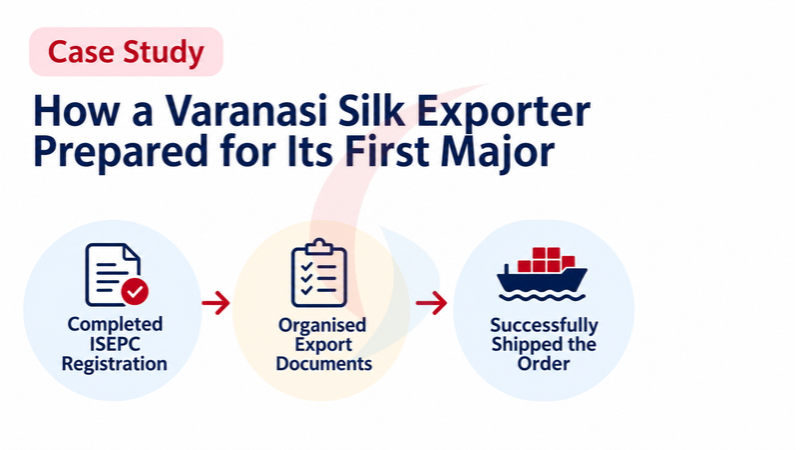
A business called Heritage Silk Creations operated a small manufacturing and trading unit in Varanasi. Its products included Banarasi silk sarees, decorative silk fabrics and custom-designed silk stoles. For several years, the company had primarily served domestic wholesalers. In 2026, an overseas textile distributor contacted the business with a proposal to purchase silk products worth Rs 14 lakh.
The business initially concentrated on production, packaging and delivery dates. During its compliance review, the management recognised that it also needed to examine customs classification, shipment documentation, overseas payment terms and applicable RCMC requirements.
The company followed a structured approach. First, it verified its IEC and business documents. Next, it identified the relevant silk product categories and reviewed the applicable ISEPC membership requirements. It then prepared an e-RCMC application through the DGFT portal and arranged the necessary commercial documentation.
|
Business challenge |
Action taken |
Practical outcome |
|
Limited export experience |
Reviewed IEC, customs and shipping requirements |
Better documentation readiness |
|
Uncertainty about RCMC |
Examined FTP requirements and ISEPC eligibility |
Appropriate registration planning |
|
Dependence on one buyer |
Explored industry networking opportunities |
Potential to diversify overseas enquiries |
|
Incorrect product descriptions |
Reviewed product categories and invoice details |
Lower risk of documentation discrepancies |
|
Long-term export planning |
Developed a compliance and membership renewal calendar |
Improved operational preparation |
The case demonstrates that registration alone cannot make an export business successful. Accurate documentation, commercial planning, product quality and reliable customer relationships are equally important. However, the right council membership can support an exporter as it moves from occasional orders towards regular international trade.
Common Mistakes to Avoid During ISEPC Registration
Several registration problems can be avoided through basic document verification. Businesses should check for differences in their IEC, PAN and registered address, incorrect selection of the Export Promotion Council, incomplete product information and missing authorisations. Another common mistake is assuming that the five-year RCMC validity means no further membership payments are required. Annual subscription obligations must be checked separately. Exporters should also avoid claiming that ISEPC membership automatically grants customs duty exemptions, GST benefits or export subsidies. Each benefit is governed by its own eligibility conditions.
ISEPC Registration vs IEC Registration: What is the Difference?
An IEC and an ISEPC RCMC serve different purposes. The IEC is the primary identification for import-export activities, while ISEPC membership connects eligible silk exporters with their sector-specific Export Promotion Council.
The IEC is issued by DGFT, whereas the ISEPC RCMC is issued by the Council through the prescribed electronic registration system. Both may be relevant to a silk exporter, but obtaining one does not automatically replace the other.
For example, a business may use its IEC to undertake permissible export transactions while obtaining the appropriate RCMC when required for relevant FTP benefits or authorisations.
Why Choose Compliance Calendar LLP for ISEPC Registration?
At Compliance Calendar LLP, we understand that starting a silk export business involves more than just finding an international buyer. From obtaining the right registrations to preparing documents and understanding DGFT requirements, even a small mistake can delay the process.
Over the years, our team has assisted businesses with various export-related registrations, RCMC applications and regulatory compliance requirements. We understand the common queries exporters face, whether it is selecting the correct Export Promotion Council, resolving document discrepancies or understanding membership requirements.
For professional assistance with ISEPC Registration, documentation, RCMC application and other export-related compliances, contact Compliance Calendar LLP at +91 9988424211 or email info@ccoffice.in.
Frequently Asked Questions (FAQs)
Q1. What is the full form of ISEPC?
Ans. ISEPC stands for Indian Silk Export Promotion Council. It is an organisation concerned with promoting India's silk exports and supporting eligible exporters.
Q2. Is ISEPC Registration mandatory for silk exporters?
Ans. An appropriate RCMC is required in specified circumstances under the Foreign Trade Policy. However, it is not automatically required for every silk export transaction.
Q3. Can merchant exporters apply for ISEPC Registration?
Ans. Yes. Eligible merchant exporters dealing in products covered by ISEPC may apply for membership and an RCMC, subject to the Council's requirements.
Q4. What is the validity of ISEPC RCMC?
Ans. An RCMC is ordinarily valid for five licensing years under Paragraph 2.81 of HBP 2023, unless otherwise specified. Annual membership renewal obligations may still apply.
Q5. How much does ISEPC Registration cost?
Ans. Fees depend on the applicable membership category. The Council's published FY 2025–26 annual renewal fees ranged from Rs 8,260 to Rs 14,160, including GST. Current fees should be verified before applying.
Q6. Can a new exporter apply without previous export turnover?
Ans. Prospective exporters may apply for associate membership under the applicable HBP provisions. The appropriate membership category and documents must be confirmed with the Council.
Q7. Where can exporters apply for ISEPC RCMC?
Ans. Exporters can apply through the DGFT electronic RCMC service by selecting The Indian Silk Export Promotion Council as the registering authority.
Q8. Is RCMC required for silk exports worth Rs 2 lakh?
Ans. Under DGFT Notification No. 36/2026-27, consignments with an FOB value not exceeding Rs 3 lakh are exempt from the specified RCMC requirement. Other export compliance obligations continue to apply.
Q9. Does ISEPC membership guarantee export subsidies?
Ans. No. Membership does not automatically entitle an exporter to subsidies or financial assistance. Benefits are subject to the conditions of the relevant government schemes and programmes.
Q10. Can ISEPC RCMC details be amended?
Ans. Yes. The DGFT e-RCMC system provides amendment functionality. Exporters must also notify relevant changes to their registering authority in accordance with the prescribed requirements.
Article last updated on : 12 Nov 2026.