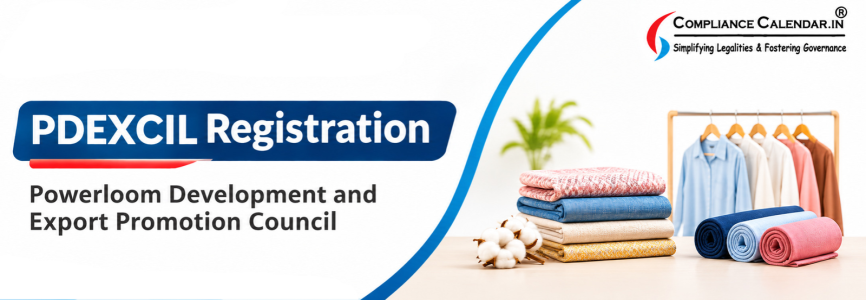



India's powerloom industry plays an important role in textile manufacturing and international trade. From fabric manufacturers in Surat and Bhiwandi to textile exporters in Erode and Ichalkaranji, thousands of businesses produce woven fabrics, home textiles, furnishing materials, and other products for domestic and overseas markets.
However, exporting textiles involves more than manufacturing good-quality fabric and finding an international buyer. Exporters must understand Import Export Code (IEC) requirements, customs documentation, product classification, applicable textile standards, and membership requirements under India's Foreign Trade Policy.
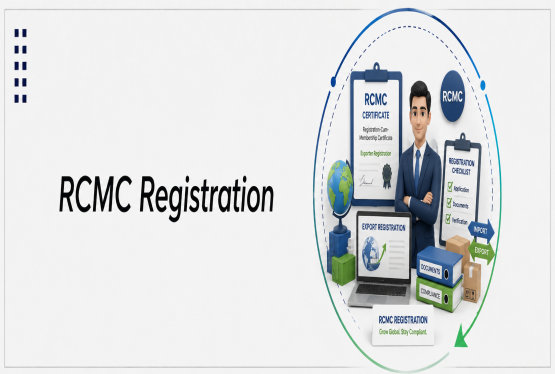
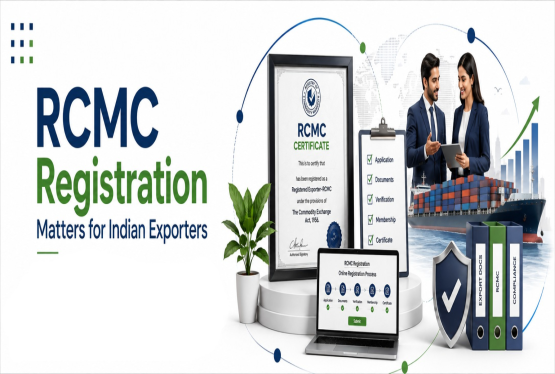
One important registration for eligible powerloom exporters is PDEXCIL Registration, which allows businesses to obtain membership of the Powerloom Development and Export Promotion Council and a Registration-cum-Membership Certificate (RCMC Registration).
What is PDEXCIL Registration?
PDEXCIL Registration is the process through which an eligible textile exporter becomes a member of the Powerloom Development and Export Promotion Council. The council is recognised as a registering authority under India's Foreign Trade Policy and issues Registration-cum-Membership Certificates for businesses falling within its jurisdiction.
An RCMC confirms the exporter's membership with the appropriate Export Promotion Council. It is particularly relevant when a business applies for certain authorisations, concessions, or benefits under the Foreign Trade Policy for which valid council registration is prescribed.
PDEXCIL membership also provides access to export promotion activities, information about overseas markets, textile trade exhibitions, buyer-seller meetings, and government-related industry updates.
However, PDEXCIL Registration should not be confused with an Import Export Code. IEC identifies a business for international trade, whereas PDEXCIL RCMC establishes membership with the relevant council.
Exporters interested in understanding the broader certification process can read our guide on RCMC Registration Online in India, which explains council selection, documents, validity, and online filing.
What is the Powerloom Development and Export Promotion Council?
The Powerloom Development and Export Promotion Council, commonly known as PDEXCIL, was established in 1995 under the Ministry of Textiles, Government of India.
The council works towards the development of India's powerloom industry and the promotion of exports of eligible fabrics, home textiles, and made-up textile products.
Unlike an organisation concerned only with overseas sales, PDEXCIL also focuses on improving the competitiveness of domestic powerloom businesses. This includes supporting industry awareness, market development, training, and communication between textile entrepreneurs and government authorities.
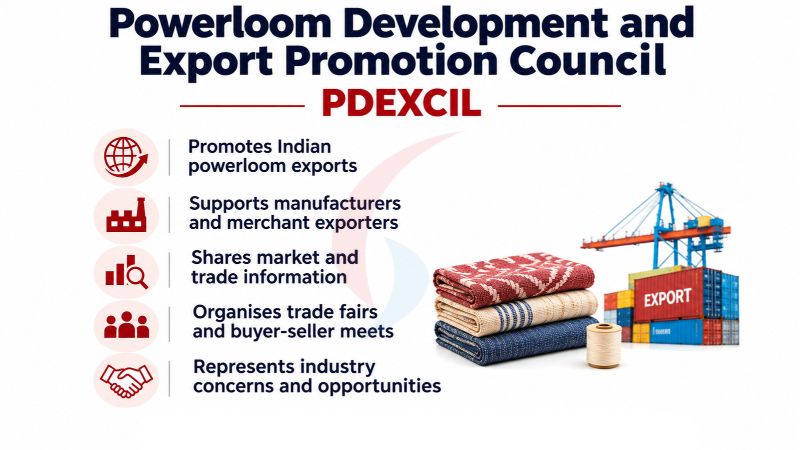
Its activities include organising international trade exhibitions, buyer-seller meetings, awareness programmes, industry workshops, and other initiatives relevant to textile manufacturing and exports.
For example, a powerloom manufacturer in Bhiwandi may produce high-quality furnishing fabrics but have little experience dealing with overseas buyers. PDEXCIL's trade promotion activities can help such businesses explore international markets and understand changing buyer expectations.
Laws and Legal Provisions Governing PDEXCIL Registration
PDEXCIL Registration is governed by India's foreign trade laws. Textile exporters must also follow applicable customs, GST, foreign exchange, and product-specific regulations.
|
Applicable Law / Regulation |
Relevant Provisions |
Key Requirements |
|---|---|---|
|
Sections 3, 5, 7 and 11 |
Governs foreign trade, IEC requirements, export restrictions, and penalties. |
|
|
Paragraphs 2.56 and 2.57 |
Specifies Export Promotion Council recognition and applicable RCMC requirements. |
|
|
Paragraphs 2.77 and 2.79–2.84 |
Covers RCMC registration, validity, amendments, de-registration, and appeals. |
|
|
Sections 17, 50, 113 and 114 |
Regulates Shipping Bills, customs declarations, and penalties for improper exports. |
|
|
Section 16 |
Provides zero-rated treatment for eligible textile exports. |
|
|
Applicable FEMA provisions and RBI directions |
Governs foreign exchange transactions and receipt of export payments. |
|
|
Textile Quality Control Orders |
Applicable product-specific notifications |
Prescribe BIS certification or quality requirements for specified textile products. |
Under the Foreign Trade Policy, PDEXCIL RCMC is required for specified export authorisations, benefits, and concessions, subject to applicable exemptions. Exporters must also maintain an active IEC and comply with customs and taxation requirements.
For further details, read Impact of GST on Export of Goods and Services to understand zero-rated exports, LUT, and GST refund procedures.
Which Products Are Covered Under PDEXCIL Registration?
PDEXCIL represents eligible exporters dealing in powerloom fabrics, home textiles, and made-up textile products. Its published product coverage includes several categories of fabrics used in clothing, furnishings, industrial applications, and household products.
|
Product Category |
Examples |
|
Woven Fabrics |
Shirting fabrics, suitings, denim, poplin, twill, sateen, jacquard, and other eligible fabrics |
|
Home Textiles |
Bed linen, pillowcases, blankets, curtains, cushion covers, and towels |
|
Furnishing Fabrics |
Upholstery fabrics, decorative fabrics, canvas, and curtain materials |
|
Traditional Textile Products |
Sarees, lungies, dhoties, and eligible woven textile articles |
|
Technical and Industrial Textiles |
Selected webbing, belting, tyre-cord fabrics, and industrial fabric products |
|
Made-up Textile Articles |
Handkerchiefs, napkins, bags, tarpaulins, narrow fabrics, and other eligible textile products |
The exact council jurisdiction must be checked against the product's ITC-HS classification and the applicable DGFT list of registering authorities. Not every textile product automatically falls under PDEXCIL.
For instance, cotton yarn and certain cotton textile products may fall within the jurisdiction of TEXPROCIL, while readymade garments may fall under the Apparel Export Promotion Council.
Businesses dealing mainly in cotton textiles can also explore TEXPROCIL Registration to understand the difference between council jurisdictions.
Who Needs PDEXCIL Registration in India?
PDEXCIL Registration is relevant to businesses involved in manufacturing or exporting eligible powerloom fabrics, home textiles, and made-up textile products. Both existing and new exporters can apply, subject to the council's eligibility requirements.
|
Type of Exporter |
Description |
|---|---|
|
Manufacturer Exporters |
Businesses manufacturing and directly exporting powerloom fabrics, furnishing materials, and other eligible textile products. |
|
Merchant Exporters |
Businesses purchasing textile products from manufacturers and exporting them under their own business name without owning a manufacturing facility. |
|
Small and Medium Textile Businesses |
MSMEs engaged in eligible powerloom products. Businesses with turnover up to Rs 2.5 crore fall under the council's lowest published FY 2026–27 fee category. |
|
New and Prospective Exporters |
Startups and new businesses planning to export eligible textile products, subject to IEC, documentation, and membership requirements. |
Practical Example: A powerloom manufacturer in Bhiwandi receives an order for 15,000 metres of furnishing fabric from Dubai. Before exporting, the business verifies its IEC, checks whether PDEXCIL RCMC is required, and prepares the necessary customs and shipping documents to avoid delays.
Eligibility Criteria for PDEXCIL Registration
Businesses applying for PDEXCIL Registration must satisfy the council's membership requirements and provide accurate business information.
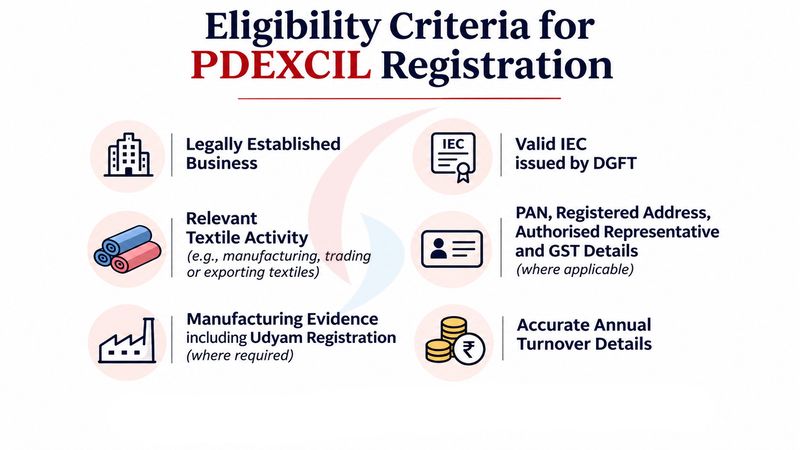
The main eligibility conditions include:
-
Legally Established Business: Applicants should operate as an eligible proprietorship, partnership firm, LLP, company, or another recognised business entity with valid constitution documents.
-
Valid IEC: An active Import Export Code issued by DGFT is generally required for RCMC applications. IEC information should match the applicant's other business records.
-
Relevant Textile Activity: The business should manufacture, trade, or intend to export fabrics or made-up textile products falling within PDEXCIL's jurisdiction.
-
Business Identification: The applicant should maintain PAN, registered address, authorised representative details, and GST information where applicable.
-
Manufacturing Evidence: Manufacturer exporters should provide acceptable manufacturing proof, including Udyam Registration where required.
-
Annual Turnover Details: Applicants must provide accurate turnover information for determining the appropriate membership fee category.
A newly established business should not assume that it must first achieve substantial export sales. PDEXCIL's fee schedule includes businesses with nil or low turnover.
Documents Required for PDEXCIL Registration
PDEXCIL requires documents establishing the applicant's legal identity, manufacturing or export activity, and eligibility for council membership. Its official FY 2026–27 membership instructions identify the following documents.
|
Document |
Purpose |
|
Import Export Code (IEC) |
Establishes the applicant's DGFT exporter identification |
|
PAN Card |
Verifies the business's tax identity |
|
Udyam Registration Certificate |
Provides applicable MSME and manufacturing information |
|
Partnership Deed |
Required where the applicant is a partnership firm |
|
Memorandum and Articles of Association |
Required for applicable company applicants |
|
Authorised Representative Card |
Identifies the person authorised to represent the business |
|
Annual Turnover Declaration |
Establishes the previous financial year's turnover for membership classification |
|
Other Supporting Records |
Includes applicable declarations and documents requested during application verification |
Applicants should ensure that their business name, IEC, PAN, constitution documents, and turnover declaration contain consistent information.
For example, a textile firm that recently changed its legal name should update its DGFT profile before submitting a PDEXCIL application. Incomplete or inconsistent records may result in clarification requests and processing delays.
First-time textile exporters can also refer to the RCMC Registration Checklist for New Export Businesses to prepare their IEC, business documents, manufacturing proof, and other required records.
PDEXCIL Registration Process Online in 2026
PDEXCIL RCMC applications are processed through the DGFT common electronic platform. The council confirms that electronic issuance, renewal, and amendment of RCMC became mandatory through the DGFT common digital system from 1 April 2022. The application process is summarised below
|
Step |
PDEXCIL Registration Process |
|
Step 1: Obtain IEC |
Ensure the applicant has an active Import Export Code |
|
Step 2: Visit DGFT Portal |
Log in to the official DGFT website using the IEC-linked account |
|
Step 3: Select e-RCMC |
Navigate to Services → e-RCMC → Apply for e-RCMC |
|
Step 4: Choose PDEXCIL |
Select Powerloom Development and Export Promotion Council as the registering authority |
|
Step 5: Enter Business Information |
Provide the business profile, textile products, authorised representative, and export details |
|
Step 6: Upload Documents |
Attach IEC, PAN, Udyam, turnover declaration, and applicable constitution records |
|
Step 7: Submit and Pay Fees |
Review the declaration, digitally sign the application, and pay the prescribed fees |
|
Step 8: Obtain RCMC |
Track the filing and download the electronic certificate after approval |
Businesses exporting powerloom fabrics and made-up textile products can explore our guide on PDEXCIL Registration to understand the eligibility criteria, required documents, and RCMC application process.
Businesses planning to export textile products must obtain a valid IEC from DGFT. Read our guide on the Procedure for Obtaining Import Export Code to understand the documents and online registration process.
Practical Example: First-Time PDEXCIL Registration in Surat
Suppose a manufacturer in Surat produces woven fabric for home furnishing companies. After securing an overseas buyer, its accounts manager begins preparing the export documents.
The manager discovers that the business's IEC profile contains an outdated office address. Instead of submitting the PDEXCIL application immediately, the company first corrects its DGFT records.
It then selects the appropriate council, uploads the prescribed documents, declares its turnover, and completes the payment process.
Once the application is approved, the business can access its electronic RCMC. The example illustrates why verifying business details before filing is often more useful than rushing through the application.
PDEXCIL Registration Fees in India for 2026–27
PDEXCIL has published a specific new membership fee schedule for financial year 2026–27. The fees depend on the applicant's total annual turnover during FY 2025–26. The prescribed amounts include the entrance fee, annual membership subscription, and GST at 18%.
New PDEXCIL Membership Fees for FY 2026–27:
|
Annual Turnover During FY 2025–26 |
Entrance Fee |
Annual Membership Fee |
Total Including GST |
|
Up to Rs 2.5 crore |
Rs 500 |
Rs 2,000 |
Rs 2,950 |
|
Above Rs 2.5 crore to Rs 5 crore |
Rs 2,500 |
Rs 4,000 |
Rs 7,670 |
|
Above Rs 5 crore to Rs 10 crore |
Rs 2,500 |
Rs 8,000 |
Rs 12,390 |
|
Rs 10 crore and above / applicable Status Holder category |
Rs 2,500 |
Rs 10,000 |
Rs 14,750 |
For example, a new powerloom exporter with annual turnover of Rs 1.8 crore falls within the lowest published turnover category. The membership amount is Rs 2,500 before GST, making the total Rs 2,950.
However, applicants should declare their turnover correctly because choosing the wrong category may result in payment discrepancies or verification queries.
Annual PDEXCIL Membership Renewal Fees for FY 2026–27
The annual renewal fee is lower than the corresponding new membership fee because the one-time entrance fee is not charged again.
|
Annual Turnover During FY 2025–26 |
Annual Renewal Fee Including GST |
|
Up to Rs 2.5 crore |
Rs 2,360 |
|
Above Rs 2.5 crore to Rs 5 crore |
Rs 4,720 |
|
Above Rs 5 crore to Rs 10 crore |
Rs 9,440 |
|
Rs 10 crore and above / applicable Status Holder category |
Rs 11,800 |
PDEXCIL also provides special multi-year renewal discounts for eligible members in the third and fourth fee categories.
The council's FY 2026–27 instructions mention a 10% discount for three-year renewal and a 15% discount for five-year renewal for qualifying members. Applicants should check the current payable amount through the DGFT system before making payment.
PDEXCIL RCMC Validity and Annual Renewal
RCMC validity and annual PDEXCIL membership renewal are two different requirements.
Under Paragraph 2.81 of the DGFT Handbook of Procedures, an RCMC is ordinarily valid for five licensing years, beginning from 1 April of the licensing year of issuance, unless otherwise specified.
For example, an RCMC issued during FY 2026–27 would generally remain valid until 31 March 2031, subject to the certificate's stated validity and applicable conditions. However, PDEXCIL follows a financial-year-based membership subscription system.
PDEXCIL Renewal Deadline for FY 2026–27
PDEXCIL's official renewal instructions state that membership renewal for FY 2026–27 was required by 30 June 2026.
The council warns that failure to renew by that date results in suspension of membership and associated privileges under the applicable provisions of its Articles of Association.
Members must also provide a self-certified annual turnover declaration, including export turnover, and the required Udyam Registration Certificate for membership classification.
Therefore, exporters should not assume that a five-year RCMC validity period eliminates the need to maintain annual membership subscriptions.
Benefits of PDEXCIL Registration for Textile Exporters
PDEXCIL membership provides practical opportunities for businesses involved in textile production and export.
International Trade Exhibitions
PDEXCIL organises and supports participation in international textile exhibitions and trade events. These programmes allow eligible exporters to present their products to potential buyers, understand market preferences, and explore new commercial relationships. Participation may be supported under relevant government export promotion schemes, subject to programme-specific eligibility and funding conditions.
Buyer-Seller Meetings
The council facilitates business interactions between Indian textile exporters and overseas buyers. For example, a manufacturer producing home furnishing fabrics may use a trade event to introduce its products to international wholesalers. However, participation does not guarantee confirmed orders or business contracts.
Industry Awareness and Training
PDEXCIL conducts seminars, workshops, and awareness programmes relating to export procedures, government schemes, trade developments, and other business matters. These activities can be useful for small textile manufacturers entering international trade for the first time.
Market Information and Policy Updates
The council publishes newsletters, bulletins, and information concerning textile markets and industry developments. Members may receive updates about international trade events, policy announcements, and export-related opportunities.
Certificate of Origin and Related Services
PDEXCIL provides services concerning non-preferential Certificates of Origin and export turnover certificates. These documents may be useful for particular export transactions, subject to applicable rules and the requirements of the importing country.
PDEXCIL Registration vs TEXPROCIL Registration
Textile exporters sometimes confuse PDEXCIL with TEXPROCIL because both councils represent businesses connected with textile exports. However, the councils have different areas of responsibility.
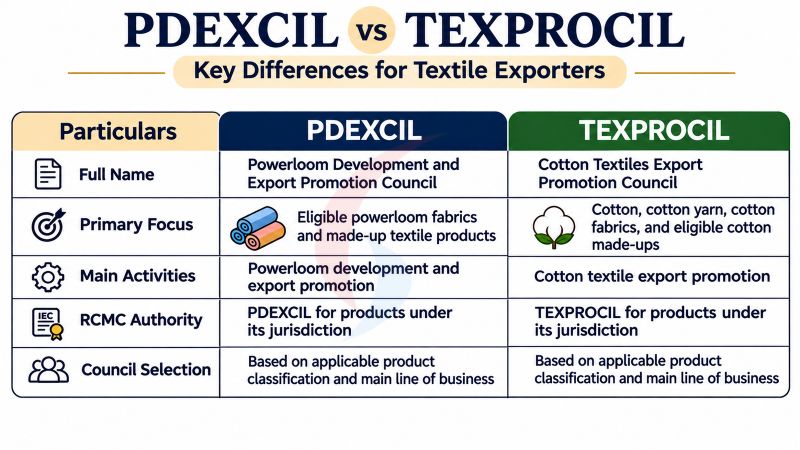
|
Particulars |
PDEXCIL |
TEXPROCIL |
|
Full Name |
Powerloom Development and Export Promotion Council |
Cotton Textiles Export Promotion Council |
|
Primary Focus |
Eligible powerloom fabrics and made-up textile products |
Cotton, cotton yarn, cotton fabrics, and eligible cotton made-ups |
|
Main Activities |
Powerloom development and export promotion |
Cotton textile export promotion |
|
RCMC Authority |
PDEXCIL for products under its jurisdiction |
TEXPROCIL for products under its jurisdiction |
|
Council Selection |
Based on applicable product classification and main line of business |
Based on applicable product classification and main line of business |
An exporter should not assume that a fabric is covered by PDEXCIL simply because it was manufactured using a powerloom. The appropriate council must be identified through the relevant product classification and DGFT requirements.
Is PDEXCIL Registration Mandatory for Every Powerloom Exporter?
PDEXCIL Registration is not an unconditional legal requirement for every powerloom fabric shipment. Under Paragraph 2.57 of the Foreign Trade Policy, RCMC is generally required for specified authorisations, benefits, and concessions unless an exemption applies. The requirement therefore depends on the proposed activity or scheme.
|
Export Situation |
Is PDEXCIL RCMC Required? |
|
Ordinary Export of Freely Exportable Fabrics |
Not automatically required solely for making the shipment |
|
Claiming Specified FTP Benefits |
Required where the relevant benefit or authorisation prescribes RCMC |
|
Export Consignment up to Rs 3 Lakh FOB |
May qualify for the September 2026 exemption |
|
Applying for Certain DGFT Authorisations |
Required where valid RCMC is specified |
|
Customs, GST, and Banking Compliance |
Separate applicable requirements remain necessary |
For example, a new textile exporter sending a qualifying sample consignment worth Rs 2.5 lakh may not need RCMC for the purpose covered by the September 2026 exemption.
However, the exporter must still comply with IEC, customs, GST, foreign exchange, and applicable product requirements.
Latest PDEXCIL Registration and Textile Export Updates in 2026
Several developments during 2026 are particularly relevant to PDEXCIL members and powerloom exporters.
|
Latest Update |
Key Changes |
|
PDEXCIL Membership Fees 2026–27 |
New membership fees start from Rs 2,950, including GST, depending on turnover |
|
Annual Renewal Deadline |
Members were required to renew their FY 2026–27 subscription by 30 June 2026 |
|
RCMC Exemption – September 2026 |
Qualifying export consignments up to Rs 3 lakh FOB are exempt from specified RCMC requirements |
|
Multi-Year Renewal Discounts |
Eligible members in higher fee categories may receive 10% or 15% discounts for the specified renewal periods |
|
Export Promotion Initiatives |
PDEXCIL continues supporting trade exhibitions, export promotion programmes, and international business opportunities |
September 2026 RCMC Exemption
DGFT Notification No. 36/2026-27, dated 15 September 2026, amended Paragraph 2.57 of the Foreign Trade Policy, 2023.
The amendment exempts qualifying export consignments with FOB value not exceeding Rs 3 lakh from the RCMC or Certificate of Registration requirement specified under that paragraph.
The relaxation aims to reduce procedural burdens for small businesses and first-time exporters, including those exporting through postal and courier channels.
However, it does not remove the requirement for IEC, customs documentation, product-specific permissions, or compliance with other applicable laws.
PDEXCIL Membership and Export Promotion Developments
PDEXCIL's official website confirms that its FY 2026–27 membership fees and renewal arrangements have been updated.
The council also continues to promote international textile exhibitions and industry networking opportunities.
It has communicated information regarding the Export Promotion Mission and government measures designed to support exporters.
Businesses should monitor council updates rather than assuming that all government export promotion programmes are automatically available to every member.
Why Choose Compliance Calendar LLP for PDEXCIL Registration?
Exporting textile products involves several regulatory procedures, including IEC, PDEXCIL membership, DGFT e-RCMC filing, customs documentation, and ongoing export compliance.
At Compliance Calendar LLP, we understand the documentation and registration challenges faced by new and established textile exporters.
Our team provides professional assistance with business registrations, RCMC applications, and related compliance requirements.
|
Our Services |
How We Can Help |
|
Eligibility Assessment |
Guidance on PDEXCIL membership eligibility and the appropriate exporter category |
|
Documentation Support |
Assistance with IEC, PAN, business documents, Udyam Registration, and turnover declarations |
|
RCMC Application |
Support with preparing and completing the DGFT e-RCMC application |
|
Renewal Guidance |
Assistance with membership renewal, amendments, and RCMC validity requirements |
|
Personalised Support |
Guidance based on textile products, business structure, and export activities |
Whether you operate a small powerloom unit or an established textile export business, our aim is to make the registration process easier to understand and manage.
For professional assistance, explore our RCMC Registration services or contact Compliance Calendar LLP on +91 9988424211 or info@ccoffice.in Final approval and issuance of RCMC remain subject to the competent authority.
Frequently Asked Questions (FAQs)
Q1. What is PDEXCIL Registration in India?
Ans: PDEXCIL Registration allows eligible exporters of powerloom fabrics, home textiles, and made-up textile products to obtain membership of the Powerloom Development and Export Promotion Council. It enables qualifying businesses to obtain RCMC and access council-related export promotion services.
Q2. Is PDEXCIL Registration mandatory for textile exporters?
Ans: PDEXCIL RCMC is required where an applicable Foreign Trade Policy authorisation, benefit, or concession specifically requires it. It is not automatically mandatory for every textile export shipment. Exporters should verify product classification and applicable DGFT requirements.
Q3. What are the PDEXCIL Registration fees in 2026–27?
Ans: New PDEXCIL membership fees range from Rs 2,950 to Rs 14,750, including 18% GST. The amount depends on annual turnover during FY 2025–26. Applicants should select the appropriate turnover category and verify the payable fee before submission.
Q4. What documents are required for PDEXCIL Registration?
Ans: Applicants generally need IEC, PAN, Udyam Registration, authorised representative details, and an annual turnover declaration. Companies and partnerships must also submit applicable constitution documents. Additional records may be requested during verification.
Q5. How can I apply for PDEXCIL Registration online?
Ans: Visit the DGFT portal and select Services → e-RCMC → Apply for e-RCMC. Choose PDEXCIL as the registering authority, enter business and product details, upload supporting documents, and pay the prescribed fees. The electronic certificate is available after approval.
Q6. What is the validity of PDEXCIL RCMC?
Ans: Under the general DGFT provisions, RCMC is ordinarily valid for five licensing years unless otherwise specified. However, PDEXCIL requires members to maintain annual membership subscriptions. Exporters should check both the certificate validity and renewal requirements.
Q7. Can a new textile exporter apply for PDEXCIL Registration?
Ans: Yes. Eligible new exporters can apply for PDEXCIL membership even without substantial previous export turnover. Applicants must have an active IEC and meet the council's business and documentation requirements.
Q8. What is the PDEXCIL membership renewal deadline for 2026–27?
Ans: PDEXCIL required members to renew their FY 2026–27 subscriptions by 30 June 2026. Failure to renew by the prescribed deadline can result in suspension of membership and associated privileges. Members should maintain accurate turnover and contact details.
Q9. Is PDEXCIL RCMC required for exports below Rs 3 lakh?
Ans: DGFT Notification No. 36/2026-27, dated 15 September 2026, exempts qualifying export consignments with FOB value not exceeding Rs 3 lakh from the specified RCMC requirement. Other applicable customs, IEC, GST, and product-specific obligations remain necessary.
Q10. Can Compliance Calendar LLP help with PDEXCIL Registration?
Ans: Yes. Compliance Calendar LLP provides assistance with RCMC applications, documentation, DGFT procedures, and renewal guidance. Textile exporters can seek professional support based on their product category and business activities.
Article last updated on : 13 Nov 2026.