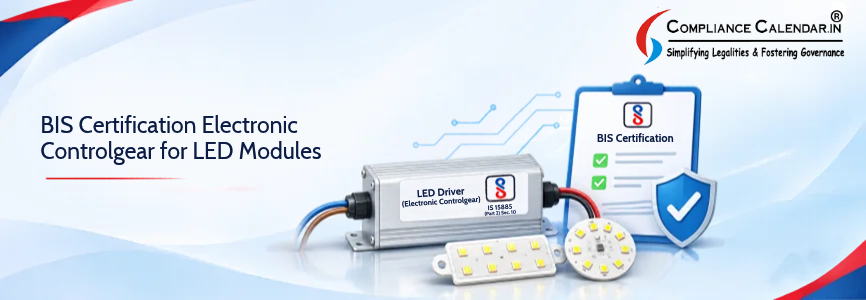



LED lighting has become an important part of homes, offices, shopping malls, factories and public spaces in India. People prefer LED lights because they consume less electricity and generally last longer than traditional lighting products. However, an LED light needs more than just a good-quality LED module to work safely. It also requires an electronic device that controls the power supplied to the LEDs. This device is known as electronic controlgear, commonly called an LED driver. It helps deliver suitable electrical power to LED modules and protects the lighting system from certain electrical problems.
If the controlgear is poorly designed or manufactured, it may overheat, damage connected components or create electrical safety risks. To address these concerns, the Bureau of Indian Standards (BIS) has made BIS Certification for Electronic Controlgear for LED Modules mandatory under its Compulsory Registration Scheme (CRS). Manufacturers must ensure that covered products meet the applicable Indian Standard before introducing them into the Indian market.
What Is Electronic Controlgear for LED Modules?
Electronic controlgear is an electrical or electronic device that regulates the power supplied to LED modules. It is often called an LED driver because it helps LEDs operate according to their required electrical characteristics. Since LEDs require controlled electrical input, connecting them directly to an unsuitable power supply can damage the lighting system.
For example, consider an office installing 100 LED ceiling lights. Each light requires an appropriate driver to supply the correct electrical output. If the driver fails to regulate the power properly, the lights may flicker, overheat or stop working earlier than expected. A properly designed controlgear unit helps maintain safe and reliable operation. Electronic controlgear is commonly used in LED streetlights, panel lights, downlights, commercial lighting systems and industrial lighting installations. Depending on its design, a controlgear unit may be built into the lighting product or supplied separately.
Businesses entering the LED lighting market can also read our guide on BIS Certification for LED Lights to understand the certification requirements for lighting products in India.
Is BIS Certification Mandatory for Electronic Controlgear for LED Modules?
Yes. DC or AC supplied electronic controlgear for LED modules is included in the products covered under the BIS Compulsory Registration Scheme. The mandatory requirement became effective on 1 December 2015. The applicable product category is listed under the Electronics and Information Technology Goods (Requirement of Compulsory Registration) Order, 2021, as amended. Manufacturers producing covered LED controlgear must obtain BIS CRS registration before supplying these products in India. The requirement also applies to covered products manufactured overseas and imported into India. Importers must ensure that the relevant manufacturing unit and product models are covered by valid BIS Registration.
To understand how mandatory product registration works in India, explore our articles on BIS CRS Registration and Certification Requirements.
Applicable Indian Standard for Electronic Controlgear for LED Modules
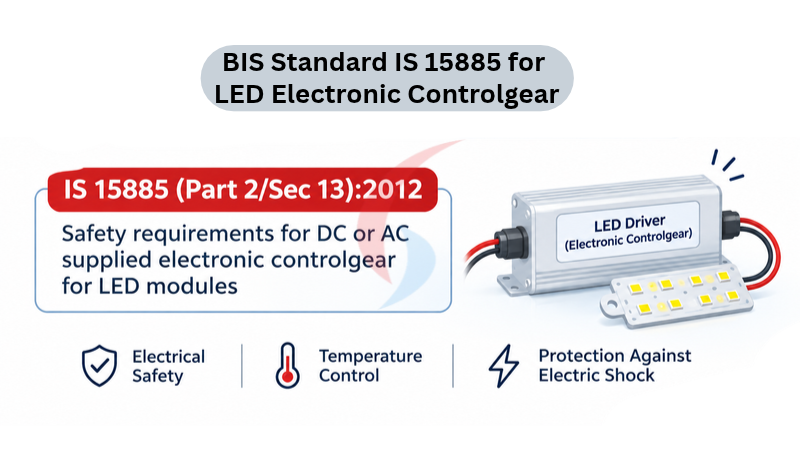
The applicable Indian Standard is IS 15885 (Part 2/Sec 13):2012, titled Safety of Lamp Controlgear – Part 2: Particular Requirements – Section 13: d.c. or a.c. Supplied Electronic Controlgear for LED Modules. This standard specifies safety requirements for electronic controlgear associated with LED modules. Its scope includes relevant controlgear operating on DC or AC supplies up to 1,000 V, subject to the conditions and limitations of the standard. The standard is applied together with relevant general safety provisions under IS 15885 (Part 1). Manufacturers should ensure that the complete applicable requirements are considered during product development and laboratory testing.
BIS Standards for Different LED Products
| Product Category | Applicable Indian Standard |
|---|---|
| Electronic Controlgear for LED Modules | IS 15885 (Part 2/Sec 13):2012 |
| Independent LED Modules for General Lighting | IS 16103 (Part 1):2025 |
| LED Dimmers | IS/IEC 60669-2-1:2021 |
| LED Luminaires | Applicable parts of the IS 10322 series, subject to relevant implementation dates |
The table shows that electronic controlgear and LED modules are separate product categories. A manufacturer should not assume that certification of an LED module automatically covers the LED driver used with it.
Who Needs BIS CRS Registration for LED Controlgear?
BIS CRS registration is relevant to manufacturers producing notified electronic controlgear for the Indian market. Domestic manufacturers must obtain registration for their covered products and manufacturing facilities. Foreign manufacturers supplying these products to India must also comply with the registration requirements. Where required, they must appoint an Authorised Indian Representative (AIR) to coordinate with BIS and fulfil applicable responsibilities. Importers, distributors and brand owners should verify the manufacturer's registration before sourcing or selling covered LED drivers. A registration certificate issued for one factory does not automatically cover another manufacturing location.
For example, an Indian company may import LED drivers from a factory in China and sell them under its own brand name. The overseas manufacturing unit must have suitable BIS registration covering the applicable brand and models before those products are placed on the Indian market.
Manufacturers should understand their registration responsibilities before launching products. For more information, read our article on CRS Compliance for Manufacturers
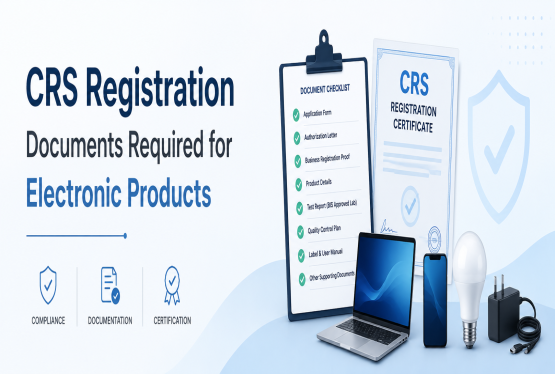
Documents Required for BIS CRS Registration
Document preparation is an important part of the BIS registration process. BIS examines the identity of the manufacturer, the manufacturing location, product details and supporting laboratory test reports.
An application may face delays if the factory address differs across documents, product details are inconsistent or the test report does not match the models submitted for registration.
Documents Required for BIS Certification
| Required Document | Purpose |
|---|---|
| Manufacturing unit address proof | Confirms the factory location |
| Business registration documents | Establishes the manufacturer's legal identity |
| BIS-recognised laboratory test report | Confirms testing against the applicable standard |
| Product technical specifications | Provides electrical ratings and product characteristics |
| Product photographs and labels | Identifies the relevant product models |
| Brand or trademark authorisation | Establishes permission to use the declared brand, where required |
| Authorised signatory documents | Identifies the person submitting the application |
| AIR nomination documents | Required for applicable foreign manufacturers |
| Undertakings and declarations | Supports compliance with BIS requirements |
The exact documents may vary depending on whether the applicant is an Indian manufacturer, an overseas manufacturer or an existing BIS licensee seeking to expand its product coverage.
Manufacturers preparing their applications can read more about BIS Certification Documents, Eligibility and Registration Procedures to avoid common documentation mistakes.
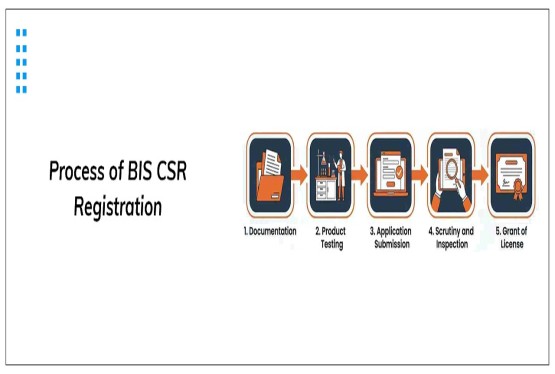
BIS CRS Registration Process for Electronic Controlgear for LED Modules
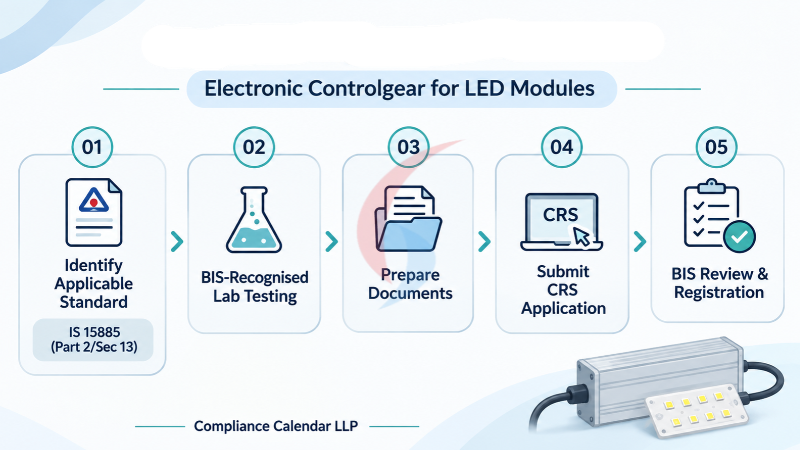
The BIS registration process involves several important stages. Manufacturers should complete the technical and documentation requirements carefully before submitting their application.
Step 1: Confirm Product Classification
The manufacturer must first determine whether its LED driver falls under the notified category of DC or AC supplied electronic controlgear for LED modules. Product specifications, electrical ratings and intended applications should be reviewed.
Step 2: Identify the Applicable Indian Standard
The manufacturer should confirm the applicable standard, IS 15885 (Part 2/Sec 13):2012, along with the relevant general safety requirements. Correct standard identification helps prevent unnecessary testing or application rejection.
Step 3: Select a BIS-Recognised Laboratory
Product samples must be tested through a laboratory recognised by BIS for the relevant standard. Manufacturers should verify the laboratory's recognition and testing scope before proceeding.
Step 4: Complete Product Testing
The manufacturer submits representative product samples for the applicable tests. The laboratory examines the samples and issues a test report recording the results.
Step 5: Prepare the Online Application
The manufacturer prepares the BIS CRS application with factory details, product specifications, brand information, required declarations and a valid laboratory test report.
Step 6: Submit the Application and Fees
The application is filed through the official BIS CRS Portal along with the prescribed fees. As specified in the BIS application instructions, the test report should not be more than 90 days old at the time of online submission.
Step 7: Respond to BIS Queries
BIS reviews the application and may request clarifications or additional documents. The manufacturer must respond within the applicable timelines and correct any identified deficiencies.
Step 8: Obtain BIS Registration
Once BIS is satisfied with the application and conformity evidence, registration is granted. The manufacturer must use the prescribed Standard Mark and registration number in accordance with the applicable marking requirements.
For a detailed explanation of application filing, product testing and BIS approval, refer to our Step-by-Step BIS CRS Registration Guide
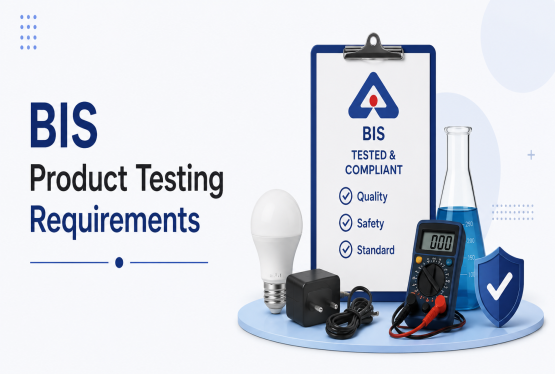
Testing Requirements for Electronic Controlgear for LED Modules
Testing ensures that electronic controlgear satisfies the relevant safety requirements before being marketed in India. An LED driver may work normally during basic testing but still have problems involving insulation, heating, construction or electrical faults.
The applicable Indian Standard addresses electrical and mechanical safety requirements for LED controlgear. Testing must be completed according to the relevant provisions of the standard rather than relying only on basic functional checks.
Important BIS Testing Areas
| Testing Area | Importance |
|---|---|
| Electric shock protection | Checks protection against hazardous electrical contact |
| Insulation resistance | Evaluates electrical insulation performance |
| Electric strength | Assesses insulation under specified test conditions |
| Temperature rise | Evaluates overheating during operation |
| Mechanical construction | Checks relevant construction and safety provisions |
| Fault conditions | Examines safety under prescribed abnormal conditions |
| Marking requirements | Verifies the required safety information and product identification |
The actual test schedule depends on the construction, classification and electrical characteristics of the product. Manufacturers should also distinguish between mandatory safety testing and other performance-related assessments. A BIS CRS registration under this standard does not automatically certify every claimed efficiency or performance characteristic of the LED driver.
Latest BIS Updates and Amendments for LED Controlgear in 2026
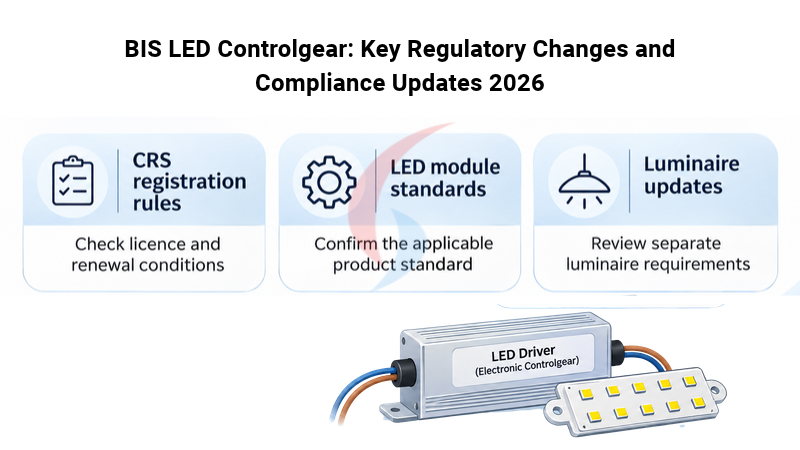
BIS regularly updates its certification procedures, product standards and registration requirements. Manufacturers of electronic controlgear for LED modules should monitor these changes because they can affect new registrations, existing licences and annual compliance.
1. BIS Conformity Assessment Amendment Regulations, 2026
The BIS (Conformity Assessment) Amendment Regulations, 2026 introduced important changes to the CRS registration system. Under the revised provisions, registration may initially be granted for up to five years and renewed for a further period of up to five years. The amendments also introduced revised annual fee and licence-continuation requirements. Manufacturers must pay the applicable fees and submit required production information within the prescribed timelines.
2. Revised Standards for LED Modules
BIS revised the safety standard for independent LED modules from IS 16103 (Part 1):2012 to IS 16103 (Part 1):2025. The implementation deadline was extended to 21 July 2026. This change is relevant to manufacturers supplying complete LED lighting systems. However, the revised LED module standard should not be confused with the separate controlgear standard, IS 15885 (Part 2/Sec 13):2012.
3. LED Luminaire Standard Updates in 2026
BIS also published revised standards and implementation guidance for several categories of LED luminaires during 2026, including extensions to transition dates. Manufacturers producing complete LED lighting fixtures should review these requirements separately. An LED driver registration alone does not necessarily satisfy the certification requirements applicable to a complete luminaire.
Businesses dealing with LED lamps, electronic controlgear and lighting equipment can explore our latest BIS certification updates and Indian Standard requirements.
BIS Certification Fees and Processing Time
The cost of BIS Certification for Electronic Controlgear for LED Modules depends on government fees, laboratory testing, number of models, manufacturing location and additional documentation requirements. Under the revised 2026 CRS fee provisions, the standard fee components for a new large-enterprise application include a Rs 1,000 application fee, Rs 25,000 processing fee and Rs 1,000 annual licence fee, excluding applicable taxes and laboratory expenses. Eligible enterprises may qualify for prescribed concessions.
Laboratory testing costs vary depending on the recognised laboratory and the tests required. Processing time also depends on test results, document accuracy and BIS scrutiny. Manufacturers should avoid assuming that registration will be granted within a guaranteed number of days.
Common Challenges in BIS Certification for LED Controlgear
One common challenge is selecting the correct product category. Manufacturers sometimes confuse LED drivers with LED modules or complete LED luminaires. Since these products can fall under different standards, incorrect classification may lead to delays. Another challenge involves product testing. A driver may perform correctly during normal operation but fail a prescribed electrical safety test. Manufacturers may then need to modify its design and arrange fresh testing.
For example, consider an LED lighting manufacturer in Delhi planning to introduce a new range of commercial LED drivers. The company completes product development and prepares its packaging before arranging BIS testing. During testing, one model does not satisfy the required temperature-rise conditions. The manufacturer must correct the technical issue and obtain suitable conformity evidence before completing registration. This example shows why BIS testing should be planned before a major product launch rather than treated as a final formality.
Benefits of BIS CRS Registration for Electronic Controlgear
BIS registration helps manufacturers demonstrate compliance with the applicable Indian safety standard. It also supports lawful market access for covered products and helps buyers identify registered manufacturers. For importers and distributors, verifying BIS registration can reduce the risk of sourcing products that do not satisfy mandatory certification requirements. Registration also encourages manufacturers to maintain proper product documentation, safety testing records and consistent product specifications.
However, certification does not eliminate every possible product failure. Manufacturers must continue maintaining conformity with the approved design and applicable BIS requirements after receiving registration.
Why Choose Compliance Calendar LLP for BIS Certification?
Getting BIS certification can become difficult when manufacturers are unfamiliar with product classification, laboratory testing and registration procedures. A small error in a product model number, manufacturing address or supporting document may delay an application. At Compliance Calendar LLP, we focus on understanding the manufacturer's actual product before proceeding with documentation. For electronic controlgear, this means reviewing the product specifications, identifying the applicable standard and explaining the registration requirements in a practical manner.
Our assistance includes BIS applicability assessment, documentation preparation, coordination with BIS-recognised testing laboratories, CRS application support, query handling and guidance on post-registration compliance.
For enquiries, contact Compliance Calendar LLP by email at info@ccoffice.in or via WhatsApp at +91 9988424211
Frequently Asked Questions (FAQs)
Q1. Is BIS Certification mandatory for electronic controlgear for LED modules?
Ans. Yes. DC or AC supplied electronic controlgear for LED modules is covered under the BIS Compulsory Registration Scheme. Manufacturers must comply with the applicable requirements before marketing covered products in India.
Q2. Which Indian Standard applies to electronic controlgear for LED modules?
Ans. The applicable standard is IS 15885 (Part 2/Sec 13):2012. It specifies particular safety requirements for DC or AC supplied electronic controlgear associated with LED modules.
Q3. When did BIS Certification become mandatory for LED controlgear?
Ans. BIS registration became mandatory for this notified product category on 1 December 2015. Manufacturers and importers must follow the current applicable requirements.
Q4. Can foreign manufacturers obtain BIS CRS Registration for LED drivers?
Ans. Yes. Eligible overseas manufacturers can obtain BIS CRS registration. They must satisfy the prescribed documentation, testing and Authorised Indian Representative requirements.
Q5. What documents are required for LED controlgear BIS Certification?
Ans. Common documents include factory address proof, manufacturer details, product specifications, brand information, laboratory test reports and prescribed declarations. Foreign manufacturers may need additional AIR documents.
Q6. How long is BIS CRS Registration valid in 2026?
Ans. Under the amended Scheme II provisions, registration can initially be granted for up to five years and renewed for up to five years. Applicable annual fees and compliance obligations must be fulfilled.
Q7. Can multiple LED driver models be registered under one BIS registration?
Ans. Multiple models may be covered when they satisfy the applicable BIS series and model-grouping requirements. Manufacturers should verify eligibility before submitting samples and applications.
Q8. Is testing mandatory for BIS Certification of electronic controlgear?
Ans. Yes. Covered products must undergo testing at a BIS-recognised laboratory against the applicable Indian Standard. A valid laboratory report is required for the registration application.
Q9. Is BIS Certification of an LED driver sufficient for an entire LED luminaire?
Ans. Not necessarily. LED drivers and complete LED luminaires may fall under different notified product categories. The certification requirements for each product must be assessed separately.
Q10. What happens if electronic controlgear is sold without mandatory BIS registration?
Ans. Manufacturing, importing or selling notified products without the required registration may lead to enforcement action under the applicable BIS legal provisions, including restrictions and penalties.
Article last updated on : 18 Nov 2026.