


Imagine a chemical manufacturer in Gujarat receiving a bulk order for Trimethyl Phosphite Technical Grade from an industrial buyer in Maharashtra. The company has a manufacturing facility, trained employees and regular laboratory testing arrangements. However, before placing the order, the buyer asks whether the chemical has BIS CRS Certification under IS 17412:2020. Although the manufacturer has internal quality reports, it has not obtained BIS registration. The company now needs to understand the mandatory certification requirements before supplying the product.
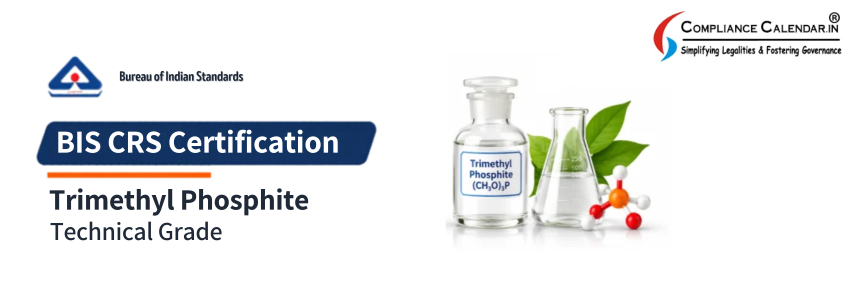
This situation explains why BIS CRS Certification for Trimethyl Phosphite Technical Grade is important for chemical manufacturers and suppliers in India. Under the Trimethyl Phosphite (Quality Control) Order, 2022, covered products must meet the applicable Indian Standard and carry the prescribed BIS Standard Mark. Understanding the registration process can help businesses avoid supply interruptions, documentation problems and regulatory action.
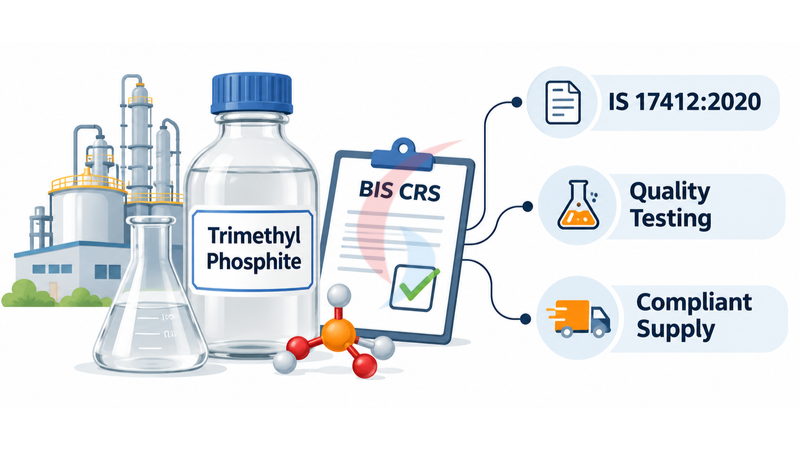
What is BIS CRS Certification for Trimethyl Phosphite Technical Grade?
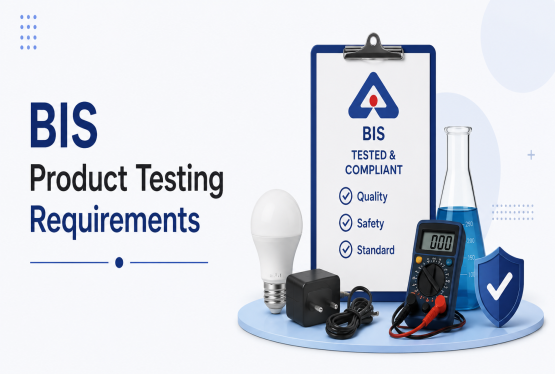
Trimethyl Phosphite is an organic phosphorus compound with the chemical formula P(OCH?)?. It is commonly used as an intermediate in chemical manufacturing, including the production of certain phosphorus-based compounds and specialty chemicals. BIS CRS Certification is a compulsory registration process administered by the Bureau of Indian Standards. It confirms that the manufacturer's covered product meets the specified Indian Standard. For Trimethyl Phosphite Technical Grade, the applicable standard is IS 17412:2020 – Trimethyl Phosphite – Technical Grade. The product falls under Scheme-II of Schedule-II of the BIS (Conformity Assessment) Regulations, 2018. Manufacturers must obtain the applicable registration and use the prescribed Standard Mark before supplying covered products to the Indian market.
For More Information: Read our BIS CRS Certification for Orthophosphoric Acid article to understand the certification requirements for another phosphorus-based chemical.
Is BIS CRS Certification Mandatory for Trimethyl Phosphite?
Yes. BIS CRS Certification is mandatory for Trimethyl Phosphite covered under the Trimethyl Phosphite (Quality Control) Order, 2022. The Ministry of Chemicals and Fertilizers issued this order through Notification S.O. 1637(E), dated 5 April 2022, under Section 16 of the Bureau of Indian Standards Act, 2016. The Department of Chemicals and Petrochemicals records its enforcement date as 3 October 2022. The order requires covered products to comply with IS 17412:2020 and bear the applicable BIS Standard Mark under a valid registration. It also provides an exemption for goods or articles meant for export.
For example, a chemical manufacturer supplying Trimethyl Phosphite to an Indian pesticide intermediate producer must check its BIS registration obligations. An ordinary laboratory certificate or ISO certification cannot replace mandatory BIS registration.
Who Needs BIS Certification for Trimethyl Phosphite?
The requirement primarily concerns manufacturers, but importers and distributors must also ensure that the chemicals they handle comply with the law.
|
Business Category |
BIS Compliance Requirement |
|
Indian manufacturers |
Registration required for covered domestic-market products |
|
Foreign manufacturers |
Registration required for covered products supplied to India |
|
Importers |
Must verify the manufacturer's valid BIS registration |
|
Traders and distributors |
Must ensure that products sold are compliant |
|
Export-only manufacturers |
Export goods are excluded under the original QCO |
|
Industrial buyers |
Should verify the supplier's registration and product scope |
Consider a Delhi-based chemical distributor purchasing Trimethyl Phosphite from an overseas supplier. Even if the chemical satisfies the buyer's internal specifications, the distributor should verify that the foreign manufacturer has the applicable BIS registration before importing the covered product.
For More Information: Small chemical manufacturers can explore BIS Certification for Small Manufacturers and MSMEs to understand eligibility, documentation and certification requirements.
Applicable Indian Standard: IS 17412:2020
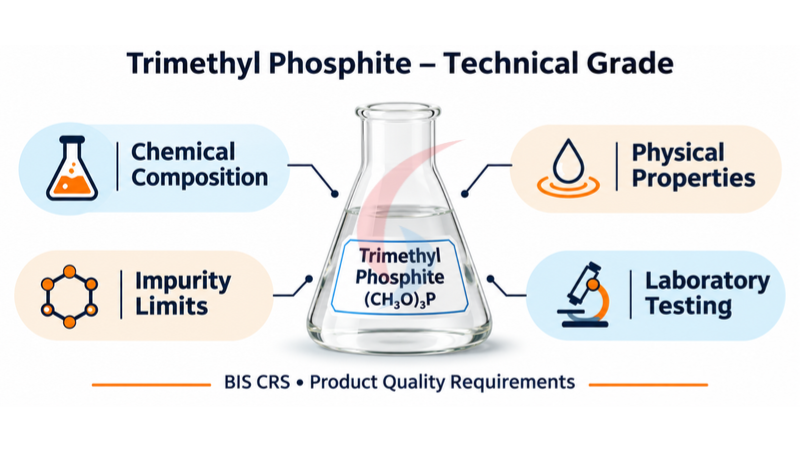
IS 17412:2020 establishes the technical requirements for Trimethyl Phosphite Technical Grade. It identifies the relevant quality characteristics and testing methods required to determine whether the chemical conforms to the prescribed specification. The standard is important because variations in composition or impurities can affect chemical reactions, storage conditions and product performance. Manufacturers should maintain appropriate quality controls and obtain testing from a BIS-recognised laboratory having the relevant standard within its approved scope.
Important Testing Parameters
|
Testing Parameter |
Purpose |
|
Description and appearance |
Checks the physical characteristics |
|
Trimethyl Phosphite content |
Determines the amount of the principal chemical |
|
Dimethyl Phosphite |
Checks a specified impurity |
|
Dimethyl Methyl Phosphonate |
Measures another specified chemical constituent |
|
Trimethyl Phosphate |
Checks the applicable impurity requirement |
|
Methanol |
Identifies residual methanol |
|
Refractive index at 25°C |
Checks the specified physical property |
These parameters appear in BIS laboratory testing information for IS 17412:2020. Manufacturers must refer to the complete current Indian Standard for the exact acceptance limits and test methods.
Latest BIS Rules and Amendments: 2026
Understanding recent regulatory changes is important because businesses sometimes rely on older registration instructions.
Important Legal Developments
|
Date |
Notification or Update |
Significance |
|
5 April 2022 |
S.O. 1637(E) |
Trimethyl Phosphite Quality Control Order notified |
|
3 October 2022 |
QCO enforcement |
Mandatory compliance came into effect |
|
25 February 2026 |
BIS Conformity Assessment Amendment Regulations |
Revised registration validity and annual fee provisions |
|
27 May 2026 |
BIS CRS guidance |
Clarified revised licence validity, renewal and annual payment requirements |
|
13 August 2026 |
BIS CRS product-category guidance |
Additional guidance on product categories |
Important 2026 Update
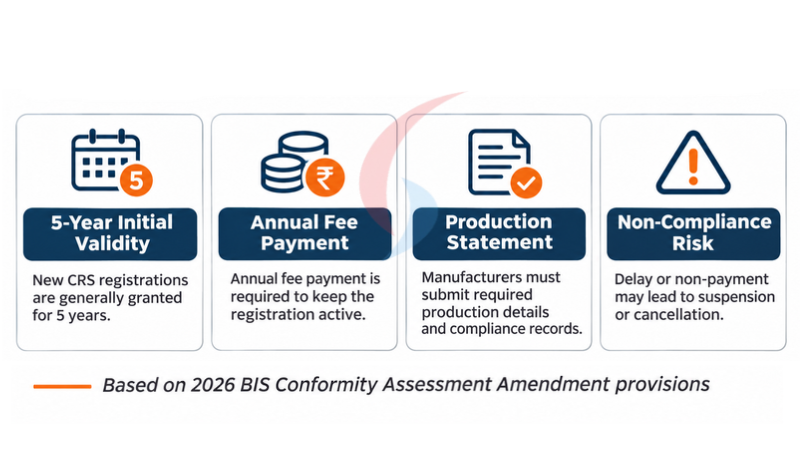
The BIS (Conformity Assessment) Amendment Regulations, 2026 introduced important changes affecting Scheme-II registration. Under the amended provisions, new CRS registrations are generally granted for five years rather than the earlier two-year period. The rules also introduce annual fee payments and production-statement requirements for continued operation of the registration.
Businesses should pay attention to the relevant due dates. Non-payment can lead to suspension and, if not corrected within the prescribed period, cancellation. As of 16 November 2026, BIS continues to list Trimethyl Phosphite under IS 17412:2020 and the original 2022 QCO. No product-specific amendment changing this standard or the original QCO requirements was identified in the official BIS listing reviewed for this article.
BIS CRS Registration Process for Trimethyl Phosphite
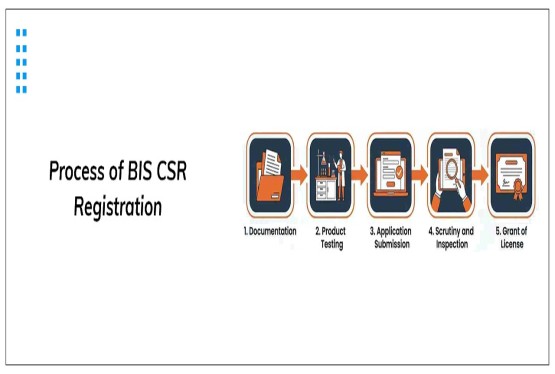
Manufacturers should confirm product applicability and complete the required testing before submitting a registration application.
Step 1: Check Product Applicability
First, confirm that the chemical is Trimethyl Phosphite Technical Grade covered by IS 17412:2020. Review its intended market, manufacturing location and any applicable exemption.
Step 2: Register on the BIS Portal
The manufacturer must create an account through the official BIS CRS Portal. The business must provide valid manufacturing-unit information and the required address documents.
Step 3: Arrange Laboratory Testing
Submit representative samples to a BIS-recognised laboratory approved for IS 17412:2020. The laboratory examines the product against the relevant requirements and issues the test report.
Step 4: Prepare Application Documents
Collect manufacturing details, product information, valid testing records, brand documents and authorised-signatory information. Foreign manufacturers may need to appoint an Authorised Indian Representative.
Step 5: Submit the CRS Application
Complete the applicable online application and attach the necessary documents. BIS instructions require the test report used for a new application to be within the prescribed validity period, generally 90 days from its issue.
Step 6: BIS Verification
BIS examines the application, declarations and test reports. If information is incomplete or inconsistent, clarification or corrected documentation may be required.
Step 7: Obtain Registration
After satisfactory verification, BIS grants registration for the approved manufacturer and product. The manufacturer may then apply the prescribed Standard Mark with its registration number, subject to the applicable conditions.
Documents Required for BIS CRS Certification
Proper documentation helps prevent avoidable objections during registration. Requirements may differ depending on the manufacturing unit, brand ownership and applicant's location.
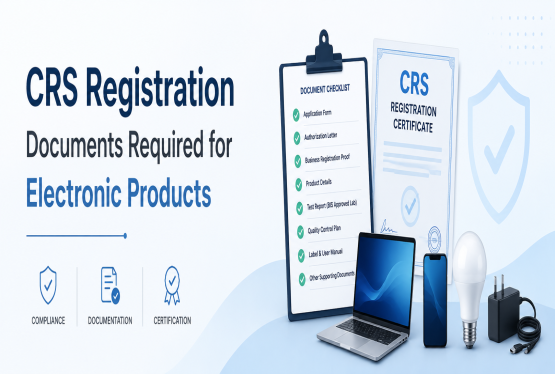
Commonly required documents include:
- Manufacturing-unit registration and government-issued address proof.
- Business identity and legal constitution documents.
- Product description and technical specifications.
- Valid test report from a BIS-recognised laboratory.
- Brand registration or brand authorisation, where applicable.
- Details of the authorised application signatory.
- Manufacturing-process and relevant product details.
- Required declarations and undertakings.
- Authorised Indian Representative documents for foreign applicants.
- Applicable registration fee payment details.
Example: A manufacturer submits a test report carrying an old factory address while the registration application mentions its new location. BIS may ask for clarification because registration documents must correctly identify the manufacturing unit.
For More Information: Explore CRS Application: Important Details to Check to understand how BIS verifies manufacturer details, product information and testing records.
BIS CRS Certification Cost and Processing Time
There is no single fixed total certification cost for every Trimethyl Phosphite manufacturer. Expenses depend on the applicable BIS fees, the testing laboratory, the number of test reports and any additional documentation requirements. The main expenses generally include the application fee, processing charges, testing fee, annual registration charges and optional professional assistance.
For example, the BIS Laboratory Information Management System lists a testing charge of Rs 9,000, excluding taxes, for Trimethyl Phosphite under IS 17412:2020 at one listed laboratory, with validity shown through 31 December 2026. This is a laboratory-specific published charge, not a universal BIS testing fee. Processing time depends on laboratory testing, the accuracy of submitted documents and BIS scrutiny. A manufacturer should therefore plan certification before making firm delivery commitments.
For More Information: Manufacturers can explore our BIS CRS Registration for Induction Stoves article to understand how the compulsory registration process applies to another regulated product category.
BIS Registration for Foreign Manufacturers
Foreign manufacturers supplying Trimethyl Phosphite Technical Grade to India must also consider the compulsory registration requirement. The application is generally made by the manufacturer rather than by an independent Indian trader. Where required, a foreign applicant without an Indian liaison or branch office must appoint an Authorised Indian Representative (AIR).
The AIR assists with prescribed declarations, documentation and communication with BIS. However, the foreign manufacturer remains responsible for ensuring that its product and manufacturing information satisfy the applicable registration requirements. Indian importers should verify the registration number and approved scope rather than relying only on assurances from overseas suppliers.
Common Mistakes Manufacturers Should Avoid
Several avoidable mistakes can delay BIS registration or create compliance problems.
The first is assuming that a general quality certificate is equivalent to BIS registration. Laboratory testing supports the application, but registration is a separate legal requirement.
The second is selecting a testing laboratory without checking whether IS 17412:2020 is included in its BIS-recognised scope.
Another common mistake is submitting inconsistent manufacturing-unit information. Differences in names, addresses or brand details can result in additional scrutiny. Manufacturers should also avoid using expired test reports, displaying the Standard Mark without authorisation or assuming that a registration covering one manufacturing unit automatically covers another.
What Happens Without BIS Certification?
Manufacturing, importing or selling covered Trimethyl Phosphite without meeting the applicable compulsory certification requirements can lead to regulatory action.
The BIS Act, 2016, contains restrictions concerning products subject to mandatory conformity assessment. Section 29 provides penalties for specified contraventions, depending on the nature of the violation. Businesses may also face commercial problems, including rejected orders, import-related difficulties and disruption to supply arrangements. For these reasons, manufacturers and importers should verify certification requirements before introducing the product into the Indian market.
Why Choose Compliance Calendar LLP for BIS CRS Certification?
Suppose a manufacturer approaches Compliance Calendar LLP with a practical question: “We manufacture Trimethyl Phosphite Technical Grade and have received a large domestic order. Our chemical already passes internal tests. Do we still require BIS registration?” Rather than immediately preparing an application, the correct approach is to examine the chemical's classification, applicable Indian Standard, manufacturing location and intended market. This initial review helps determine whether compulsory registration applies and what the manufacturer should do next.
At Compliance Calendar LLP, we assist chemical manufacturers, importers and industrial businesses with such product-specific compliance requirements. Our team helps review applicable BIS standards, organise manufacturing and product documentation, coordinate recognised-laboratory testing and prepare CRS registration applications.
For a business facing questions about a test report, factory address, product classification or foreign manufacturer documentation, we focus on resolving those issues before they become avoidable delays. Our approach is to explain each requirement clearly and help clients understand the steps involved in achieving compliance.
For assistance with BIS CRS Certification for Trimethyl Phosphite Technical Grade, contact Compliance Calendar LLP at +91 9988424211 or info@ccoffice.in.
Frequently Asked Questions (FAQs)
Q1. Is BIS CRS Certification mandatory for Trimethyl Phosphite?
Ans. Yes. BIS CRS Certification is mandatory for Trimethyl Phosphite Technical Grade covered by the 2022 Quality Control Order, subject to applicable exemptions.
Q2. Which Indian Standard applies to Trimethyl Phosphite?
Ans. IS 17412:2020 is the applicable Indian Standard. It specifies the quality requirements for Trimethyl Phosphite Technical Grade.
Q3. When did BIS Certification become mandatory for Trimethyl Phosphite?
Ans. The Department of Chemicals and Petrochemicals records 3 October 2022 as the enforcement date of the Trimethyl Phosphite (Quality Control) Order, 2022.
Q4. Can Trimethyl Phosphite be imported without BIS Registration?
Ans. Covered imports generally require the relevant manufacturer's valid BIS registration. Importers should verify whether an applicable legal exemption exists before importing.
Q5. Who can apply for BIS CRS Registration?
Ans. Indian and foreign manufacturers of covered products can apply. Foreign applicants must follow the applicable requirements for appointing an Authorised Indian Representative.
Q6. What is the cost of BIS CRS Certification?
Ans. The total cost depends on BIS fees, recognised-laboratory testing charges and application circumstances. There is no universal total certification cost.
Q7. How long does BIS CRS Registration take?
Ans. The time depends on laboratory testing, document completeness and BIS scrutiny. Incorrect documents or failed testing may extend the process.
Q8. Is laboratory testing mandatory?
Ans. Yes. Product testing through an appropriately recognised BIS laboratory is an essential part of establishing conformity with IS 17412:2020.
Q9. What is the BIS CRS registration validity in 2026?
Ans. The 2026 regulatory amendments introduced a five-year initial validity for new Scheme-II registrations, subject to applicable annual payments and continued compliance.
Q10. Is BIS Registration required for export-only Trimethyl Phosphite?
Ans. The original Quality Control Order excludes goods or articles meant for export. Businesses must ensure that the export-only exemption genuinely applies to the products concerned.
Article last updated on : 18 Nov 2026.