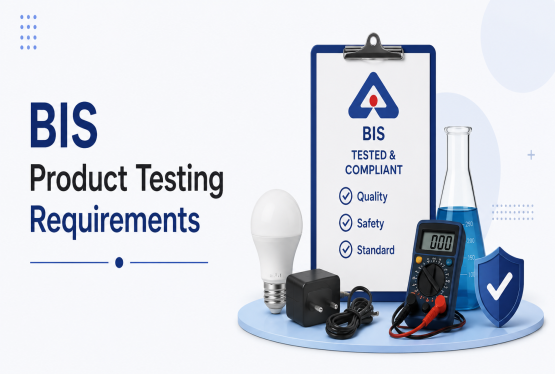



Imagine a lighting manufacturer in Delhi preparing to launch a new range of LED ceiling lights. The products are ready, packaging is complete, and distributors are interested. However, just before the launch, the manufacturer learns that the lights cannot be sold in India without the required BIS registration. Product testing, documentation and approval must be completed before entering the market. This situation explains why businesses should understand BIS CRS Registration for Fixed General Purpose LED Luminaires before starting commercial production or imports.
Fixed LED luminaires are commonly installed in homes, offices, hospitals, hotels and commercial buildings. While customers usually focus on brightness, appearance and energy consumption, electrical safety is equally important. Poor insulation, excessive heating or unsafe wiring can create risks during everyday use. The Bureau of Indian Standards (BIS) regulates these notified products through the Compulsory Registration Scheme (CRS). Manufacturers must demonstrate compliance with the applicable Indian Standard and obtain registration for covered products.
Understanding Fixed General Purpose LED Luminaires
A fixed general-purpose LED luminaire is a lighting fixture designed to be securely installed at a particular location. Unlike portable lamps that can be moved around easily, these fixtures are normally attached to ceilings, walls or other permanent structures. A complete LED luminaire usually includes an LED light source, electrical connections, a suitable driver or controlgear, and a housing that holds and protects the components.
For example, when a company installs LED batten lights across its office, the fixtures remain attached to the ceiling or wall. These products must function safely under the conditions specified by the applicable Indian Standard.
Some common examples include:
-
Surface-mounted LED ceiling lights
-
Fixed LED batten lights
-
Certain wall-mounted LED fixtures
-
Fixed decorative LED luminaires
-
General-purpose LED lighting fixtures
Not every permanently installed LED light belongs to the same BIS category. Recessed luminaires, streetlights and floodlights may be subject to separate product standards. Classification depends on the product's design and intended use.
Why Is BIS Registration Necessary for Fixed LED Luminaires?
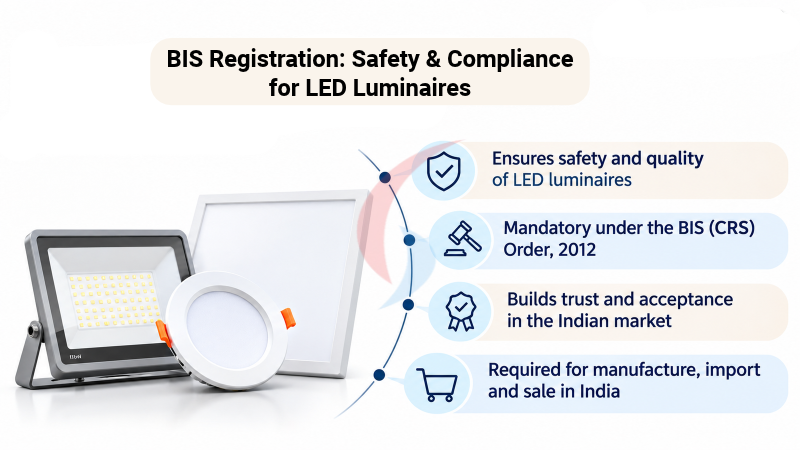
Most customers cannot determine whether a lighting product is electrically safe simply by looking at it. A luminaire may produce sufficient light but still contain electrical or construction defects that become dangerous during extended operation. BIS registration addresses this concern by requiring notified products to undergo testing against prescribed Indian Standards. The testing examines important safety characteristics rather than only checking whether the light switches on. The obligation applies to covered products manufactured domestically and those supplied to India by overseas manufacturers. Importers and brand owners must ensure that the actual manufacturing facility and relevant models have appropriate registration.
Is Your LED Product Covered Under BIS CRS?
Before launching a lighting product, manufacturers should identify its exact BIS category. Our guide on BIS Certification for LED Lights explains the requirements for different LED lighting products in India.
Which BIS Standard Applies to Fixed General Purpose LED Luminaires?
The relevant revised standard is IS 10322 (Part 5/Sec 1):2026, corresponding to IEC 60598-2-1:2020.
It specifies particular safety requirements for fixed general-purpose luminaires and is used alongside the applicable general requirements of IS 10322 (Part 1):2026. Previously, the product category was covered by IS 10322 (Part 5/Sec 1):2012. BIS revised the standard in March 2026 and established a transition period to allow manufacturers to update their certification arrangements.
BIS Standards for Common LED Luminaires
|
LED Product Category |
Revised Indian Standard |
|---|---|
|
Fixed General Purpose LED Luminaires |
IS 10322 (Part 5/Sec 1):2026 |
|
Recessed LED Luminaires |
IS 10322 (Part 5/Sec 2):2026 |
|
LED Road and Street Lights |
IS 10322 (Part 5/Sec 3):2026 |
|
LED Flood Lights |
IS 10322 (Part 5/Sec 5):2026 |
|
LED Lighting Chains |
IS 10322 (Part 5/Sec 7):2026 |
|
General Safety Requirements for Luminaires |
IS 10322 (Part 1):2026 |
The difference between these standards matters. A manufacturer producing ceiling-mounted LED lights and recessed downlights cannot automatically assume that the same product classification and registration scope apply to both.
What Changed in BIS LED Luminaire Standards in 2026?
The revised Indian Standards introduced changes that manufacturers must examine before continuing production or submitting new applications.
The important developments are explained below.
1. Revision of IS 10322 (Part 5/Sec 1)
The 2026 revision updated references to the general luminaire standard and modified the product scope to include all electric light sources covered by the relevant requirements. This means manufacturers should consider the complete construction of the product rather than only the LED light source.
2. Changes to General Luminaire Safety Requirements
The revised IS 10322 (Part 1):2026 introduced several technical changes, including updated marking provisions, electrical protection requirements, electromagnetic-field safety provisions and additional requirements relevant to certain lighting technologies. Some changes apply only to products with particular features. Manufacturers should assess applicability based on their product's actual design.
3. Deadline Extended to 2 February 2027
BIS originally provided 2 August 2026 as the deadline for transition to the revised standards. Through its circular dated 31 July 2026, BIS extended the last date of concurrent running to 2 February 2027. During the permitted transition period, the older and revised editions may be used subject to BIS implementation conditions. Manufacturers should plan testing and documentation early rather than wait until the deadline.
Important BIS Transition Deadline - 2 February 2027 Read the official BIS extension circular
4. Requirements for Existing BIS Licensees
Existing licensees must establish compliance with the revised standard through complete test reports for applicable lead models. They are also required to provide an undertaking for other covered series models, according to BIS implementation guidelines. Failure to complete the transition may affect the continued validity of registration coverage or lead to deletion of non-compliant models.
Read our article on BIS LED Luminaire Standards: Key Update Before 02 August 2026 for background on the changes.
Who Must Obtain BIS CRS Registration?
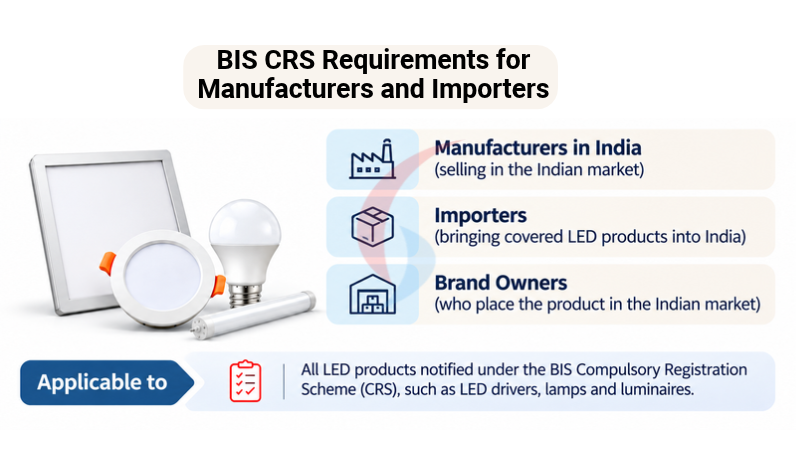
The requirement primarily concerns manufacturers of notified LED luminaires. However, importers, brand owners and distributors also need to ensure that the products they deal with comply with applicable BIS requirements.
-
Indian manufacturers: A manufacturing unit producing covered LED luminaires must obtain appropriate registration before marketing them.
-
Foreign manufacturers: Overseas manufacturers supplying covered luminaires to India must satisfy the applicable registration requirements and generally appoint an Authorised Indian Representative (AIR).
-
Brand owners: Businesses selling products under their own labels must ensure that the actual manufacturer has registration covering the relevant brand and models.
-
Importers: Importers should verify the manufacturer's registration status before placing orders or arranging shipments.
For example, if a company purchases LED ceiling lights from two different factories, registration for one factory does not automatically cover the second. Each manufacturing arrangement must be assessed separately.
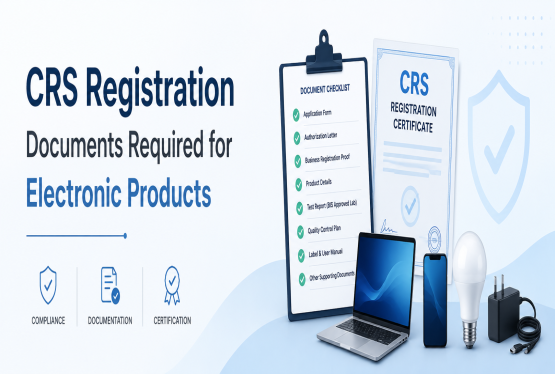
Documents Required for BIS CRS Registration
A technically compliant product can still face application delays when the supporting documents are incomplete or inconsistent.
Manufacturers should organise their product specifications, factory information and brand documents before arranging testing. The model information shown in the test report should also match the details declared in the application.
BIS Registration Document Checklist
|
Document |
Why BIS Needs It |
|---|---|
|
Manufacturing unit address proof |
To identify the production location |
|
Business registration documents |
To verify manufacturer details |
|
Product specifications |
To establish electrical ratings and construction |
|
BIS-recognised laboratory test report |
To demonstrate conformity with the standard |
|
Product photographs and labels |
To identify the brand and models |
|
Brand authorisation, where applicable |
To establish brand-use rights |
|
Authorised signatory details |
To identify the application representative |
|
AIR documents, where applicable |
For applicable overseas manufacturers |
|
Required undertakings |
To confirm regulatory responsibilities |
The exact requirements may differ according to the applicant's circumstances and the type of application.
Learn more about product testing and applicable standards in our guide to BIS CRS Certification for Self-Ballasted LED Lamps.
How Does the BIS Registration Process Work?
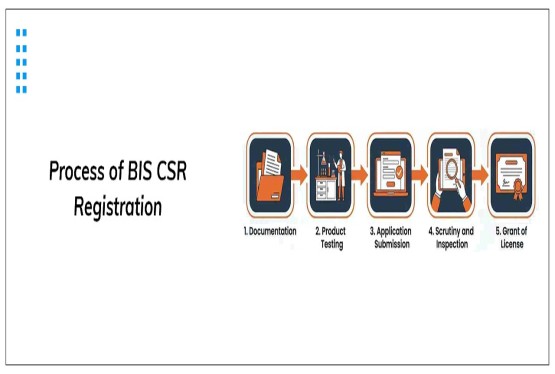
The application process can be understood as a sequence of technical and administrative checks. The most important part is ensuring that the product and documents are ready before the online submission.
- Check the product category- Identify whether the product falls under fixed general-purpose luminaires or another LED lighting category.
- Confirm the applicable Indian Standard - Review the 2026 standard and the relevant BIS transition conditions.
- Arrange laboratory testing - Submit suitable product samples to a BIS-recognised laboratory with the required testing scope.
- Review the laboratory report - Confirm that the test report covers the intended product and records conformity with the applicable requirements.
- Prepare and file the online application - Submit manufacturer details, model specifications, declarations and the required laboratory report through the CRS portal.
- Resolve BIS observations - Provide clarifications or corrected documents if BIS raises queries during scrutiny.
- Receive registration and follow marking rules - After approval, use the prescribed Standard Mark and registration details for products covered by the approved scope.
Manufacturers should note that the laboratory test report generally must not be older than 90 days at the time of online application submission, under the BIS CRS application instructions. Official application guidance is available through the BIS CRS How to Apply portal.
Planning Your First BIS Application?
If your company has not previously applied under CRS, our Step-by-Step BIS CRS Registration Guide explains how manufacturers can prepare for testing and registration.
What Safety Tests Are Required for Fixed LED Luminaires?
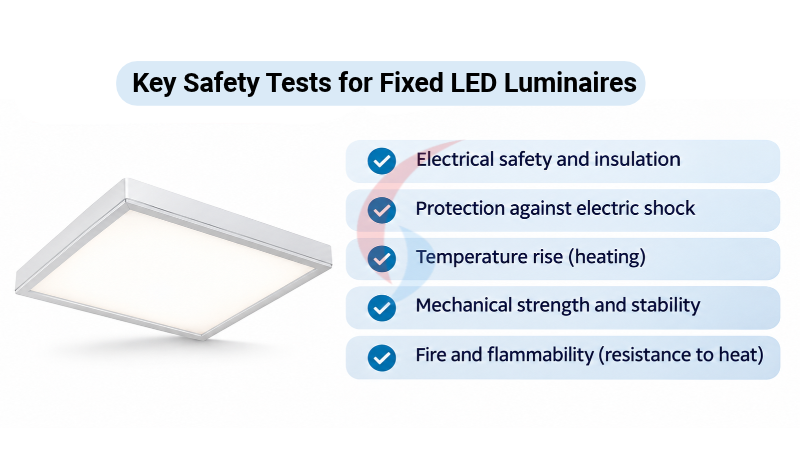
A fixed LED luminaire is expected to operate safely for extended periods. Since these fixtures are often installed in ceilings or walls, electrical faults may not become visible immediately.
BIS testing examines whether the product satisfies the relevant safety provisions of the applicable standard. The complete testing programme depends on the luminaire's construction, classification and features.
Major Safety Testing Areas
|
Testing Requirement |
What It Checks |
|---|---|
|
Protection Against Electric Shock |
Protection from accessible live parts |
|
Temperature Rise |
Excessive heating during operation |
|
Insulation Resistance |
Electrical insulation performance |
|
Electric Strength |
Insulation under prescribed voltage conditions |
|
Mechanical Strength |
Resistance to specified mechanical stresses |
|
Earthing Provisions |
Protective earthing, where applicable |
|
Heat and Fire Resistance |
Safety of relevant materials |
|
Marking Requirements |
Mandatory safety information and identification |
A product passing basic electrical or functional testing does not automatically qualify for BIS registration. The required assessments must be completed under the applicable Indian Standard.
Understanding BIS Registration Fees and Processing Time
One common question manufacturers ask is, “How much will BIS registration cost?”
There is no single total cost suitable for every manufacturer. Expenses vary depending on laboratory testing, number of models, registration fees, technical specifications and additional requirements for foreign manufacturers.
Under the 2026 amendment to the BIS Conformity Assessment Regulations, the general Scheme II fee structure includes a Rs 1,000 application fee, a Rs 25,000 annual processing fee and a Rs 1,000 annual licence fee for applicants without a concession, subject to the applicable provisions. Testing charges and taxes are additional. Eligible enterprises may qualify for fee concessions. Processing time also depends on how quickly laboratory testing is completed and whether BIS raises queries. Manufacturers should begin certification planning before committing to commercial delivery dates.
Mistakes That Can Delay BIS Approval
Not every delay is caused by failed product testing. In many cases, manufacturers face difficulties because of avoidable documentation or registration errors. The most common issues include choosing the wrong product category, submitting inconsistent factory information, using an unsuitable laboratory, declaring incorrect model numbers and overlooking revised-standard requirements. Businesses should also avoid assuming that registration for an LED driver automatically covers the complete luminaire. Separate notified product categories may require independent compliance assessments.
Do LED Drivers Need Separate BIS Registration?
Explore our article on BIS Certification for Electronic Controlgear for LED Modules to understand the certification requirements for electronic controlgear.
What Happens After BIS Registration Is Granted?
Receiving a BIS registration certificate does not mean that the manufacturer can stop monitoring compliance. The manufacturer must continue producing luminaires that conform to the registered product specifications and applicable safety requirements. Any changes affecting registration coverage, such as introducing new models or changing relevant product characteristics, should be examined under BIS procedures.
Manufacturers also need to maintain registration conditions, pay applicable annual fees and retain appropriate conformity and production records. The BIS (Conformity Assessment) Amendment Regulations, 2026 revised Scheme II licence validity and continuation provisions. Licences may initially be granted for up to five years and renewed for up to five years, subject to applicable conditions and annual fee payments.
For a detailed explanation of manufacturers' ongoing responsibilities, refer to our CRS Compliance for Manufacturers article.
Why Choose Compliance Calendar LLP for BIS CRS Registration?
For a lighting manufacturer, obtaining BIS registration often involves more than understanding the application form. Businesses need to identify the right standard, coordinate with recognised laboratories, maintain technical documents and respond to BIS queries.
At Compliance Calendar LLP, we focus on understanding the product and the manufacturer's practical requirements before beginning the registration process. Compliance Calendar LLP can assist with BIS applicability assessments, documentation preparation, laboratory testing coordination, online registration applications, query responses and guidance on post-registration compliance.
For professional assistance with BIS CRS Registration for Fixed General Purpose LED Luminaires, contact Compliance Calendar LLP at +91 9988424211 or info@ccoffice.in
Frequently Asked Questions (FAQs)
Q1. Is BIS CRS Registration mandatory for Fixed General Purpose LED Luminaires?
Ans. Yes. The product category is covered under the BIS Compulsory Registration Scheme. Covered luminaires must satisfy mandatory registration requirements before being marketed in India.
Q2. Which BIS standard applies to fixed general-purpose LED luminaires in 2026?
Ans. The revised standard is IS 10322 (Part 5/Sec 1):2026, read with the relevant requirements of IS 10322 (Part 1):2026.
Q3. When did BIS registration become mandatory for these luminaires?
Ans. The mandatory BIS CRS registration requirement for Fixed General Purpose LED Luminaires became effective on 1 March 2016.
Q4. What is the latest BIS deadline for implementing the revised standard?
Ans. BIS extended the last date of concurrent running of the old and revised standards to 2 February 2027.
Q5. Can foreign manufacturers obtain BIS CRS Registration?
Ans. Yes. Eligible foreign manufacturers can apply under CRS. They must meet the prescribed requirements, including AIR nomination where applicable.
Q6. What documents are needed for BIS certification?
Ans. Common documents include manufacturer details, factory address proof, product specifications, brand information, recognised laboratory test reports and required declarations.
Q7. Is laboratory testing compulsory for Fixed General Purpose LED Luminaires?
Ans. Yes. Covered products must undergo applicable testing through a BIS-recognised laboratory before registration can be granted.
Q8. Can multiple LED luminaire models be covered under one registration?
Ans. Multiple eligible models may be included according to BIS grouping guidelines. The models must fall within the approved registration scope.
Q9. Does registration for an LED driver cover a complete LED luminaire?
Ans. Not automatically. LED drivers and complete luminaires may be covered by different notified product categories and applicable Indian Standards.
Q10. What happens if a manufacturer sells LED luminaires without mandatory BIS registration?
Ans. Non-compliance may result in regulatory action under the BIS Act, 2016 and the applicable compulsory registration provisions, including penalties and restrictions.
Article last updated on : 18 Nov 2026.