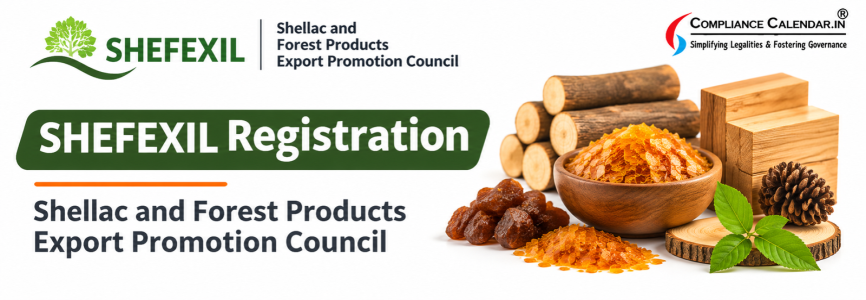



India's forests support more than biodiversity. They also provide raw materials used in medicines, food products, cosmetics, natural resins, industrial ingredients, and several other industries. Products such as shellac, guar gum, herbal extracts, and vegetable gums have created business opportunities for Indian exporters in international markets.
However, exporting forest-based products requires careful planning. A product may be freely exportable, restricted, or subject to special conditions depending on its botanical origin, processing, and ITC (HS) classification. Exporters must also understand registration requirements under India's Foreign Trade Policy.
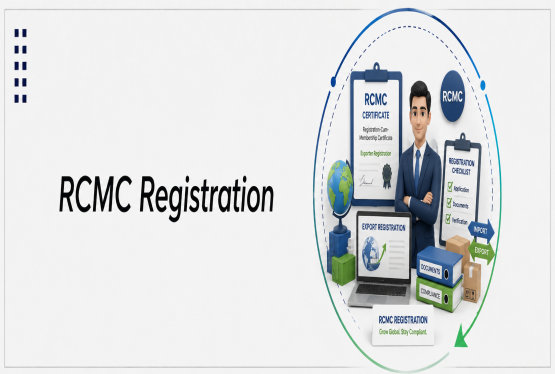
This is where SHEFEXIL Registration becomes relevant. The Shellac and Forest Products Export Promotion Council provides membership and Registration-cum-Membership Certificates (RCMC) to eligible exporters dealing in products covered by its jurisdiction.
For businesses entering international markets, understanding SHEFEXIL membership fees, eligibility, documentation, and legal requirements can prevent avoidable delays. This article explains the SHEFEXIL Registration process in 2026, with practical examples and the latest applicable regulatory developments.
What is SHEFEXIL Registration in India?
SHEFEXIL Registration is the process through which an eligible Indian exporter obtains membership with the Shellac and Forest Products Export Promotion Council. The council is recognised as an Export Promotion Council under India's foreign trade arrangements and issues RCMC to qualifying members.
The certificate identifies the exporter as a registered member of the appropriate council for products falling within its jurisdiction. It may be needed when an exporter applies for specified benefits, authorisations, or concessions under the Foreign Trade Policy, subject to applicable exemptions.
SHEFEXIL membership is relevant to manufacturers, merchant exporters, and eligible businesses dealing in shellac, lac-based products, vegetable extracts, guar gum, herbs, oil cakes, and other covered products.
Exporters unfamiliar with the membership process can read our guide on RCMC Registration Online in India to understand how Export Promotion Council registration works.
What is the Shellac and Forest Products Export Promotion Council?
SHEFEXIL has a long history connected with India's natural products export industry. It was originally established in 1957 as the Shellac Export Promotion Council under the sponsorship of the Ministry of Commerce and Industry, Government of India.
Initially, the council concentrated on shellac and lac-based products. In April 2005, its responsibilities expanded to cover various non-timber forest products, including vegetable saps, extracts, guar gum, herbs, and other related commodities.
Following this expansion, the organisation became known as the Shellac and Forest Products Export Promotion Council, or SHEFEXIL. In October 2007, SHEFEXIL also received a special role as the nodal Export Promotion Council for India's North Eastern region, subject to the product-specific exceptions prescribed under DGFT procedures.
Today, the council supports exporters through trade promotion activities, international market information, industry representation, and membership services. Its work is particularly relevant for businesses seeking to sell natural ingredients and processed forest-based products to international manufacturers, distributors, and industrial buyers.
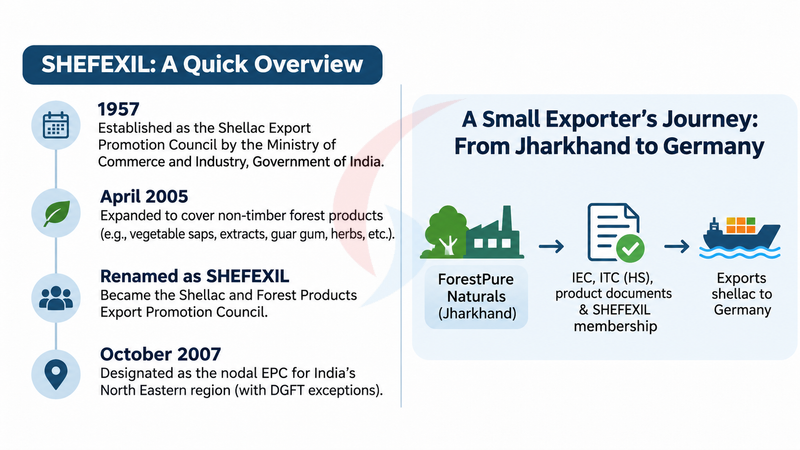
A Small Exporter's Journey: From Jharkhand to Germany
Imagine a small business called ForestPure Naturals, operating in Jharkhand. The company purchases lac from local suppliers, processes it into shellac, and sells the finished material to Indian manufacturers. One day, a German company contacts ForestPure Naturals and requests a shipment of shellac for use in industrial coating applications.
The business owner is excited about the international order. However, the overseas buyer requests technical specifications, product quality documents, and proof that the company can legally export the material. The owner obtains an IEC, checks the relevant ITC (HS) classification, and examines whether any product-specific export restrictions apply. The company also considers SHEFEXIL membership because shellac is one of the council's principal product categories.
After preparing the required documents, ForestPure Naturals applies through the DGFT e-RCMC portal. This example shows why exporters should consider regulatory requirements before accepting overseas orders. A good product and an interested buyer are important, but accurate documentation and export compliance are equally necessary.
Products Covered Under SHEFEXIL Registration
SHEFEXIL covers several categories of shellac, forest-based, and related products. Its official website identifies the following principal product panels.
|
Product Category |
Examples |
|
Shellac and Lac-Based Products |
Shellac, seedlac, buttonlac, bleached lac, and aleuritic acid |
|
Vegetable Saps and Extracts |
Natural gums, vegetable extracts, peppermint oil, and selected essential oils |
|
Guar Gum |
Guar gum and eligible related products |
|
Herbs |
Dried herbs, plant portions, leaves, roots, bark, and selected herbal ingredients |
|
Fixed Vegetable Oils and Oil Cakes |
Covered vegetable oils, oil cakes, and related materials |
|
Other Vegetable Materials |
Eligible vegetable products and natural materials |
|
North Eastern Region |
Qualifying multi-product exports under the special regional provisions |
The correct registering authority must be identified through the product's ITC (HS) code and applicable DGFT jurisdiction. Not every agricultural or herbal product automatically falls under SHEFEXIL. Some products are covered by APEDA, the Spices Board, the Tea Board, or another recognised authority.
For example, businesses exporting eligible oilseeds should also understand IOPEPC Registration before selecting their registering authority.
Laws and Legal Provisions Governing SHEFEXIL Registration
SHEFEXIL Registration is governed by India's foreign trade laws and DGFT procedures. Exporters must also comply with applicable customs, GST, foreign exchange, and wildlife protection requirements depending on the products they export.
|
Applicable Law or Regulation |
Important Provisions and Requirements |
|---|---|
|
Sections 3 and 5 regulate foreign trade policies, Section 7 covers IEC requirements, and Section 11 addresses violations and penalties. |
|
|
Paragraphs 2.56 and 2.57 govern Export Promotion Councils and applicable RCMC requirements, subject to exemptions. |
|
|
Paragraphs 2.79–2.84 cover RCMC applications, council selection, validity, amendments, de-registration, and appeals. |
|
|
Sections 17, 50, 113 and 114 govern customs assessment, export declarations, confiscation, and penalties. |
|
|
Regulates trade involving specified protected plants and wildlife, including applicable permissions. |
|
|
Section 16 provides zero-rated treatment for qualifying exports, subject to prescribed conditions. |
|
|
Section 7 and applicable RBI regulations govern export declarations and foreign exchange requirements. |
Exporters should verify their product classification, obtain the necessary permissions, and follow the latest DGFT requirements. SHEFEXIL membership does not replace separate statutory approvals for restricted or regulated products. For official notifications and amendments, visit the DGFT website.
Who is Eligible for SHEFEXIL Registration?
SHEFEXIL membership is available to eligible businesses engaged in exporting products falling within the council's jurisdiction.
Applicants may operate as proprietorships, partnership firms, LLPs, companies, or other legally recognised business entities permitted under the council's membership rules.
Both manufacturer exporters and merchant exporters may qualify. A manufacturer exporter processes or manufactures the goods being exported, while a merchant exporter generally purchases products from suppliers and exports them without necessarily operating a manufacturing facility.
The applicant should have an active IEC, accurate business details, and the supporting documentation prescribed by the council.
The council's published membership instructions also require relevant tax details, MSME or Udyam information, and an FSSAI licence. Applicants dealing in non-food products should confirm the applicability of FSSAI documentation with SHEFEXIL rather than assuming that every industrial product requires a food licence.
Special Eligibility for North Eastern Exporters
SHEFEXIL has a particularly important role for exporters based in Assam, Arunachal Pradesh, Manipur, Meghalaya, Mizoram, Nagaland, Sikkim, and Tripura. Under Paragraph 2.80(c) of the Handbook of Procedures, 2023, eligible multi-product exporters having their head office or registered office in the North Eastern states may obtain RCMC from SHEFEXIL.
However, this provision excludes products handled by APEDA, the Spices Board, and the Tea Board. For example, an Assam-based business exporting several eligible natural products may consider SHEFEXIL membership under the regional provision, provided the relevant product coverage and eligibility conditions are satisfied.
Documents Required for SHEFEXIL Registration
Applicants should prepare their business and export documents before starting the online application. SHEFEXIL's official membership instructions prescribe the following principal records.
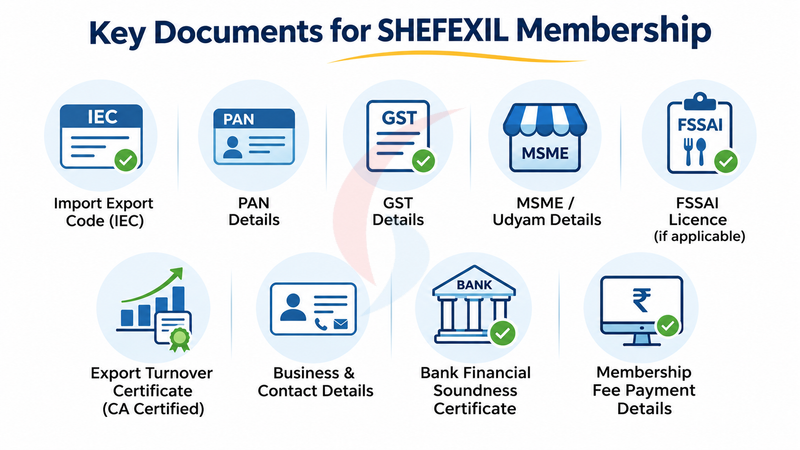
|
Required Document |
Purpose |
|
Confirms DGFT exporter identification |
|
|
PAN Details |
Establishes the applicant's tax identity |
|
GST Details |
Provides applicable GST registration information |
|
Supports business classification and registration information |
|
|
Required where applicable under the council's checklist and food laws |
|
|
Export Turnover Certificate |
CA certification required for the lower annual-fee category |
|
Business and Contact Details |
Identifies the applicant and authorised representative |
|
Bank Financial Soundness Certificate |
Required under SHEFEXIL's Articles of Association |
|
Membership Fee Payment Details |
Confirms payment of applicable charges |
Additional information may be required depending on the applicant's constitution, membership category, products, and verification requirements. All submitted records should contain consistent business information. Differences in IEC, PAN, GST, company name, or registered address may lead to clarification requests.
Businesses without an IEC can read our guide on the Procedure for Obtaining Import Export Code to understand the registration process before applying for SHEFEXIL membership.
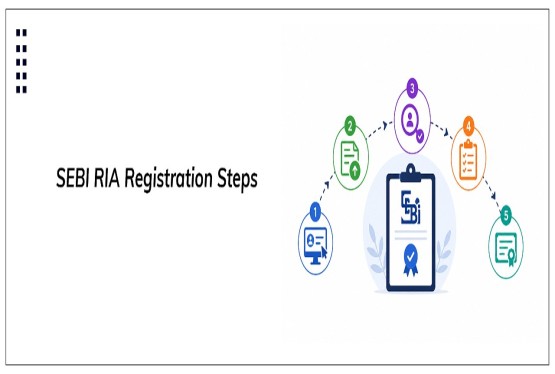
SHEFEXIL Registration Process Online in 2026
SHEFEXIL Registration applications for FY 2026–27 are submitted through the DGFT e-RCMC portal. Exporters must complete the online application, upload the required documents, and pay the applicable membership fees.
|
Step |
Registration Process |
Details |
|---|---|---|
|
Step 1 |
Obtain an Active IEC |
Ensure the business has a valid Import Export Code issued by DGFT with updated details. |
|
Step 2 |
Visit DGFT Portal |
Visit www.dgft.gov.in and log in using the registered account linked to the IEC. |
|
Step 3 |
Select e-RCMC Service |
Navigate to Services → e-RCMC → Apply for e-RCMC. |
|
Step 4 |
Select SHEFEXIL |
Choose Shellac and Forest Products Export Promotion Council as the registering authority. |
|
Step 5 |
Complete Application |
Enter business details, exporter category, product information, export turnover, and authorised representative details. |
|
Step 6 |
Upload Documents |
Submit IEC, PAN, GST, business documents, and a CA certificate where applicable. |
|
Step 7 |
Pay Membership Fees |
Pay the applicable entrance fee, annual membership subscription, and GST through the prescribed payment process. |
|
Step 8 |
Download RCMC |
Track application status, respond to queries if required, and download the electronic RCMC after approval. |
Processing Time: SHEFEXIL's Articles of Association provide for a membership decision within 45 days of receiving a properly completed application. Actual processing may vary depending on document verification and clarification requirements.
SHEFEXIL Registration Fees for FY 2026–27
SHEFEXIL's published FY 2026–27 membership instructions specify a one-time entrance fee and annual membership subscriptions based on export turnover.
|
Fee Particulars |
Amount |
GST at 18% |
Total |
|
One-Time Entrance Fee |
Rs 20,000 |
Rs 3,600 |
Rs 23,600 |
|
Annual Fee – Export Turnover up to Rs 50 lakh |
Rs 5,000 |
Rs 900 |
Rs 5,900 |
|
Annual Fee – Export Turnover above Rs 50 lakh |
Rs 10,000 |
Rs 1,800 |
Rs 11,800 |
Therefore, the published combined entrance and annual membership charges for a new applicant are:
- Up to Rs 50 lakh export turnover: Rs 29,500, including GST.
- Above Rs 50 lakh export turnover: Rs 35,400, including GST.
The council requires a CA certificate for applicants paying the Rs 5,000 annual membership fee.
These are council membership charges, not a universal government licence fee. Applicants should check the payable amount displayed in the DGFT portal before completing payment.
Example: How Export Turnover Affects Membership Fees
Suppose a Jaipur-based company exports guar gum worth Rs 38 lakh during the relevant financial year. If it satisfies SHEFEXIL's lower turnover conditions and provides the required CA certificate, the published annual subscription is Rs 5,000 plus GST.
Now consider another company with export turnover of Rs 75 lakh. Under the same published schedule, its annual subscription is Rs 10,000 plus GST. The difference depends on the applicable export turnover category, not simply whether the business operates as a manufacturer or merchant exporter.
Validity and Renewal of SHEFEXIL RCMC
Under Paragraph 2.81 of the Handbook of Procedures, 2023, an RCMC is ordinarily valid for five licensing years, beginning from 1 April of the licensing year in which it is issued, unless otherwise specified. However, the validity of the RCMC and payment of annual council membership fees are separate matters.
SHEFEXIL members must maintain their annual subscription and complete renewal requirements through the prescribed DGFT system. Businesses should regularly verify their certificate status, membership payment records, and IEC information.
If the company changes its ownership, legal constitution, name, or address, Paragraph 2.82 requires it to inform the registering authority within one month, subject to the provision allowing delays to be condoned on merits. Timely updating is particularly important when exporters apply for subsequent trade authorisations or submit documents to overseas buyers.
Benefits of SHEFEXIL Registration for Exporters
SHEFEXIL membership offers support to businesses seeking opportunities in international natural products markets.
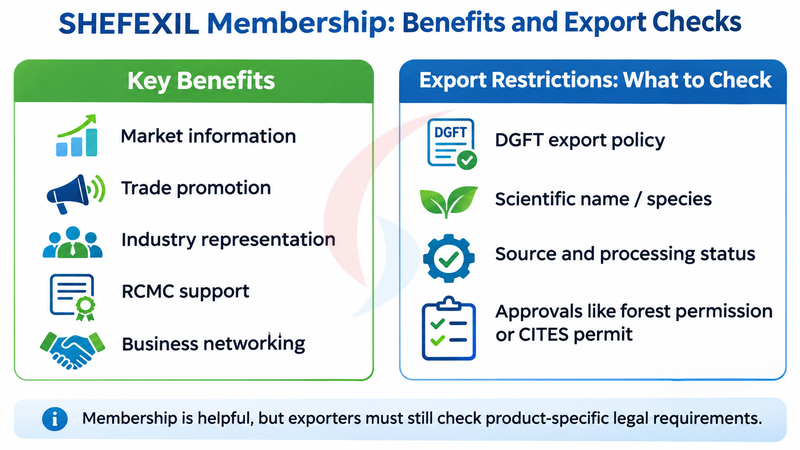
|
Benefits |
How It Helps Exporters |
|
International Market Information |
Provides information about export markets and emerging product opportunities |
|
Trade Promotion Activities |
Supports participation in relevant exhibitions and buyer-seller interactions |
|
Industry Representation |
Represents exporter interests before relevant government authorities |
|
RCMC Certification |
Helps satisfy applicable RCMC requirements under the Foreign Trade Policy |
|
Product-Specific Guidance |
Provides information relating to the council's covered product categories |
|
Business Networking |
Creates opportunities to connect with exporters, buyers, and industry participants |
These benefits can be particularly valuable for small businesses that have limited experience with international trade. However, membership does not guarantee overseas orders, export incentives, or approval to export a restricted commodity.
Export Restrictions for Herbs and Forest-Based Products
One of the most important legal issues in forest-product exports is determining whether the goods can legally leave India. Products involving protected plants, wild-collected materials, or species regulated under international conservation arrangements may require additional permissions.
The Wild Life (Protection) Act, 1972 and India's obligations under the Convention on International Trade in Endangered Species of Wild Fauna and Flora (CITES) are especially relevant in such cases. Exporters should examine the relevant DGFT ITC (HS) export policy entry, the scientific name of the species, its source, and the product's processing status.
Depending on the product and applicable rules, documentation may include evidence of lawful possession, a cultivation certificate, forest department permission, or a CITES permit. These requirements are product-specific and cannot be replaced by a SHEFEXIL certificate.
Example: A Herbal Exporter from Uttarakhand
Consider Himalayan Herb Traders, a business purchasing dried medicinal herbs from suppliers in Uttarakhand. The company receives an international enquiry for a botanical ingredient used in herbal formulations.
Before confirming the order, the exporter discovers that the scientific identity and source of the plant must be checked against the applicable export policy. The exporter obtains details from its suppliers, verifies whether the plant is cultivated or wild-collected, and reviews the relevant forest and wildlife requirements.
If the product is restricted or requires certification, the business must obtain the necessary permission before export. This example highlights an important principle: SHEFEXIL membership confirms council registration, but it does not establish that every botanical product is legally exportable.
FSSAI, GST and Customs Requirements for SHEFEXIL Exporters
Apart from RCMC, exporters may need to comply with other regulations depending on their products.
FSSAI Requirements
The Food Safety and Standards Act, 2006 and applicable FSSAI regulations may apply to businesses exporting food ingredients, edible gums, herbal food products, or other regulated food items. The exact licensing requirements depend on whether the product and business activity fall within food laws. An exporter supplying industrial-grade shellac should not automatically assume that its product is regulated in the same manner as edible food ingredients.
GST on Exports
Section 16 of the Integrated Goods and Services Tax Act, 2017 provides zero-rated treatment for qualifying exports, subject to applicable requirements. Exporters should review the relevant GST procedures, including LUT, payment of IGST where applicable, documentation, and refund rules.
For more details, read our guide on the Impact of GST on Export of Goods and Services.
Customs Documentation
Section 50 of the Customs Act, 1962 governs the filing of export declarations for goods.Exporters generally need appropriate commercial invoices, packing lists, shipping documentation, and other records required for customs clearance.
Businesses using electronic customs services can read about ICEGATE Registration for Import Export Business.
Foreign Exchange Compliance
Exporters must also comply with applicable RBI directions concerning export declarations, receipt of export proceeds, and banking arrangements. They should maintain accurate records of invoices, shipping documents, foreign remittances, and any authorised dealer bank communications.
Latest SHEFEXIL Registration Updates in 2026
SHEFEXIL Registration continues to operate through the DGFT e-RCMC system. Several regulatory developments in 2026 are relevant to exporters, particularly changes concerning low-value consignments, online membership applications, and product classification.
|
Latest Update |
Key Details |
|---|---|
|
Online e-RCMC Filing for FY 2026–27 |
SHEFEXIL membership applications are submitted through the DGFT e-RCMC portal with the prescribed documents and fees. |
|
RCMC Exemption – September 2026 |
DGFT Notification No. 36/2026-27, dated 15 September 2026, exempts qualifying export consignments with FOB value up to Rs 3 lakh from RCMC requirements. |
|
Product Classification Requirements |
Exporters must identify the correct ITC (HS) code and Export Promotion Council according to DGFT provisions. |
|
Digital Membership Administration |
SHEFEXIL applications and related membership processing continue through the online DGFT system. |
|
Other Export Permissions |
The RCMC exemption does not remove applicable IEC, customs, FSSAI, wildlife, or other statutory obligations. |
Practical Example: A shellac exporter receives an overseas order worth Rs 2.40 lakh FOB. Under the September 2026 amendment, the qualifying consignment is exempt from the RCMC requirement. However, the exporter must still comply with applicable customs procedures, product classification rules, and other export regulations. SHEFEXIL membership may remain useful for businesses planning regular exports and seeking council services.
Why Choose Compliance Calendar LLP for SHEFEXIL Registration?
At Compliance Calendar LLP, we assist exporters with SHEFEXIL Registration, DGFT e-RCMC applications, documentation, and related compliance requirements.
|
Our Services |
How We Help |
|---|---|
|
Eligibility Assessment |
Help determine SHEFEXIL membership eligibility based on products and business activities. |
|
IEC Registration |
Assist businesses in obtaining or updating their Import Export Code. |
|
Documentation Support |
Help prepare IEC, PAN, GST, financial records, and other required documents. |
|
DGFT e-RCMC Application |
Assist with online application filing, document submission, and application tracking. |
|
Product-Specific Guidance |
Provide guidance based on the requirements of shellac, herbs, and other eligible forest products. |
|
Renewal and Compliance |
Support membership renewal, amendments, and ongoing registration requirements. |
For professional assistance, explore our RCMC Registration Services or IEC Registration Services. Contact Compliance Calendar LLP: +91 9988424211 or info@ccoffice.in for SHEFEXIL Registration assistance.
Frequently Asked Questions (FAQs)
Q1. What is SHEFEXIL Registration?
Ans: SHEFEXIL Registration is membership with the Shellac and Forest Products Export Promotion Council. Eligible exporters receive an RCMC for the products covered by the council.
Q2. Is SHEFEXIL Registration mandatory for all forest-product exporters?
Ans: No. RCMC is required where the Foreign Trade Policy mandates it for a particular authorisation, benefit, or concession, subject to exemptions. Other export permissions may still apply.
Q3. What is the SHEFEXIL Registration fee in 2026?
Ans: The published entrance fee is Rs 20,000 plus GST. Annual membership fees are Rs 5,000 or Rs 10,000 plus GST, depending on the export turnover category.
Q4. What documents are required for SHEFEXIL Registration?
Ans: Important documents include IEC, PAN, GST details, relevant MSME information, applicable FSSAI documentation, business details, and the CA certificate where required.
5. How can I apply for SHEFEXIL Registration online?
Ans: Applicants can log in to the DGFT portal, select e-RCMC, choose SHEFEXIL, complete the application, upload the documents, and pay the required fees.
Q6. What is the validity of SHEFEXIL RCMC?
Ans: Under general DGFT provisions, RCMC is ordinarily valid for five licensing years unless otherwise specified. Annual council membership requirements must also be maintained.
Q7. Can merchant exporters apply for SHEFEXIL Registration?
Ans: Yes. Eligible merchant exporters dealing in products covered by SHEFEXIL can apply, subject to the council's membership rules and documentation requirements.
Q8. Is FSSAI Registration required for SHEFEXIL exporters?
Ans: FSSAI licensing may be necessary for exporters handling products regulated under Indian food laws. SHEFEXIL also requests FSSAI documentation in its membership checklist, so applicants should clarify applicability for their products.
Q9. What is the latest RCMC exemption in 2026?
Ans: DGFT Notification No. 36/2026-27, dated 15 September 2026, exempts export consignments having FOB value up to Rs 3 lakh from RCMC or Certificate of Registration requirements.
Q10. Can Compliance Calendar LLP help with SHEFEXIL Registration?
Ans: Yes. Compliance Calendar LLP provides support with IEC, RCMC documentation, DGFT application procedures, and related registration assistance.
Article last updated on : 16 Nov 2026.