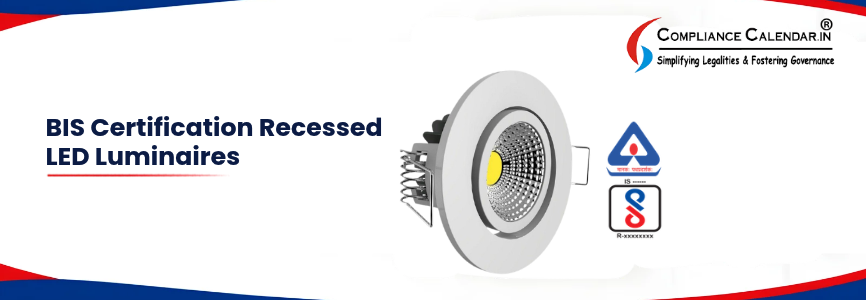



Recessed LED lights have become a popular choice for modern homes, offices, hotels, hospitals and commercial buildings. Unlike traditional lighting fixtures that hang from a ceiling or remain visible on the surface, recessed LED luminaires are installed inside ceilings or other suitable mounting surfaces. Their neat appearance, energy-efficient operation and ability to provide comfortable lighting make them a common choice for interior lighting projects.
However, most buyers focus on brightness, appearance and electricity consumption without considering the electrical safety of the complete lighting fixture. A recessed LED luminaire may look attractive and perform well initially, but problems involving insulation, overheating or improper construction can create safety risks, particularly when the product is installed inside a ceiling. This is why BIS Certification for Recessed LED Luminaires is important. The Bureau of Indian Standards (BIS) regulates these products under its Compulsory Registration Scheme (CRS). Manufacturers supplying covered recessed LED luminaires in India must ensure that their products meet the applicable Indian Standard and registration requirements.
What Are Recessed LED Luminaires?
Recessed LED luminaires are lighting fixtures designed to be installed partly or fully inside a ceiling, wall or another suitable mounting surface. Their visible portion usually consists of a trim, diffuser or light-emitting surface, while other components remain within the installation area.
For example, imagine entering a newly constructed office where the ceiling contains multiple round LED downlights. The lights are neatly integrated into the ceiling instead of hanging below it. These are common examples of recessed LED luminaires.
Such products are frequently used in offices, hotels, shopping centres, residential buildings and commercial interiors. Their designs may vary according to the installation method, light distribution, electrical ratings and associated LED drivers. Although these products offer practical and aesthetic advantages, their installation conditions can create additional safety considerations. Heat generated by the luminaire must be managed appropriately, and electrical components must remain protected against hazards during normal operation.
Is BIS Certification Mandatory for Recessed LED Luminaires?
Yes. Recessed LED luminaires are specifically included in the list of products requiring mandatory registration under the BIS Compulsory Registration Scheme. The requirement became effective on 23 May 2018, following the relevant government notification issued in August 2017. These products are now covered through the Electronics and Information Technology Goods (Requirement of Compulsory Registration) Order, 2021, as amended.
Manufacturers producing covered recessed LED luminaires for the Indian market must obtain appropriate BIS registration. The requirement also applies to covered products manufactured overseas and supplied to India. Under the BIS Act, 2016, read with the applicable compulsory registration order and conformity assessment regulations, notified products must comply with the prescribed certification and Standard Mark requirements.
Why Does BIS Registration Matter?
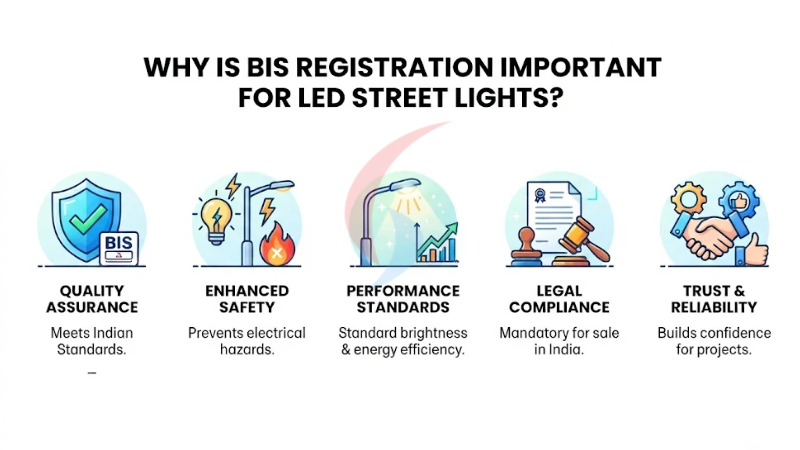
A recessed lighting fixture may remain installed inside a ceiling for years. Customers generally cannot inspect its internal wiring, insulation or electrical components after installation. BIS certification helps address these safety concerns by requiring covered products to undergo prescribed testing. It also establishes a registration system through which manufacturers must maintain conformity with the applicable Indian Standard.
Manufacturers can read our BIS CRS Registration for Fixed General Purpose LED Luminaires guide to understand the difference between fixed and recessed LED lighting products.
Applicable Indian Standard for Recessed LED Luminaires
The applicable revised Indian Standard is IS 10322 (Part 5/Sec 2):2026, corresponding to IEC 60598-2-2:2023.
The standard is titled Luminaires – Part 5: Particular Requirements – Section 2: Recessed Luminaires and Recessed Air-Handling Luminaires. Previously, recessed LED luminaires were covered by IS 10322 (Part 5/Sec 2):2012. BIS revised the standard in 2026 and introduced implementation guidelines for transitioning from the earlier edition. The requirements are applied alongside the applicable general safety provisions of IS 10322 (Part 1). Manufacturers should consider both the particular requirements for recessed luminaires and the general luminaire safety requirements when planning product testing.
BIS Standards Applicable to LED Luminaires
|
LED Product Category |
Applicable Revised Standard |
|
Recessed LED Luminaires |
IS 10322 (Part 5/Sec 2):2026 |
|
Fixed General Purpose LED Luminaires |
IS 10322 (Part 5/Sec 1):2026 |
|
LED Road and Street Lighting |
IS 10322 (Part 5/Sec 3):2026 |
|
LED Flood Lights |
IS 10322 (Part 5/Sec 5):2026 |
|
LED Luminaires for Emergency Lighting |
IS 10322 (Part 5/Sec 8):2026 |
|
General Luminaire Safety Requirements |
IS 10322 (Part 1):2026 |
Different LED lighting products are covered by different standards. For example, a recessed ceiling downlight and an outdoor LED floodlight may contain similar electronic components, but they are not automatically covered by the same registration category.
Who Needs BIS CRS Registration for Recessed LED Luminaires?
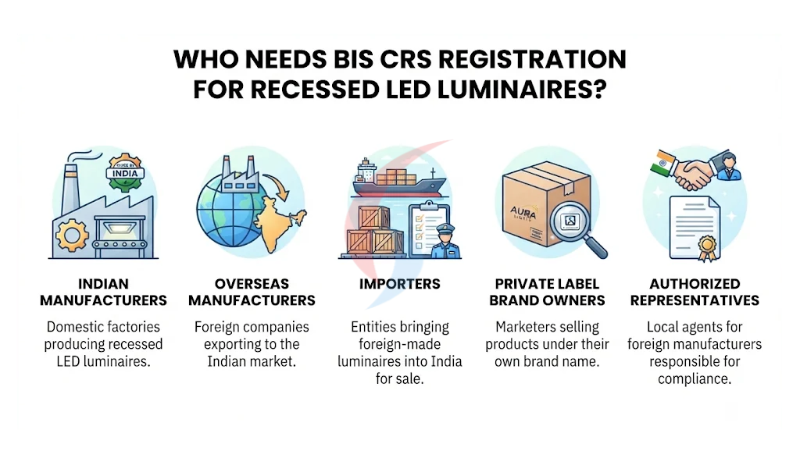
BIS registration is primarily the responsibility of the actual manufacturer. Indian manufacturers producing notified recessed LED luminaires must obtain registration covering their manufacturing unit and applicable products. Foreign manufacturers supplying recessed LED luminaires to India must also satisfy the applicable BIS requirements. They generally need to appoint an Authorised Indian Representative (AIR), who coordinates with BIS and fulfils the prescribed responsibilities. Importers and brand owners should verify the manufacturer's registration before sourcing products. BIS registration is associated with the manufacturer, manufacturing location, brand and approved product scope rather than merely the name of the importer.
For example, suppose a lighting company in Delhi imports recessed LED panel lights from a factory in China. The importer plans to sell these products under its own brand. Before placing the products on the Indian market, the company must ensure that the overseas manufacturing unit has appropriate BIS registration covering the relevant brand and models.
Documents Required for BIS Certification for Recessed LED Luminaires
Document preparation is an important stage of the BIS CRS registration process. Manufacturers must provide sufficient information to establish their identity, manufacturing location and product conformity.
A mismatch between the model numbers mentioned in the laboratory report and those included in the application can create difficulties during scrutiny. Similarly, incorrect factory details or missing brand authorisations may delay registration.
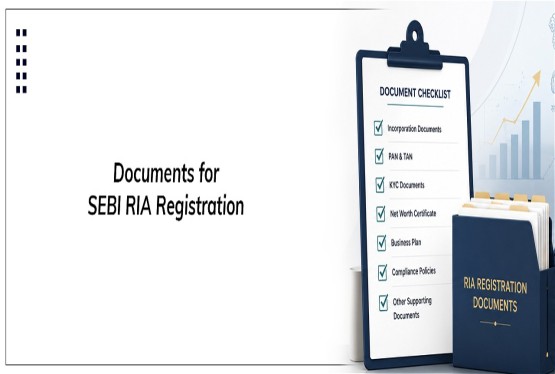
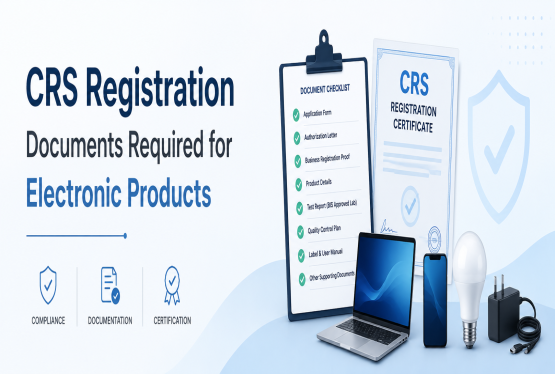
Documents Required for BIS CRS Registration
|
Document |
Purpose |
|
Manufacturer's business registration |
Establishes legal identity |
|
Factory address proof |
Verifies the manufacturing location |
|
BIS-recognised laboratory test report |
Demonstrates product testing |
|
Product technical specifications |
Identifies electrical ratings and construction |
|
Product photographs |
Supports product identification |
|
Brand or trademark authorisation |
Establishes brand rights, where applicable |
|
Authorised signatory details |
Identifies the application representative |
|
AIR nomination documents |
Required for applicable foreign manufacturers |
|
Undertakings and declarations |
Confirms compliance with BIS requirements |
|
Product label details |
Supports marking verification |
Manufacturers may need additional documents depending on their application category, product construction, existing registration status and queries raised during scrutiny.
To understand common documentation requirements, read our Step-by-Step BIS CRS Registration Guide.
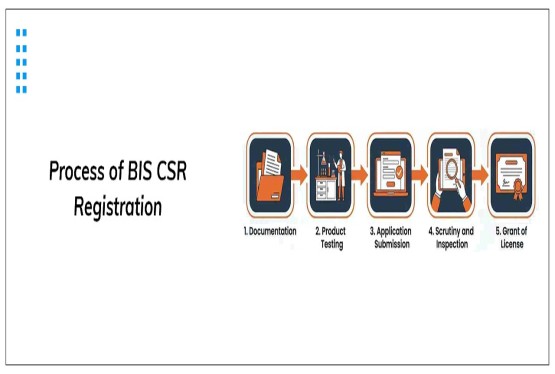
BIS CRS Registration Process for Recessed LED Luminaires
The BIS certification process involves product classification, laboratory testing, application preparation and verification. Manufacturers should complete these stages before planning commercial sales of covered products.
Step 1: Confirm the Product Category
The manufacturer should first determine whether the lighting fixture falls under recessed LED luminaires. Product construction, mounting arrangement, intended application and technical specifications must be examined.
Step 2: Identify the Applicable Standard
The manufacturer should identify IS 10322 (Part 5/Sec 2):2026 and the relevant general safety requirements. During a permitted transition period, the applicable BIS implementation circular should be checked before selecting the testing edition.
Step 3: Select a BIS-Recognised Testing Laboratory
The manufacturer must select a laboratory recognised by BIS for the applicable standard. Recognition for another LED lighting category does not automatically establish recognition for recessed LED luminaires.
Step 4: Submit Product Samples
Representative samples are submitted to the recognised laboratory. The laboratory conducts the relevant safety tests and prepares a test report.
Step 5: Prepare the Application
The manufacturer prepares the CRS application with manufacturing details, product specifications, brand information, declarations and laboratory test results.
Step 6: Submit the Application and Fees
The application is submitted through the official BIS CRS registration system along with the required fees. Manufacturers should observe the applicable test report validity requirements and filing instructions.
Step 7: Respond to BIS Queries
BIS examines the application and may request clarification or additional documents. The manufacturer must address identified deficiencies before registration can be granted.
Step 8: Obtain Registration and Follow Marking Requirements
After satisfactory assessment, BIS grants registration covering the approved scope. The manufacturer must comply with the prescribed Standard Mark and registration-number display requirements.
For additional procedural guidance, manufacturers can consult the official BIS CRS application guidelines.
What Safety Tests Are Required for Recessed LED Luminaires?
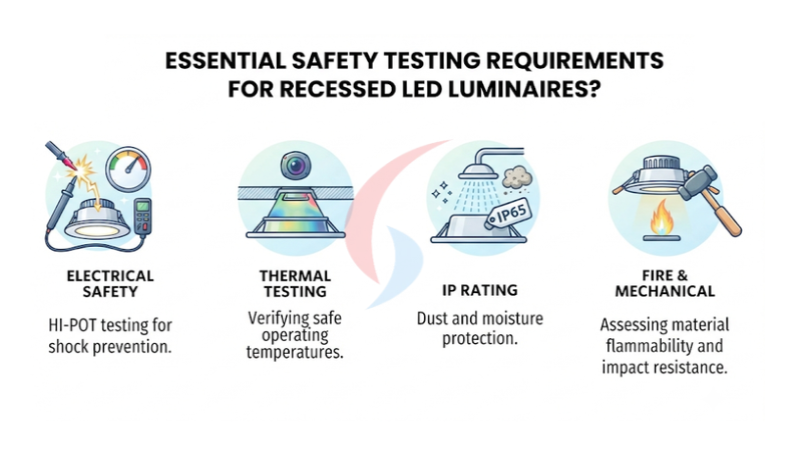
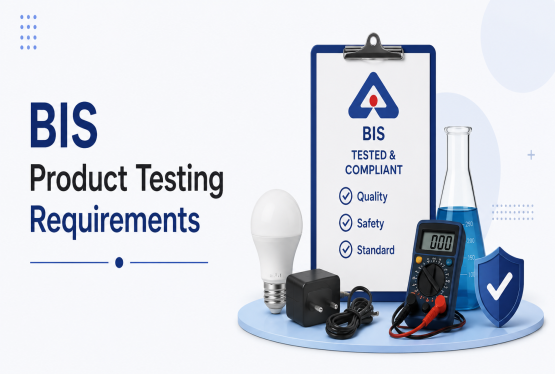
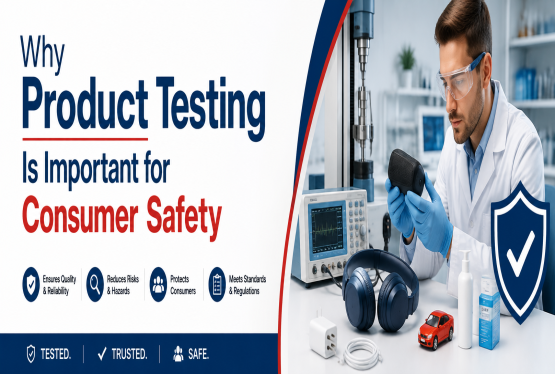
Safety testing is essential because recessed luminaires operate in enclosed or partially enclosed installation spaces. Their construction must provide appropriate protection against electrical, mechanical and thermal hazards. Testing generally considers protection against electric shock, insulation, temperature rise, mechanical construction and resistance to heat or fire. The applicable test schedule is determined by the Indian Standard and the product's characteristics.
Important BIS Safety Testing Areas
|
Testing Area |
Why It Matters |
|
Protection against electric shock |
Reduces risks from accessible hazardous live parts |
|
Insulation resistance |
Evaluates insulation performance |
|
Electric strength |
Checks insulation under prescribed electrical conditions |
|
Temperature rise and thermal testing |
Evaluates heating during operation |
|
Mechanical construction |
Examines relevant construction and mounting safety |
|
Resistance to heat and fire |
Assesses specified material safety characteristics |
|
Creepage distances and clearances |
Checks required separation between electrical parts |
|
Marking and instructions |
Verifies safety information provided by the manufacturer |
The complete test programme must be based on the applicable clauses of IS 10322 rather than only the general examples in this table.
For laboratory information, manufacturers can use the BIS Laboratory Information Management System.
Latest BIS Updates and Amendments for Recessed LED Luminaires in 2026
The year 2026 brought significant changes to the Indian Standards applicable to LED lighting products. Manufacturers should pay particular attention to these developments because they affect existing registrations, new applications and product testing.
1. Revision of IS 10322 (Part 5/Sec 2):2026
BIS revised the earlier 2012 edition of the recessed luminaire standard in 2026. The revised standard incorporates updated requirements for recessed luminaires and recessed air-handling luminaires. According to the BIS guidelines dated 20 March 2026, important changes include additional marking requirements, provisions relating to air-handling luminaires and updated references to the general luminaire safety standard.
Manufacturers must also consider relevant technical changes under IS 10322 (Part 1):2026, including revised electrical safety and photobiological safety provisions.
2. Implementation Deadline Extended to 2 February 2027
The original implementation guidelines prescribed 2 August 2026 as the last date for concurrent running of the previous and revised standards. However, through its circular dated 31 July 2026, BIS extended this deadline to 2 February 2027. The extension covers recessed LED luminaires and six other LED luminaire categories. This means manufacturers have additional time to complete the required transition. However, the extension does not remove the existing obligation to obtain BIS registration for covered recessed LED luminaires.
3. Requirements for Existing BIS Licensees
Existing manufacturers must demonstrate conformity with the revised standard within the applicable transition period. The March 2026 guidelines require complete laboratory test reports for relevant lead models previously tested against the old standard. Manufacturers must also submit the prescribed undertaking confirming implementation of the revised requirements for other relevant series models. Failure to complete the transition within the applicable deadline may result in deletion of affected models or cancellation proceedings under the BIS guidelines.
4. BIS Conformity Assessment Amendment Regulations, 2026
The 2026 amendments also changed important Scheme II provisions relating to registration validity, renewal and annual fee payments. Under the amended rules, BIS CRS registration may be granted initially for up to five years and renewed for a further period of up to five years. Applicable fees must be paid annually in advance, and manufacturers must fulfil the prescribed production reporting obligations. Non-compliance with fee payment or reporting requirements can affect the continuation of registration.
Read our BIS LED Luminaire Standards Update to understand the revised standards. Note that the original August 2026 implementation date was subsequently extended to February 2027.
BIS Certification Fees and Processing Time
The overall cost of BIS Certification for Recessed LED Luminaires depends on government fees, testing charges, the number of models and the manufacturer's circumstances. Under the 2026 Scheme II fee provisions, the standard fee structure for a new large-enterprise application includes an application fee of Rs 1,000, a processing fee of Rs 25,000 and an annual licence fee of Rs 1,000, subject to the applicable rules, concessions and taxes. Laboratory testing and other related expenses are additional.
Testing charges vary between BIS-recognised laboratories. For example, published BIS laboratory listings show different charges for testing under IS 10322 (Part 5/Sec 2):2026. Manufacturers should obtain a quotation after confirming the applicable testing scope. Processing time is influenced by laboratory availability, test results, application accuracy and BIS queries. Manufacturers should begin the registration process before finalising large-scale production or import schedules.
Common Challenges in BIS Certification for Recessed LED Luminaires
One of the most common problems is incorrect product classification. Manufacturers sometimes assume that every ceiling-mounted LED light qualifies as a fixed general-purpose luminaire. However, recessed LED luminaires have a separate product category and applicable standard. Another challenge involves testing against the appropriate edition of the standard. With the revised 2026 standards and the transition deadline approaching, manufacturers need to plan their testing arrangements carefully.
Consider the fictional example of a lighting manufacturer in Noida preparing to launch recessed LED downlights for a hotel project. The company has developed several models with different wattages and housing designs. Initially, management assumes that one laboratory report will automatically cover all models. During the certification review, the company discovers that model grouping must follow the applicable BIS guidelines. It therefore reviews the product variations, identifies the appropriate lead models and arranges the necessary testing before submitting its application. This situation demonstrates why early compliance planning matters. Manufacturers should review product design, model coverage, laboratory requirements and documentation before committing to large commercial orders.
Benefits of BIS CRS Registration for Recessed LED Luminaires
BIS certification provides a recognised mechanism for demonstrating conformity with applicable Indian safety requirements. It helps manufacturers meet mandatory regulatory obligations while giving buyers greater confidence that the registered product has undergone prescribed testing. For importers and distributors, verifying BIS registration helps reduce the risk of sourcing products that do not meet compulsory certification requirements.
Registration can also support better product documentation and quality control within the manufacturing business. However, manufacturers must continue maintaining conformity after registration is granted. Certification should not be treated as a one-time exercise that replaces ongoing product safety responsibilities.
Why Choose Compliance Calendar LLP for BIS Certification?
Obtaining BIS registration for recessed LED luminaires requires more than submitting a form. Manufacturers must understand which product category applies, select the appropriate standard, arrange laboratory testing and prepare documents that accurately describe their products. At Compliance Calendar LLP, we help manufacturers and importers understand these requirements before beginning the registration process. Our approach starts with reviewing the product's technical details and identifying the applicable certification requirements.
Our support includes product classification, BIS applicability review, coordination with recognised laboratories, application documentation, registration filing assistance, responding to queries and guidance on maintaining compliance. We also understand that businesses may be working towards supply commitments or product launch dates. Clear documentation and early testing coordination can help reduce avoidable delays.
For professional assistance with BIS Certification for Recessed LED Luminaires, contact Compliance Calendar LLP at +91 9988424211 or info@ccoffice.in
Frequently Asked Questions (FAQs)
Q1. Is BIS Certification mandatory for recessed LED luminaires in India?Ans. Yes. Recessed LED luminaires are notified under the BIS Compulsory Registration Scheme. Manufacturers supplying covered products in India must comply with the applicable registration and safety requirements before marketing them.
Q2. Which Indian Standard applies to recessed LED luminaires?Ans. The revised Indian Standard is IS 10322 (Part 5/Sec 2):2026, corresponding to IEC 60598-2-2:2023. It addresses particular safety requirements for recessed luminaires and recessed air-handling luminaires.
Q3. When did BIS registration become mandatory for recessed LED luminaires?Ans. Mandatory BIS registration became effective on 23 May 2018. The obligation continues to apply, including during the transition from the previous Indian Standard to the revised 2026 edition.
Q4. What is the latest BIS compliance deadline for recessed LED luminaires?Ans. BIS extended the concurrent-running period for the older and revised standards until 2 February 2027. Manufacturers must complete the applicable transition requirements by this date unless a further official extension is issued.
Q5. Can foreign manufacturers apply for BIS CRS Registration?Ans. Yes. Eligible overseas manufacturers can apply for BIS CRS registration. They must comply with the applicable testing, documentation and Authorised Indian Representative requirements.
Q6. What documents are required for BIS registration of recessed LED luminaires?Ans. Commonly required documents include factory address proof, business registration information, product specifications, a valid laboratory test report, brand details and prescribed declarations. Foreign manufacturers may need additional AIR documentation.
Q7. Is laboratory testing mandatory for recessed LED luminaires?Ans. Yes. Covered products must undergo testing at a BIS-recognised laboratory against the applicable Indian Standard. The laboratory's recognition scope should be checked before samples are submitted.
Q8. Can multiple recessed LED luminaire models be included under one BIS registration?Ans. Multiple eligible models may be covered under the relevant BIS registration scope, subject to applicable grouping and testing requirements. Manufacturers should verify the eligibility of each model before submitting the application.
Q9. What is the validity of BIS CRS Registration in 2026?Ans. Under the amended Scheme II provisions, registration may be granted for up to five years and renewed for a further period of up to five years. Annual fees and other ongoing compliance requirements remain applicable.
Q10. What happens if recessed LED luminaires are sold without mandatory BIS registration?Ans. Manufacturing, importing or selling notified products without complying with mandatory BIS requirements can result in regulatory enforcement action, including applicable restrictions and penalties under the BIS Act, 2016.
Article last updated on : 18 Nov 2026.