


A solar power converter does not receive much attention when a solar installation works properly. Solar panels generate electricity, the converter processes it, and the building receives usable power. But consider a different situation. A 100 kW inverter installed at a commercial facility begins shutting down whenever the electrical load changes. The solar panels are functioning correctly, yet electricity generation is repeatedly interrupted. An investigation reveals that the inverter's protection settings and operating characteristics need closer examination.
In India, BIS CRS Registration for Solar PV Power Converters helps establish compliance with the prescribed Indian Standards. The Solar Systems, Devices and Components Goods Order, 2025, introduced revised requirements, while subsequent BIS guidelines clarified testing and registration procedures. Further developments in July 2026 provided conditional compliance relief for certain large-capacity inverters.
Understanding Solar PV Power Converters
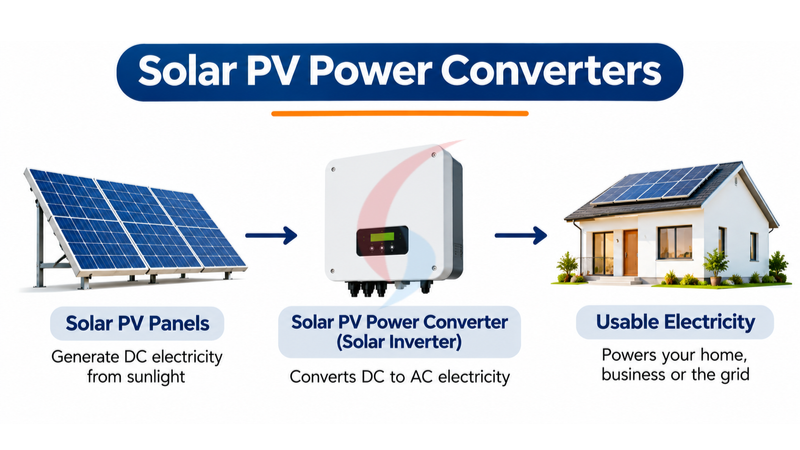
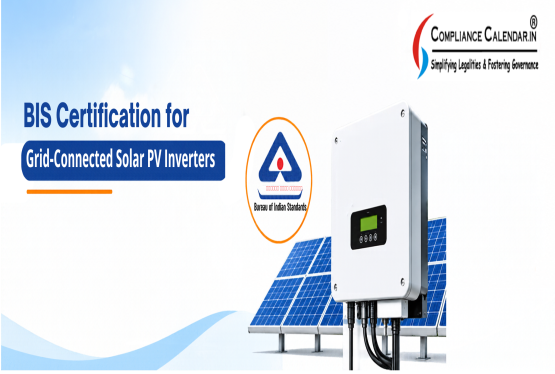
Solar photovoltaic panels produce electricity in the form of direct current (DC). However, most commercial and residential electrical systems use alternating current (AC). Solar power inverters perform the conversion needed to make photovoltaic electricity usable in these systems. Modern solar power converters do more than convert DC into AC. Depending on their design, they may regulate voltage, monitor power output, track the maximum available power from solar panels and provide protection against electrical faults.
A standalone inverter operates independently of the electricity grid. A grid-connected inverter operates in coordination with the utility network and must meet additional technical requirements. This distinction is important because Indian regulations identify different product categories for solar power inverters and utility-interconnected photovoltaic inverters.
Is BIS CRS Registration Mandatory for Solar PV Power Converters?
Yes. Solar PV power converters falling within the notified categories are subject to mandatory BIS registration, unless an applicable exemption or transitional provision permits otherwise. The legal requirement arises from the Bureau of Indian Standards Act, 2016, and the Solar Systems, Devices and Components Goods Order, 2025, notified by the Ministry of New and Renewable Energy (MNRE) on 27 January 2025 through S.O. 492(E).
The order was issued under Section 16(1) and 16(2), read with Section 17 and Section 25(3), of the BIS Act, 2016. It superseded the previous 2017 order and became effective on 27 July 2025, following the prescribed transition period. Under Scheme II of the BIS (Conformity Assessment) Regulations, 2018, manufacturers of covered products must demonstrate conformity with the applicable Indian Standards and obtain registration before supplying their products in India, subject to specified provisions.
Read our BIS CRS Certification for Crystalline Silicon Solar PV Modules article to understand how module certification differs from power converter registration.
Standalone vs Grid-Connected Solar Power Converters
One of the most common mistakes is treating all solar inverters as a single product category. A standalone system and a utility-interconnected installation may perform similar conversion functions, but their regulatory requirements differ.
|
Particulars |
Standalone Solar Inverter |
Grid-Connected Solar Inverter |
|---|---|---|
|
Main function |
Supplies electricity independently of the grid |
Supplies AC power in coordination with the grid |
|
Common application |
Remote installations and off-grid systems |
Rooftop and commercial grid-connected projects |
|
Safety requirement |
IS 16221 (Part 2):2015 |
IS 16221 (Part 2):2015 |
|
Additional notified standards |
IS/IEC 61683:1999 |
IS 16169:2019 and IS 17980:2022 |
|
Important testing focus |
Inverter safety and conversion efficiency |
Inverter safety, anti-islanding and MPPT efficiency |
The product's classification should be established from its technical specifications and operating functions, rather than solely from the description used in its marketing brochure.
For example, an inverter advertised as a hybrid solar power converter may support both battery operation and grid interaction. Its applicable BIS requirements must be assessed according to the product's actual functions and the notified categories.
Applicable Indian Standards for Solar PV Power Converters
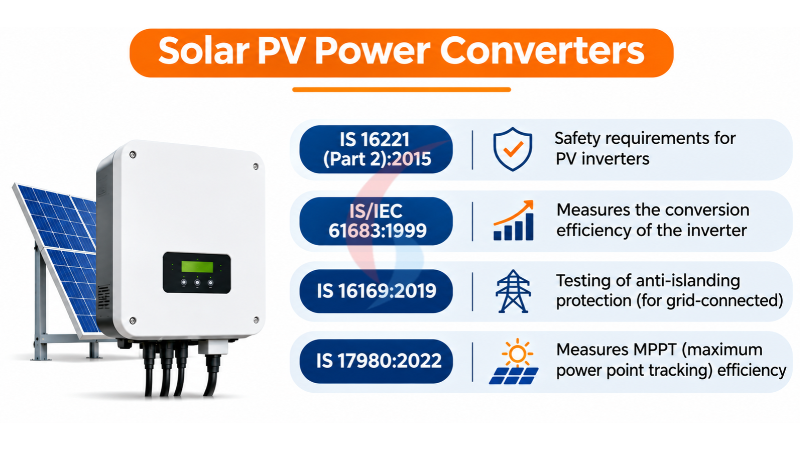
The Indian Standards prescribed for solar inverters cover different aspects of safety and performance. Each standard has a separate purpose.
IS 16221 (Part 2):2015 – Inverter Safety
IS 16221 (Part 2):2015 corresponds to IEC 62109-2:2011 and specifies particular safety requirements for inverters used in photovoltaic power systems. It addresses electrical hazards, relevant construction requirements and protection arrangements. Manufacturers must ensure that the inverter satisfies the prescribed provisions under the applicable test programme.
IS/IEC 61683:1999 – Conversion Efficiency
IS/IEC 61683:1999 provides procedures for measuring the efficiency of photovoltaic power conditioners. Consider an inverter that receives 10 kW of DC power and delivers 9.5 kW of AC power at a particular operating point. Its conversion efficiency at that point is 95%. This is a simplified illustration; certification testing follows the measurements and procedures prescribed by the applicable standard.
The revised 2025 order introduced IS/IEC 61683:1999 as an additional requirement for power inverters used in photovoltaic systems.
IS 16169:2019 – Anti-Islanding Protection
This standard corresponds to IEC 62116:2014 and addresses testing procedures for islanding prevention measures in utility-interconnected photovoltaic inverters. Islanding can occur when a section of the electrical network continues receiving power from distributed generation after the utility supply has been interrupted. Anti-islanding protection helps ensure that an inverter responds appropriately under the prescribed conditions.
IS 17980:2022 – MPPT Efficiency
IS 17980:2022 corresponds to IEC 62891:2020 and specifies procedures for measuring the efficiency of maximum power point tracking (MPPT) in grid-connected photovoltaic inverters. MPPT helps an inverter identify the operating point at which connected solar panels can provide maximum available power under changing conditions. These standards were specifically addressed in BIS's implementation guidelines issued on 26 March 2025.
Why BIS Testing Is Different from Ordinary Factory Testing
Factory testing generally checks whether manufactured products perform according to internal quality specifications. BIS conformity assessment goes further by requiring testing against prescribed Indian Standards. A manufacturer may conduct internal checks for voltage output, operating temperature, protection functions and electrical performance. However, successful internal testing does not automatically establish compliance with every clause of the applicable Indian Standard.
BIS-recognised laboratories evaluate the submitted samples according to the required testing scope. For solar inverters, relevant testing may include electrical insulation, temperature performance, protection against electrical hazards, conversion efficiency and other prescribed parameters. Utility-interconnected inverters also require the applicable anti-islanding and MPPT efficiency assessments. The manufacturer should identify suitable lead models and relevant series models before testing. BIS guidelines require reports for representative lead models under the applicable MNRE series approval provisions.
Read our BIS Certification for UPS and Inverters Up to 5 kVA article to understand how safety requirements apply to another category of electrical equipment.
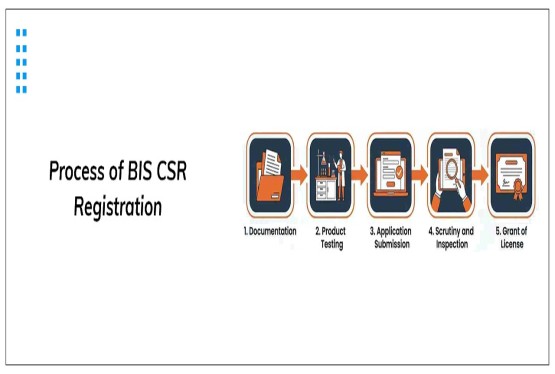
BIS CRS Registration Process: What Manufacturers Should Do First
The best starting point is not filling out the BIS application form. It is checking whether the product specifications, factory records and test requirements are aligned. A manufacturer should begin by reviewing the inverter's rated capacity, operating modes, electrical design and intended application. This helps identify the correct product category and applicable standards.
Once the category is established, the company should prepare technical drawings, product datasheets, model details, critical component information and manufacturing records. Where multiple inverter models are involved, it should examine the applicable series approval guidelines before arranging laboratory testing. Representative samples are then submitted to a BIS-recognised laboratory. After receiving satisfactory test reports, the manufacturer can submit its application through the official BIS CRS Portal, together with the prescribed documents and fees.
BIS examines the application and may seek clarification regarding the factory address, model specifications, test reports or other information. Registration is granted after the applicable requirements have been satisfied. Once registration is obtained, the manufacturer must ensure that the approved models continue to conform to the relevant standards. Additional models or significant product changes should be assessed under BIS procedures before commercial introduction.
Documents Required for BIS CRS Registration
Documentation is often responsible for avoidable application delays. Manufacturers should ensure that their technical records match the information submitted to BIS and the testing laboratory. The commonly required documents include the company's registration details, manufacturing facility address, authorised signatory information, product specifications, technical datasheets, electrical circuit diagrams, model descriptions, manufacturing details, laboratory test reports and brand authorisation documents, where applicable. Foreign manufacturers may also need to appoint an eligible Authorised Indian Representative (AIR) and provide the prescribed authorisation documents.
For example, if the manufacturer's datasheet mentions a 50 kW inverter but the laboratory report identifies a 60 kW model, BIS may require clarification. The applicant should establish whether the difference is a documentation error or relates to a separate model requiring assessment.
Latest BIS and MNRE Updates in 2025–2026
Manufacturers should pay particular attention to the following regulatory developments. These changes affect both new applicants and existing registration holders.
|
Date |
Regulatory Development |
Importance |
|---|---|---|
|
27 January 2025 |
Solar Systems, Devices and Components Goods Order, 2025 |
Introduced revised notified standards |
|
26 March 2025 |
BIS inverter implementation guidelines |
Explained updated testing and registration requirements |
|
27 July 2025 |
Revised QCO effective date |
Updated requirements became operative |
|
5 August 2025 |
S.O. 3597(E) |
Extended conditional self-certification for inverters above 200 kW until 30 June 2026 |
|
3 July 2026 |
S.O. 3706(E) |
Extended the specified arrangement until 31 December 2026 or further orders |
New Efficiency Testing Requirement
One important development was the addition of IS/IEC 61683:1999 for power inverters used in photovoltaic power systems. Under BIS guidelines dated 26 March 2025, existing registration holders were instructed to demonstrate compliance through the prescribed online procedure. They were required to submit relevant test reports for lead models and declare the efficiency of the models covered within the applicable series. For new applicants, compliance with the additional standard became necessary after the revised order's effective date. BIS stated that new registrations would not be granted without compliance with the revised requirements after 27 July 2025.
Revised Requirements for Grid-Connected Inverters
BIS also issued revised implementation guidelines for utility-interconnected photovoltaic inverters on 26 March 2025. These guidelines addressed the transition from IS 16169:2014 to IS 16169:2019 and the introduction of IS 17980:2022 for MPPT efficiency measurement. The revised anti-islanding standard also changes certain test conditions and requires relevant voltage and frequency settings to be aligned with the applicable national requirements.
Important July 2026 Extension for Inverters Above 200 kW
The most important recent development is MNRE Notification S.O. 3706(E), dated 3 July 2026, published in the Gazette on 8 July 2026. The government extended the implementation period for solar PV inverters under Items 4 and 5 of the 2025 order with capacities greater than 200 kW until 31 December 2026 or further orders, whichever is earlier.
The extension allows a conditional self-certification arrangement for eligible manufacturers. They must possess valid IEC certificates corresponding to the prescribed Indian Standards, along with test reports issued by accredited laboratories. This is not an unrestricted exemption. Manufacturers must satisfy the notification's specific documentary and technical conditions.
Manufacturers of high-capacity inverters should review the MNRE Notification S.O. 3706(E), dated 3 July 2026 before relying on the temporary self-certification arrangement.
BIS Registration Cost and Processing Time
There is no single total certification cost applicable to every solar power converter. The amount depends on the prescribed BIS fees, laboratory charges, number of lead models, applicable test standards and any additional testing requirements. BIS's March 2025 implementation guidelines specified Rs 30,000 plus applicable taxes, including one test report, for the prescribed revised-QCO implementation application by existing power inverter licensees. Each additional test report under that procedure attracted Rs 20,000 plus applicable taxes. These amounts relate to that particular implementation procedure and should not be presented as the complete cost of a new BIS registration.
What Happens When a Registered Converter Is Modified?
Solar inverter manufacturers regularly update product designs to improve efficiency, reduce costs or address component availability.
However, changing a safety-critical component may affect conformity with the tested construction.
|
Product Change |
Recommended Compliance Review |
|---|---|
|
New model with higher rated capacity |
Check series eligibility and required testing |
|
Change in power semiconductor or protection circuit |
Assess impact on electrical safety |
|
Change in inverter operating functions |
Reassess product classification and applicable standards |
|
Change in model number only |
Determine applicable documentation and model-inclusion requirements |
|
Addition of grid-interconnection capability |
Review grid-related standards and testing |
Manufacturers should maintain proper records of design changes and determine whether BIS approval, model inclusion or additional testing is required.
The important principle is simple: A product should not be assumed compliant merely because an earlier version received BIS registration.
Common Compliance Problems Manufacturers Should Avoid
One frequent problem is selecting the wrong product category. Manufacturers sometimes arrange testing under one Indian Standard without first determining whether additional standards apply to their inverter. Another difficulty is failing to coordinate model specifications between the engineering department, testing laboratory and compliance team. Different model descriptions or ratings can lead to additional BIS queries.
Businesses also risk misunderstanding the extension for inverters above 200 kW. The July 2026 notification is limited to specific products and conditions. It cannot be treated as permission to market every inverter without the otherwise required certification. These problems can often be reduced through an early technical assessment, a complete document review and proper coordination with the laboratory.
Why Choose Compliance Calendar LLP for BIS CRS Registration?
Solar inverter manufacturers often face technical questions before they even begin the registration process. One business may need help determining whether a hybrid inverter falls under a particular notified category. Another may have several models with different capacities and want to understand which models require separate testing.
At Compliance Calendar LLP, we focus on addressing these practical compliance questions rather than simply preparing application forms.
For enquiries, contact Compliance Calendar LLP by email at info@ccoffice.in or via WhatsApp at +91 9988424211
Frequently Asked Questions (FAQs)
Q1. Is BIS CRS Registration mandatory for solar PV power converters?
Ans. Yes. Solar PV power converters falling under the notified product categories require BIS registration, subject to applicable exemptions and transitional provisions.
Q2. Which Indian Standard applies to solar PV power converters?
Ans. IS 16221 (Part 2):2015 and IS/IEC 61683:1999 apply to the notified power inverter category. Utility-interconnected inverters have additional applicable standards.
Q3. Is BIS registration mandatory for grid-connected solar inverters?
Ans. Yes. Grid-connected solar inverters covered by the applicable notification must comply with the prescribed Indian Standards and registration requirements.
Q4. What is the purpose of IS/IEC 61683:1999?
Ans. This standard establishes procedures for measuring the efficiency of photovoltaic power conditioners, helping assess electrical conversion performance.
Q5. Can foreign manufacturers obtain BIS CRS Registration?
Ans. Yes. Foreign manufacturers can apply under the prescribed procedure, including appointment of an eligible Authorised Indian Representative where required.
Q6. Are solar inverters above 200 kW exempt from BIS certification in 2026?
Ans. Not completely. A conditional self-certification arrangement applies until 31 December 2026 or further orders, whichever is earlier, subject to the specified technical documentation.
Q7. Can multiple inverter models be included under one BIS registration?
Ans. Eligible models may be included according to the applicable series approval and BIS requirements. Manufacturers should check model eligibility before testing.
Q8. What is the BIS certification cost for solar PV power converters?
Ans. The cost depends on government fees, testing charges, product category and number of models. Manufacturers should obtain a product-specific estimate.
Q9. Is an IEC certificate sufficient for selling solar inverters in India?
Ans. An IEC certificate alone does not ordinarily replace BIS registration. Specific transitional provisions may allow conditional self-certification for eligible products.
Q10. What happens if a solar inverter fails BIS testing?
Ans. The manufacturer must investigate the non-conformity, make necessary corrections and complete the required retesting before establishing compliance.
Q11. Is BIS registration required for imported solar power converters?
Ans. Yes, where the imported product falls within the notified scope and no applicable exemption or transitional arrangement applies.
Q12. What is the latest important solar inverter BIS update in 2026?
Ans. MNRE's July 2026 notification extended the conditional self-certification arrangement for specified solar PV inverters exceeding 200 kW until 31 December 2026 or further orders, whichever is earlier.
Article last updated on : 18 Nov 2026.