


LED lighting has become common in Indian homes, offices, hotels and commercial buildings. People now prefer lights that allow them to adjust brightness according to their needs. This is where LED dimmers play an important role. They help control lighting levels, improve comfort and support energy-efficient lighting arrangements.
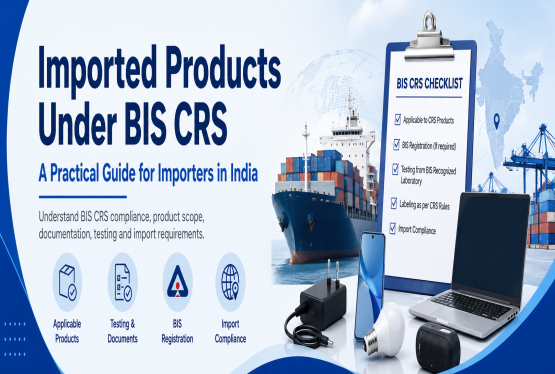
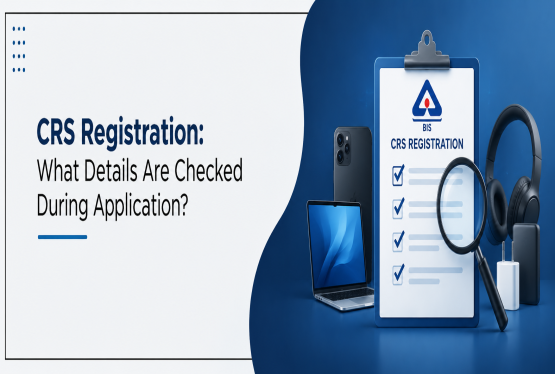
However, manufacturers and importers cannot overlook product safety while introducing LED dimmers into the Indian market. These products fall under the Bureau of Indian Standards (BIS) Compulsory Registration Scheme, subject to the applicable product scope. BIS CRS Registration for LED Dimmers helps ensure that products meet prescribed electrical safety requirements before they are marketed in India.
What Are LED Dimmers?
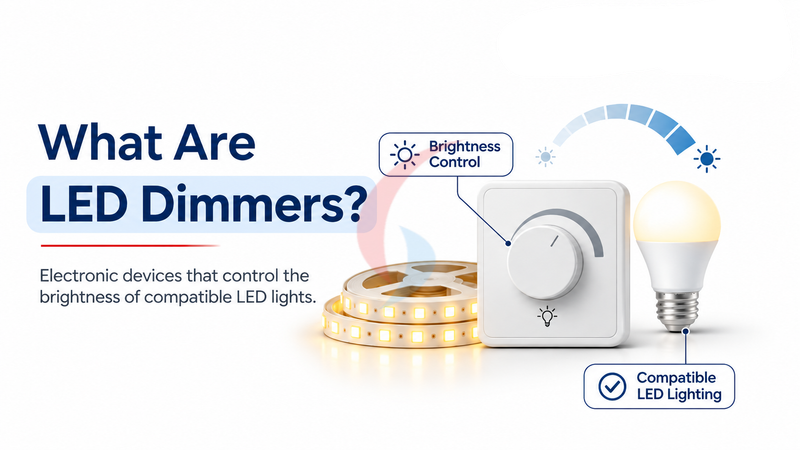
An LED dimmer is an electronic device used to control the brightness of compatible LED lights. Instead of keeping the light at one fixed level, users can increase or decrease its brightness according to their requirements. These devices are commonly installed in residential lighting, restaurants, hotels, offices and commercial spaces.
For example, a restaurant may use bright lighting during cleaning hours and softer lighting during dinner service. An LED dimmer allows the restaurant to make these adjustments without changing the lighting fixtures. However, the dimmer must be compatible with the connected LED lamp or driver to work properly. LED dimmers are available in different designs, including rotary controls, touch-sensitive switches, electronic wall switches and smart dimming controls. Their applicable certification requirements depend on their construction, intended use and electrical characteristics.
Is BIS CRS Registration Mandatory for LED Dimmers?
Yes. Dimmers for LED products are included in the list of notified products under the BIS Compulsory Registration Scheme. The requirement became effective on 1 October 2021, under the Electronics and Information Technology Goods (Requirement of Compulsory Registration) Order, 2021.
This means that manufacturers producing covered LED dimmers for the Indian market must obtain the necessary BIS registration before marketing their products. Foreign manufacturers supplying covered LED dimmers to India must also comply with the applicable requirements. Under the BIS Act, 2016 and relevant regulations, notified products cannot be manufactured, imported, distributed or sold contrary to the mandatory certification requirements. The applicable standard is important because it establishes the safety conditions that manufacturers must satisfy.
For a detailed understanding of mandatory certification, read our BIS CRS Certification Process in India
Applicable Indian Standard for LED Dimmers
LED dimmers are covered under IS/IEC 60669-2-1:2021, titled Switches for Household and Similar Fixed Electrical Installations – Part 2-1: Particular Requirements – Electronic Switches.
The earlier edition, IS/IEC 60669-2-1:2008, was replaced through the revised-standard implementation process. BIS directed existing licensees to complete their transition by 12 October 2024. Therefore, manufacturers preparing new applications in 2026 should follow the revised 2021 standard rather than relying on the old edition.
Manufacturers dealing with other LED lighting products can explore our BIS Certification for LED Lights
BIS Standards Applicable to LED Lighting Products
|
Product Category |
Applicable Indian Standard |
|
LED Dimmers |
IS/IEC 60669-2-1:2021 |
|
Electronic Controlgear for LED Modules |
IS 15885 (Part 2/Sec 13):2012 |
|
Independent LED Modules for General Lighting |
IS 16103 (Part 1):2025 / IEC 62031:2018 |
|
IS 16102 (Part 1):2026, subject to implementation transition |
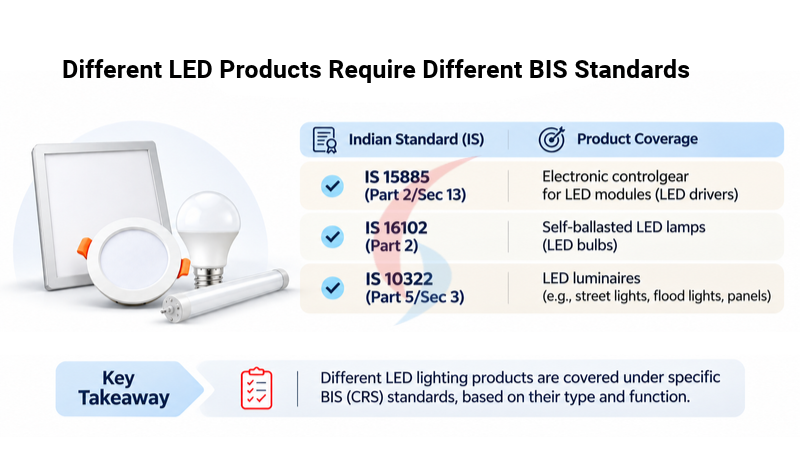
The table shows why manufacturers should not assume that every LED-related product requires the same registration. An LED dimmer, LED driver and LED module serve different purposes and can be covered by separate standards.
Who Needs BIS CRS Registration for LED Dimmers?
BIS registration is relevant to businesses involved in manufacturing or supplying covered LED dimmers in India. Domestic manufacturers must obtain registration for their manufacturing units and applicable products. Foreign manufacturers must also secure the required registration before exporting notified products to India. Importers and brand owners should verify that the actual manufacturing unit has a valid BIS Registration covering the intended brand and models. Registration is issued to the manufacturer, not simply to the trader or importer. If a business sources LED dimmers from several manufacturing locations, the applicable registration coverage must be checked separately.
For example, an Indian lighting company may purchase dimmers from a factory in China and sell them under its own brand. The overseas manufacturer must obtain the appropriate BIS CRS registration, with the relevant brand and model details included in the approved scope.
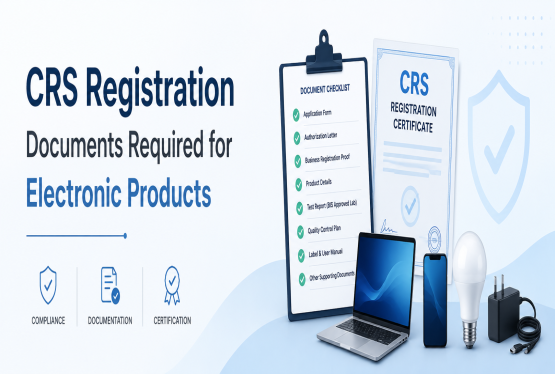
Documents Required for BIS CRS Registration
Proper documentation is essential because BIS examines both the manufacturer's identity and the product's conformity with the applicable standard. Incorrect factory addresses, inconsistent brand details and incomplete laboratory reports can delay an application.
Documents Required for LED Dimmer BIS Registration
|
Document |
Purpose |
|
Business or factory registration proof |
Establishes the manufacturer's identity and address |
|
BIS-recognised laboratory test report |
Confirms compliance with the applicable Indian Standard |
|
Product technical specifications |
Explains ratings, construction and product characteristics |
|
Product photographs and labels |
Identifies the product, brand and model |
|
Brand or trademark authorisation, where applicable |
Establishes the right to use the declared brand |
|
Authorised signatory details |
Identifies the person handling the application |
|
AIR nomination documents, where applicable |
Required for eligible foreign manufacturers |
|
Undertaking and declarations |
Confirms compliance with applicable BIS requirements |
Additional documents may be requested depending on the manufacturing arrangement, application category and findings during scrutiny.
To understand common application documents and avoid filing mistakes, explore our articles on BIS Certification Documents and Registration Process.
BIS CRS Registration Process for LED Dimmers
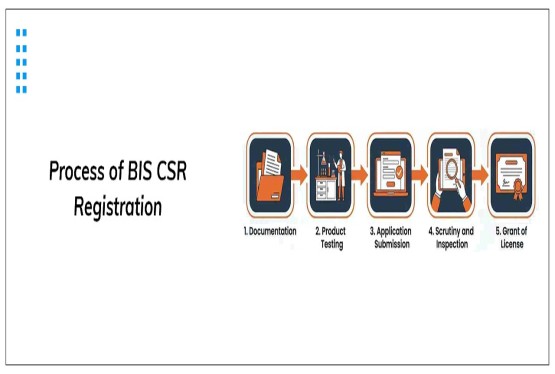
The BIS CRS application process involves product identification, laboratory testing, online filing and document verification. Manufacturers should complete each stage carefully because errors identified later may require corrections or additional testing.
Step 1: Identify the Applicable Standard
The manufacturer should first confirm whether the proposed product falls under the notified category of LED dimmers. The electrical ratings, product design and intended use must be reviewed against IS/IEC 60669-2-1:2021.
Step 2: Select a BIS-Recognised Laboratory
The manufacturer must identify a laboratory recognised by BIS for testing under the applicable standard. The laboratory's current scope of recognition should be verified before submitting samples.
Step 3: Submit Product Samples for Testing
Representative LED dimmer samples are submitted for testing. The testing laboratory examines the product against the relevant safety requirements and issues its report after completing the prescribed assessments.
Step 4: Prepare the BIS Application
The manufacturer creates or uses its account on the official BIS CRS portal and prepares the application with the required product details, manufacturing information, declarations and laboratory report.
Step 5: Submit the Application and Fees
The application is filed with supporting documents and the prescribed fees. BIS instructions require the laboratory test report to be no more than 90 days old at the time of online application submission.
Step 6: Respond to BIS Queries
BIS reviews the submitted information and may raise questions or request corrections. The manufacturer must respond with suitable explanations or additional documents.
Step 7: Obtain Registration and Apply the Standard Mark
After satisfactory verification, BIS grants registration covering the approved manufacturer, brand and models. The manufacturer must follow the prescribed Standard Mark and labelling requirements before marketing the registered products.
Learn how to prepare and file applications through our Step-by-Step BIS CRS Registration Guide
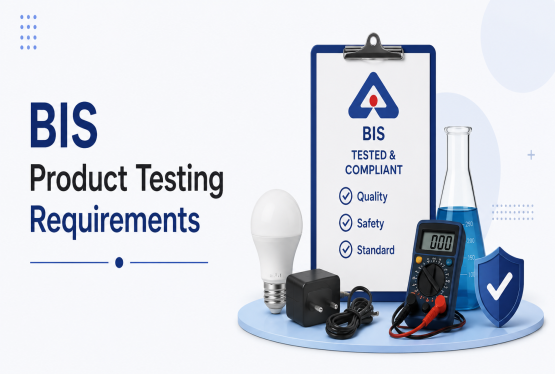
Testing Requirements for LED Dimmers
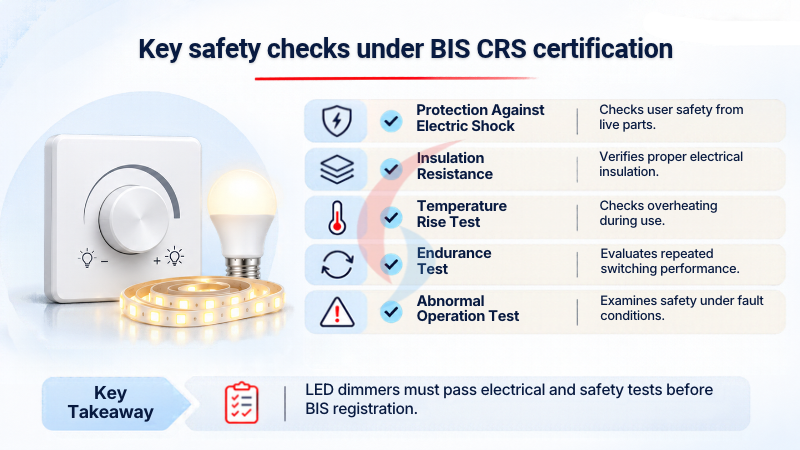
Testing is one of the most important stages of BIS CRS Registration for LED Dimmers. An LED dimmer may appear to function correctly during everyday use, but it must also satisfy the safety requirements prescribed under the applicable standard. Relevant assessments may cover protection against electric shock, insulation performance, temperature rise, mechanical construction, electrical endurance and abnormal operating conditions. The precise test programme depends on the standard and the product's construction.
Important Safety Areas
|
Testing Area |
Why It Matters |
|
Electric shock protection |
Reduces risk from accessible live parts |
|
Insulation and dielectric strength |
Checks electrical separation and insulation integrity |
|
Temperature rise |
Examines overheating risks |
|
Mechanical strength |
Evaluates resistance to specified mechanical stresses |
|
Endurance |
Checks performance under repeated operation |
|
Abnormal operation |
Evaluates safety under specified fault conditions |
Manufacturers should not treat these as a replacement for the complete test schedule. The BIS-recognised laboratory determines the applicable tests under the revised Indian Standard.
Latest BIS Updates and Amendments for LED Dimmers in 2026
Manufacturers should regularly review BIS notifications because standards, registration procedures and licence conditions can change. Several developments are particularly relevant to businesses dealing in LED dimmers.
1. Revised Standard IS/IEC 60669-2-1:2021
BIS issued implementation guidelines on 27 September 2024 for the revised standard. Existing licensees were instructed to submit updated test reports for lead models and confirm conformity for other covered series models. A subsequent extension circular was listed on 16 October 2024. Manufacturers should therefore verify the final implementation requirements and ensure their registration reflects the revised standard.
2. BIS Conformity Assessment Amendment Regulations, 2026
The 2026 amendments introduced important changes concerning licence validity, annual fee payments and continuation of licences. Under the amended Scheme II provisions, registration may initially be granted for up to five years and renewed for up to five years, with annual fees payable in advance. Non-payment of annual dues and failure to submit the required production statement can lead to suspension and eventual cancellation, subject to the applicable provisions. These changes make ongoing compliance important even after registration is granted.
3. Updated CRS Product Guidance
On 13 August 2026, BIS listed guidance concerning product categories under CRS. Manufacturers should use the latest guidance when determining whether new dimming technologies and designs fall within the notified category. BIS also published separate revised-standard guidance for LED luminaires during 2026. Those updates should not automatically be treated as amendments to the LED dimmer standard.
Explore the latest BIS certification updates and regulatory changes to understand how revised standards can affect manufacturers and importers.
BIS CRS Registration Cost and Processing Time
The overall cost depends on laboratory testing charges, the applicable BIS fees, number of models, product variations and documentation requirements. Foreign manufacturers may also incur expenses for an Authorised Indian Representative (AIR). Laboratory fees vary according to the recognised laboratory and required testing. Manufacturers should obtain an updated quotation before preparing their budget. Processing time also varies. Although BIS publishes indicative processing timelines, technical failures, incomplete documents or additional queries can increase the time needed for approval.
Common Challenges in LED Dimmer BIS Registration
A manufacturer may develop an LED dimmer that works perfectly during normal operation but still encounters problems during BIS testing. Electrical insulation, heating performance or other safety characteristics may not satisfy the prescribed standard. Another common issue occurs when businesses submit applications under incorrect product categories or use laboratory reports that do not match the declared models.
For example, imagine a Delhi-based lighting company planning to import 5,000 smart LED dimmers. The company places its order before confirming the manufacturer's registration status. Later, it discovers that the supplier's BIS registration does not cover the intended product models. This could delay the import and launch. The practical lesson is simple: verify the manufacturer, applicable standard, approved model scope and registration status before placing large orders.
For registration maintenance and compliance obligations, read CRS Compliance for Manufacturers
Benefits of BIS CRS Registration for LED Dimmers
BIS CRS registration allows manufacturers to demonstrate compliance with applicable safety requirements. It also helps importers, distributors and buyers identify products covered by a recognised conformity assessment process. For businesses, valid registration supports lawful market access and can reduce the risk of regulatory disruption. Buyers gain additional assurance that the product has undergone the required safety assessment.
However, BIS registration does not automatically guarantee compatibility with every LED lamp or lighting installation. Manufacturers must still provide accurate specifications and appropriate installation instructions.
Businesses dealing with LED drivers and other lighting equipment can explore our BIS Certification for Electronic Controlgear and LED Lighting Products articles.
Why Choose Compliance Calendar LLP for BIS CRS Registration?
Getting BIS registration is not just about submitting an application. Manufacturers need to understand the correct Indian Standard, arrange testing, prepare accurate documents and respond to BIS queries. For a business launching LED dimmers, even a small documentation error can delay its market entry.
At Compliance Calendar LLP, we understand the practical questions businesses face during product certification. A manufacturer may approach us after discovering that its test report does not match the product model, or an importer may need clarity about registration requirements before placing an overseas order. Our approach is to first understand the product and identify the relevant compliance requirements rather than immediately proceeding with paperwork.
For enquiries, contact Compliance Calendar LLP by email at info@ccoffice.in or via WhatsApp at +91 9988424211
Frequently Asked Questions (FAQs)
Q1. Is BIS CRS Registration mandatory for LED dimmers in India?
Ans. Yes. Dimmers for LED products are included under the BIS Compulsory Registration Scheme. Covered products must comply with the prescribed Indian Standard and applicable registration requirements before being marketed in India.
Q2. Which Indian Standard applies to LED dimmers?
Ans. The relevant revised standard is IS/IEC 60669-2-1:2021. It covers safety requirements for electronic switches used in household and similar fixed electrical installations, including applicable LED dimmers.
Q3. When did BIS registration become mandatory for LED dimmers?
Ans. The mandatory registration requirement for dimmers for LED products became effective on 1 October 2021. Manufacturers and importers must follow the applicable compulsory registration provisions.
Q4. Can foreign manufacturers obtain BIS CRS Registration?
Ans. Yes. Eligible foreign manufacturers can apply for BIS registration. They generally need to appoint an Authorised Indian Representative and submit the prescribed documentation.
Q5. What is the validity of BIS CRS Registration in 2026?
Ans. Following the 2026 regulatory amendments, a Scheme II licence may be granted initially for up to five years and renewed for up to five years. Annual fee and compliance conditions must be followed.
Q6. Is laboratory testing compulsory for LED dimmers?
Ans. Yes. Covered LED dimmers must undergo applicable testing at a BIS-recognised laboratory. The test report forms an important part of the registration application.
Q7. Can an importer apply directly for BIS registration?
Ans. BIS CRS registration is generally issued to the manufacturer. Importers must ensure that the manufacturing unit and the products being imported are covered by valid registration.
Q8. Can multiple LED dimmer models be covered under one registration?
Ans. Multiple eligible models may be covered under a registration according to applicable series guidelines. The manufacturer must ensure that the approved scope includes the relevant models.
Q9. What happens if LED dimmers are sold without mandatory BIS registration?
Ans. Selling or importing notified products without complying with applicable BIS requirements can invite regulatory action. Businesses may face restrictions and penalties under the relevant legal provisions.
Q10. How can manufacturers check BIS registration status?
Ans. Manufacturers and buyers can check registration information through the official BIS CRS portal. The registration number, manufacturer, brand, model coverage and validity should be verified.
Article last updated on : 18 Nov 2026.