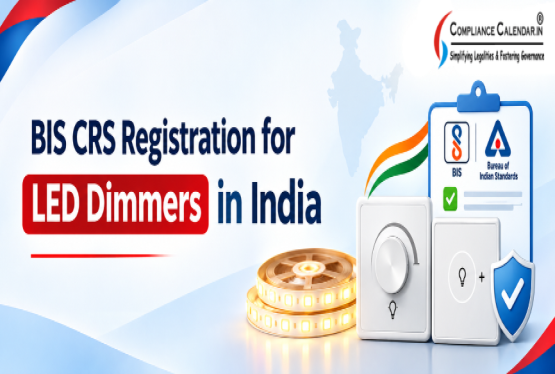



India's LED lighting industry has grown considerably as businesses and consumers increasingly prefer energy-efficient lighting products. From commercial offices and residential buildings to industrial facilities and retail spaces, LED technology is used in various lighting applications. Behind many of these products is a small but important component known as an LED module. Although it may appear to be a simple electronic component, an LED module can involve important electrical safety requirements.
For manufacturers and importers, understanding BIS CRS Registration for Independent LED Modules is essential before introducing covered products into the Indian market. The Bureau of Indian Standards (BIS) regulates Independent LED Modules for General Lighting under the Compulsory Registration Scheme (CRS). Manufacturers must ensure conformity with the applicable Indian Standard and obtain registration before manufacturing or supplying covered products commercially in India.
What Are Independent LED Modules?
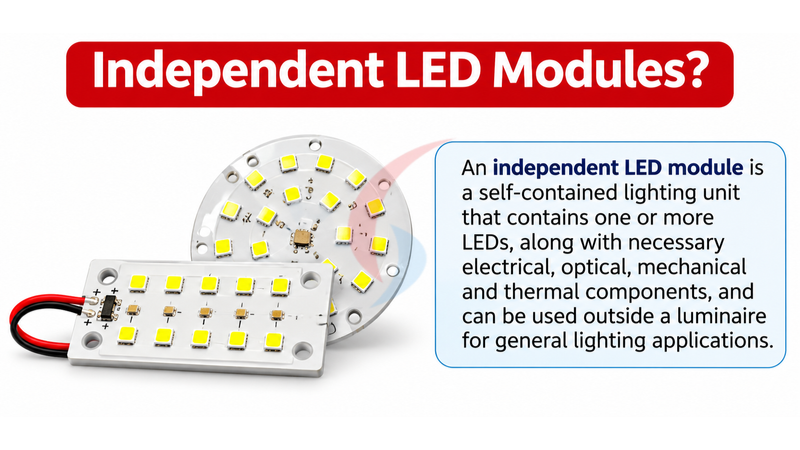
An LED module is a lighting component containing one or more light-emitting diodes and, depending on its design, associated electrical, optical, mechanical or thermal components. These modules are used as light sources in different lighting products, including certain general lighting applications. An independent LED module is designed as a separate unit that can be used outside a luminaire or equipment without requiring an additional enclosure solely to meet the applicable safety requirements. This distinguishes it from certain built-in LED modules, which rely on the luminaire or equipment in which they are installed for part of their protection.
For example, imagine an LED lighting manufacturer producing compact modules that can be connected to a suitable external power supply and installed independently for general illumination. If the product satisfies the relevant definition and falls within the notified category, BIS registration is required. The presence of LEDs on a printed circuit board does not automatically mean that the product is an independent LED module. Product classification depends on its construction, intended use, electrical characteristics and the definitions provided in the applicable standard.
Our guide on Process to Get BIS Certification for LED Lights explains the general certification procedure, including testing and documentation.
Why Is BIS CRS Registration Mandatory for Independent LED Modules?
BIS CRS Registration is mandatory because Independent LED Modules for General Lighting are specifically included in the products notified under India's compulsory registration requirements. The category was initially notified as Standalone LED Modules for General Lighting through the Ministry of Electronics and Information Technology (MeitY) notification dated 1 April 2020. A subsequent notification dated 16 September 2020 changed the category description to Independent LED Modules for General Lighting and extended implementation to 1 April 2021.
Independent LED Modules for General Lighting are covered under India's Compulsory Registration Scheme. According to the official BIS Notified Product List, mandatory registration became applicable on 1 April 2021. Manufacturers of covered products must obtain the prescribed registration before commercial supply.
Under the applicable regulatory system, manufacturers of notified products must obtain BIS registration based on conformity with the relevant Indian Standard. This requirement serves an important purpose. Independent LED modules may operate for extended periods, and problems involving insulation, electrical connections, excessive heating or inadequate construction can create safety risks. Government Notification: MeitY's Notification S.O. 3170(E), dated 16 September 2020 confirms the change in product description and the implementation date of 1 April 2021.
Applicable BIS Standard for Independent LED Modules in India
The principal Indian Standard for this product category is IS 16103 (Part 1), which specifies safety requirements for LED modules for general lighting. Previously, the applicable edition was IS 16103 (Part 1):2012. BIS revised the standard in 2025 and issued implementation guidelines on 9 September 2025.
The revised standard is IS 16103 (Part 1):2025 / IEC 62031:2018. After a subsequent extension, the final implementation deadline was 21 July 2026.
|
Particulars |
Details |
|---|---|
|
Product category |
|
|
Certification scheme |
BIS Compulsory Registration Scheme (CRS) |
|
Earlier standard |
IS 16103 (Part 1):2012 |
|
Revised standard |
IS 16103 (Part 1):2025 |
|
International reference |
IEC 62031:2018 |
|
Regulating authority |
Bureau of Indian Standards |
|
Responsible ministry |
|
|
Mandatory registration date |
1 April 2021 |
|
Revised standard implementation deadline |
21 July 2026 |
The official BIS product list now identifies the 2025 standard as the applicable edition for this category. Accordingly, manufacturers submitting new applications in November 2026 should follow the revised standard rather than relying on the withdrawn 2012 edition.
Important Update for 2026: BIS extended the implementation deadline for IS 16103 (Part 1):2025 to 21 July 2026 through its official notification dated 1 January 2026.
Difference Between Independent LED Modules and LED Controlgear
One common source of confusion is the difference between an LED module and the electronic controlgear used to operate it. An LED module primarily performs the light-emitting function. Electronic controlgear, often referred to as an LED driver, regulates or supplies electrical power to the module. These components may be used together in a lighting system, but they can fall under separate BIS product categories.
|
Particulars |
Independent LED Modules |
Electronic Controlgear for LED Modules |
|---|---|---|
|
Primary function |
Produces light |
Supplies or regulates electrical power |
|
Applicable standard |
IS 16103 (Part 1):2025 |
IS 15885 (Part 2/Sec 13):2012 |
|
BIS category |
Independent LED Modules for General Lighting |
DC or AC Supplied Electronic Controlgear for LED Modules |
|
Primary safety focus |
LED module construction and electrical safety |
Controlgear electrical and operational safety |
|
Registration |
Required for covered independent modules |
Required for covered electronic controlgear |
For example, a manufacturer may sell an independent LED module together with an external LED driver. In such circumstances, the manufacturer should assess the applicability of BIS requirements to each notified product rather than assuming that registration of the module automatically covers the driver.
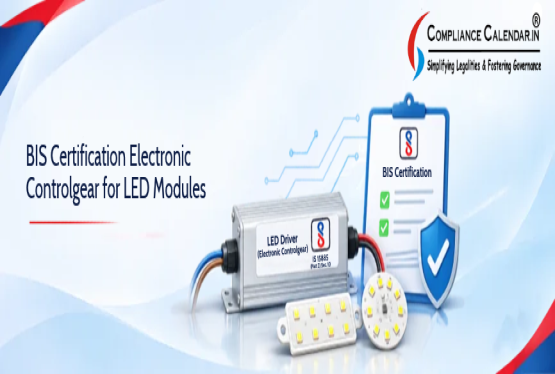
Read our related article on BIS Certification for Electronic Controlgear for LED Modules to understand the separate certification requirements.
Who Needs BIS CRS Registration for Independent LED Modules?
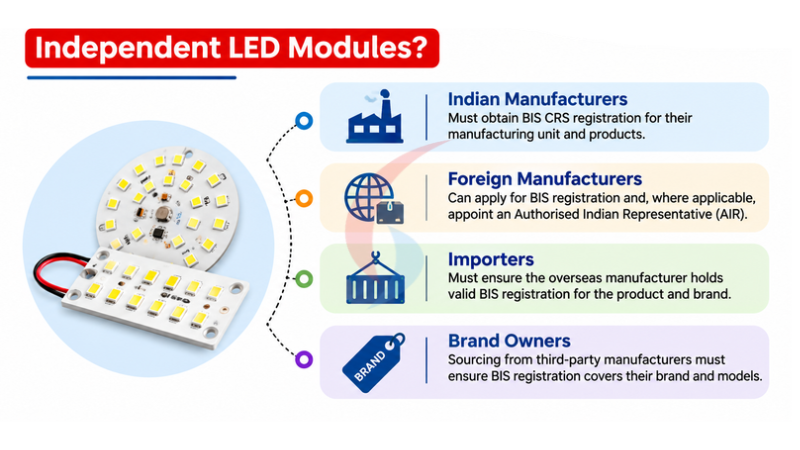
BIS registration is primarily issued to manufacturers of notified products. Businesses operating at different stages of the supply chain must therefore understand how their responsibilities are connected with the actual manufacturing unit.
-
Indian Manufacturers: Companies manufacturing independent LED modules in India must obtain registration for the relevant manufacturing location, product category and brand before supplying covered products commercially.
-
Foreign Manufacturers: Overseas manufacturers exporting independent LED modules to India are also eligible to apply for BIS registration. Where applicable, they must appoint an Authorised Indian Representative (AIR) to fulfil the prescribed responsibilities.
-
Importers: Importers must verify whether the actual overseas manufacturer holds valid BIS registration covering the relevant products and brand. Merely obtaining an international safety certificate does not automatically satisfy the Indian requirement.
-
Brand Owners: Businesses purchasing modules from third-party factories and marketing them under their own brand must ensure that the manufacturer's BIS registration appropriately covers the brand and product models.
BIS registration is linked to the actual manufacturing unit. A company operating multiple manufacturing facilities should not assume that registration associated with one factory automatically covers another.
The official BIS eligibility guidelines confirm that manufacturers located in India or outside India may apply for registration.
Documents Required for BIS CRS Registration for Independent LED Modules
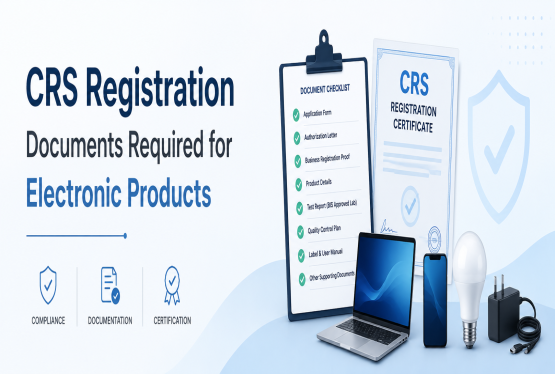
Documentation plays an important role in the registration process because BIS must verify the manufacturer's identity, factory details, product specifications and test results. The exact documents depend on the application circumstances, but commonly required records include the following:
|
Document |
Purpose |
|---|---|
|
Certificate of Incorporation or business registration |
Establishes the legal identity of the manufacturer |
|
Manufacturing unit address proof |
Confirms the production location |
|
Factory details |
Identifies the actual manufacturing facility |
|
Product specifications |
Describes electrical characteristics and construction |
|
Circuit diagrams and technical drawings |
Supports product evaluation |
|
Component and material information |
Identifies relevant safety-related components |
|
Product photographs |
Helps identify the module and model |
|
Brand ownership or authorisation |
Supports use of the declared trademark |
|
BIS-recognised laboratory test report |
Demonstrates conformity with the applicable Indian Standard |
|
Authorised signatory details |
Identifies the applicant's representative |
|
AIR nomination documents, where applicable |
Supports foreign manufacturer applications |
|
Prescribed declarations and undertakings |
Confirms compliance with BIS requirements |
Manufacturers should ensure that the model names, brand details, product descriptions and factory address appearing on the test report correspond with the registration application. If the information is inconsistent, BIS may request clarifications or corrected documents, which can delay the application.
Step-by-Step BIS CRS Registration Process for Independent LED Modules
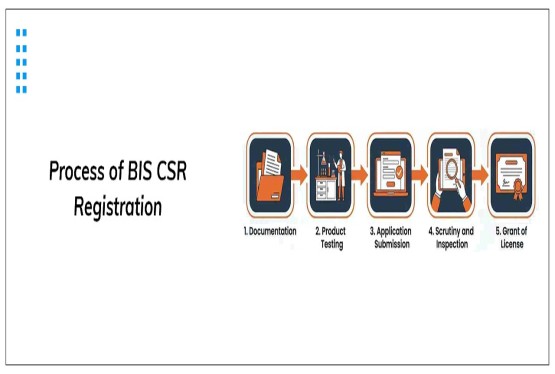
Obtaining BIS CRS Registration for Independent LED Modules involves identifying the applicable Indian Standard, arranging laboratory testing and completing the registration application. Manufacturers should begin these activities before finalising commercial supply arrangements.
Step 1: Identify the Product Category
The manufacturer must confirm that the product qualifies as an Independent LED Module for General Lighting. This requires reviewing its construction, electrical characteristics, intended installation and applicable definitions under IS 16103 (Part 1):2025. A bare LED circuit board should not automatically be classified as an independent module. Incorrect classification can result in testing under the wrong standard and subsequent registration difficulties.
Step 2: Select a BIS-Recognised Laboratory
Once the product classification is established, the manufacturer should select a laboratory recognised by BIS for IS 16103 (Part 1):2025. The laboratory's current recognition and testing scope must be confirmed before submitting samples. Laboratories recognised for other LED products may not necessarily be authorised for this particular standard.
Step 3: Submit Product Samples for Testing
The manufacturer submits representative independent LED module samples along with the required technical documents. The laboratory examines conformity with the applicable safety requirements. If a sample does not satisfy a mandatory requirement, the manufacturer may need to revise the design or components and arrange additional testing before proceeding.
Step 4: Prepare the Registration Application
After obtaining a satisfactory laboratory test report, the manufacturer prepares the BIS registration application. The documents generally include manufacturer identification, factory information, brand details, model specifications, declarations and the test report. Foreign manufacturers must also satisfy the applicable AIR requirements.
Step 5: Submit the Online Application
The manufacturer submits the application through the BIS CRS Registration Portal and pays the applicable government charges. BIS examines the application and supporting documents. Where required, the applicant must provide clarifications or correct discrepancies before approval.
Step 6: Obtain BIS CRS Registration
Once BIS is satisfied that the necessary requirements have been met, registration is granted for the relevant manufacturing unit, product category, brand and approved scope. The manufacturer must then use the prescribed CRS Standard Mark and registration number in accordance with the applicable requirements. The BIS CRS Application Instructions explain the registration procedure, testing requirements and application scrutiny.
Manufacturers can also read Compliance Calendar LLP's BIS CRS Registration Step-by-Step Process for Electronic Products for additional guidance.
What Tests Are Required for Independent LED Modules?
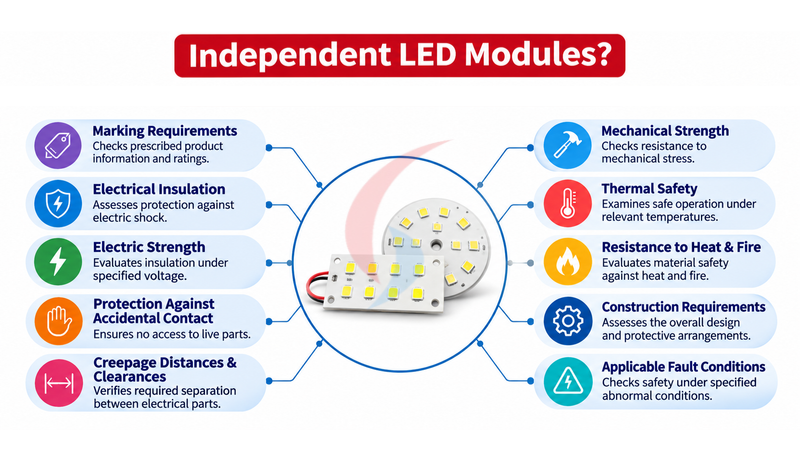
Testing is one of the most important stages of the certification process. Independent LED modules must be evaluated to confirm that their design and construction meet the safety requirements specified by the applicable Indian Standard. An LED module may operate correctly when first connected to a power source, but that does not necessarily establish that it meets the prescribed electrical, thermal and mechanical safety conditions.
The relevant tests may include the following areas, depending on the product's construction and classification.
|
Testing area |
Purpose |
|---|---|
|
Marking requirements |
Verifies prescribed product identification and electrical information |
|
Electrical insulation |
Assesses protection against electrical hazards |
|
Electric strength |
Evaluates insulation under specified electrical stress |
|
Protection against accidental contact |
Examines safeguards against hazardous live parts |
|
Creepage distances and clearances |
Checks prescribed separation between electrical parts |
|
Mechanical strength |
Evaluates resistance to specified mechanical stresses |
|
Thermal safety |
Examines safety under relevant temperature conditions |
|
Resistance to heat and fire |
Evaluates applicable material safety characteristics |
|
Construction requirements |
Assesses the module's design and protective arrangements |
|
Applicable fault conditions |
Evaluates safety under prescribed abnormal conditions |
The actual testing programme must follow the complete provisions of IS 16103 (Part 1):2025. Not every test listed above necessarily applies identically to all module designs.
For example, an independent LED module intended for a particular electrical supply arrangement may have different technical characteristics from another module designed for a different installation environment. The laboratory must evaluate the relevant clauses based on the actual product.
Why Is Thermal Management Important for Independent LED Modules?
Heat management is an important consideration when designing LED modules because their electrical and optical performance can be affected by operating temperature. Although LEDs are generally energy-efficient, they still generate heat during operation. If this heat is not adequately managed, temperatures around the LED chips, solder connections and other components can increase.
For example, consider two LED modules designed to provide similar illumination. One has an appropriate thermal design that allows heat to dissipate effectively. The other has insufficient heat dissipation and operates at a higher temperature.
Over time, excessive heating may affect component reliability and create safety concerns. Manufacturers must therefore consider the thermal characteristics of their product and ensure that the design satisfies the applicable safety requirements. This is particularly important when a module is designed for independent installation, where its protective construction cannot simply rely on an additional external luminaire enclosure.
Businesses can explore BIS Certification for Electronic Controlgear for LED Modules to understand the separate compliance requirements.
BIS CRS Registration Fees for Independent LED Modules
The total cost of BIS registration generally consists of government charges, laboratory testing expenses and any additional professional or documentation costs. The exact amount depends on the current BIS fee structure, manufacturer category, number of models and required testing arrangements.
|
Fee component |
Cost considerations |
|---|---|
|
BIS application fee |
Payable according to the current government fee schedule |
|
Registration processing fee |
Depends on the applicable CRS provisions |
|
Annual licence charges |
Subject to the current registration provisions |
|
Laboratory testing fees |
Vary by laboratory and required test scope |
|
Additional model testing |
Depends on model differences and grouping requirements |
|
Foreign manufacturer documentation |
May involve AIR-related requirements |
|
Professional assistance |
Separate charges where consultancy is engaged |
BIS published revised provisions for registration validity, renewal and annual fee payments on 27 May 2026. Manufacturers should therefore verify the current fees before applying rather than relying exclusively on older CRS fee charts. The laboratory testing quotation should also be obtained separately. A manufacturer applying for several technically different modules may incur more testing expenses than one applying for a single model. The BIS Official Circulars page provides access to the relevant 2026 updates.
Latest BIS Updates for Independent LED Modules in 2026
The most important recent development for this category is the implementation of IS 16103 (Part 1):2025. BIS issued implementation guidelines on 9 September 2025, originally identifying 21 January 2026 as the last date of concurrent running between the earlier 2012 standard and the revised 2025 standard.
On 1 January 2026, BIS extended the implementation deadline to 21 July 2026. Read the Official BIS Extension Notification. The revised standard has therefore become particularly important for manufacturers applying for registration in November 2026.
|
Date |
Regulatory development |
|---|---|
|
1 April 2020 |
Product category notified under the compulsory registration requirements |
|
16 September 2020 |
Category renamed Independent LED Modules for General Lighting |
|
1 April 2021 |
Mandatory registration requirement took effect |
|
9 September 2025 |
BIS issued revised-standard implementation guidelines |
|
21 January 2026 |
Original revised-standard implementation deadline |
|
1 January 2026 |
BIS issued an extension notification |
|
21 July 2026 |
Extended implementation deadline for IS 16103 (Part 1):2025 |
What Do the Revised Standard Requirements Mean for Existing Manufacturers?
Manufacturers who previously obtained BIS registration under IS 16103 (Part 1):2012 were required to demonstrate conformity with the revised standard within the prescribed transition period. According to the BIS implementation guidelines, existing licensees were required to submit complete test reports from BIS-recognised laboratories for applicable lead models previously tested under the earlier standard. They were also required to provide an undertaking confirming implementation of the revised requirements for other existing series models covered by their registration.
The guidelines warn that failure to implement the revised standard may result in cancellation of registration or deletion of affected models from the registration scope.Refer to the Implementation Guidelines for IS 16103 (Part 1):2025 and the Extension Notification dated 1 January 2026 for the applicable requirements. Manufacturers should distinguish this deadline from the separate 2026 revisions affecting various LED luminaire standards under the IS 10322 series. Those transition arrangements should not automatically be applied to Independent LED Modules for General Lighting.
Can Multiple Independent LED Module Models Be Covered Under One Registration?
Manufacturers often develop different LED module models based on power ratings, dimensions, circuit arrangements and other technical specifications. Some models may be eligible for inclusion under a single BIS registration, subject to the applicable series guidelines and testing requirements.
For example, a company manufacturing several LED modules with related construction may want to register them together. However, significant differences in safety-related electrical or construction characteristics could require additional testing.
The manufacturer should identify representative lead models in accordance with applicable BIS grouping requirements and ensure that all intended models are appropriately covered before commercial supply. Where new models are introduced after the initial registration, the manufacturer should follow the applicable inclusion procedure rather than assuming that the original registration automatically covers the entire future product range.
BIS Marking and Labelling Requirements for Independent LED Modules
Following registration, the manufacturer must apply the prescribed BIS CRS Standard Mark and registration number in accordance with the applicable marking requirements. Depending on the module's design and the standard's requirements, additional marking information may include manufacturer or brand identification, model details, rated electrical characteristics and relevant safety instructions.
The information must be clear, accurate and provided in the prescribed manner. Manufacturers should ensure that the registration number corresponds to the actual manufacturing unit and approved product scope. Where the applicable marking provisions permit information to appear on associated documentation or packaging, manufacturers must follow those provisions rather than choosing an alternative marking arrangement on their own.
Common Mistakes to Avoid During BIS CRS Registration
One common mistake is selecting an incorrect Indian Standard. Independent LED modules, electronic controlgear, self-ballasted LED lamps and complete LED luminaires may all involve LED technology, but they do not necessarily fall within the same BIS category. Manufacturers also sometimes overlook the difference between independent, built-in and integrated LED modules. This can lead to incorrect classification and unnecessary testing expenses.
Another common issue is submitting incomplete technical documentation. Missing electrical specifications, incorrect brand details or inconsistencies between the test report and application can delay registration. Businesses should also be careful when introducing new module models. A registration covering one product does not automatically establish compliance for every variation produced by the factory. Finally, manufacturers holding older registrations must monitor revisions to Indian Standards and BIS instructions. Maintaining compliance after registration is just as important as obtaining the initial approval.
Why Choose Compliance Calendar LLP for BIS CRS Registration?
Obtaining BIS CRS Registration for Independent LED Modules involves understanding product classification, applicable Indian Standards, laboratory testing requirements and registration documentation. For manufacturers developing new lighting components, these requirements can be challenging to manage alongside commercial production and product development. Compliance Calendar LLP provides professional assistance with BIS CRS Registration in India, including regulatory documentation, product classification, coordination with BIS-recognised laboratories and registration application support.
For professional assistance with BIS registration, contact Compliance Calendar LLP at +91 9988424211 or info@ccoffice.in
Frequently Asked Questions (FAQs)
Q1. Is BIS CRS Registration mandatory for Independent LED Modules in India?
Ans. Yes. Independent LED Modules for General Lighting are included under the BIS Compulsory Registration Scheme. The mandatory requirement became effective on 1 April 2021. Manufacturers of covered products must obtain the applicable registration before supplying them commercially in India.
Q2. Which BIS Standard applies to Independent LED Modules?
Ans. The applicable Indian Standard is IS 16103 (Part 1):2025 / IEC 62031:2018. It replaced the earlier IS 16103 (Part 1):2012 edition, with the extended implementation deadline of 21 July 2026. Manufacturers applying in November 2026 should follow the revised standard.
Q3. What is the difference between an Independent LED Module and an LED driver?
Ans. An independent LED module is a light-emitting unit designed for independent use under its applicable classification. An LED driver or electronic controlgear supplies or regulates electrical power. The two products may be covered by separate BIS standards and registration requirements.
Q4. Can foreign manufacturers obtain BIS Registration for Independent LED Modules?
Ans. Yes. Foreign manufacturers exporting covered independent LED modules to India can apply for BIS registration. They must comply with the applicable testing, documentation and Authorised Indian Representative requirements.
Q5. What documents are required for BIS CRS Registration?
Ans. Common documents include factory details, manufacturer registration documents, product specifications, circuit diagrams, brand authorisation, prescribed declarations and a satisfactory test report from a BIS-recognised laboratory. Foreign manufacturers may also require AIR nomination documents.
Q6. How much does BIS Registration for Independent LED Modules cost?
Ans. The total cost depends on the current BIS government fees, laboratory testing charges, number of models and documentation requirements. Manufacturers should obtain an updated laboratory quotation and verify the applicable government fee schedule before applying.
Q7. How long does BIS CRS Registration take?
Ans. The registration timeline depends on laboratory testing, completeness of documentation and BIS scrutiny. If the product requires design changes, retesting or additional clarification, the process may take longer. Manufacturers should begin certification activities before their planned commercial launch.
Q8. Can multiple Independent LED Module models be registered together?
Ans. Eligible models may be covered under one registration subject to BIS grouping and model inclusion requirements. Differences in electrical design, construction or other safety-related characteristics may require additional testing. Manufacturers should verify the applicable series guidelines before submitting an application.
Q9. What is the latest BIS update for Independent LED Modules in 2026?
Ans. The major update is the transition to IS 16103 (Part 1):2025 / IEC 62031:2018. BIS extended the implementation deadline from 21 January 2026 to 21 July 2026. Existing registration holders were required to meet the applicable transition conditions.
Q10. What happens if Independent LED Modules are sold without BIS Registration?
Ans. Manufacturing, importing or supplying covered independent LED modules without complying with the mandatory BIS requirements can result in regulatory enforcement under the applicable law. Depending on the circumstances, businesses may face product restrictions, seizure, prosecution or statutory penalties.
Article last updated on : 20 Nov 2026.