


LED hand lamps have become a common part of everyday life in India. From electricians working inside buildings to mechanics repairing vehicles and households preparing for power cuts, portable LED lighting products are used in many situations. Their compact size, energy efficiency and convenient handling make them popular among consumers and businesses. However, when an LED hand lamp is manufactured or imported for the Indian market, its electrical safety and compliance with applicable Indian Standards become equally important.
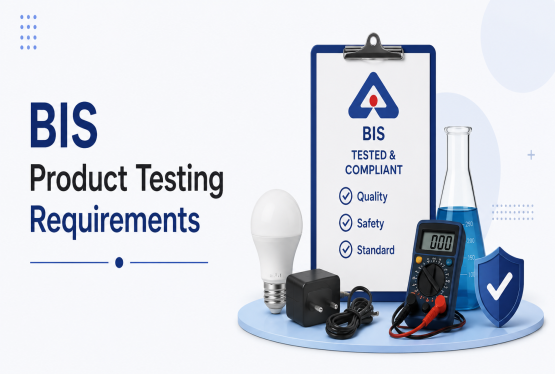
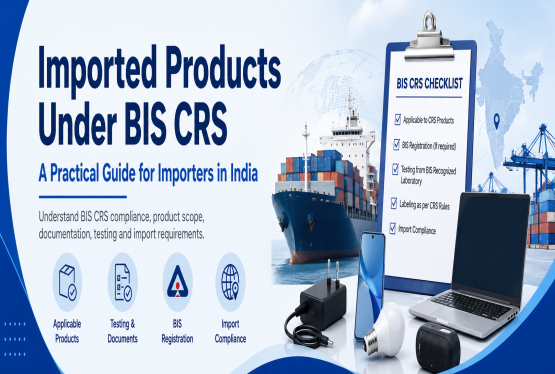
This is where BIS Registration for LED Hand Lamps in India becomes essential. The Bureau of Indian Standards (BIS) regulates notified electronic and lighting products under the Compulsory Registration Scheme (CRS). Manufacturers of covered LED hand lamps must ensure that their products meet prescribed safety requirements and obtain the necessary BIS registration before placing them on the Indian market.
LED hand lamps are specifically listed under the BIS CRS product categories. Their applicable product standard has also undergone revision in 2026, making it important for manufacturers and importers to understand the latest requirements rather than relying entirely on older certification procedures. This article explains the applicability, Indian Standards, eligibility, documents, testing requirements, registration process, fees and important compliance obligations for LED hand lamps in India.
What Are LED Hand Lamps?
LED hand lamps are portable lighting devices that use light-emitting diodes (LEDs) to produce illumination. They are designed to provide light in places where fixed lighting may not be available or practical. Many hand lamps are fitted with handles, hooks or supporting arrangements that allow users to carry, hang or position them during work.
For example, an electrician repairing a distribution board may need a portable lamp to illuminate a confined space. Similarly, a mechanic inspecting the underside of a vehicle may use a hand lamp because ordinary ceiling lights cannot adequately illuminate the working area. LED technology makes these products attractive because it generally offers lower energy consumption, long operating life and reduced heat generation compared with many traditional lighting technologies.
For BIS classification, however, the appearance or commercial name of a product is not the only deciding factor. The relevant handlamp standard addresses portable luminaires designed to be held, hooked or rested on a surface. Manufacturers should examine the product's construction, power source, intended use and applicable technical definition before determining its registration category. A rechargeable torch, for example, should not automatically be classified as an LED hand lamp without examining the relevant BIS scope.
Is BIS Registration Mandatory for LED Hand Lamps in India?
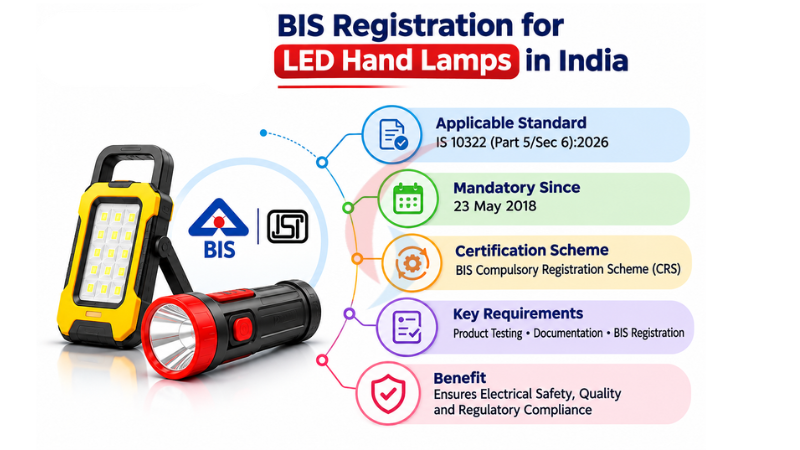
Yes. LED hand lamps covered by the notified product category require BIS registration under the Compulsory Registration Scheme. The category was brought under mandatory registration with an implementation date of 23 May 2018. The regulatory requirement applies to relevant products manufactured for sale in India as well as imported products covered by the applicable order.
The requirement was originally introduced through the Electronics and Information Technology Goods (Requirement for Compulsory Registration) Order and subsequently carried forward under the 2021 order and its amendments. Under this system, manufacturers obtain product testing from a BIS-recognised laboratory and apply for registration with BIS. Once registration is granted, they may use the prescribed Standard Mark and registration number in accordance with the scheme. LED hand lamps are included in the official BIS Compulsory Registration Product List. The applicable notification made registration mandatory from 23 May 2018, requiring manufacturers of covered products to comply with the prescribed Indian Standard before commercial supply.
Applicable Indian Standard for BIS Registration of LED Hand Lamps
The principal Indian Standard for this product category is IS 10322 (Part 5/Sec 6), dealing with particular requirements for handlamps. The earlier edition, IS 10322 (Part 5/Sec 6):2013, has been revised to IS 10322 (Part 5/Sec 6):2026, aligned with IEC 60598-2-8:2013.
The standard is concerned with the safe construction and operation of handlamps. It addresses the technical characteristics of portable luminaires, including requirements connected with their construction, electrical insulation, mechanical strength and safe handling.
Manufacturers can also explore BIS CRS Registration for Fixed General Purpose LED Luminaires to understand how certification requirements vary between lighting categories.
|
Particulars |
Details |
|
Product category |
LED Hand Lamps |
|
Earlier standard |
IS 10322 (Part 5/Sec 6):2013 |
|
Revised standard |
IS 10322 (Part 5/Sec 6):2026 |
|
International reference |
IEC 60598-2-8:2013 |
|
Certification scheme |
BIS Compulsory Registration Scheme (CRS) |
|
Regulating authority |
Bureau of Indian Standards |
|
Relevant ministry |
The revised 2026 standard is an important consideration for new applications, existing registrations and product testing. Manufacturers must follow BIS transition instructions and the applicable implementation deadlines when selecting the standard edition for their application.
Who Needs BIS Registration for LED Hand Lamps?
BIS registration primarily applies to the manufacturer of the covered product. However, importers, private-label businesses and foreign companies must also understand the registration requirements because a product sold under their brand may need to be covered by the actual manufacturer's registration.
-
Indian Manufacturers: A company manufacturing LED hand lamps at a factory in India must obtain registration covering the applicable product category and brand before selling its notified products. The manufacturing unit's address and product details must correspond with the information submitted to BIS.
-
Foreign Manufacturers: Overseas manufacturers exporting LED hand lamps to India must also comply with BIS registration requirements. Where the foreign manufacturer has no qualifying office in India, an Authorised Indian Representative (AIR) must be appointed in accordance with BIS guidelines.
-
Importers and Distributors: Importers generally do not obtain a separate manufacturer registration merely because they import the product. Instead, they must ensure that the foreign manufacturer's registration appropriately covers the product, factory and brand being imported.
-
Brand Owners and Private-Label Businesses: Businesses that purchase LED hand lamps from another factory and sell them under their own brand must confirm that the manufacturing unit has the necessary BIS registration and that the relevant brand and models are properly covered. A different company name printed on the packaging does not replace the manufacturer's legal responsibility.
Documents Required for BIS Registration of LED Hand Lamps
Preparing accurate documents is one of the most important stages of the BIS CRS registration process. Even when the product successfully passes laboratory testing, incomplete factory details, inconsistent brand information or missing authorisations can delay the registration application.
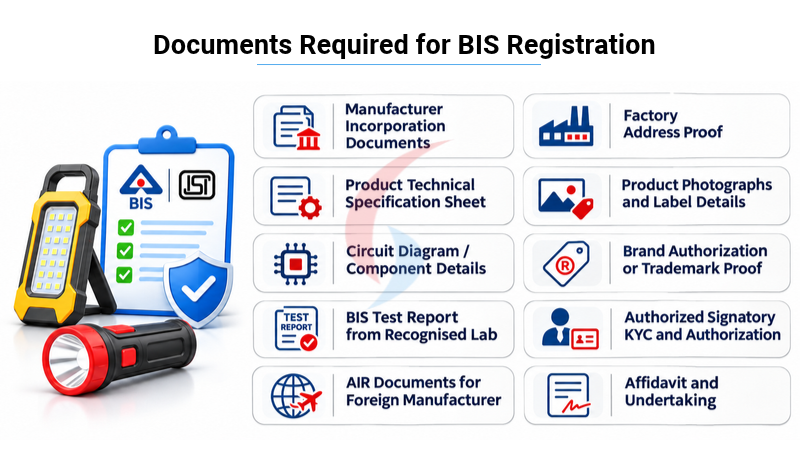
The following documents are commonly required, depending on the applicant's circumstances:
|
Document |
Purpose |
|
Business registration or incorporation documents |
Establishes the manufacturer's legal identity |
|
Factory address proof |
Confirms the manufacturing location |
|
Manufacturing unit details |
Identifies the production facility |
|
Authorised signatory details |
Identifies the person submitting the application |
|
Brand ownership document or authorisation |
Supports use of the declared brand |
|
Product technical specifications |
Explains electrical ratings and construction |
|
Product photographs and label artwork |
Helps identify the product and marking |
|
Circuit diagrams and component details |
Supports laboratory evaluation |
|
BIS-recognised laboratory test report |
Demonstrates conformity with the applicable standard |
|
Affidavit-cum-undertaking |
Provides the prescribed compliance declaration |
|
AIR nomination documents, if applicable |
Establishes authorised representation for a foreign manufacturer |
For example, suppose an LED lighting manufacturer operates one factory in Noida and another in Pune. The company should not assume that registration issued for the Noida factory automatically covers production from Pune. BIS CRS registration is linked to the manufacturing unit, and the additional factory's registration requirements must be addressed separately.
Applicants should also ensure that the brand name appearing on the test report, packaging and BIS application is consistent. A mismatch between these documents may lead to clarification requests or additional verification. The exact document checklist should always be checked against the applicable BIS portal instructions.
BIS Registration Process for LED Hand Lamps in India
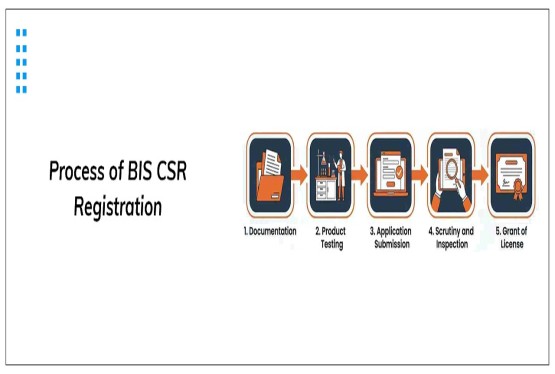
The BIS CRS registration process involves identifying the applicable standard, conducting testing, preparing an application and obtaining approval from BIS. Although the process may appear straightforward, a mistake during product classification or testing can result in unnecessary costs and delays.
Step 1: Identify the Applicable BIS Standard
The manufacturer must first determine whether the product falls within the LED hand lamp category. Its design, intended application, electrical characteristics and construction should be examined against IS 10322 (Part 5/Sec 6). In 2026, manufacturers must also consider the revised standard and the applicable transition instructions. Selecting an outdated test standard without checking the BIS implementation schedule may result in additional testing or documentation requirements.
Step 2: Select a BIS-Recognised Testing Laboratory
Once the applicable standard is confirmed, the manufacturer must identify a laboratory recognised by BIS for the required testing scope. Recognition for another LED product category does not automatically mean the laboratory is approved for LED handlamp testing. The manufacturer should confirm the laboratory's current scope, testing charges, sample requirements and expected reporting arrangements before submitting the products.
Step 3: Submit Product Samples for Testing
The manufacturer submits representative LED hand lamp samples to the selected laboratory. The laboratory examines the products against the applicable Indian Standard and issues a test report recording the results. If a sample fails any mandatory requirement, the manufacturer may need to modify the design or components and arrange further testing. A failed report cannot be treated as evidence of conformity.
Step 4: Prepare the BIS CRS Application
After obtaining a satisfactory test report, the manufacturer prepares the BIS application with the required factory, brand, product and authorised representative information. Supporting documents and the prescribed undertakings must be included. Foreign applicants must also complete the applicable AIR documentation. All information must match the details appearing in the laboratory report and supporting records.
Step 5: Submit the Application and Pay Fees
The application is submitted through the official BIS CRS portal. The applicant pays the applicable registration and processing fees and completes the required submission formalities. BIS examines the submitted application and may request corrections, explanations or additional documents. Applicants should respond promptly to avoid delays.
Step 6: Obtain BIS Registration
Once BIS is satisfied that the product complies with the relevant requirements and the application is complete, registration is granted to the manufacturer for the covered product and brand. The manufacturer can then apply the prescribed BIS Standard Mark and registration details to the approved products in accordance with the applicable marking requirements.
Manufacturers who want to understand the complete certification procedure can also read our guide on Process to Get BIS Certification for LED Lights, which explains the important steps involved in compliance.
What Safety Tests Are Required for LED Hand Lamps?
LED hand lamps are frequently used in places where users must hold or move them while they are operating. This makes electrical insulation, wiring protection, mechanical strength and thermal safety particularly important. For instance, a hand lamp used in a workshop may be repeatedly moved, placed on rough surfaces and exposed to routine physical handling. If its cable becomes damaged or the enclosure is poorly constructed, the product may create an electrical safety risk.
The applicable IS 10322 requirements address several areas of safety.
|
Test or requirement |
What it evaluates |
|
Electric strength |
Ability of insulation to withstand prescribed electrical stress |
|
Insulation resistance |
Effectiveness of electrical insulation |
|
Mechanical strength |
Resistance to specified physical stresses |
|
Temperature and thermal safety |
Safety during operation and heating |
|
Resistance to heat and fire |
Suitability of materials under specified conditions |
|
Protection against dust and moisture |
Resistance appropriate to the product's classification |
|
Cable and cord flexing |
Safety of flexible electrical connections |
|
Construction and handle requirements |
Safe design and handling of the lamp |
|
Endurance testing |
Safety during repeated operating conditions |
|
Marking requirements |
Presence of applicable safety and identification information |
The specific test programme depends on the product's classification and the applicable edition of the standard. Where relevant, additional requirements relating to photobiological safety or other characteristics may also need evaluation. Manufacturers should not treat this table as an exhaustive test checklist. The laboratory must apply the complete relevant standard, including applicable general luminaire requirements and current BIS instructions.
BIS Registration Fees for LED Hand Lamps in India
The total cost of BIS Registration for LED Hand Lamps generally includes government registration charges, laboratory testing expenses and any professional consultancy or documentation costs. The amount may vary depending on the number of models, testing requirements and whether the applicant is an Indian or foreign manufacturer.
|
Fee component |
Cost considerations |
|
BIS application fee |
As per the current official fee schedule |
|
Registration and processing charges |
Based on the applicable BIS CRS provisions |
|
Laboratory testing fees |
Vary according to laboratory, standard and testing scope |
|
Additional model testing |
Depends on technical differences and BIS grouping rules |
|
Professional consultancy |
Charged separately, if services are used |
|
Renewal or annual fees |
As applicable under the current registration provisions |
The BIS CRS portal published revised provisions concerning registration validity, renewal and annual fee payments on 27 May 2026. Consequently, older fee charts showing fixed charges for a two-year registration should not be relied upon without checking the current provisions. Laboratory testing is a significant variable. A manufacturer with several technically different LED hand lamp models may incur greater testing expenses than one applying for a single model. The final cost should therefore be estimated after examining the product specifications and relevant testing scope.
How Long Does BIS Registration for LED Hand Lamps Take?
The total time required for BIS registration depends on product testing, document preparation, application completeness and the time taken to resolve queries raised during scrutiny. The manufacturer's readiness can have a considerable effect on the overall schedule. BIS's published process guidance has indicated a normal application-processing period of approximately 20 working days, subject to its stated conditions. However, this should not be interpreted as a guarantee that the entire certification process, including sample testing and preparation, will be completed within that period.
For example, if a manufacturer submits a sample that fails the mechanical strength test, the design may require modification before retesting. Similarly, where a foreign factory's address or AIR authorisation documents are inconsistent, the application may require corrections. Manufacturers planning a product launch or import shipment should therefore begin the BIS compliance process well before the proposed commercial release date.
Latest BIS Updates for LED Hand Lamps in 2026
One of the most important developments for LED hand lamp manufacturers in 2026 is the revision of IS 10322 (Part 5/Sec 6). BIS issued implementation guidelines on 20 March 2026 to facilitate the transition from the earlier 2013 standard to the revised 2026 standard. The initial concurrent-running deadline was 2 August 2026. However, BIS subsequently issued an extension notice, listed on its CRS portal on 5 August 2026, extending the concurrent-running period for the specified LED luminaire standards, including LED hand lamps, to 2 February 2027. This is particularly relevant for businesses that already hold a BIS registration under the earlier standard. Manufacturers must review the changeover guidelines, determine whether supplementary testing or documentation is required, and complete the transition in accordance with BIS instructions.
For example, consider a company that received BIS registration for LED hand lamps in 2024. If the company continues selling the same models in 2026, it cannot simply assume that compliance with the earlier standard will remain sufficient indefinitely. The manufacturer must examine the revised requirements, coordinate the necessary testing and ensure that its registration remains compliant.
The following developments are particularly important:
|
Date |
Regulatory development |
|
23 May 2018 |
Mandatory BIS CRS implementation for LED hand lamps |
|
2 February 2026 |
Establishment of revised IS 10322 (Part 5/Sec 6):2026 |
|
20 March 2026 |
BIS implementation guidelines for revised LED luminaire standards |
|
27 May 2026 |
Revised CRS provisions for licence validity, renewal and annual fee payment |
|
5 August 2026 |
BIS portal notice concerning extension of revised LED luminaire standards |
|
2 February 2027 |
Extended end date of concurrent running for the specified earlier standards |
For a broader understanding of these changes, read BIS LED Luminaire Standards: Key Update Before 02 August 2026. Readers should also check subsequent BIS extension notices for the latest deadlines.
BIS Marking and Labelling Requirements for LED Hand Lamps
After receiving BIS registration, the manufacturer must follow the applicable product marking and labelling requirements. The purpose of proper marking is to identify the registered product and provide consumers, distributors and regulatory authorities with relevant compliance information. LED hand lamps must carry the prescribed CRS Standard Mark with the relevant registration number in the manner permitted by BIS. Additional information required by the applicable product standard may include electrical ratings, manufacturer identification and safety-related markings. Manufacturers should pay particular attention to the legibility, durability and positioning of product markings. The BIS registration number used on a product must correspond with the registration covering that product, manufacturing unit and brand.
For instance, a lighting company may manufacture three LED hand lamp models under one brand. Before placing the same registration number on all three models, the company should ensure that those models are appropriately included within the registration. Unapproved models should not be presented as registered merely because they belong to the same product family.
Can Multiple LED Hand Lamp Models Be Covered Under One BIS Registration?
Yes, multiple models may be covered under a single BIS registration when they meet the applicable eligibility and product-grouping requirements. This can be useful for manufacturers offering different LED hand lamp designs under the same brand. However, the ability to include multiple models depends on the relevant BIS grouping guidelines, technical specifications and testing requirements. Differences in input voltage, construction, electrical protection or other safety-related features may affect the testing and registration arrangements.
Suppose a manufacturer offers one LED hand lamp designed for indoor workshop use and another with additional protection for more demanding conditions. Although both products belong to the same broad category, their technical differences may require separate evaluation. Manufacturers who already possess registration can request model inclusion using the applicable BIS procedure. The products should not be marketed as covered by the existing registration until the required inclusion formalities are completed.
What Happens If LED Hand Lamps Are Sold Without BIS Registration?
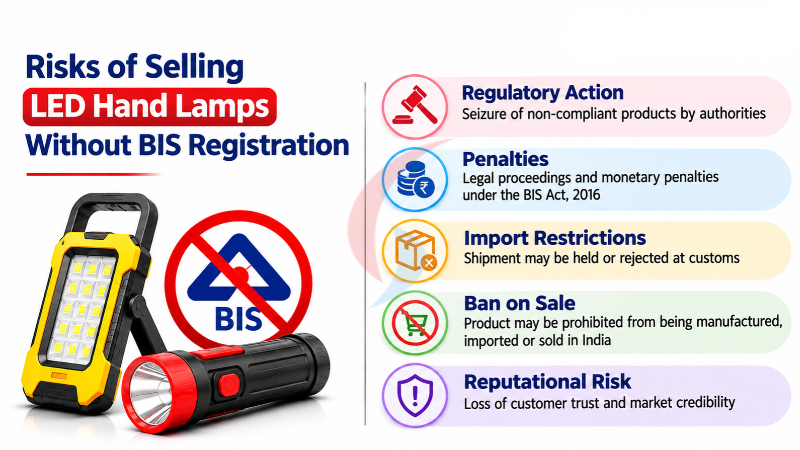
Selling a product subject to compulsory BIS registration without complying with the applicable order can expose the responsible business to regulatory action. The BIS Act, 2016 and the relevant compulsory registration provisions provide the legal basis for enforcement against non-compliant products. Depending on the circumstances, violations may result in seizure of goods, prosecution, statutory penalties or restrictions on manufacturing, importing and selling the affected products. False or misleading use of the BIS Standard Mark may create additional legal consequences.
For importers, non-compliance may also lead to difficulties during customs clearance. A shipment that does not satisfy the applicable compulsory registration requirements may be detained or otherwise dealt with under relevant laws and procedures. Therefore, checking the manufacturer's BIS registration before placing an order is important. It is generally less expensive to resolve certification issues before importing products than to deal with rejected shipments, delayed deliveries or regulatory proceedings later.
Common Mistakes to Avoid During BIS Registration
Manufacturers sometimes face registration delays because of mistakes that could have been prevented during the initial planning stage. One common issue is using an incorrect Indian Standard for the product. Although LED hand lamps, LED flood lights and LED street lighting luminaires all use LED technology, they have different product classifications and particular safety requirements. Another issue is selecting a testing laboratory without confirming recognition for the relevant standard. A laboratory may have extensive experience testing LED products but may not possess the required BIS recognition for the exact handlamp standard and testing scope.
Incorrect factory documentation, inconsistencies in brand names, missing AIR authorisations and insufficient technical specifications can also create application difficulties. Businesses must ensure that the records submitted to BIS accurately reflect the actual manufacturing arrangements. It is equally important to monitor compliance after registration. Adding new products, changing components or moving production to another facility may have implications for testing and registration. BIS compliance should be treated as an ongoing responsibility rather than a formality completed only once.
For example, BIS Certification for Recessed LED Luminaires follows separate product-specific requirements that should not automatically be applied to portable LED hand lamps.
Why Choose Compliance Calendar LLP for BIS Registration of LED Hand Lamps?
Obtaining BIS Registration for LED Hand Lamps requires a clear understanding of Indian Standards, product classification, laboratory testing and regulatory documentation. For businesses launching new lighting products or importing LED equipment into India, managing these requirements alongside daily commercial operations can be challenging. Compliance Calendar LLP provides professional assistance with BIS Registration, BIS CRS Certification and regulatory compliance for electronic and lighting products.
The team assists manufacturers and businesses in understanding applicable requirements, preparing documents, coordinating with BIS-recognised laboratories and managing registration applications. Businesses planning to manufacture or import LED hand lamps can seek assistance with product classification, documentation, model inclusion, renewal and compliance with revised Indian Standards.
For professional assistance, contact Compliance Calendar LLP at +91 9988424211 or info@ccoffice.in
Frequently Asked Questions (FAQs)
Q1. Is BIS Registration compulsory for LED hand lamps in India?
Ans. Yes. LED hand lamps falling within the notified product category are covered under the BIS Compulsory Registration Scheme. Manufacturers must obtain the applicable registration before marketing such products in India. The requirements also apply to relevant imported products.
Q2. Which BIS Standard applies to LED hand lamps?
Ans. LED hand lamps are covered under IS 10322 (Part 5/Sec 6). The earlier edition was published in 2013, while a revised edition was introduced in 2026. Manufacturers must comply with the applicable edition and relevant BIS transition guidelines.
Q3. What is the BIS registration process for LED hand lamps?
Ans. The process generally involves product classification, selection of a BIS-recognised laboratory, sample testing, preparation of supporting documents and submission of an online application. BIS examines the application and grants registration when the necessary requirements are fulfilled.
Q4. Can foreign manufacturers obtain BIS Registration for LED Hand Lamps?
Ans. Yes. Foreign manufacturers supplying covered LED hand lamps to India can apply for BIS registration. Where required, they must appoint an Authorised Indian Representative and complete the prescribed declarations and documentation.
Q5. What is the cost of BIS Registration for LED Hand Lamps?
Ans. The total cost depends on the applicable BIS government fees, laboratory testing charges, number of models and documentation requirements. Professional assistance, where used, is an additional expense. Businesses should check the current fee provisions before budgeting.
Q6. How long does BIS Registration for LED Hand Lamps take?
Ans. The time depends on laboratory testing, completeness of the application and BIS scrutiny. Applications involving failed tests, incomplete documents or additional queries may take longer than straightforward cases. Manufacturers should plan registration before their intended product launch.
Q7. Can an importer use the foreign manufacturer's BIS registration?
Ans. An importer may rely on a valid BIS registration issued to the actual foreign manufacturer, provided the registration properly covers the product, manufacturing facility and brand being imported. The importer should verify all relevant details before purchasing or shipping the products.
Q8. Is BIS registration required for every LED hand lamp model?
Ans. Each relevant model must be appropriately covered by the manufacturer's registration. Eligible models may be grouped or included under an existing registration according to BIS rules. Whether additional testing is necessary depends on their technical characteristics.
Q9. What is the latest BIS update for LED hand lamps in 2026?
Ans. The important update is the revision of IS 10322 (Part 5/Sec 6):2013 to IS 10322 (Part 5/Sec 6):2026. BIS subsequently extended the concurrent-running deadline for the specified LED luminaire standards to 2 February 2027. Manufacturers should examine the applicable transition requirements.
Q10. Can LED hand lamps be imported without BIS registration?
Ans. Covered LED hand lamps generally cannot be imported for ordinary commercial sale without compliance with the applicable compulsory registration requirements. Any exemption or special treatment must be established under the relevant legal provisions rather than assumed.
Article last updated on : 19 Nov 2026.