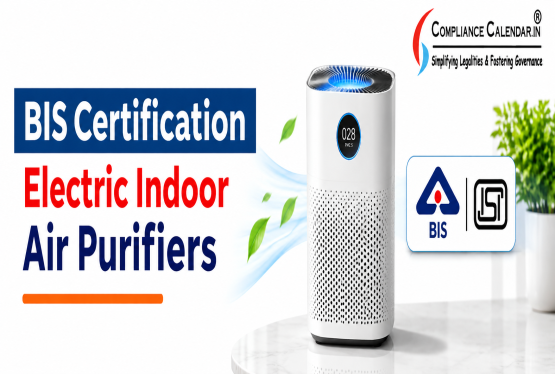



Air pollution is no longer a problem limited to busy roads and industrial areas. It has become a concern inside homes, offices, schools, hospitals and other enclosed spaces. Dust, smoke, fine particulate matter and other pollutants can enter buildings through doors, windows and ventilation systems. As a result, portable electric indoor air purifiers have become increasingly popular among Indian consumers. However, choosing a good air purifier involves more than checking its design, price or brand name. Two machines may look similar but perform very differently when tested under controlled conditions.
One may effectively remove suspended particles, while another may consume more electricity without providing the expected cleaning performance. This is where Indian product standards become important. For manufacturers and importers, understanding IS 17531:2021 for Portable Electric Indoor Air Purifiers is important for product development, testing, regulatory compliance and marketing. The standard also needs to be considered alongside the applicable electrical appliance safety requirements and government Quality Control Orders (QCOs).
What Is IS 17531:2021 for Portable Electric Indoor Air Purifiers?
IS 17531:2021 is an Indian Standard published by the Bureau of Indian Standards for portable electric indoor air purifiers. Its official title is Portable Electric Indoor Air Purifier – Specification. It provides a technical reference for evaluating air purifiers intended for indoor use. The standard falls under the BIS Chemical Department and is handled by Technical Committee CHD 35, which deals with air quality. According to the official BIS Standards Portal, the standard was reaffirmed in June 2025, with no amendments listed in the current standard record.
It is classified as a product specification and includes references to relevant Indian and international standards concerning electrical safety and product testing.
|
Particulars |
Details |
|
Indian Standard |
IS 17531:2021 |
|
Standard title |
Portable Electric Indoor Air Purifier – Specification |
|
Regulatory standards body |
Bureau of Indian Standards |
|
Department |
Chemical Department |
|
Technical committee |
CHD 35 – Air Quality |
|
Original publication year |
2021 |
|
Latest listed reaffirmation |
June 2025 |
|
Standard category |
Product Specification |
|
Relevant safety standard |
|
|
Applicable legal |
BIS Act, 2016 and relevant QCOs |
Manufacturers can examine the standard through the official BIS IS 17531:2021 standard record. The full standard should be consulted for its exact clauses, prescribed methods, test conditions and acceptance criteria.
Why Was IS 17531:2021 Introduced in India?
The increasing demand for air purifiers created a need for consistent product evaluation. Consumers often compare machines using advertised room coverage, filtration efficiency, airflow and CADR. However, these figures may not be directly comparable when different manufacturers use different testing procedures. Consider a family purchasing an air purifier for a bedroom. One manufacturer advertises a filtration efficiency of 99.97%, while another claims a high clean air delivery rate. The family may assume that the highest percentage automatically indicates the better product. In reality, filtration media efficiency alone does not describe how effectively the complete machine cleans the air in a room.
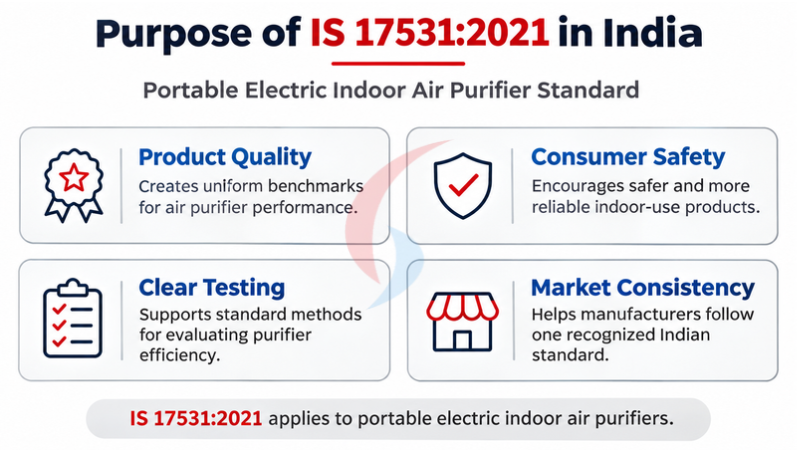
IS 17531:2021 helps address this problem by providing a standardised approach to evaluating portable electric indoor air purifiers. The standard is relevant because it supports more consistent testing, meaningful product comparisons and evidence-based performance claims. It also provides manufacturers with a recognised technical reference for developing products intended for the Indian market. India's National Physical Laboratory (CSIR-NPL) has also reported developing a facility for testing the CADR of air purifiers based on IS 17531:2021, illustrating the importance of standardised measurement facilities.
Products Covered Under IS 17531:2021
The standard concerns portable electric indoor air purifiers. These are generally self-contained electrical appliances designed to reduce specified airborne pollutants in indoor environments. Examples of products requiring assessment for applicability include portable room air purifiers, HEPA-filter air purifiers, activated-carbon filtration appliances and smart air purifiers equipped with electronic controls.
Some products combine filtration with additional technologies, such as ionisation, ultraviolet treatment or electrostatic collection. The mere presence of these technologies does not establish that every feature or pollutant-removal claim is covered by IS 17531:2021. Manufacturers should examine the complete standard before determining whether a particular technology, model or claimed function falls within its scope. Similarly, general ventilation filters installed inside large HVAC systems should not automatically be classified as portable electric air purifiers. Those products may be subject to separate standards, such as IS 17570 (Part 1):2021.
Important Technical Requirements Under IS 17531:2021
Understanding the technical characteristics of a portable air purifier is important before beginning product testing. A purifier's actual performance depends on several factors, including the type of filtration system, fan capacity, airflow path, construction and operating conditions.
The following parameters are relevant to product evaluation. Exact mandatory tests and limits must be checked in the complete standard.
|
Technical parameter |
Importance |
|
Clean Air Delivery Rate (CADR) |
Evaluates delivery of cleaned air under specified test conditions |
|
Air cleaning performance |
Helps assess pollutant-removal capability |
|
Airflow characteristics |
Indicates air movement through the complete appliance |
|
Noise level |
Supports assessment of operating sound |
|
Power consumption |
Helps determine electricity use |
|
Electrical safety |
Addresses risks associated with electrical components |
|
Product construction |
Supports assessment of design and operating reliability |
|
Marking and instructions |
Provides product identification and user information |
The BIS standard record refers to standards covering electrical appliance safety, sound measurement, particle measurement and standby power. However, these references should not be interpreted as confirmation that every possible test applies identically to every product design. Manufacturers should obtain the relevant standard and establish a product-specific testing plan before certification.
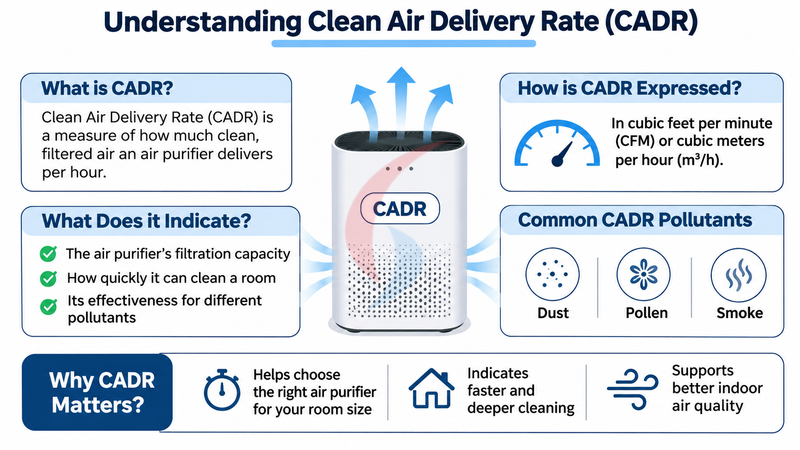
Clean Air Delivery Rate is one of the most useful performance measures for a portable electric air purifier. It indicates the volume of cleaned air that a purifier effectively delivers under defined testing conditions. CADR is generally expressed in cubic metres per hour (m³/h). A higher CADR for a particular pollutant under comparable conditions normally indicates that a machine can remove that pollutant from room air more quickly.
For example, consider two fictional air purifiers tested using the same method.
|
Parameter |
Air Purifier A |
Air Purifier B |
|
Measured CADR |
200 m³/h |
350 m³/h |
|
Intended use |
Smaller rooms |
Larger rooms |
|
Performance comparison |
Lower clean-air delivery |
Higher clean-air delivery |
Air Purifier B delivers a higher quantity of cleaned air under the stated test conditions. However, this does not automatically mean that it is more energy-efficient, quieter or suitable for every room. Actual indoor performance also depends on the room's size, ventilation, pollutant sources, placement of the appliance and filter maintenance. An air purifier advertised with a high filtration efficiency but a low airflow rate may deliver less cleaned air than expected. Therefore, CADR should be assessed alongside the other relevant product characteristics.
Air Purifier Testing Requirements Under IS 17531:2021
Testing allows manufacturers to evaluate whether their portable electric indoor air purifiers meet the applicable Indian Standard. It is also important for supporting technical claims made in product brochures, advertisements and online listings.
The testing process begins with identifying the complete appliance, its electrical ratings, filtration system and intended functions. The laboratory must use the relevant test methods and conditions prescribed by the applicable standard.
1. Air Cleaning Performance
The purifier's ability to reduce specified airborne contaminants must be evaluated under relevant test conditions. This helps determine whether the machine performs as intended rather than relying only on the filtration material's advertised efficiency.
2. Clean Air Delivery Rate
CADR testing evaluates the rate at which an air purifier delivers cleaned air for the specified test pollutant. The measurement must follow the relevant standardised procedure and test conditions.
3. Electrical Safety
An air purifier operates using electrical components such as motors, fans, controls and power-supply systems. Applicable safety assessment may examine protection against electric shock, temperature rise, insulation, abnormal operation and other relevant hazards.
4. Noise and Power Consumption
Noise levels and electricity consumption can influence whether a product is suitable for continuous indoor operation. Where required by the applicable standard, these characteristics must be evaluated using prescribed measurement methods.
5. Product Marking and User Information
Manufacturers must ensure that product labels, identification details, technical claims, warnings and operating instructions comply with the relevant requirements. Product labels should not include misleading certification claims or an unauthorised BIS Standard Mark.
Is BIS Certification Mandatory Under IS 17531:2021 in 2026?
This is an important question for manufacturers because the existence of an Indian Standard does not automatically make certification under that standard compulsory. DPIIT published a draft Portable Electric Indoor Air Purifier (Quality Control) Order, 2025, proposing compulsory certification under IS 17531:2021.
The proposal provides for the compulsory use of the BIS Standard Mark under Scheme I of Schedule II to the BIS (Conformity Assessment) Regulations, 2018. However, the publicly available draft contains an unfilled Gazette notification date and number. The BIS standard record also does not establish an active compulsory certification requirement specifically under IS 17531:2021. Accordingly, the draft should not be presented as a final, enforceable QCO without confirming publication of the final order.
Proposed Implementation Schedule
|
Manufacturer category |
Period proposed in the draft |
|
General manufacturers |
6 months from final Gazette notification |
|
Small enterprises |
9 months from final Gazette notification |
|
Micro enterprises |
12 months from final Gazette notification |
These are proposed periods rather than confirmed implementation dates. They cannot be converted into specific calendar deadlines until a final notified order is identified. The draft also proposes an exemption for goods manufactured domestically for export.
Official draft: Portable Electric Indoor Air Purifier (Quality Control) Order, 2025.
Latest Government Update: Electrical Appliance Safety QCO 2026
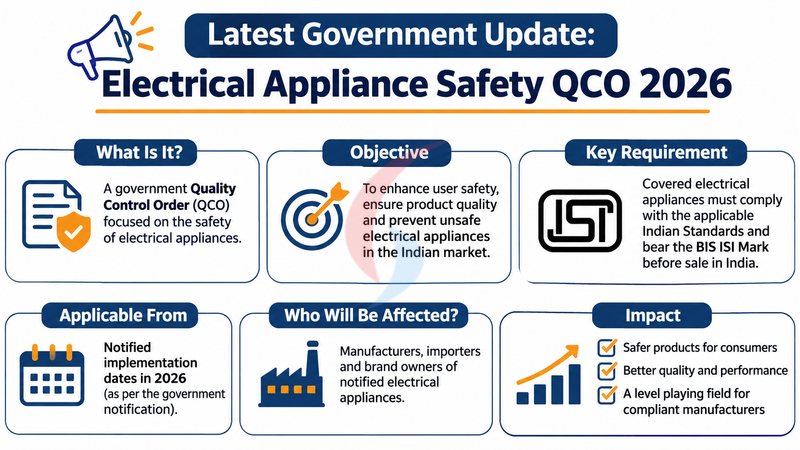
The Indian government introduced a separate mandatory certification requirement through the Safety of Household, Commercial and Similar Electrical Appliances (Quality Control) Order, 2026, notified through S.O. 1739(E), dated 6 April 2026.
The order applies to covered electrical appliances intended for household, commercial and similar applications, including air-cleaning appliances. It specifies IS 302 (Part 1):2024 / IEC 60335-1:2020 for electrical safety certification and provides for compulsory use of the BIS Standard Mark under Scheme I. The order covers appliances rated up to 250 volts for single-phase equipment and 480 volts for other appliances, including eligible DC-supplied and battery-operated products. It also excludes appliances already covered by another applicable QCO or compulsory BIS certification requirement under another law.
Implementation Dates
|
Manufacturer category |
Effective date |
|
General manufacturers |
1 October 2026 |
|
Small enterprises |
1 January 2027 |
|
Micro enterprises |
1 April 2027 |
As of 20 November 2026, the general implementation date has passed. However, small and micro enterprises have later dates under this order, and the product's precise scope and any applicable transitional provisions must be checked. The order also contains provisions concerning domestically manufactured export goods, specified research and development imports, and eligible pre-implementation stock.
Official Gazette notification: Electrical Appliances Safety QCO, 2026 – S.O. 1739(E).
Difference Between IS 17531:2021 and IS 302 (Part 1):2024
Manufacturers should understand that these standards serve different purposes.
|
Basis |
IS 17531:2021 |
IS 302 (Part 1):2024 |
|
Main focus |
Portable air purifier product specification |
General electrical appliance safety |
|
Product category |
Portable electric indoor air purifiers |
Covered household and similar electrical appliances |
|
Primary assessment |
Air purifier performance and related requirements |
Electrical safety and construction |
|
Regulatory position |
Separate product-specific QCO proposed; final enforcement not established from the cited draft |
Compulsory for covered appliances under the 2026 QCO |
|
Certification route |
Proposed Scheme I under the draft |
Scheme I under the final 2026 QCO |
An air purifier manufacturer should therefore distinguish between conformity with the product-performance standard and mandatory electrical safety certification.
For related information, read Compliance Calendar's Home Appliance Safety in India: BIS Certification and Manufacturer Accountability.
Legal Provisions Applicable to Portable Electric Indoor Air Purifiers
Product certification in India is governed primarily by the Bureau of Indian Standards Act, 2016, the BIS (Conformity Assessment) Regulations, 2018 and relevant Quality Control Orders issued by the Central Government.
Section 16 of the BIS Act, 2016
Section 16 empowers the Central Government to notify compulsory use of the Standard Mark for specified goods, articles, processes, systems or services in the public interest. This provision forms the legal basis for many BIS Quality Control Orders. However, a standard is not automatically mandatory merely because it has been published.
Section 17 of the BIS Act, 2016
Section 17 imposes restrictions relating to notified products, including specified manufacturing, import, distribution, storage, sale and exhibition activities where applicable conformity and marking requirements are not met. Manufacturers and importers should therefore verify whether their products fall under an enforceable QCO before beginning regulated commercial operations.
Section 29 of the BIS Act, 2016
Section 29 contains penalties for specified contraventions involving compulsory certification and other BIS requirements. The consequences depend on the nature of the violation and the applicable statutory provisions. Businesses should also avoid displaying a BIS mark without proper authorisation.
BIS (Conformity Assessment) Regulations, 2018
These regulations establish the relevant procedures and schemes for assessing conformity with Indian Standards. Scheme I generally involves a product certification licence and the use of the prescribed Standard Mark, whereas Scheme II is the Compulsory Registration Scheme used for specified notified products. Air purifier manufacturers should select their certification route based on the actual applicable QCO rather than assuming that every electrical product requires CRS.
For further information, see Different Types of BIS Certification in India.
Documents Required for BIS Certification of Portable Electric Indoor Air Purifiers
Documentation helps BIS and the relevant laboratory establish the identity of the manufacturer, product construction, electrical ratings and manufacturing capabilities. For Scheme I applications, manufacturers commonly need company records, technical documents, manufacturing information and evidence supporting conformity.
|
Document |
Purpose |
|
Certificate of Incorporation or business registration |
Establishes the legal identity of the manufacturer |
|
Factory address proof |
Identifies the manufacturing premises |
|
Manufacturing process flow chart |
Describes production and assembly operations |
|
Product technical specification |
Explains the purifier's construction and functionality |
|
Model and brand details |
Identifies the proposed certification scope |
|
Electrical circuit diagram |
Supports electrical safety evaluation |
|
Bill of materials |
Identifies relevant product components |
|
Product label and photographs |
Supports marking and identification verification |
|
Machinery and equipment list |
Establishes manufacturing capabilities |
|
Testing equipment details |
Supports in-house quality control assessment |
|
Calibration certificates |
Demonstrates calibration of measuring equipment |
|
Laboratory test reports |
Provides evidence of relevant product testing |
|
Quality control records |
Supports production consistency |
|
Authorisation letter |
Identifies the authorised applicant |
|
AIR documents, where applicable |
Supports foreign manufacturer representation |
These are commonly relevant documents, not a definitive checklist under IS 17531:2021. The exact requirements must be obtained from the relevant BIS scheme, product instructions and application portal.
Read List of Important Documents Required for ISI Mark Certification for additional details.
Step-by-Step BIS Certification Process for Portable Electric Indoor Air Purifiers
The process depends on the relevant certification requirement. Where Scheme I applies to a covered product, manufacturers generally follow the procedure described below.
Step 1: Identify the Product and Applicable Standard
The manufacturer first examines the purifier's construction, operating voltage, intended use, air-cleaning technology and model specifications. IS 17531:2021 may be used to establish product performance requirements. The manufacturer must separately verify whether IS 302 (Part 1):2024 and any other applicable standards or notifications govern the product's compulsory certification. Correct classification is important because choosing the wrong standard may result in unnecessary testing or an invalid application.
Step 2: Review Product Testing Requirements
The manufacturer should identify the complete testing scope before sending the product to a laboratory. Testing may involve CADR, relevant performance characteristics and electrical safety, depending on the applicable standard. The laboratory should have the appropriate accreditation or BIS recognition for the relevant test methods, as required by the certification procedure.
Step 3: Prepare the Manufacturing Facility
The factory should have suitable production machinery, quality control arrangements, competent technical personnel and testing facilities. For a portable air purifier manufacturer, production control may involve assembly of fans and motors, verification of electrical components, filter installation, product inspection and final functional checks. Quality records should be organised before certification assessment.
Step 4: Apply Through BIS Manak Online
Eligible manufacturers can submit the application through the official BIS Manak Online Portal. The application must contain the correct manufacturer information, Indian Standard, factory address and supporting documents. The applicant should ensure consistency between product labels, factory records and the models declared in the application.
Step 5: Arrange BIS Factory Inspection
Under the applicable Scheme I procedure, BIS may inspect the manufacturing premises to assess the production system, available machinery, testing facilities and quality control practices. Officials may examine technical documents, review records and draw product samples for further evaluation. Manufacturers should prepare for the inspection by checking testing equipment, calibration status, relevant documentation and personnel responsibilities.
Compliance Calendar provides additional guidance in BIS Certification: What Happens During a BIS Factory Visit?.
Step 6: Complete Testing and Resolve Observations
BIS reviews the applicable test reports and inspection findings. If a product fails a prescribed requirement, the manufacturer may need to address the deficiency and complete additional testing. Any observations concerning incomplete documentation, inadequate test facilities or inconsistent product information should be resolved before licence approval.
Step 7: Obtain the BIS Licence
After the relevant requirements are satisfactorily fulfilled, BIS may grant the applicable certification licence. The manufacturer can use the Standard Mark only for products included within the approved licence scope and in accordance with the applicable marking rules. A licence for one approved manufacturing location or product category should not be assumed to authorise unrelated factories or models.
Step 8: Maintain Post-Certification Compliance
The manufacturer must continue producing goods that conform to the applicable standard. Changes to important components, product construction, manufacturing arrangements or model specifications should be reviewed to determine whether fresh testing, additional approval or an amendment to the licence scope is necessary.
For more information, read BIS Certification for Indian Manufacturers.
BIS Certification Fees for Portable Electric Indoor Air Purifiers
The cost of BIS Certification depends on the applicable Indian Standard, testing requirements, certification scheme, manufacturing location and number of models included in the application. Manufacturers should not assume that the cost of testing under IS 17531:2021 is identical to the cost of obtaining mandatory electrical safety certification under IS 302 (Part 1):2024.
|
Cost component |
Description |
|
BIS application fee |
Charged according to the applicable certification scheme |
|
Laboratory testing charges |
Depends on testing scope and laboratory |
|
Factory inspection expenses |
Based on the applicable BIS procedure |
|
Licence and marking fees |
As prescribed in the current fee schedule |
|
Additional model testing |
Depends on product differences and licence scope |
|
Foreign manufacturer expenses |
May include overseas inspection and AIR-related expenses |
|
Documentation and consultancy |
Depends on the assistance required |
Actual costs should be confirmed through the relevant BIS fee schedule and laboratory quotations.
Manufacturers can also refer to BIS Scheme-I Marking Fees Update 2026 for more information regarding Scheme I fees.
BIS Requirements for Imported Portable Electric Air Purifiers
India imports portable air purifiers from several overseas manufacturing markets. Importers may source finished products under international brands or arrange manufacturing through overseas original equipment manufacturers (OEMs). Where a product is covered by a mandatory QCO, imported goods must satisfy the relevant BIS requirements unless a specific exemption applies.
Under the Foreign Manufacturers Certification Scheme (FMCS), an eligible overseas manufacturer may obtain BIS product certification for the applicable Indian Standard. The process generally involves evaluation of the overseas manufacturing facility, technical documents, product testing and appointment of an Authorised Indian Representative (AIR) where required. The AIR serves as the manufacturer's representative in India and assists with communication and regulatory obligations. From 1 June 2026, BIS moved fresh FMCS applications to an online-only application process through Manak Online.
Read BIS FMCS Certification Process in India for Foreign Manufacturers for more information.
Common Mistakes Manufacturers Should Avoid
One common mistake is assuming that a HEPA filter certificate automatically establishes conformity of the complete air purifier. A filter medium and a complete electrical appliance are different products, and the performance of the assembled purifier may depend on airflow, leakage, operating speed and other design characteristics.
Another mistake is confusing voluntary compliance with an Indian product specification and mandatory certification under a government QCO. Manufacturers should establish whether the relevant order is final and enforceable before making claims about the legal status of certification under IS 17531:2021.
Some businesses also advertise a large room coverage area without explaining the test conditions used to support the claim. The suitable room size may depend on ceiling height, desired air changes, actual CADR and ventilation conditions. Manufacturers should also avoid using BIS or ISI marks before obtaining the necessary authorisation. A private laboratory report or pending certification application does not itself permit the use of a BIS Standard Mark.
Why Choose Compliance Calendar LLP for BIS Certification?
Obtaining BIS Certification for Portable Electric Indoor Air Purifiers requires a proper understanding of product specifications, applicable Indian Standards, electrical safety requirements, testing procedures and certification documentation. Compliance Calendar LLP provides professional assistance to Indian manufacturers, importers and foreign businesses seeking BIS certification support.
Our team helps businesses identify applicable standards, prepare technical and legal documents, coordinate with testing laboratories, submit BIS applications and address regulatory queries. We also assist with factory inspection preparation, model inclusion, licence-related requirements and post-certification compliance. Whether you are developing a new portable air purifier or planning to import an established product into India, Compliance Calendar LLP can guide you through the relevant certification procedures.
For assistance, contact +91 9988424211 or info@ccoffice.in
Frequently Asked Questions (FAQs)
Q1. What is IS 17531:2021?
Ans. IS 17531:2021 is the Indian Standard titled Portable Electric Indoor Air Purifier – Specification. It was published by BIS to provide technical requirements for evaluating portable electric indoor air purifiers. The standard supports product performance assessment and recognised testing procedures.
Q2. Is IS 17531:2021 mandatory in India?
Ans. A draft Quality Control Order proposes compulsory certification under IS 17531:2021. However, the cited draft does not establish that this specific requirement has become legally enforceable. Manufacturers must separately comply with any applicable mandatory electrical appliance safety QCO.
Q3. What is the latest BIS update for air purifiers in 2026?
Ans. The Safety of Household, Commercial and Similar Electrical Appliances (Quality Control) Order, 2026 introduced compulsory safety certification for covered electrical appliances under IS 302 (Part 1):2024. The general implementation date is 1 October 2026, with later dates for small and micro enterprises.
Q4. What is CADR in an air purifier?
Ans. CADR stands for Clean Air Delivery Rate. It measures the delivery rate of cleaned air under specified testing conditions and is commonly expressed in cubic metres per hour. CADR helps consumers compare the air-cleaning performance of different machines when tested using comparable methods.
Q5. Does a HEPA filter certificate replace BIS Certification of the air purifier?
Ans. No. A filter certificate does not automatically establish that the complete electrical appliance meets the applicable product and safety requirements. The assembled purifier may need separate performance and electrical safety assessments.
Q6. Which BIS certification scheme applies to portable air purifiers?
Ans. The applicable scheme depends on the relevant government notification. The final 2026 electrical appliance safety QCO specifies Scheme I for covered products. The draft product-specific QCO for IS 17531:2021 also proposes Scheme I, but its final status must be verified.
Q7. What documents are required for BIS Certification of air purifiers?
Ans. Common documents include business registration, factory address proof, technical specifications, circuit diagrams, machinery details, testing equipment information, quality control records, product photographs and applicable laboratory reports. Exact requirements depend on the scheme and product classification.
Q8. Can foreign manufacturers obtain BIS Certification for portable air purifiers?
Ans. Eligible foreign manufacturers can apply under the applicable BIS certification scheme, including FMCS where appropriate. They must satisfy the relevant testing, factory inspection, documentation and Authorised Indian Representative requirements.
Q9. How much does BIS Certification for portable electric air purifiers cost?
Ans. The cost depends on the certification route, relevant standard, testing requirements, factory location, model scope and prescribed BIS fees. Manufacturers should confirm the current official fee schedule and obtain laboratory quotations before applying.
Q10. Where can I find IS 17531:2021 and apply for BIS Certification?
Ans. Manufacturers can find the standard on the official BIS Standards Portal and use BIS Manak Online for eligible certification applications. Before applying, the manufacturer should confirm the applicable standard, certification scheme and current regulatory requirements.
Article last updated on : 20 Nov 2026.